Showing posts with label James Garner. Show all posts

Friday, May 22, 2026

Darby's Rangers

Another of the movies that will be airing as part of this year's TCM Memorial Day weekend marathon of war movies is Darby's Rangers. It shows up tomorrow, May 23, at 3:45 PM.

Darby's Rangers is based on a real person, Maj. (later promoted to colonel) William O. Darby (James Garner in his first starring role). As the movie opens, Darby is stuck in an office in Washington with his adjutant, Master Sgt. Saul Rosen (Jack Warden, who also narrates the movie). There's a war going on, this being 1942, and Darby as a West Point graduate wants to fight. However, as Gen. Truscott informs him, Darby has excellent skills as a planner, and planning is in fact something that the war effort needs just as much as people who can do the actual fighting. Darby's idea is to have the army have its own form of Rangers, who would do much the same sorts of commando work that the Marines do. They can't use the Marines in Europe because the Marines are stretched too thin in the Pacific theater.

So Darby suggests his idea to another general, and is able to convince that general to give him the role of commander of the first batch of Rangers, who are going to go off to Scotland to train with the British since at the time it was considered that the British had the best commandos going. This also gives us the opportunity to meet some of the supporting characters. Hank Bishop (Stuart Whitman) meets bus conductor Wendy Hollister (Joan Elan) in London; she just knows she's going to get Hank to propose to her even though he doesn't know it yet. There's also Sutherland, who beds a girl in every port, or the army equivalent; Rollo Burns (Peter Brown); and some others. They all wind up in Scotland, and since the base where they'll be doing their training is short of barracks, the men are billeted with local families which also provides a couple to meet women they're going to fall in love with, notably Burns meeting the daughter of the Scot training them.

Eventually the training is done, and it's time for the Rangers to go off and do actual fighting, which starts in French North Africa in what is now Algeria. The Rangers serve with distinction, which puts them at the forefront of the next phase of the war, the invasion of Italy. As you may recall from your history or from having seen enough other war movies, the invasion started in Sicily as that's the closest point in Italy to Africa. After taking Sicily they established a beachhead in the southwestern most part of the boot of Italy, only to get bottled up by the Germans. So the Allies decided they were going to try to jump ahead of the German position by doing an amphibious invasion at Anzio.

This being a war movie, some of the Rangers die, which is the opportunity to bring in another character, Lt. Dittman (Edd Byrnes), a commander who's come straight from West Point and is just as by the books and humorless as you'd expect somebody who hasn't experienced combat and the stresses of having killed people and lost friends. As part of a delousing operation, he meets local girl Angelina (Etchika Choureau) and falls in love with her, which becomes another sub-plot in the movie.

If you read carefully, you might have noticed that I didn't talk all that much about the war action in Darby's Rangers. That's because there's not a whole lot of it, with a copious amount of military footage from the Army subbed in. The portions of the movie dealing with the training and then the romantic subplots take up a lot more of the film, which is fairly formulaic anyway. Darby's Rangers apparently didn't get the best reviews at the time it was released, and having watched it, it's not too hard to see why.

Monday, April 6, 2026

For some values of sweet

I didn't intend to do posts on two of what I refer to as the 1960s "generation gap" movies in fairly close succession, after last week's post on Don't Make Waves. I also didn't intend to do posts on two Debbie Reynolds movies a few weeks apart, after I Love Melvin. But it turns out there's a movie on my DVR that's showing up on TCM tomorrow, April 7, that relates to both of those films. That movie is How Sweet It Is! at 8:00 AM as part of a birthdy salute to actor James Garner.

After wannabe groovy opening titles and one of those awful 1960s MOR songs, the action shifts to a bedroom in an upper-middle-class suburban house in New Rochelle, NY, where a man and a woman are in bed together making mad passionate love -- or least as mad and passionate as you could get on screen in 1968 -- in the middle of the day. The woman, Jenny Henderson (Debbie Reynolds), is worried about Davey (Donald Losby) returning home from work and catching the two in bed together. Davey does show up, but in a twist it turns out that Davey is Jenny's teenaged son, and the man in bed is Grif Henderson (James Garner), who is Jenny's wife and Davey's father.

Grif is a photojournalist, and the magazine he works for sends him on foreign assignments often enough that he doesn't get to see Jenny so often. Worse is that he doesn't get to see Davey, which worries Mom since she knows Davey needs a father figure. So when Grif goes to have a father/son chat, he learns that Davey is dating Bootsie (Hilary Thompson), the daughter of Grif's boss at the magazine. Bootsie is going to be spending the summer on one of those guided student tours of Europe, and Davey wants to use the money from his job to go over to Europe and follow Bootsie around. Dad kind of likes the idea -- it's a good way to learn about girls -- but Mom isn't so certain.

So what Jenny's Mom does is get Bootsie's mom to put pressure on Bootsie's dad. He, as the editor of the magazine, is planning to send a photographer along to document the trip for the magazine -- American student life on the European grand tour or some such. Perhaps it can be arranged so that Grif is the photographer, and Davey his assistant, so Dad can watch to see that Davey doesn't get into too much hijinks. Jenny, for her part, will rent a house on the Riviera for the family to stay in after the tour.

Except that Jenny is a bit naïve and gets taken in by an obvious con artist (Terry-Thomas in a brief role) and the transatlantic voyage offers no prospects of rekindling the romance. When everybody gets to France, Jenny goes south to the house they've rented for the summer, only to find out that the owner, Philippe Maspere (Maurice Ronet), a prominent lawyer, is living there as his summer house. But since there's no place else for Jenny to go and he's obviously attracted to her, he lets her rent the place for the second half of what she was going to pay the agent.

The standard love triangle hijinks ensue, with Philippe kinda-sorta pursuing Jenny, who for her part seems flattered although she really does love Grif. Grif, meanwhile, is being pursued by the guide Nancy, who is thrilled to have an adult male with her after having to spend so much time with teenagers. One coincidence leads to another, and the movie climaxes with Grif and Jenny getting arrested; Jenny getting bailed out by a bordello owner (she's in a holding pen with the owner's stable of prostitutes); and Grif and Davey showing up at the bordello.

From what I've read, James Garner hated How Sweet It Is!, although he enjoyed the people he worked with on the movie. I can't say I disagree with him. The premise, beyond a middle-aged couple still having a sex drive but mostly unable by circumstance to act upon it, is forced, and the budget doesn't even allow for the sort of establishing shots or location shooting other "Hollywood goes to Europe" movies of the era had. Worse, a lot of the movie feels like it's trying to appeal to a younger crowd but failing badly. The movie also has any number of plot holes. The ocean voyage wouldn't give a husband and wife a cabin together? The teenagers' given ages are also much too young.

If you want to watch another example of Hollywood's difficulty in adjusting to changing social values in the 1960s, How Sweet It Is! fits the bill. But it's not a particuarly good movie.

Friday, May 23, 2025

The Fan

Mario Cantone sat down with Ben Mankiewicz last October to do a TCM programming series on, well, I'm not quite certain what it was supposed to be about since the movies don't quite all fit one genre. Anyhow, there was one surprisingly new-to-me movie that once again I recorded because I hadn't heard of it and the plot synopsis sounds interesting. That movie was an early 1980s thriller called The Fan.

Michael Biehn plays the titular fan, whose name is revealed to be Douglas Breen, and as the movie opens we hear him clacking away at a typewriter and voicing over a letter that he's writing to Sally Ross (Lauren Bacall). Sally was a big movie star, and Douglas claims to be Sally's biggest fan. Of course, the letter he writes sounds a lot more creepy than any sort of letter a loving, or even emotionally stable, fan would write.

Sally's personal assistant, Belle (Maureen Stapleton), handles all of Sally's correspondence, as a big star like Sally presumably gets a lot of mail. Sally has left Hollywood for New York, where's she's currently in rehearsals for what she hopes is her big new triumph of an off-Broadway musical, and she doesn't know anything about Douglas. Belle sends Douglas a signed photo of Sally, and disposes of his letter since Sally gets so much mail it's pointless to keep all those letters.

Douglas gets the photo, and he's not particularly happy as he already has a copy of this particular photo, and he being Sally's #1 fan clearly deserves much better fan service. He keeps writing increasingly unhinged letters that Belle deals with without making poor Sally have to deal with this stuff. She's got enough in her regular life what with the new show and a complicated relationship with ex-husband Jake (James Garner).

Douglas eventually starts stalking the apartment building where Sally lives. One evening, as Belle exits the building, Douglas follows her -- and slashes her with a straight razor! She survives, but the incident is troubling for everybody. Sally's in danger, and Belle is badly hurt, although amazingly we see a shot of her later in the movie where she has no scar where those facial bandages had been. The police send detective Raphael Andrews (Héctor Elizondo) to investigate, and as the stabbings begin to pile up, eventually gives Sally round-the-clock protection. But you can see why Raphael is disappointed Belle never saved Breen's correspondence.

As you might guess, The Fan winds its way toward the inevitable climax of Sally and Douglas winding up alone in a darkened space where the final showdown between the two of them takes place, and everybody lives happily ever after. Well, OK, they don't all live happily ever after, but that's another thing you could probably have guessed.

The Fan was a box-office bomb on its release back in 1981, and having seen it, I can see why. It's fairly predictable with wooden actng from Biehn. And the show-within-a-show is terrible despite having songs written by Marvin Hamlisch. On the bright side, The Fan is entertainingly bad, and that makes it worth a watch.

Thursday, November 28, 2024

Flight Test Center

I'm always surprised at how many new-to-me movies there still are on TCM, even from the studio era. I don't just mean movies that I'd already heard of the title but have never gotten around to watching; I mean things that I didn't know existed until they showed up on the TCM schedule. Another such movie that I recorded some months back is Toward the Unknown.

The opening credits as well as a card on screen thanking the US Air Force clearly give away, if you will, that this is going to be a movie about avaiation, and specifically test piloting. After all those credits, a man drives up to Edwards Air Force base, getting waved through the guard house, where the two men on duty identify the man as Maj. Lincoln Bond (William Holden) and wondering what he's up to know, which implies that he has a past.

We then hear radio chatter from the pilot to the ground about the difficulties one of the planes is having; that plane eventually crashes and burns, while Maj. Bond watches from the ground. At the officers' club, Maj. Bond hears from a fellow officer, Maj. Lee (Murray Hamilton), that the plan was being flown by Gen. Banner (Lloyd Nolan), who still likes to do test piloting even though you'd think as a general he's far too important for that as well a far too old. But this is also foreshadowing for what's to come later in the movie.

Maj. Bond then meets with Col. McKee (Charles McGraw), in a scene to provide character exposition and plot advancement. Bond has returned from Washington, and would like to start test flights. He had piloted planes in the past, but then the Korean War came. Bond was shot down and taken POW by the North Koreans, who tortured him until he broke. As a result, nobody really wants to trust him or let him fly planes again.

But one of the defense contractors is trying to sell the Air Force on a new plane, and that means lots of test flights as well as people to fly support behind the plane being tested. Maj. Bond does a test flight of the plane being marketed, and comes to the conclusion that the plane has fundamental engineering flaws that are going to make it unfit for purpose. Nobody wants to believe him thanks to his past in North Korea, and because other, lesser pilots don't spot any flaws.

Further complicating matters are two other subplots. One has been referenced before, which is Gen. Banner's advancing age. Maj. Bond sees him come close to collapse after a flight, but Banner still wants to conduct test flights. Worse is that Gen. Banner has as a secrtary and love interest Connie Mitchell (Virginia Leith). Connie is also the ex-girlfriend of Maj. Bond, from the days before he was taken prisoner in Korea.

Toward the Unknown doesn't tread any new ground -- or should I say airspace since this is an aviation moive. But what it does it does competently enough. And for the people into aviation is has a lot of footage that they'll like. It also has a fair number of good supporting performances. In addition to the aforementioned Nolan and McGraw, Paul Fix shows up as another general, while James Garner has one of his earliest roles as another test pilot. Toward the Unkown is certainly worth a watch for aviation buffs.

Sunday, May 19, 2024

Big Prize

Once again, TCM has a pair of movies coming up in close succession that are on my DVR and that I haven't posted about. So one of them is going to get a post a good day and a half before it shows up on TCM. That movie is Grand Prix, which TCM has on at 2:30 AM on May 21 (so still just before midnight May 20 in the Pacific time zone).

Now, with a movie with a title like Grand Prix, you'd expect it to have a climactic scene set at the big car race, and in fact you'd be right. What's slightly more surprising, however, is that the movie opens up at a car race, the Monaco Grand Prix. Even more surprising is that this isn't a plot device where the movie opens up near the end and then goes into flashback. It is, however, an effective way of introducing the audience to the main characters, or at least the drivers:

Frenchman Jean-Pierre Sarti (Yves Montand) drives for Ferrari, one of the big names in Grand Prix racing. He's the sort of older champion, and the stand-in for Continental tradition.
The UK was a big player in Grand Prix at the time as well, so they have a top driver in the form of Scott Stoddard (Brian Bedford), representing the sort of "England may be different from the Continent, but the way we do things is right" mentality.
And, since this is a Hollywood movie, you need an American, who is also of course the shorthand for a brash up-and-comer who does things his way, which might not be what the "sophisticated" Europeans like. That racer is Pete Aron, played by James Garner.

Monaco is a notoriously tight racetrack, nowadays with limited opportunities for passing, since it's right in the middle of a ridiculously crowded city. And, since this is a car racing movie, it's unsurprising that there's a big crash, since those are cinematically more interesting than just cars going around in loops. It's Scott and Pete who get into a crash, with the result that Pete loses his driver's spot in the championship while Scott ends up badly injured enough that he may have to retire. An American journalist, Louise Frederickson (Eva Marie Saint), there to do an article, can't comprehend why Jean-Pierre and the other uninjured drivers take a sang-froid attitude to it all.

But Louise winds up becoming interested enough in the sport that she has an affair with Jean-Pierre, even though he's already married to a woman who is never going to grant him a divorce, because not granting your unahppy spouse a divorce is one of the most original plot devices in movie history. Almost as original as the flashback. And it's not the only affair in the movie, as Pete starts seeing Scott's wife Pat (Jessica Walter), who was never particularly thrilled with her husband driving a race car.

Pete stars working as a color commentator for one of the US broadcasters, but there's another upstart about to enter the picture: Japanese car constructor Yamura (Toshiro Mifune), who is wealthy enough to think about entering a third car into Formula 1. With that in mind, he offers Pete a second chance at driving.

One more driver enters the picture, the new European Nino (Antonio Sabato), who is the second driver for Ferrari. And then to make matters more interesting, Scott "recovers" from his injury, at least enough for his crew to pick him up and put him in the car which he can drive. All four men wind up close to each other in the points race going into the final race, the Italian Grand Prix at Monza, a race track which was apparently notoriously fast.

To be honest, the story in Grand Prix is little more than serviceable, largely because it's tough to be original with car racing movies. All the tropes have been done to death. What is, however, more original about Grand Prix, is that they were able to get on the real race tracks and get real footage from Forumla 1 drivers as well as the sort of sports car that would do races like the 24 Hours of Le Mans and could be repurposed to drive enough laps on the Forumla 1 circuits to get useful footage. This is an era of Formula 1 that was much more dangerous than today (I'm not much of a fan of car racing but the people I know who are Formula 1 fans tend to think of today's racing as little more than a procession). That, and many of the tracks are either no longer used or used in very different configurations today.

If you like auto racing, especially if you're into vintage cars, I think you'll love Grand Prix.

Wednesday, February 28, 2024

The Art of Love

Norman Jewison died back in January. I knew that TCM would likely wait until after 31 Days of Oscar to do a programming tribute to him; looking ahead to the March schedule I see that there is one planned for some time after 31 Days of Oscar. But I'll post on that closer to the day of the actual tribute. I had a movie on my DVR that was directed by Jewison and is unsurprisingly not part of the programming tribute, so I've decided not to delay my post on it to coincide with the tribute. That movie is The Art of Love.

After an animated opening credits sequence that looks like it's imitating the Pink Panther style in large part because it was made by the same people (DePatie-Freleng), we cut to a shot of Dick Van Dyke punching his fist through a bunch of art canvases. It's more or less OK, however: Van Dyke is playng Paul Sloan, a starving artist living in a garret apartment in Paris, together with his friend, equally struggling write Casey Barnett (James Garner). Paul has decided to give up the dream of becoming an artist and plans to move back to America to marry his fiancée Laurie. Casey is distressed by this because the two of them have been living off allowances sent by Laurie's wealthy father. If Paul goes back to the US, so do the allowances.

Casey tries to sell some of Paul's canvases, and comes up with an idea. He's trying to write a book based on the American owner of a dive nightclub, Madame Coco (Ethel Merman) and the young women who make up the floor show there. Madame Coco is struggling too, so Casey comes up with the idea that she should buy a couple of the paintings in order that Paul will have enough money to stay in Paris, at which point Casey will too, and can complete the book that will be a big advertising boost to Madame Coco.

Paul, meanwhile, has gone to his art dealer, Zorgus (Roger C. Carmel). In a conversation, Zorgus mentions that a lot of artists are bums, but that bums have a way of becoming famous after death and their paintings suddenly becoming worth a lot more even though they're no better artistically than before the artist's death. With that in mind, Paul mentions it to Casey, and they joke about suicide, with Casey beginning to write a phony manifesto on one of the bridges over the Seine.

But Paul sees a car on the bridge with the headlights still on and the doors open. A woman is threatening to jump off the bridge! Paul doesn't think about his own life any more and decides he's going to try to save her. She falls in the river while he falls on top of one of the barges carrying cargo down the Seine. Thankfully, he's able to save the woman, a young girl named Nikki (Elke Sommer) who had been living with an uncle in Strasbourg but tried to make it in Paris. Not having done so, she decided to try to kill herself instead of going back to Strasbourg. The next day, after the trip has traveled some distance away from Paris, Paul convinces her to get on a bus for Strasbourg.

But at the bus stop, Paul sees a newspaper that has announced the suicide of an American in Paris. As you can guess, that American was one Paul Sloan. Paul of course knows he's not dead, but since he doesn't have any ID with him he wouldn't be able to prove it to the authorities. Or he just doesn't think about that, this being a comedy. Instead, he decides to make his way back to Paris. There, he finds that with his suicide having been publicized in the media, his paintings are selling like hotcakes. Casey concocts a nutty plan to keep Paul in hiding, making new paintings, until showing up at an art show claiming amnesia.

Complicating all of this is that Laurie has decided she's going to come to Paris, although she doesn't know about Paul's supposed suicide or any of the stuff that's followed from there. (She not being the wife, the embassy wouldn't inform her, I guess.) Things fairly quickly spiral out of control from there, as you wonder how the writers are going to extricate themselves from all of this and come up with an ending that satisfies the still-in-place Production Code along with giving viewers the requisite happy ending.

The Art of Love was part of an evening of Dick Van Dyke movies on TCM, presented by Dave Karger. In his outro after the movie, he mentioned that it was a flop. It's really not hard to see why. The movie is an absolute mess. It's not nearly as funny as it would like to think it is, and it seems like there are so many absurd plot holes surrounding Paul's "death" not being found out. It also doesn't help that the Casey character becomes increasingly mean, and taking big part in one of those "comedies of lies" that I tend not to like.

I can see why the people involved with The Art of Love wanted to make it, but can also see where it fails. But as always, judge for yourself.

Sunday, February 12, 2023

My Fellow Americans

I had a free preview weekend over Thanksgiving, back when I wasn't certain when I'd be moving into the new digs, so I recorded a whole bunch of movies more recent than most of what TCM shows. Not that they're terribly recent, as my next selection was released over a quarter of a century ago: My Fellow Americans.

The movie starts off with a brief establishing sequence that gives us half of the main conflict. A newscaster tells us of the tight election battle between Republican Senator Russell Kramer (Jack Lemmon) and Democratic Governor Matt Douglas (James Garner). Kramer wins. Fast forward four years, and the two men square off against each other, with Douglas winning. But Douglas only serves one term as well, being defeated by the Republicans' new ticket of William Haney (Dan Aykroyd) and Ted Matthews (John Heard). The two ex-presidents both go off to the lecture and public appearance circuit, which is really little more than an after-the-fact influence peddling scheme, much like today's presidential memoirs where no publisher is going to make back the advance. In and among all this, we also learn that unsurprisingly, the two ex-Presidents aren't exactly friends.

Anyhow, we're now three years into President Haney's administration, which means that it's about time for the next presidential campaign to get started. And there's a reasonable chance that the Haney administration could come crashing down. The head of the Democratic National Committee, Joe Hollis (Wilford Brimley), has heard about something called "Olympia", which appears to be some sort of defense procurement scandal. Hollis suggests that an ex-President like Douglas would be a perfect person to sniff around and do some investigation; in exchange, Hollis might be willing to help Douglas get renominated.

Meanwhile, the calculating President Haney has learned that Hollis has heard about Olympia. Haney knows it would be curtains for him, but what if he could figure out a way to fram ex-President Kramer for the scandal, even though Kramer knows nothing about it and was not involved at all. Kramer gets word of this, and starts poking around, just like Douglas.

Douglas is the first person to get to the defense contractor in question, but just as Douglas is about to get the scoop, the contractor is shot dead by a sniper, putting Douglas' life in danger. Not only that, but it puts Kramer's life in danger as well. The two have to team up together and go on the run to try to get to the bottom of the story.

My Fellow Americans is the sort of movie that has the potential to make some really trenchant commentary about the American political system, but never really does so. Instead, it trades in the sort of 1970s conspiracy theory tropes that aren't really realistic, as opposed to those things that are real, namely the permanent civil service acting in its own interest, actively trying to thwart anybody who could be perceived as an outsider and threat to the civil service's (and by extension the permanent state's) power. It's a theme that was brilliantly explored in the British sitcom Yes, Minister, while the six years since the election of Donald Trump showed that there's a similar permanent state with a lot of power. Nothing like shooting down Marine One is necessary.

My Fellow Americans also subordinates the plot to what is effectively a series of set pieces as the two ex-Presidents try to escape, in a sort of way lesser Alfred Hitchcock "wrong man on the road" movie. These set pieces do more or less work individually, helped by the fact that Lemmon and Garner feel like naturals in their roles, but together add up to a lot less than the sum of the parts. The movie is entertaining and amiable enough, but ultimately forgettable and leaving the feeling of something that the stars made to take on a fun job that comes with a nice paycheck, too.

Sunday, September 6, 2020

Well-made submarine movie #8782578923782587924657962794

Another of the movies I only recently got around to watching after having recorded months ago is Up Periscope. It's another of the many movies available on DVD courtesy of the Warner Archive.

The scene is 1942, somehwere in the Pacific. Paul Stevenson (Edmond O'Brien) commands the Barracuda, a submarine patrolling the ocean but currently staying underwater and not moving to avoid detection by the Japanese. Unfortunately they've got an injured seaman aboard, and having to stay motionless delays their getting back to Hawaii to get the seaman to hospital. This delay results in the guy dying.

Stateside, in San Diego, Navy Lt. (JG) Kenneth Braden (James Garner) is frolicking on the beach with Sally Johnson (Andra Martin). They only met a week and a half earlier, but with a war on, Kenneth thinks the time is right to ask Sally to marry him. She demurs, suggesting that she needs more time. Unfortunately for Kenneth, this more time is interrupted by his receiving orders to report to Hawaii for a mission. Not that he should be surprised, of course, considering he's in the Navy.

As you can probably guess, Lt. Braden is going to get assigned to the Barracuda, or else we wouldn't have had that opening scene. Before that, however, we learn the nature of of Braden's mission. This being 1942, the tide of war hasn't yet begun to turn, and the Japanese are able to send coded messages to all their ships in the Pacific courtesy of a radio relay in the Marshall Islands. The Americans have been spectacularly unable to break that code, so they'd like to send a frogman ashore to the island where the Japanese have that radio station, and get pictures of the codebook.

It seems like an impossible mission, and to be honest there are a lot of problems along the way. Braden is roomed with first mate Lt. Carney (Carleton Carpenter) and Lt. Malone (Alan Hale Jr.), but isn't allowed to reveal the nature of his mission to them. Only Cmdr. Stevenson knows, and he's strict but fair. As an example, when Braden proposes the submarine drop him off 500 yards from shore, Stevenson is aghast because this means going in to the lagoon where there's a perfectly good chance he could be trapped.

On the way to the island, they have to surface to refresh the air supply, and on one of those surfacings, they're spotted by Japanese planes who strafe the sub, killing Lt. Carney among others. Of course the sub survives, because we wouldn't have a movie if it had been destroyed before getting to the island for Braden's mission. Get there they do, and Stevenson has more bad news for Braden. He's only got 18 hours to do the mission, and if he's not back to the sub by that time, they'll leave without him.

I've commented before on other submarine movies that there's only so much you can do in a submarine movie because you simply can't open up a submarine to more sets. In the case of Up Periscope, the writers tried to broaden things by adding the Braden character, giving a good half-hour climax on land and the typical suspense of the ship waiting for him and whether he'd get back to the sub on time. (You can probably guess how that's going to end.)

Still, Up Periscope works, largely because most of the submarine movies I've watched have worked rather well. Garner does a more than adequate job as Braden, and O'Brien is equally good as Stevenson. As for the rest of the cast, they're in supporting roles and don't do anything to detract from the movie. This being a submarine movie, there's nothing special here, but also nothing wrong. If you want to see an entertaining World War II movie you haven't seen before, than Up Periscope is certainly worth a watch.

Tuesday, December 3, 2019

Boys' Night Out


I've mentioned a few times in the past that I always enjoy watching those 60s color comedies at least for the set design, even if the movies aren't always particularly good. Another example of such a movie that came up short for me was Boys' Night Out.

Fred (James Garner) is a man from suburban Connecticut who works in New York City, taking the train in with three of his friends: George Drayton (Tony Randall), Doug Jackson (Howard Duff) and Howard McIllenny (Howard Morris). The four man, in addition to commuting together, also spend every Thursday evening staying in the city for a night out. Except that over time, the nights out haven't been particularly exciting, with them just drinking in a bar.

And then one night, Fred sees his boss Mr. Bingham (Larry Keating) walk in with a lovely lady who Fred knows is not Mrs. Bingham. Bingham is obviously wealthy enough that he can keep an apartment in town and have his girlfriend in it, not having to rely on an employee like C.C. Baxter to lend him an apartment for his assignations. Our four commuters start thinking about the idea of being able to have such an affair, although it is of course much too expense for middle-level workers such as themselves.

However, one of them gets the idea that perhaps they could rent an apartment together to put up a woman, and each of them could use it one night a week. At first, the math on this doesn't work out, as the good apartments are still too expensive. This is much to Fred's relief, as he doesn't like the idea since it implies they're all sharing the same women. The other three all have wives, and while Fred doesn't, he has his mother (Jessie Royce Landis) living with him. So he goes for an apartment that's obviously going to be out of their price range. But because of a scandal that happened there, the landlord is willing to rent it out cheap.

Meanwhile, they need a woman, and Fred is shocked that he's able to get one to respond so quickly. That woman is Cathy (Kim Novak). What she doesn't tell Fred is that she's a graduate student in sociology, working on her dissertation, on the sexual fantasies of the suburban male. So when she figures out what Fred and his friends have in mind, she's actually thrilled with the prospect, since it's perfect for the thesis. Her doctoral adviser, Prof. Prokosch (Oskar Homolka), however, thinks it won't work.

And to be fair, it doesn't quite work out the way Cathy or any of the guys plan it. Cathy starts to fall in love with Fred, and he with her, although they're not certain they realize it. The other three guys come to the apartment for their one night a week, and all three wind up being less than romantic, more getting companionship out of Cathy than they could at home with their harried wives and families.

As for those wives -- and Fred's mom -- they suspect something is up, but they can't quite figure it out, hiring a detective and then ultimately heading into New York to find out for themselves what's going on. They're going to find out just in time for the big comedic finale.

One of the big problems I had with Boys' Night Out is that that big finale was for me more grating than comedic. It also didn't help that Fred's three friends all come across as more obnoxious than funny, too. Even Tony Randall, who's normally quite good at material like this.

I did mention the set design, which is certainly worth a look, as in this view of the main room of the apartment Cathy is billeted in:


There's also the foam kitchen appliances in the apartment, with other pastels in the houses in Connecticut. It wasn't enough to make the movie fully worthwhile for me, but I'm sure there are other people who are going to like Boys' Night Out a lot more than I did. This is definitely one you should watch and judge for yourself.

Saturday, October 19, 2019

A Doris Day comedy without Doris Day


Another recent watch off the DVR was the 1960s comedy The Wheeler Dealers.

James Garner plays Henry Tyroon, who in a pre-credits sequence shows up to one of his oil wells in west Texas. They're drilling, and ominous sound effects imply they're just about to hit something. The do indeed hit... dust. It's the latest in a string of dry wells. Henry is short on money and time, so he decides to go to New York to get that money.

In New York, brokerage boss Bullard Bear (Jim Backus) is overseeing a firm that's losing money somehow. One of the big bosses died recently, having personally selected some absolute dogs of stocks. However, there's one company they can't figure out anything about, Universal Widget. Bear has just the right analyst to task with trying to sell off these stocks to unsuspecting people, Molly Thatcher (Lee Remick).

Molly, of course, is a woman, part of a very small breed of stock analysts in the early 1960s. Never mind that the job itself is stressful enough, they also have to face the idea that the proper job for a woman is to get married -- even Molly's roommate Eloise (Patricia Crowley) is only working uptown so she can find a suitable husband -- and all the concomitant prejudice from men who don't think women can handle the pressure. Bullard is setting Molly up to fail, and Molly eventually figures that out.

But enter Henry again. He shows up at Bear's firm, and Bear gets the idea that perhaps Henry is a good person for Molly to foist those Universal Widget shares on. What neither Bear nor Molly expect is that Henry is a "wheeler dealer", who barely keeps on the right side of securities law whan he does his various business deals. Henry falls in love with Molly, and engages in sevral of those schemes to try to win Molly's love. She seems more interested in business, since she's already got a neurotic art critic boyfriend.

But in investigating Universal Widget, she and Henry figure out both the source of its wealth and why it's privately held with the privacy being jealously guarded. Henry realizes they could have a winner on their hands if only they can promote the company "properly". Of course, this really means something much different for Henry than for the head of the company or even for Molly. And this time, the scheme might just fall afoul of those securities laws.

The Wheeler Dealers is a broad comedy that takes aim at a lot of targets. The stereotype of the brash Texas oilman is unsurprisingly one, but I was actually surprised by the very modern handling of attitudes toward women in business. The movie is also skewering big business in general, traditional New England Yankee probity, and modern art. But somewhere along the way, the movie loses its way as the scheme to promote Universal Widget first goes into action and then comes undone, seriously lowering my assessment of the movie.

James Garner made a couple of comedies like this in the 1960s, so he fits the role well. Doris Day would have been an obvious choice for the female lead; indeed she and Garner made two movies together. But this time, it's Lee Remick gettin the female lead, and she does surprisingly well. The supporting cast come across reasonably well, while the production design is generally appealing. I just wish the movie hadn't gone off the rails in the third act.

The Wheeler Dealers is available on DVD courtesy of the Warner Archive.

Monday, September 9, 2019

Marlowe


My attempts to free up space on my DVR continued over the weekend; this time one of the movies watched was Marlowe.

The movie starts off with a sequence of a man hiding in the bushes taking photographs of a man and a woman together. You get a fleeting glimpse of the photographer, and you might think you've just seen Philip Marlowe. But you'd be wrong. Marlowe is back in Los Angeles and is only going to have anything to do with all this later. Philip Marlowe (James Garner) is Raymond Chandler's private detective who appeared in other movies like The Big Sleep, and back in Los Angeles Marlowe is approached by Orfamay Quest (Sharon Farrell). She's looking for her brother Orrin, who moved out west from Kansas and hasn't been heard from by his family for quite some time.

Marlowe finds that he was supposed to have been at a hotel, but when he searches through the register and goes to the room Orrin is supposed to be in, only to find another man, Grant Hicks (Jackie Coogan). The manager hadn't been much help, and was trying to call some guy named "Doc". Marlowe pumps Coogan for information and gets none. When he goes to leave the hotel, he finds that the manager has been stabbed to death, with an icepick to the base of the brain! But it turns out that Hicks does have information, calling from a hotel closer to Los Angeles.

That information turns out to be a check receipt to pick up a bunch of photographs after they've been developed. But Marlowe gets attacked by a woman and when he comes to he finds that Hicks has also been killed with an icepick. Fortunately they're able to get the license plate of the woman's car, and Marlowe gets the photographs, which are of TV star Mavis Wald (Gayle Hunnicutt) and gangster Sonny Steelgrave (H.M. Wynant). Presumably Orrin is trying to blackmail somebody and that or another somebody is killing either to get the photos or to stop the blackmail some other way.

Also investigating the case are the police, in the form of detective Lt. French (Carroll O'Connor) and his second-in-command, Sgt. Beifus (Kenneth Tobey). Mavis doesn't want Marlowe involved, but the advertiser backing her TV show wants no controversy so gives Marlowe carte blanche to keep going. It all gets complicated, but Marlowe eventually does get the case to unravel.

Marlowe is a reasonably good movie, for two main reasons. One is James Garner, who fits the role well. This was several years before The Rockford Files, but Garner hits the right tone of sarcasm and cynicism for an updated version of the character. The other stars add nice support. I haven't mentioned Rita Moreno as Mavis' friend Dolores, or Bruce Lee in a cameo who gets to do his martial arts before coming to a stupid end.

The other reason to watch Marlowe is for the look at late 60s Los Angeles. Marlowe's office looked darn familiar, which is because it's in the Bradbury Building, a frequent location for shooting. Classic movie fans would probably most recognize it as the building where David Wayne hides in the 1951 version of M. But the seedy hotels of the era are well depicted, as is the set design.

Just don't try to pay too much attention to the mystery plot of Marlowe, which I found wasn't quite satisfactorily wrapped up. It's also too complex for its own good. But the movie as a whole works if you want to sit back with a bowl of popcorn and watch.

Friday, April 12, 2019

Victor Victoria

Victor Victoria ran on TCM during 31 Days of Oscar, and never having done a blog post on it, I decided to DVR it so I could watch and do a post.

It's a movie where most people probably already know the story, or at least the basic hook of Julie Andrews dresses as a man to play a female impersonator. It's a little bit more complicated than that, but not much. Andrews plays Victoria, a struggling opera singer in 1934 Paris who can't pay the rent, or even the restaurant tab. One evening, she meets Carole Todd (Robert Preston), a gay cabaret singer who has recently lost his job, so he's in much the same boat as Victoria. But Carole has an idea: since female impersonators are a thing in the gay cabaret scene, Victoria would be great as a woman. Of course, she already is a woman, so she's going to have to be the gay Polish Count Victor Grazinski, a heretofore unknown impersonator who was disowned by his Polish family for being gay.

Carole then manages Grazinski (I'll use "Grazinski" for when Victoria is passing herself off as a man), and gets him an audition with one of the swankiest cabarets in all of Paris to play Victoria. Of course Victoria is great being a natural woman, and the Grazinski act becomes the hit of Paris. Visiting Paris is American gangster King Marchand (James Garner), together with his underling Squash (Alex Karras) and girlfriend Norma (Lesley Ann Warren). King falls in love with the stage Victoria, although when he finds out that it's Grazinski doing an act he's not so sure what to do, since he's not gay. But he also suspects that Grazinski might not be what he's claiming.

King isn't the only one who suspects, as a waiter at the club turns out to have seen Victoria and Carole together at the restaurant where the two first met, and reports this to the owner. This sets the club owner to investigating. Meanwhile, King figures out that Grazinski really is a woman, and wants her to give up the act and be with him. The problem is that it's a very lucrative act, and what's that going to do to Carole?

The idea behind Victor Victoria is one that is a fertile ground for comedy, and unsurprisingly, the movie takes all those opportunities. All of the leads give good performances, with one possible exception. Julie Andrews is completely unconvincing as a man. It's easy to see why King wouldn't believe Grazinski, but why everybody else apparently does is mystifying. However, I have a feeling it was intenional to have Andrews' original Victoria be unconvincing as Grazinski.

The other problem I had is that the musical numbers bordered on the interminable. Obviously, Andrews has to perform a few at least, first in order to get the job and then to wow King, while the final musical number also needs to be in the movie. But the movie was directed by Blake Edwards, also Mr. Julie Andrews, so I couldn't help but wonder whether he was adding musical numbers to showcase his wife.

Still, Victor Victoria is a lot of fun, and well worth a watch. It's available on DVD from the Warner Archive Collection.

Wednesday, January 4, 2017

Skin Game (1971)

Over the holiday weekend, one of the films I watched was the 1971 comic western Skin Game. (Note: do not confuse this with The Skin Game, an early 1930s movie from Alfred Hitchcock.) The movie is on DVD courtesy of the Warner Archive and can be bought at the TCM Shop. It's certainly worth a watch.

The opening states, "Missouri, 1857", which should tell you something, certainly if you're an American. Quincy (James Garner) is riding a horse, with Jason (Louis Gossett, Jr.) tied up and walking behind Quincy. You can guess that Jason is Quincy's slave. Except that, as it turns out, he really isn't. Jason was born a free man in New Jersey, but he and Quincy are both con artists. They've developed an interesting con: Quincy sells his "slave" Jason and pockets the cash, only for Jason to escape soon afterward and go off with Quincy to the next town, where they'll do the same con again.

Of course, they're running out of towns in Missouri, having already worked their way through Tennessee and Kentucky, and Jason, being the one who winds up in bondage, would really rather quite while they're ahead. But Quincy persuades him to go on to Kansas, site of heated debate over whether slavery should be extended to the territory. Along the way they meet Plunkett (Ed Asner), who makes his money capturing runaway slaves and returning them south. He points out to Quincy that he never forgets a face, which means there's some obvious foreshadowing going on and that the two will meet again.

Anyhow, in Kansas, Quincy is just about to sell Jason again at an auction, except Jason falls in love with one of the other slaves and wants Quincy to buy her and give her her freedom. Well, Jason will do it out of his cut of the take. The only thing is, there's no take any longer, because in town, Quincy and Jason met the lovely Ginger (Susan Clark), who is a con artist, too. She steals Quincy's watch and then the bankroll! And Quincy isn't able to get a new bankroll because the slave auction is broken up by John Brown.

Of course, the con is bound to go wrong sometime, and that happens when, going through Missouri on their way back to Chicago, Quincy and Jason run into a former mark, who more worryingly happens to be in the same town as Plunkett. Plunkett buys Jason off of the man, and takes him south, leaving Quincy to try to find him.

Lucky for Quincy, he's able to find Ginger again, and with her being a natural con artist, she's sure to come up with a good idea for finding Jason and getting his freedom. But can Quincy and Jason really trust her?

There's a lot to like about Skin Game. It's the sort of easy-going comedy that James Garner was a natural at, and the material gives him a chance to shine once again. Lou Gossett shows that he could be adept at comedy, given the right material. Susan Clark also does just fine, although she had a bigger chance to cut her comic chops 15 years later on the TV series Webster. Gossett gets to deliver some trenchant comments about race; after all although Jason and Quincy are more or less equal as conmen, the whole master/slave dynamic is bound to cause some problems in their relationship. It's not Quincy getting examined like a piece of meat, or getting whipped.

There are quite a few good supporting performances, too. In addition to Asner, there's Royal Dano in his one scene as John Brown, and Juanita Moore as a life-long slave who has to help teach poor Jason how to survive slavery. One thing that I found fell flat for me was the introduction of some fresh-off-the-boat slaves who didn't speak English. They almost seemed to be there for comic relief since the Jason being captured plot line does get rather serious. But they really came across as too zany and almost irritating. But it's a minor flaw in an otherwise well-made light comedy.

Sunday, July 20, 2014

James Garner, 1928-2014


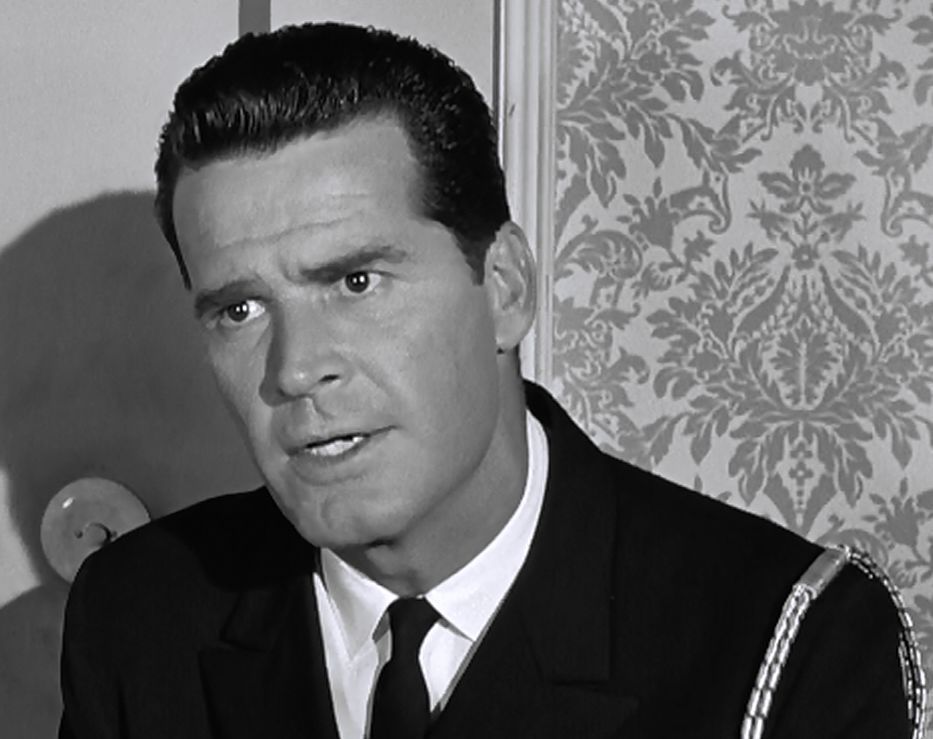
James Garner in The Americanization of Emily (1964)

James Garner, who starred in a bunch of movies in the 1960s but will probably be best remembered for the title role in the 1970s TV series The Rockford Files, has died at the age of 86. This being a movie blog, though, we're going to remember him for those movies. There's The Americanization of Emily, which is pictured above, which has Garner as an American who is selected to be the first man to go ashore during the D-Day invasion, although he's really more of a coward who's been trying to stay out of the war by doing desk jobs in London.


Another movie dealing with the D-Day invasion is 36 Hours, which is a thriller in which US Army officer Garner knows the plans for the D-Day invasion, and is kidnapped by the Nazis who, under the leadership of Rod Taylor, plan to get the information out of him! Garner was also in the war movie The Great Escape.


Garner was also good in light comedy, having made a couple of movies with Doris Day: The Thrill of It All, and Move Over, Darling. Doris Day isn't particularly my favorite actress, so when it comes to Garner and comedy, I'd recommend the comic western Support Your Local Sheriff! Garner could also do straight drama too, as in The Children's Hour.

Since Garner's death only hit the news overnight, I don't think TCM has had the time to come up with a programming tribute yet. I wouldn't be surprised if they get something in before Summer Under the Stars begins in August, since Garner isn't getting his own day in Summer Under the Stars.