Showing posts with label Maureen O'Hara. Show all posts

Tuesday, September 8, 2026

In which Paul Henreid buckles swashes

It's been longer than I thought since I had a post on a pirate movie. With one of them about to expire fro the DVR -- The Spanish Main, I watched it so that I could write up a post on it and schedule it here. And then after writing up this post, I saw that TCM scheduled it for early tomorrow (Sept. 9) at 3:15 AM as part of the TCM spotlight of swashbuckling movies, so now is when it finally gets scheduled.

Paul Henreid stars as Laurent van Horn, a Dutch ship's captain who is taking a bunch of Dutch to the Carolinas circa 1720 to settle. A storm blows them wildly off course, since they're rescued in the Caribbean and taken to the colony at Cartagena, which is modern-day Colombia. That also happens to be part of a ring of colonies that control much of the Caribbean coast all the way up to the Gulf of Mexico. Non-Spanish ships are in decided danger there, even if they're blown off course. The local colonial viceroy, Don Juan Alvarado (Walter Slezak), takes van Horn and puts him in prison with plans to hang him. But several of the prisoners are able to effect an escape.

Fast-forward five years. There's a ship predating what the Spanish think should be their sea, one called the Barracuda, and the captain of that ship has been given that name by the Spanish since they don't know his real identity. As for van Horn, he's working as a navigator that's taking Francisca (Maureen O'Hara) to be married off to a man she's never seen before in what is clearly a political marriage. Her father is the viceroy of Mexico, while her husband-to-be is... Don Juan Alvarado, still viceroy of Cartagena. The Barracuda shows up to pirate the Spanish ship, and it turns out that the captain of the Barracuda is actually van Horn! Francisca decides to do a noble thing, which is to surrender herself to van Horn and let him marry her with the proviso that he'll not kill the people on the ship she was on or its escort. Of course, the other reason she had is that she finds van Horn so damn handsome.

The Barracuda puts in at Tortuga, where we learn that among the pirates is Anne Bonny (Binnie Barnes), whom you get the impression has really been pining after van Horn. It's not all a bed of roses for van Horn, as there are a bunch of pirates there, and not all of them get along so well with each other. There's a bigger problem, however, considering that Don Juan Alvarado is understandably displeased about having lost his betrothed and will stop at nothing to get Francisca for himself. The fact that she's actually married to van Horn, and the marriage is as far as we can tell licit under Catholic canon law, complicates things.

Don Juan is no dummy, and uses those pirates who don't care for van Horn to go after him. Francisca, you might think, would be just the wedge to get van Horn, but remember that she's never seen Don Juan so she has no allegiance to him. And as is unsurprising for a film like this, Francisca has also been falling in love for real with van Horn. All of this leads up to the climactic swashbuckling fight as Francisca and Anne try to break van Horn and his fellow prisoners out of jail before they can be executed.

There's nothing particularly new to the plot of The Spanish Main, but it's a movie that succeeds largely because it's not trying to do anything serious in a genre that's more about entertainment value than making big statements. Paul Henreid actually does OK as a pirate even though that's not the sort of character you'd expect him to be playing. Maureen O'Hara is as gorgeous as ever in Technicolor, Walter Slezak is suitably villainous, and Binnie Barnes hits the right slightly saucy notes as Anne Bonny.

Sit back, watch The Spanish Main, and be entertained.

Wednesday, April 15, 2026

Lovely views of Italy

A movie that I'd seen show up on TCM several times in the past but had never watched was The Battle of the Villa Fiorita. So as with a bunch of other movies, the last time it showed up on TCM, I decided I'd record it in order to be able to watch it and finally get it off my list of movies I hadn't seen before.

Maureen O'Hara stars as Moira, an upper-class British woman married to Darrell (Richard Todd) and with two youngish children Debbie and Michael who can afford to go to boarding school and even have a horse! But life for Moira is boring since Darrell isn't the most exciting person. So when the two go to a concert and Moira is introduced to to pianist Lorenzo (Rossanno Brazzi), she immediately falls for him and the two start an affair that results in Darrell basically kicking Moira out of the house and sending her to live with Lorenzo at his palatial estate near Lake Garda in northern Italy.

The two kids get back from school and find out that Mom has left them, and they're not very happy about it. So, like any good kids, the decide that they'd like to see Mom and convince her to come back home. Of course, there's the difficulty of just getting there, since this is the mid-1960s and they're young enough that independent international travel is a big deal, never mind the expense that results in them selling Debbie's horse which becomes a plot point later in the story.

But, the two kids are able to run away from home and somehow Dad never really seems to worry where they are since the trip is an overnight one. But in any case, the two kids are able to find the Villa Fiorita and see their mother again. Mom and her paramour put the kids up since it's not as if they can do anything else, at least not until they can contact Darrell who might be able to come and get the kids. In the meantime, the two British kids get to meet Lorenzo's daughter Donna (a young Olivia Hussey), and the kids all become friends of a sort.

Meanwhile, the kids have a plan to bring Debbie and Michael's parents back together, which basically involves going on a hunger strike, or at least not eating this newfangled Italian food that's totally alien to the two British kids. Debbie is too young to realize that this isn't a complete hunger strike in that the kids are supposed to be sneaking food in from elsewhere, and rather stupidly gets pissed when she catches Michael and Donna eating. Oh, and kissing, too. Debbie does get a local priest involved in things, though, even though the family is Protestant (a bit humorous, I found, considering Maureen O'Hara was fairly prominently Irish).

Things continue to escalate until Michael and Donna decide to run off and get in a small sailboat on Lake Garda just as a storm is about to come up. Michael may have learned the basics of sailing, but he's not that good a sailor.

For some reason, I went into The Battle of the Villa Fiorita expecting something like one of those light comedies of the 1930s where the kids of a widow(er) or divorced parent find another person who would make just the right partner for their parent, and work to bring the two leads together in the final reel. The only difference being that in this case the two right partners are supposed to be the original mother and father. However, The Battle of the Villa Fiorita is a straight-up drama, with some melodramatic elements in it. That drama doesn't really work for me, and the kids aren't all that appealing. Italy is lovely, however, even though the print TCM ran doesn't do it justice.

But maybe The Battle of the Villa Fiorita will work better for some of you than it did for me.

Wednesday, December 18, 2024

Sinbad the Sailor

One of those vintage action movies I had never actually seen before is the 1940s Douglas Fairbanks Jr. version of Sinbad the Sailor. So, the last time it was on TCM some months back, I finally got around to watching it, and now I can do the review on it.

As you can guess, it's Fairbanks who plays Sinbad. At the time the movie opens, Sinbad is already quite famous for his voyages and having told tales of seven of them. Famous enough, in fact, that the people he tries to tell the stories to already know all of them second hand. So Sinbad comes up with a flashback to a story of an eighth voyage....

Some time back, Sinbad and his friend Abbu (George Tobias) are on an island somehwere in the Persian gulf when another boat comes along. This leads them to a much larger boat, called the Prince Ahmed, which seems to be drifting. Sinbad and Abbu board, only to find that the entire crew of the boat is dead, having drunk poisoned water! (The movie is in Technicolor and the poisoned water is dyed green to make it especially photogenic and obvious that this is not good water.) By the law of salvage, this should rightly be Sinbad's boat, so he sails it back to the port city of Basra.

While on board, Sinbad discovers a map that looks like it could be the sort of stereotypical map from pirate movies leading to buried treasure, at a place called Deryabar, which is in the movie a reference to a legend of treasure from the days of Alexander the Great. And Sinbad has a medallion he wears with a Deryabar logo, something that he also finds on one of the ship's windows! However, when he gets to Basra, the next morning he sees that somebody has stolen the map. Also, the local authorities have declared a change to the law on salvage such that all rescued boats need be put to auction.

Thankfully, Sinbad is able to discourage all of the sailors from bidding at the auction with claims that the boat is cursed; after all, the entire crew died under mysterious circumstances. However, there's one person he can't stop from bidding. That turns out to be Shireen (Maureen O'Hara), one of the women in the harem of the Emir of Daibul (Anthony Quinn). Sinbad is able to use more trickery first to win the auction and then actually to pay for the boat, and sets off trying to figure out where Deryabar is.

The Emir knows that Sinbad has met Shireen, so he gets on a boat of his own with Shireen to follow Sinbad who will lead them to Deryabar. Except that there are a lot of twists and turns along the way along with shifting loyalties. Rounding out the cast is Walter Slezak, who plays the ship's barber but who clearly has some sort of ulterior motive for being on the boat.

This version of Sinbad the Sailor is one that will probably suit young boys looking for an adventure movie, the sort of audience who don't care anything about historical accuracy and are fine with a fictional world built on tropes that aren't meant to be offensive although some modern-day people will likely complain. Younger viewers are also not going to care all that much about the plot which is rather convoluted, and just sit back and enjoy the action. In that regard, the action is moderately successful, although people with more discerning taste will find the movie a bit lacking, I think.

Sunday, October 1, 2023

Our Man in Havana

I've stated on several occasions before that I'm not the biggest fan of those "serious" 1960s spy movies. One (well, technically not a 1960s film) that's not quite so serious, although also not a spoof like the Matt Helm movies, is the 1959 film Our Man in Havana. I had actually never seen it before, so when I noticed it was available on one of the streaming services, I decided to watch.

The movie informs us that it was set before the "recent" revolution in Cuba finally succeeded -- the movie was made on location in Cuba but based on a 1958 book by author Graham Greene. It tells the story of James Wormold (Alec Guinness), who is working as a vacuum cleaner salesman for a British company's Havana office. You would think that this is a job that doesn't pay all that much money, and to make matters worse, James is a widower with a teenaged daughter Milly (Jo Morrow) who has expensive tastes.

Somebody in MI6 back in London, most likely spymaster "C" (Ralph Richardson) has come up with the brilliant idea that they should recruit spies from among normal people, because apparently the professional spies aren't getting the job done and all the professionals on the other side know who the British professionals are, anyway. So the head spy in the Caribbean, Hawthorne (Noël Coward), code number 59200, approaches Wormorld with a proposition to do some spying for his motherland. Wormold isn't so sure, but he could use the extra money, so he takes up the offer.

Of course, part of what is supposed to be the humor in the movie is that Wormold has no idea what he's doing, since he hasn't been given much instruction by Hawthorne. And Wormold is expected to recruit his own spies, like some sort of twisted multi-level marketing scheme. So after a bit of picking the mind of a friend, the American doctor Hasselbacher (Burl Ives), Wormold decides that he's just going to make crap up.

But for better or worse, Wormold is good at coming up with plausible secrets. The folks back in London believe the secrets, while the Cubans think Wormold has come up with something even though he hasn't. With that in mind, the British send a secretary, Beatrice (Maureen O'Hara), out into the field to assist Wormold. The Cubans, meanwhile, assassinate of one Wormold's underlings, and the Cuban authorites in the form of Segura (Ernie Kovacs) start to put the pressure on Wormold. Wouldn't it just be easier to declare him persona non grata and deport him back to the UK?

The big problem I had with Our Man in Havana is that it felt like one of those stories that was trying to be too clever by half, and as a result winds up not being all that great, despite the presence of a pretty good cast. It's not as bad in that regards as the grimmer spy tales of the 1960s, but it still didn't work for me. But because of the cast, Our Man in Havana is one of those movies you're definitely going to want to watch and judge for yourself.

Sunday, January 16, 2022

In case The Quiet Man isn't mawkish enough for you

Tyrone Power was one of the people honored in Summer Under the Stars last August. One of his movies that I hadn't blogged about before is The Long Gray Line. With that in mind, I put it on the DVR in order to watch it at some point in the future and do the inevitable blog post. That future is now.

Tyrone Power plays Martin Maher, a real person who at the start of the movie is about to be subjected to forced retirement from his job at the US Military Academy at West Point after 50 years of service to the country. President Eisenhower had been a cadet at West Point before his glittering military career and becoming president, so he brings Maher down to the White House to discuss Maher's situation. Cue the inevitable flashback....

Go back to 1898, when Maher first arrives from Ireland. For some reason, he winds up at West Point instead of New York, and the only job available for a civilian like him is as a server for the cadets in the mess hall, which surprised me since I would have thought the cadets ate cafeteria style or did the serving themselves as part of their duties. Maher is spectacularly unsuited to the work, but sees from the Master of the Sword, Koehler (Ward Bond), that guardhouse duty is a big deal. This, however, requires enlistment, which Maher does.

Some time passes, and Maher is living on base. A civilian there is Mary O'Donnell (Maureen O'Hara), another Irish immigrant who is the cook for the Koehlers. Needless to say, Marty and Mary fall in love and eventually marry, and have the sort of marriage you'd expect from two Irish-Americans in a John Ford movie. Mary is even able to save up the money to bring Marty's father (Donald Crisp) over to America.

More time passes, and we get to World War I. Everybody wants to sign up because that's the patriotic thing to do and what you'd expect from a John Ford movie hitting you over the head with its themes. Indeed, even Marty's father tries to enlist although the real life Marty's father had died some years before. Marty would like to serve in the actual war, but the higher-ups insist that he would be of more service staying at West Point. Among the various cadets Maher has tended to over his 15-plus years at West Point heading off to America are the aforementioned Eisenhower along with other famous names like Omar Bradley and George Patton. There's also the fictitious Sundstrom (William Leslie) who is killed in action, leaving behind a widow Kitty (Betsy Palmer) and infant son (who grows up to be played by Robert Francis).

Sundstrom had won a Medal of Honor in death, and the law allows for the young son of a Medal of Honor recipient automatic entry to West Point on adulthood, not that Mom wants that since she doesn't want to lose another son. But this being a John Ford movie, you know that young Sundstrom Jr. is eventually going to follow in Dad's footsteps and become a cadet too.

Fast forward a bunch more years, to December 7, 1941. Japan has attacked Pearl Harbor and the cadets are told to assume they're at war. But Sundstrom has violated his oath by getting married, even though the marriage was annulled. Marty is able to convince him to do the right thing by resigning his commission and enlisting in the regular army.

We get one more emotionally manipulative scene of Mary's death (which in real life occurred a few years after the end of World War II), and a final bit of hokum after Marty returns from his visit to the White House.

If you want cheap sentimentality and a film that glories in the way it hits you over the head with its messages, The Long Gray Line is a good place to start. John Ford is tremendously unsubtle here both with the doe-eyed view of Irish immigrants, and with the message of service to one's country. And when you think he can't go any further with it, by god he does. As you can tell, The Long Gray Line is the sort of movie I had a lot of problems with, although I can see why it's a film that other people would really like. So watch and judge for yourself.

Monday, November 8, 2021

Strong enough for a man, but made for a woman?

Gloria Grahame had a day in Summer Under the Stars this past August, so I recorded one of her movies that I hadn't done a blog post on before: A Woman's Secret. Recently, I watched it so I could do a post on it here.

Grahame plays Susan Caldwell, a singer and actress who performs on the radio under the stage name Estrellita. She finishes up her radio show one night and goes back to her posh apartment in Manhattan where she lives with her friend who discovered her, Marian Washburn (Maureen O'Hara). Susan announces that she's going to give up performing, which causes an argument between the two women. Susan goes up to her room, Marian following her into the room. We then hear a gun shot, and Susan is gravely injured.

Unsusprisingly, the police, in the form of lead investigator Fowler (Jay C. Flippen) arrest Marian and hold her on a charge of attempted murder. What's much more surprising is that Marian confesses right away, basically shushing anybody around her who might try to stop her. One of those who would try to stop Marian is Luke Jordan (Melvyn Douglas). He's a pianist and bon vivant who also appears on radio shows due to his knowledge of all genres of music. He's convinced Marian couldn't have shot Susan, and is going to try to get Marian cleared of the charges, even if Marian doesn't seem to want to.

To that end, Luke impresses upon lawyer Brook Matthews (Victor Jory), who was apparently romantically involved with both Marian and Susan at different times, to take on Marian's case, even though he'll have a client who doesn't want him to represent her and in spite of that convoluted back story. As you can guess, since all of this happens in roughly the first quarter of the movie, we're going to get a flashback as to what really happened. Well, that only comes after half a movie's worth of Luke giving the back story involving himself and the two women.

Susan had been a singer herself back before the war, but she got some sort of illness that took away the qualities in her voice that made her a good singer, leaving her with a voice that's fine for talking but not singing. Around this time Marian and Luke discover Susan, and since she's got some talent, the start building her up, with Marian becoming a sort of manager. So there's the possibility that if Susan retires, it would take away Marian's meal ticket. Add in a GI they met in France (Bill Williams) and things get even more complicated.

In fact, I think a big part of the problem is that A Woman's Secret is too complicated for its own good. There's also not much of a secret going on here. If it's not attempted murder then there are only one or two other possibilities; it's not as if an attempted murder with a bunch of different suspects. But the biggest problem of them all is that the writing came across as flat. It's just really hard to get emotionially involved in the story of any of these characters, and that's a pretty big failing. All of the stars do the best they can with the material they're given, but in the end it's just not enough.

Wednesday, March 17, 2021

The Quiet Man

With today being St. Patrick's Day, it's unsurprising that TCM is running a bunch of Irish-themed movies. Among them is The Quiet Man at 8:00 PM. Not having blogged about it before, I recently watched it. Interestingly, the recording was from TCM, last St. Patrick's Day at 8:00 PM.

John Wayne plays Sean Thornton, who shows up on the train in the small Irish town of Castletown. He asks the people at the train station the way to Inisfree, but they all have the gift of gab and can't be bothered to give him accurate directions to Inisfree. Thornton, it turns out, is American, and his family came from Inisfree before emigrating to the US, specifically Pittsburgh and the steel mills there. Dad died young and Sean heard all the doe-eyed memories from Mom about Ireland, so Sean wanted to come back and find the old family farm.

The place is still there, more or less, although it's not exactly in the best condition, since it hasn't been used in a while. It's now owned by the widow Tillane (Mildred Natwick), who, as with Tonight's the Night that I mentioned a few weeks back, seems to own a lot around Inisfree. She may be willing to sell that bit of land, but there's a catch. Local "squire" Will Danaher (Victor McLaglen) also wants to buy it.

A bidding war ensues, with Thornton winning. Having met Will, he also meets Will's spinster sister Mary Kate (Maureen O'Hara). These characters being played by John Wayne and Maureen O'Hara, you know that they're going to fall in love. But again, there's a problem. In the traditional Irish society of the 1920s when the movie is set, her family has to approve of the marriage and pay the dowry. Her parents having died, Will is the patriarch of the family, and being pissed off at Sean, refuses.

So local schemer Michaeleen Flynn (Barry Fitzgerald, playing the same sort of irritating schemer he played in Tonight's the Night) decides to start intimating that the widow Tillane might be interested in marrying Will if there's no Mary Kate around to interfere with their happiness. With that, Will approves of Mary Kate's marriage to Sean. But he finds out about the deception at the reception, since nobody bothered to inform Tillane about it. Will refuses to pay the dowry, and Mary Kate refuses to perform her wifely duties because an undowried wife would apparently be a scandalous thing.

To win back the dowry, Sean is going to have to fight Will, literally. Sean, however, is reluctant to do this because of his past in Pittsburgh. He was a boxer, but as with Killer McCoy, he accidentally killed a man in the ring. He retired from boxing, and understandably doesn't want to fight again. But since this is the only way to win the dowry and happiness with Mary Kate, he eventually does it....

There's actually a good story in The Quiet Man, and there's gorgeous cinematography. But all of the parts that portray director John Ford's doe-eyed view of Ireland makes the movie a bit of a slog at times. Barry Fitzgerald's character is as annoying as ever, while the music, which may appeal to some people, didn't appeal to me. John Wayne is John Wayne here, but O'Hara and Natwick both give good performances.

A lot of people will like The Quiet Man more than I did, so I'd say it's definitely worth a watch. It's also available on DVD.

Friday, May 29, 2020

The Fallen Sparrow


I watched The Fallen Sparrow some weeks back. I thought I had blogged about it, but I'm a few weeks ahead in a sense in that I have a couple of other movies I watched weeks back but haven't blogged about due to needing to watch other things actually coming up on one or another of the movie channels soon and blogging about those. A search of the blog suggested that I hadn't yet blogged about it, and on further consideration, I was thinking of Experiment Perilous, which I did do a post on back in March. So now's the time to blog about The Fallen Sparrow.

John Garfield plays John "Kit" McKittrick, who is returning to his old home in New York after quite a long time away. He served with the Abraham Lincoln Briagde in the Spanish Civil War and spent a substantial amount of time first as a POW (the Lincoln Brigades having been on the losing side of the war) and then after having escaped, recuperating out west. But he's returning now because of the death of an old friend.

That old friend had helped Kit escape from the POW camp in Spain, and his death was ruled a suicide, but Kit just knows different. Still, it's going to be tough to figure out, in part because the police want the case dropped; the people responsible for the death are going to be tough to crack; and Kit still isn't fully recovered from his POW experience, hearing sounds that sound like his torturer, sounds which may not exist.

One person who may be able to help Kit is Ab (Bruce Edwards, an old friend of Kit's who lets Kit stay at his apartment. Kit also meets Toni (Maureen O'Hara), who seems involved in all of this somehow, being the purported relative of a French prince who may or may not be a real French prince. In the prince's circle of acquaintances is Dr. Skaas (Walter Slezak), who also clearly knows far more than he's letting on, and has a son Otto (Hugh Beaumont years before becoming Ward Cleaver) who is also in on it all.

Apparently everybody is after Kit because his unit killed a big Nazi general, and Hitler wants to avenge the general's death by getting the unit's standard. Kit supposedly knows where it is (well, he actually does), which is why he was tortured in the POW camp and why the Nazis follow him to New York to find where that damn flag is.

The Fallen Sparrow is a movie that unfortunately has an inscrutable plot, which is a shame because Garfield gives about as good a performance as the material lets him. O'Hara is somewhat miscast but does as well as she can too, while Slezak once again runs with the story and gets to have fun as the bad guy. It's just a shame that all of this is in service of a bizarre plot that makes little sense (which is probably why it and Experiment Perilous ran together in my mind).

The Fallen Sparrow is available on DVD courtesy of the Warner Archive collection.

Saturday, May 23, 2020

The Wings of Eagles


This being Memorial Day weekend, TCM is running a bunch of war movies, as they always do. One that I haven't blogged about before is The Wings of Eagles, which is on tomorrow afternoon at 2:30 PM.

John Wayne plays Frank W. "Spig" Wead (1895-1947). At the start of the movie, Spig is stationed at the naval base in Pensacola, FL, where he's interested in combining naval operations with flight, something which was new in the early 1920s. His attempt to fly solo is a disaster, nearly getting him court-martialed, something which bothers his long-suffering wife Min (Maureen O'Hara).

Then the Army announces it's going to do the first round-the-world flight and Spig and his buddies, not wanting the Army to win, try to convince the Navy to sanction a similar flight that will beat the Army to the punch; all of this is more of an excuse to have Wayne and friends engage in fight scenes with the folks playing Army men.

Along the way, there's family strife for Spig. First, his infant son dies; then, his being away from Min all the time causes more problems since she's left to take care of the two other kids pretty much by herself. It's going to get even worse when Spig returns home one night to celebrate a promotion. He trips and falls down the stairs, resulting in his being paralyzed.

Slowly, he learns to walk again but clearly can't return to military service, so he winds up with a second career as a screen writer (The Wings of Eagles was released by MGM and the clip we see is of Wallace Beery and Clark Gable in Hell Divers, written by Wead and released by... MGM). This goes well until the Japanese attack Pearl Harbor, and Spig wants to contribute to the aircraft carrier problem.

Spig Wead sounds like a really interesting character; as such, it's only natural that Hollywood should eventually make a biopic about him. Unfortunately, The Wings of Eagles is the biopic we get. I found that this movie has two big problems: star John Wayne and director John Ford. I don't necessarily dislike John Wayne, but felt like he was the wrong person to play Wead. Not so much because Wayne was pushing 50 and Wead was much younger for most of the events depicted, but because this movie has John Wayne being John Wayne, which just doesn't work here.

Add to that the direction from John Ford. I've found myself having a diffident attitude to a lot of his post-war movies, and that stems from what I would describe as a ham-fisted bravado that permeates a lot of Ford's later movies. In the case of The Wings of Eagles, that manifests itself in the movie developing really slowly, with the opening scenes in Pensacola going on way too long, as well as the fight scenes between the Army and Navy, all of which just make Wead look like a jerk.

As always, however, you may want to judge for yourself, as there are a lot of other people who really like The Wings of Eagles. It did get a DVD release from the Warner Archive Collection, although it's another one that the TCM Shop oddly claimed is on backorder the last time I checked. You can get it off of Amazon, or which it on Prime Video if you do the streaming thing.

Friday, October 19, 2018

The Foxes of Harrow

FXM recently took The Foxes of Harrow out of the vault and has been running it into the ground. It's going to be on FXM again tomorrow morning at 9:20 AM and is available on DVD from Fox's MOD scheme.

Rex Harrison plays Stephen Fox who was born in Ireland in the late 1790s. The only thing is, he was born out of wedlock to one of the daughters of a wealthy landowner of an estate named Harrow, and there was no way the owner was going to let his daughter keep the child. Eventually, it's off to America for the orphan to make his way in the world. Fast forward to 1827 Louisiana. Stephen is being forcibly removed from a riverboat for cheating at gambling, and one of the lovely young ladies on the boat comments about his being left on a sandbar in the middle of the Mississippi. As if you couldn't tell their paths will cross again.

Stephen is rescued by pigboat captain Farrell (Victor McLaglen), who eventually becomes a working-class friend of the would-be wealthy Stephen, something which is going to cause friction later. Stephen, in New Orleans, helps out Andre (Richard Haydn), and Richard repays the kindness by letting Stephen stay at his house for a time. It's also what gives Stephen the idea to crash the charity ball being held by the D'Arceneaux family, father Henri (Gene Lockhart) and daughters Odalie (Maureen O'Hara) and Aurore (Vanessa Brown).

Stephen meets Odalie at the ball, and is shocked to discover that she's the woman he met when he was getting thrown off the boat. Actually, Odalie is even more shocked. Stphen vows to win Odalie's heart, while Odalie vows never to see Stephen again.

To try to win Odalie's heart, Stephen wins a run-down estate in a card game, and builds a new Harrow for Odalie. He's able to convince Odalie that he's changed, but he's so driven that in some ways it turns her off. It doesn't help that he's got a mistress on the side. They have sex once, though, because nine months after their wedding day a son is born unto them. But the son dies tragically amid the Panic of 1837, threatening Stephen and Harrow....

In addition to the Fox musicals of the 1940s, they were also making a lot of period piece literary adaptations. The Foxes of Harrow is to my mind one of the weaker of these, in part because I didn't care for either of the main characters. Stephen comes across as more of a self-centered jerk than somebody with an iron determination to rise up from difficult circumstances, the way Joan Crawford's Mildred Pierce for one did. It's easy to see why Odalie wouldn't like him, but then she turns on a dime at multiple points in the movie without good motivation. There's also no real antagonist. Finally, I found the score overbearing.

Still, I always like to point out when I pan a movie that one should judge for oneself.

Monday, September 24, 2018

The Rare Breed

I mentioned a few months back getting a box set of James Stewart westerns. Over the weeked I watched The Rare Breed off that set.

James Stewart plays Sam Burnett, who works as a cowboy leading cattle drives for racners. He's in St. Louis, where he's going to be attending a cattle auction. At that auction is Martha Price (Maureen O'Hara), togehter with her daughter Hilary (Juliet Mills). The made the journey from England along with their husband and a Hereford steer as they intend to introduce the Hereford to the land of the Longhorn. But the husband died on the boat, and now it's up to the two women to get the bull to Texas.

Burnett eventually winds up accompanying the two woman as the three of them take the bull to its final destination, but the journey is not going to be without some difficulty. The women overheard Sam having a conversation that led them to believe he's not going to take the bull to its intended destination, a Scottish-American rancher named Bowen (Brian Keith). The overland journey once they get off the train is also not going to be easy.

Things get further complicated when they actually get to the destination. Bowen's son Jamie (Don Galloway) has been on the journey to bring the new steer to his father, and he and Hilary wind up falling in love, which leads to the expectation that the widow Martha is going to marry Jamie's father. But she and Burnett have kind of taken a shine to each other. The other problem is actually getting that prize Hereford bull to breed with the Longhorn cows....

I had some problems with The Rare Breed, which came down mostly to the fact that it didn't seem ot know exactly what kind of material it wanted to be. The core of the subject (bringing a new type of cattle to breed) makes it sound like it should all be played for comic effect, but large portions of the movie seem overly dramatic and low on the comedy. The production values also looked to me as though the movie was more studio-bound than it should have been. Still, the movie is amiable enough that fans of westerns will probably enjoy it as a change of pace. At worst, it's just an inoffensive movie that doesn't quite do what it set out to do.

Monday, February 15, 2016

Immortal Sergeant

Ooh, there's a movie coming up on FXM Retro that I haven't blogged about before: Immortal Sergeant, airing at 8:00 AM tomorrow and again at 6:00 AM Wednesday.

Henry Fonda stars, but he's not the title character. Instead, Fonda playsa corporal, Colin Spence. Cpl. Spence is a Canadian who was in London when World War II began and who signed up with the British, so now he's serving somewhere in North Africa, under the titular Sergeant Kelly (Thomas Mitchell). The start of the movie sees the regiment in a bit of down time, with the mail arriving. Spence gets a letter from his old flame Valentine (Maureen O'Hara), begins to read it, and begins to have a flashback....

Spence is going to have a bunch of flashbacks over the course of the movie, intertwining with the action in North Africa. As for this first one, we see that before the war, Spence was an unsuccessful writer living in London and having fallen in love with Valentine. Spence's old friend Tom Benedict (Reginald Gardiner) also writes, and has become a much more successful author and war correspondent. And when he sees Colin and Valentine show up for a function, he takes more of an interest in Valentine than in Colin....

Anyhow, back to the present day. The soldiers' downtime turns out to be all too fleeting, as they're forced to go back on patrol. Sgt. Kelly's band of 14 men are given the task of going out in the desert to do reconnaissance. For Colin, it's just another mission, as he seems to be trying simply to serve out the war, doing whatever is asked of him and little more, since by nature he's a very reserved man. For Sgt. Kelly, however, this is his life, which is why he stayed in the army after the first World War and is such a good commanding officer, to the point that everybody has extreme respect for him. Kelly actually has respect for Spence, too, believing that Spence could command men effectively if he ever had to.

Meanwhile, we learn in the flashbacks more about Spence's past and his reserved nature. I'd almost compare Spence to the James Cagney character in The Strawberry Blonde, with Tom Benedict being the Jack Carson character. Well, minus the criminality. Spence gives an excuse about finding somebody he knew in Paris getting it from the Gestapo as to why he joined the British, but that's probably just an excuse; in reality it's losing Valentine to Tom that would make him want to join up with the British to get away from London.

As you can probably guess, Colin is going to have to command men eventually. Nazi warplanes come overhead while Kelly's men are out on their patrol, and the Nazis shoot all but one of the vehicles, killing eight of the men and leaving the remaining one with fairly little gas. That, and Kelly's compass is broken, so in a featureless desert, it's going to be hard to find one's way. To make matters worse, the soldiers come upon a Nazi armored vehicle. They're able to ambush and kill the Nazis, but in that ambush, Kelly gets a fatal injury. Now Spence is in command with a limited amount of food and even less water, miles and miles from nowhere....

Immortal Sergeant is a movie that has some good ideas, but ultimately comes up as being rather less than the sum of its parts. I think the big reason for this is the fact that we're constantly going from the present day to flashbacks, to the point that it makes the action a bit harder to follow and really breaks it up. That, and we don't really get Spence fully fleshed out in the flashback, as opposed to the way that the flashback in The Strawberry Blonde gets right at the heart of the matter. Maureen O'Hara and Reginald Gardiner are both underused, and the way Spence basically uses the voice of Sgt. Kelly to help him in command (hence the title) is overused. Still, I think that Immortal Sergeant is a movie that deserves one watch.

Immortal Sergeant does seem to be available on DVD.

Thursday, November 19, 2015

TCM's Maureen O'Hara tribute


Maureen O'Hara died last month at the age of 95. TCM has put aside its regularly scheduled programming for tomorrow, November 20, in order to air a 24-hour salute to the actress with a dozen of her movies.

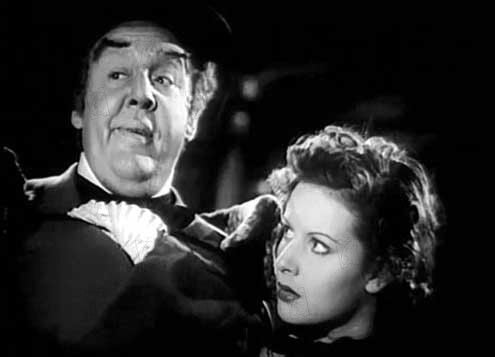
The day kicks off at 6:00 AM with Jamaica Inn, from which the above photo is taken. The rest of the schedule includes:
The Deadly Companions at 7:45 AM;
Spencer's Mountain at 9:30 AM;
McClintock! at 11:30 AM;
Battle of the Villa Fiorita at 1:45 PM;
Big Jake at 3:45 PM;
The Wings of Eagles at 5:45 PM;
The Hunchback of Notre Dame at 8:00 PM;
The Quiet Man at 10:15 PM;
At Sword's Point at 12:30 AM;
Sinbad the Sailor at 2:00 AM; and
The Spanish Main at 4:00 AM;

Tuesday, October 27, 2015

I see recently deceased people!

I suppose the above title could be appropriate for a post on zombie movies, but that's not the subject of this post, even though Halloween is coming up this weekend. Instead, it's about a couple of real, no fooling, film people who died recently and have films coming up that were previously scheduled well before their deaths.

First is a reminder about Chantal Akerman's film Jeanne Dielman, 23 Quai du Commerce, 1080 Bruxelles, which you can catch overnight at 3:15 AM.

Maureen O'Hara died over the weekend. TCM have already scheduled a 24-hour programming salute to her, but that isn't until November 20. (It'll be replacing a day and night of fairly often-aired musicals, with the exception of A Chorus Line, which doesn't show up on TCM very often.) As far as I can tell there's not much for O'Hara on TCM in the next couple of days, what with Halloween coming up. However, she does show up over on FXM Retro, in Immortal Sergeant, at 6:00 AM tomorrow. O'Hara plays the girl back home for Henry Fonda, who plays the man serving under the titular sergeant (Thomas Mitchell). FXM, if they had half a brain, could do a nice tribute to O'Hara, considering the number of films she made at Fox in the 40s. But that wouldn't be commercial.

Saturday, October 24, 2015

Maureen O'Hara, 1920-2015


Maureen O'Hara (r.) with Charles Laughton in a scene from Jamaica Inn (1939)

Maureen O'Hara, the Irish-born actress probably most famous for playing opposit John Wayne in a series of films in the 1950s, died today at the age of 95.

O'Hara started her career in the late 1930s, opposite Charles Laughton in the underrated Jamaica Inn. This one was directed by Alfred Hitchcock as a favor to Charles Laughton who produced, and while it's not quite the style that Hitchcock had come to create starting a few years earlier with The Man Who Knew Too Much and especially The 39 Steps, it's still immensely entertaining. And young O'Hara is positively radiant on screen.

Jamaica Inn resulted in O'Hara's getting to go to Hollywood to make the 1939 version of The Hunchback of Notre Dame opposite Laughton. The two would work together yet again in This Land Is Mine.


But it's probably the work with John Wayne that will probably be best remembered. I think the best remembered of them is likely The Quiet Man, a film I don't particularly care for largely because of it's obnoxiously doe-eyed view of Ireland. They also made Rio Grande, The Wings of Eagles, McClintock!, and Big Jake together.

How Green Was My Valley and certainly Miracle on 34th Street are certainly worth mentioning, although one that I'd also like to point out having blogged about is Spencer's Mountain.

I'm sure TCM is going to be doing a programming tribute to O'Hara at some point, but I haven't heard about anything yet. As far as TCM goes, here's O'Hara doing an interview with Robert Osborne at the 2014 TCM Film Festival:

Wednesday, July 8, 2015

How Green Was My Valley heads-up

I see that I still haven't done a full-length post on How Green Was My Valley yet, even though I've mentioned its airing on several occasions. It's back on FXM Retro -- actually, I think it came back sometime last month.

Roddy McDowall plays Huw Morgan, the youngest son in a Welsh family where all the men go into the coal mines to work because there's not much to do. The movie is basically Huw as an adult looking back at growing up in such a town, and despite being filmed entirely on soundstages and backlots does an excellent job of creating the atmosphere of a coal-mining town. (I think; I didn't grow up in a coal mining town or in Wales.) Anyhow, you have a chance to catch it on FXM Retro tomorrow, July 9, at 6:00 AM.

Tuesday, July 29, 2014

Spencer's Mountain

Coming up at 10:00 PM tonight as part of the last night of Maureen O'Hara movies is Spencer's Mountain.

O'Hara plays Olivia Spencer, wife of Clay Spencer Sr. (Henry Fonda) and together the parents of a large family out in Wyoming earning a living partly by running a farm on the titular mountain, and partly by dad working in the local quarry. The oldest of the children, Clay Jr., called Clay-Boy (James MacArthur), is graduating high school, and is more than smart enough that he could go on to college and make big things of himself. The only problem is, where is this poor family going to get the money to send him to college? Clay-Boy, for his part, is also feeling the first stirrings of falling in love with a young woman....

It's just the latest money problem for the large family. Clay Sr. has always been trying to build Olivia the house she always wanted up at the top of the mountain, but something in terms of money has always come up to slow down the building of the house, and that provides the other plot of dramatic tension running throughout the movie. They've never been rich, but there's always love and the money always seems to come from somewhere eventually.

Other than that, there's not really a whole lot to the story. It's written by Earl Hamner, Jr., and if that name sounds familiar -- and especially if you find the movie starts to look famliiar -- that's because it should be. This is the same story that several years later was moved to West Virginia, and back in time a couple of decades, for what became the long-running TV series The Waltons. There's even a scene in Spencer's Mountain in which everybody says good night to each other, just the way they did on the TV show.

Although the movie's plot seems a bit threadbare, the movie itself is not uninteresting. It's filled out with a bunch of homespun vignettes providing gentle humor, such as when free-thinking Dad, who doesn't have much use for religion, goes fishing with a man he doesn't realize at first is the new preacher. And then imagine Clay Sr.'s shock when he finds that although there's a place for Clay Jr. at the college, it's in the theology department. (You'd think students even back then would have been able to choose their majors.) There's also drama and sadness, as when Grandpa (Donald Crisp in his final film performace) dies. By the end of the movie, though, generic Christian values -- not so much the God stuff as the "do unto others as you'd have done unto you" or "be kind and honest" stuff -- win through. The movie's values are really fairly inoffensive even for non-believers.

In fact, Spencer's Mountain, like the later TV show The Waltons, is good for the whole family, except maybe for teenagers who will probably retch at the material only to have a change of heart when they get older. Henry Fonda generally isn't thought of as a comic actor, but he was more than capable of providing a few laughs when a movie called for it, and does a wonderful job here. Maureen O'Hara is sturdy enough as the loving mother, but nothing spectacular. The younger kids are kids, for better or for worse. Overall, though, the cast gives a nice ensemble performance.

If this post hasn't come far enough in advance for you to see the TCM showing, don't worry; it's been released to DVD.

Tuesday, July 1, 2014

TCM Star of the Month July 2014: Maureen O'Hara

We've already reached the first day of a new month, and this time, it's also the first of five nights given over to a new Star of the Month on TCM: Maureen O'Hara. O'Hara might be best remembered for the westerns she made with John Ford and John Wayne, and indeed there's an interesting Word of Mouth piece that TCM runs from time to time featuring O'Hara talking about her experiences with the two of them. They were making another movie together, and one night Ford and Wayne got drunk enough that Wayne was in no condition to drive. So Ford told O'Hara to drive Wayne home, and along the way, Wayne made O'Hara stop at the house of some complete strangers, where he pounded on the door and got the residents to fix him a drink!

None of O'Hara's movies with Wayne are on tonight's schedule. Instead, it starts off at 8:00 PM with the 1939 version of The Hunchback of Notre Dame, in which O'Hara plays Esmeralda opposite Charles Laughton's Quasimodo.

That's followed at 10:15 PM by How Green Was My Valley, in which O'Hara plays the adult daughter in a Welsh family where the only work around for the men is going down in the coal mines.

Sentimental Journey is up third at 12:30 AM; this one has O'Hara as a terminally ill actress trying to adopt a child for her husband so he won't be alone after she dies. You'd think the adoption agencies would reject such a request outright.

Then at 2:15 AM is The Forbidden Street which I think is a TCM premiere; in this Victorian-era drama O'Hara plays a woman from a reasonably well-to-do family who marries down and finds tragedy.

Wednesday, June 18, 2014

Kangaroo

A week or so ago I mentioned that when I went to watch the movie Kangaroo, I noticed that what used to be the Fox Movie Channel had finally been rebranded as FXM Retro. Ever since I started watching the channel a decade or more ago, I noticed that they seemed to take a limited number of movies out of their vault and run them over and over before putting them back in the vault. So it's not surprising that Kangaroo shows up again, tomorrow afternoon at 1:35 PM on FXM Retro.

Finlay Currie plays Michael McGuire, a cattleman somewhere in the outback of South Australia circa 1900 who's come to the big city to try to take out a loan. The weather's been bad, and the drought threatens to kill off everybody's stock of cattle, so McGuire is looking for a loan to tide his ranch over until the next rainy season -- if the rainy season comes. McGuire is also an inveterate drinker, which would probably explain why he's staying at a flophouse for sailors, and why he goes babbling on about some long-lost son. Seeing everything at the sailors' hotel is John Gamble (Richard Boone). The two will meet up again later.

But first, Gamble has some other business to take care of. Passing by the local casino, he hears Richard Connor's (Peter Lawford) winning £4,000, so Gamble proceeds to try to rob Connor out of the money. Except that Connor actually lost the money, and is broke, so the two team up to try to rob the casino's safe. They get the money, but unfotunately the manager gets shot along the way, so now our two gamblers are going to be criminals wanted by the police. Which is where Michael McGuire comes in again.

What better way to get out of Sydney than by telling McGuire they'd like to buy some of his cattle off of him? It'll give McGuire the money he needs, and it will get our two criminals on the run out to South Australia presumably safely away from the police, for a while at least. And to grease the wheels, Gamble suggests to McGuire that Connor is in fact that long-lost son he's been looking for. Not that Connor is particularly happy about it, since his presence here feels more at times as though he's been blackmailed into the whole cockamamie scheme. And things are going to get a whole lot more complicated when they get back to the ranch and find that McGuire has a lovely daughter named Dell (Maureen O'Hara). Connor would like to fall in love with Dell, excapt that he's supposed to be her brother, which presents all sorts of problems. There's also the fact that one of the ranch hands eventually notices the marks from the leg irons one of the escapees was in....

Kangaroo, to me, plays out like a typical Hollywood Western, only with the action moved over to Australia instead of the US west, much like The Jackals and Untamed would use South Africa later. The problem is, the Australian settings -- and Fox really did go to the expense of filming on location in Australia -- are not used to the effect they could. There's a couple of sequences with Aboriginals, and some footage of native Australian fauna. But there's really nothing to give the impression that they couldn't have set the story in the US and filmed in some western scrubland location. The plot is also fairly thin, and the actors are all pedestrian. Kangaroo is by no means a bad movie; instead, there's just nothing distinguishing about it.

Amazon claims that Kangaroo did get a DVD release at some point in the past, but it seems to be out of print.

Saturday, November 16, 2013

This Land Is Mine

A search of the blog, as well as a search of that portion of my hard drive where I save my blog posts, claims that I have never done a post about This Land Is Mine before. It's airing tomorrow morning at 6:15 AM on TCM.

The setting is a village somewhere in France, or at least the RKO backlot dressed up to look like Hollywood's conception of bucolic France. The movie was released in 1943, a date which means World War II, and an occupied France. Surely enough, this town is occupied by the Nazis, represented by Major von Keller (Walter Slezak, again providing a suitably evil Nazi as he did in Lifeboat). Albert Lory (Charles Laughton), meanwhile, is one of the schoolteachers in the village. He just wants to survive by making as few waves as possible. Not that he wants to collaborate with the Nazis; he just doesn't want to run afoul of them either. In fact, Albert is so meek that he still lives with his overbearing mother Emma (Una O'Connor). That, and he can't bring himself to disclose his feelings for fellow teacher, and neighbor Louise Martin (Maureen O'Hara). In some ways, though, that's not a bad thing, as she's already engaged to George Lambert (George Sanders), who is the superinendent at the rail yard.

Of course, you know all this is going to change thanks to the Nazi occupation. Louise's brother Paul (Kent Smith) is part of the Resistance, but, more importantly for Albert, Nazi propaganda is coming to the school. Lory would rather teach the truth, although not at the cost of his life; Louise, for her part, is sympathetic enough to the Resistance that she's going to rebel in passive ways where her brother is going to resist in more active ways.

It's that active resistance that's going to change everybody and get Albert to wake up from his torpor and realize how evil the Nazis are and that, my goodness, every right-thinking person is supposed to fight them everywhere and no matter the cost. More specifically, there's an act of sabotage at the railyards. It's at this point we learn that Lambert is, in fact, a collaborator! Paul, for his part, has been engaging in some of that sabotage, and when the Nazis come after him, he asks Louise and Albert for help. Albert lies ot the Nazis to protect Paul, his first major act of resistance.

Albert is going to get more chances to resist the Nazis, as his character transforms from meek to either foolhardy or somebody who realizes his previous life was pointless. It culminates in Albert being wrongly accused of murdering Lambert, and being put on what was always going to be a show trial anyway for it. Since Albert knows it's a show trial and there's no chance of being found not guilty, he can tell off the Nazis for what they really are. (I don't think it's giving too much away, since you know a movie like this has to have a positive message for the American audience for which this is intended, and the Nazis are always going to be portrayed in the worst possible manner.)

Charles Laughton is, as always, exceptional. I wouldn't say he steals every scene he's in since he's the star of the movie, but he certainly makes every scene his own, outshining the other cast members. That's not to say they're not good; it's just that when you're up against somebody like a Charles Laughton, it takes a lot to shine as much as he does. Clark Gable was able to do it in Mutiny on the Bounty; Maureen O'Hara and the rest instead provide a good atmosphere for Laughton to show his chops. And to be fair to them, they're all quite good at it. If the movie has any flaws, it's the fact that, being set in World War II and made at the time, it's kind of constrained in how it can present the unbelievably virtuous Resistance and preternaturally wicked Nazis. Somebody like Catherine Deneuve in The Last Metro is probably a more realistic portrayal of having to deal with Nazis.

This Land Is Mine does seem to be available on DVD courtesy of the Warner Archive Collection.