Showing posts with label Robert Taylor. Show all posts

Tuesday, July 28, 2026

Pinky Tomlin

Another of those B movies that I hadn't heard of before the last time TCM ran is is Times Square Lady. But once again, since the plot synopsis sounded interesting enough, I decided I'd record it and give it a go, and since it's only 68 minutes, it wouldn't be as if I wasted much time it it wasn't very good.

Robert Taylor is top billed here, right at the beginning of his career being top-billed, but of course he's not the Times Square Lady. That honor goes to Virginia Bruce, although we don't meet her either in the opening scene. Instead, the opening deals with the sudden death of King Bradley, a promoter who has his fingers in a whole bunch of different sports/entertainment businesses in New York, which are at various points on the spectrum of being maybe illegal. Certainly, the sort of people running them aren't the most ethical.

As for Taylor, he plays Steve Gordon, who manages the Casa Nova, a nightclub that Bradley owned, and which features a new singer fresh from Oklahoma, Pinky Tomlin (playing himself), who had beome big at the time for a song called "The Object of My Affection". Steve has a girlfriend in Margo (Helen Twelvetrees), and a manservant in Mack (Nat Pendleton), who is clearly on the wrong side of the law. Virginia Bruce plays Toni Bradley, who is the daughter of King Bradley but for some reason not clearly mentioned is living in Iowa as the movie opens. Dad's business associates didn't know anything about the daughter, so they're stunned when the will is read and discover that Toni inherits everything.

Their idea to deal with this is one that's not unreasonable. They suspect that Toni won't have any interest in running such businesses, and may not have the acumen to do so. So they're more than willing to buy the businesses out from Toni, in what I think today would be called a leveraged buyout. But of course they also want to get the businesses for the best price they can, which for them is the lowest, before reselling them to a promoter who would pay true market value. Steve's job is to wine and dine Toni, since Steve's the only one with the requisite looks that Toni might fall for. (The rest of them are played by middle-aged character actors you've probably seen in a bunch of 1930s movies.) But, since they're also businessmen with dubious ethics, they're not above doing things like injuring their own hockey players or poisoning dogs at the greyhound track.

But, as you can guess, Steve falls in love with Toni which presents multiple problems. One is that he's got that girlfriend already, while the other one is that the other business associates are going to be none too happy with Steve working with Toni not to sell the businesses. And since they've got those questionable ethics, they're going to use those to try to force Steve and Toni out of the picture if they can.

I titled the post after Pinky largely because I have to admit to not having heard of him before seeing this movie. He didn't have that much interest in the movies and got out of the music business fairly early, going into oil. He gets a substantial subplot here, involving singing a second of his songs in a scene where he also milks a cow. His character isn't really necessary to the story, and it's also easy to see why he didn't have a long movie career. Certainly World War II and the changing tastes that came along would have ended it in any case.

For a bunch of reasons, Times Square Lady turns out to be a mediocre B movie. But again, it's only 68 movies, and seeing how Hollywood deals with this sort of business as it was back in the 1930s is a mildly interesting time capsule.

Friday, November 28, 2025

His sister-in-law

Barbara Stanywck was TCM's Star of the Month back in March 2025, which gave me the chance to record a couple of her movies that I hadn't done posts on before. Among those was the melodramatic programmer His Brother's Wife.

Robert Taylor plays the he who has a brother and eventually a sister-in-law. The "he" in question is Chris Claybourne, the latest in a family line of medical researchers who, despite having been trained to do medical research, would rather be a playboy. To be fair to him, the research in question is the tick-borne disease spotted fever, which is affecting mining camps in the jungles of South America; since a lot of the basic research has to be done down there away from civilization, it's understandable why Chris might not want to go down there. This disappoints his dad (Samuel S. Hinds) and older brother Tom (John Eldredge), also medical researchers. Tom has an unseen fiancée Mary.

Chris makes an agreement with his family, which is that before he goes off to South America at the beginning of June to work with Prof. Fahrenheim (Jean Hersholt), he gets to spend the month of May doing what he wants. So he goes to the Crescent Club, a gambling establishment run by a guy called "Fish Eye" (Joseph Calleia). Working at the club as a tout who brings in rich guys to be fleeced by the club in exchange for a commission on how much they're fleeced is Rita Wilson (Barbara Stanwyck, who would go on to marry Robert Taylor after making this movie). Not that Chris knows Rita is workin for Fish Eye, or that she has debts of her own to him that she's basically working off. In any case the two of them fall in love, with Chris deciding to elope with Rita instead of going to South America.

Except that Chris runs up $5,000 in gambling debts that he can't pay off, passing off a bad check since it's generally believed he's going to go down to South America away from American law. Fish Eye is no dummy and calls Chris on his bluff. Dad can't mortgage the clinic again to pay off his son's debt, so Tom makes Chris agree that he (Tom) will pay off the debt in exchange for Chris' going off to South America for that two-year research hitch. If Rita really loves Chris, she'll wait the two years before Chris returns and only marry him then.

Rita is no dummy and understands that Tom is trying to get rid of her because she's déclassé and the Claybournes are high-class. So she goes into debt herself to pay off Chris' debt, not telling either Chris or Tom, and letting Chris go off to South America. She then starts working her wiles on Tom, getting him to dump that unseen fiancée and marrying Rita, who really doesn't love him and is certainly never going to grant him a divorce.

If that's not insane enough, Chris returns from South American before the two years are up and finds out about the marriage. He knows Rita is still at the Crescent Club, and discovers that she still loves him, although now it's Tom who won't grant a divorce. So he takes her to South America on the theory that this will make Tom finally grant that divorce. Meanwhile, the research into the spotted fever isn't going well, to the point that the South American authorities will charge Chris or Fahrenheim with manslaughter if they try out a serum on another local and that local doesn't survive. You can guess where this is leading....

His Brother's Wife is the sort of movie that audiences of the 1930s might have liked, but 90 years on seems dated and with a plot that veers in a direction that feels like a hilarious misfire. Stanwyck does the best she can with the material, as do the rest of the cast. This is one of those movies where the studio (MGM) has the ability to cast a fine stable of stars, even if the material more or less sinks the movie.

Sunday, August 3, 2025

Ride, Vaquero!

Tomorrow's (Aug. 4) star in TCM's Summer Under the Stars is Howard Keel, and his day kicks off with one of those movies whose titles I'd seen show up on TCM several times over the years, what with the movie having been made at MGM, but never actually watched until the last time it showed up on TCM and I recorded it. That movie is Ride, Vaquero!, at 6:00 AM.

Howard Keel is technically not the star here, as we don't see him for several minutes and the bigger role goes to Robert Taylor. Taylor plays Rio Cameron, a man in South Texas not long after the Civil War who works for José Esqueda (Anthony Quinn) and is José's foster brother: it's mentioned later in the film that Rio was orphaned and raised by José's mom alongside José. Esqueda is the leader of a group of disaffected people who are probably old enough to remember the days of the Texas Republic, and possibly even when Texas was still part of Mexico. Esqueda expects a lot more Anglos to come pouring into this part of Texas, and worries what it will mean for their lands.

One such person is King Cameron (Howard Keel). He's recently gotten married to Cordelia (Ava Gardner), and plans on making a new life for the two of them as a rancher in the Rio Grande valley. He's even spent the money he's saved up on the land and, one presumes, a bunch of cattle. But on the way to their new home, he and Cordelia see smoke on the horizon. That smoke is from the small house he had built on the land before getting Cordelia, and King has no illusions about who's responsible for the fire.

So King goes into town in order to organize the Anglos into finally bringing some law to the area. Oh, there's a sheriff, all right, but he's not able to do much so the rest of the time it's up to the cavalry to save the day, as is going to happen multiple times over the course of the movie. Esqueda and Rio show up to the meeting, so everybody of importance in the movie knows what's up. The one person who wants all the violence to stop is the local priest, Fr. Antonio (Kurt Kasznar).

Cameron rebuilds, only for all his hired help to flee the place -- they know that Esqueda is going to burn them out again, and again, as long as it takes for the Anglos to get the message that they're not welcome. Rio is caught in the middle, and when Cameron catches Rio after a raid gone wrong, Rio actually starts working briefly for Cameron. Complicating matters is the fact that Cordelia finds herself falling in love with Cameron. There's more violence to come, as well as a showdown between Rio and José when Esqueda decides to raid Brownsville.

Ride, Vaquero! is a competently-made movie, but I think there are good reasons why it's not so well known compared to other classic westerns. In my opinion a lot of that has to do with the time when it was released, in 1953. There's nothing groundbreaking in Ride, Vaquero!, and other westerns, like the Anthony Mann/James Stewart collaborations or Budd Boetticher's stuff, were beginning to show a darker psychological edge to their heroes. Worse for Ride, Vaquero! is that came out two months before The Robe, the first movie released in the new wide-screen Cinemascope format. Being in the old Academy ratio makes Ride, Vaquero! look even more dated and lacking in vista.

Ride, Vaquero! is entertaining enough, and that's not a bad thing. But there is better, and more spectacular, out there.

Wednesday, May 21, 2025

Out west with Stewart Granger

When you think of stars whom you wouldn't necessarily think of as doing westerns, there are any number that come to mind, although I think more stars from the studio era did at least one western at some point in their careers than you might realize. Stewart Granger, who was good enough in all those British-set costume pieces did a couple of westerns over the course of his career, including The Last Hunt.

The movie is set in the Dakota Territory in the mid-1880s. Opening titles inform us that before Europeans started pushing westward past the Mississippi, there were millions of buffalo roaming the Great Plains, although by the 1880s, hunting by both the Indians and the whites had pushed that number down to the four-figure range. Stewart Granger plays Sandy McKenzie, a former buffalo hunter who turned rancher after the hunting ceased being good and he tired of the killing. Unfortunately, there are still just enough buffalo left to stampede his cattle, leaving him in need of a way to make money.

Enter Charles Gilson, played by Robert Taylor. He served in the Civil War and decided to go west and hunt buffalo after the War because he discovered he had a taste for shooting things dead and was good at it. Charles needs a crew for the next buffalo hunt, and Sandy reluctantly joins because he needs the money. In town, they're able to find two more men to round out the crew. Woodfoot (Lloyd Nolan) is a good mule hand, while Jimmy (Russ Tamblyn) is mixed race but for whatever reason has decided he's going to thrown in his lot with the white man instead of his Sioux half.

It's not going to be an easy hunt, and not only because of the dwindling number of buffalo out there in the wild. The Sioux aren't happy that the white man has been killing off the buffalo, in part because the Sioux need the buffalo to survive just as much, if not more, as the white man does. The Sioux also have religious beliefs surrounding albino buffaloes, so when Charley kills one of those, the Sioux are really displeased. In trying to gain revenge on the Indians, Charley enters the reservation and takes a young Indian woman (Debra Paget) hostage.

The bigger issue, however, is the way that Charley likes killing and Sandy no longer does. This personality clash is going to grow bigger as Sandy gets the distinct impression that Charley is getting too violent for his own good. To that end, Sandy gets the idea that perhaps he should try to save the Indian woman by taking her away from Charley and the buffalo hunting party, but that's only going to make Charley more jealous and lead to the ultimate climax.

The Last Hunt is a competently-made movie, helped out in no small part by the location shooting as well as the assistance of the Department of the Interior who allowed MGM to shoot real footage of a buffalo cull since the herds rebounded by the time the movie was made to a number where the herds had to be managed. The color and widescreen photography really help the location shooting. Unfortunately, the story is only serviceable. It's not a bad story by any means, but there have been a lot of better western stories put to screen.

Monday, April 29, 2024

Ivanhoe

I mentioned yesterday that TCM would have two movies showing on April 30 that were on my DVR but that I hadn't blogged about before. The second of them is the 1952 adaptation of Ivanhoe, which shows up at 11:45 AM.

I haven't read Walter Scott's book on which this movie is based, so I can't say anything on how different the movie is. In any case, it starts off at the end of the 12th century. If you remember The Adventures of Robin Hood, you'll recall that English king Richard the Lionhearted went off to fight in one of the Crusades, only to be captured on the way home by Leopold of Austria and held for ransom. As the movie opens, a man looking like one of the old troubadours is riding his horse past various castles, singing a song in English. Eventually, at one of the castles, the man gets a response, followed by a small bag being thrown from a window high up. The man who threw the bag is Richard, as you can tell by the three lions crest on the bag, which contains a letter stating that he's being held for ransom, and that his brother John (Guy Rolfe) is aware of this and deliberately not paying the ransom.

The man who's been riding arouind looking for Richard is Wilfred of Ivanhoe (Robert Taylor), and he returns to England. However, there are all sorts of problems for him in England. One is that he's a Saxon, and the English monarchy are all Normans, descended from the invaders of 125 years prior. Prince John has been brutal in his desire to make the Saxons bend the knee to him, while Richard was more conciliatory about wanting to bring everyone together. It's because of this that Wilfrid's father Cedric (Finlay Currie) has disowned him for going off on a Crusade with those nasty Normans. But Wilfrid wants to see Cedric's ward Rowena (Joan Fontaine), with whom he has been in love. So when the unrecognized Wilfrid as troubadour runs into a group of Norman knights who are in Sherwood forest looking for a place to spend the night, Wilfrid directs them to his father's place nearby.

Wilfrid hides from his father, anad at the house one other guest shows up. Isaac (Felix Aylmer) is a Jew, having been forced to flee from Spain because the Jews are being persecuted pretty much all over Europe, much like they are even today for not willing to let Hamas extirpate them. Isaac meets Wilfrid, who tells him about Richard's captivity, and gives Isaac an assurance that Richard will let Jews in England live in peace. So Isaac takes Wilfred back to his place, Wilfrid bringing a jester he liberated, Wamba (Emlyn Williams) along in exchage for making Wamba a squire.

Isaac has a very lovely daughter, Rebecca (Elizabeth Taylor). Neither of them has anything close to the wealth needed to pay Richard's ransom, but Rebecca does have a way to help Wilfrid. Prince John wants a series of jousts in which the Normans will best the Saxons, thereby finally subjugating them. Wilfrid is the one Saxon who could beat them, but he doesn't have a suitable jousting horse or suit of chain mail. Rebecca has the wealth at least to purchase those. She falls in love with Wilfrid, but of course he's a Gentile, and is already in love with Rowena anyway.

Wilfrid does best the Normans, but picks up a fairly serious injury in the process. He also gains an enemy in Norman knight De Bois-Guilbert (George Sanders), who vows to destroy the Saxons once and for all, and that's what the rest of the movie is about.

Ivanhoe is the sort of literary adaptation MGM was generally pretty good at making, combined with vibrant Technicolor and location shooting in the British Isles. Robert Taylor isn't a particular favorite of mine, but once again he gives a professional performance, as do Elizabeth Taylor and the underused Joan Fontaine. George Sanders gets to play another of his villain roles, and the British supporting cast is uniformly good. The story is a rousing one, full of action and easy to follow.

Ivanhoe may not be as good as Warner Bros.' The Adventures of Robin Hood, but not a whole lot of films are. It's eminently watchable in its own right, however.

Thursday, March 28, 2024

Westward the Women

A movie that's part of the old Turner library that formed the backbone of the TCM programming back in the day, one that I'd seen show up on the schedule a bunch of times but never got around to watching, was Westward the Women. The last time it showed up on TCM, I made a point of putting it on the DVR so that I could finally watch it and do a review on it.

The movie opens with a title card telling us that it's California, 1851. So, it's just after statehood, but much of what's between California and Missouri is terribly undeveloped such that getting across the country is difficult. As such, a lot more men have moved west than women, and in a place like Whitman's Valley, there's a bunch of unmarried men and no unmarried women. Mr. Whitman (John McIntire) meets Buck Wyatt (Robert Taylor), who recently guided another party across the plains and Rockies to San Diego. Whitman discusses the area's problems, and eventually decides that perhaps Buck should go back east for and arrange another crossing party, but this one with unmarried women who can then marry the men in Whitman's Valley.

Three months later, Whitman and Buck have made their way to Chicago, where they set about recruiting women for the trip. Buck expects that fully one-third of the women are likely to die since the trip is so difficult and who knows how experienced these women are. Some of the women seem like they're more than tough enough for the journey, such as Patience Hawley (Hope Emerson). On the other hand, a couple of showgirls, Fifi (Denise Darcel) and Laurie (Julie Bishop) show up in their good clothes. Whitman and Buck both think that's going to be a problem, but the two are so earnest that they find themselves some plain clothes and convince the two men to take them along.

After assembling a large group of women, Buck begins to tell them just how hard the journey is going to be, telling the women they're more than welcome to leave at this point, although of course none of them do. Thankfully a couple of them know how to handle horses, so they'll be able to teach the other women how to lead the horses and mules that are going to be handling the wagons and their packs. One other catch, however, is that Buck doesn't want the women fraternizing with his men, since that's bound to lead to conflicts if either multiple women like the same man or multiple men like the same woman.

Eventually, they set off on the voyage west. At least the first part isn't that difficult, as they head up the Missouri River to Independence, which is about as far west as they can get in Missouri without being too far north of where they need to go in California. That part they can do by boat. Once they get to Independence, they have several days to start training for all the hard work they're going to have to do, before finally setting out overland to California.

Unsurprisingly, the journey is as difficult as you can imagine, with pretty much everything you can think of as fitting into a movie about pioneering west showing up. Will everyone get to California? Will a third of the women die as Buck tells them at the beginning? Well, I won't tell you who lives and who dies; as with any good disaster movie from the 70s part of what makes it interesting is that it's not obvious who will be around in the final reel.

Westward the Women was made at MGM, where Robert Taylor was a contract player, and to be honest, westerns are the sort of genre I wouldn't expect MGM to be all that good at. But thanks to a very good script (conceived some years earlier by Frank Capra of all people) and excellent direction (unsurprising considering it's William Wellman), the movie turns out very well. And for an MGM movie it's surprisingly harsh at times.

The only bad thing is that Westward the Women was released in 1951, and in black and white. I think it would have benefited somewhat from color, but would have looked even better had it been made after the introduction of widescreen. Indeed, I'm thinking of a similar movie from much earlier, The Big Trail, which was actually released in an experimental wide-screen practice and covers many of the same themes. In any case, Westward the Women is definitely worth watching.

Sunday, February 11, 2024

Knights of the Round Table

The story of King Arthur is one that's relatively well known. I was, however, a bit surprised to see that I had never done a post on the 1953 MGM movie Knights of the Round Table, which, as you can guess, is about Arthurian legend. It was on TCM not too long ago, so I recorded it. It's going to be on TCM again, tomorrow (Feb. 12) at 6:00 PM. So I made certain to watch it in order to be able to do a review on it here.

An opening voiceover tells us that the action is set in Britain not long after the Romans abandoned the island, which would make it the 5th century or so. Britain was in turmoil with rival warlords waging war against one another, until the king Uther Pendragon died. He left behind a pair of issue: Morgan Le Fay (Anne Crawford) was a legitimate daughter, but of course a woman. Then there's Arthur (Mel Ferrer), who was of questionable provenance. The sorcerer Merlin (Felix Aylmer) leads them to Excalibur, the "Sword in the Stone", and declares that whoever can get it out of the stone shall be King. Morgan's son Modred (Stanley Baker) tries and fails; Arthur succeeds.

Meanwhile, the French knight Lancelot (Robert Taylor) comes looking for Arthur. Along the way, he runs into a lone woman, Elaine (Maureen Swanson), who falls in love with him, and the two eventually marry, but much later in the movie. The two are waylaid by a bunch of Modred's men, but Lancelot is able to see them off, before Arthur shows up. Lancelot, not realizing who it is, challenges him to a fight which ends in a long draw, earning mutual respect. Then Elaine's brother Percival arrives, and declares that he wants to be a knight too. He's eventually going to be given the task of finding the Holy Grail.

It's going to take until the following spring for Arthur to defeat Modred and Morgan. Having done so, he can become the rightful king with all of the knights sitting around that round table. And they'll all live happily ever after. Well, of course that's not going to happen, since all of this happens with only one third of the film's running time having elapse. And we haven't even met Guinevere (Ava Gardner) yet.

Lancelot is back out on the road and comes to a castle where Guinevere is being held captive, Lancelot not realizing that Guinevere is already betrothed to Arthur. Still, he frees her and brings her back to Arrhur, thereby cementing his trust with the king. The king, however, has been fairly foolish in that after defeating Modred and Morgan and having united the island, he pardons them. They're looking for any way they can to get back at the king, and they think they've found one.

Lancelot, despite being set to marry Elaine, also pines for Guinevere, although in this movie he's utterly chaste about it because the Production Code would never let this Lancelot and Guinevere have an adulterous relationship. Still, when Modred's men find the two of them alone together, it doesn't take much for them to start gossiping and get enough people to believe that Lancelot and Guinevere have committed high treason with their relationship. It threatens to destroy all of Camelot.

Knights of the Round Table was the sort of movie that MGM was quite good at making. Here, they have the added advantage of Cinemascope, this being the studio's first movie in the wide-screen process. However, the movie feels like it's missing something. I think that's partly because the film's star, Robert Taylor, didn't particularly like making this sort of movie. Mel Ferrer is also decidedly not the right actor to be playing King Arthur.

For me, however, the bigger issue is that the movie really feels like multiple movies, or maybe an anthology story, in that the initial defeat of Modred and Morgan doesn't feel like it's at all connected with the love triangle of the second section. And then the final conflict is wrapped up rather too neatly and again in a way that doesn't feel so connected to the other two parts. At the same time, though, it's also easy to see why audiences of the early 1950s would have gone for a costume drama like this, especially one shot partly on location in vibrant color and that wide screen they couldn't get at home.

So watch Knights of the Round Table and judge for yourself.

Sunday, September 3, 2023

Many Rivers to Cross

I have to admit that I'm not the biggest fan of Robert Taylor. But since he was under contract to MGM for 20-plus years, they put him in everything. For those who like the sort of movie that MGM made, they'll probably enjoy Taylor's comic turn in Many Rivers to Cross.

The setting is Kentucky around the time that it became a state in the late 1790s. Kentucky was still a relatively wild place, and it was the women on the frontier just as much as the men who helped make it a place where the white man could live. Among the men are Bushrod Genty (Robert Taylor), a trapper when a man could still make a living trapping in Kentucky. He's a concerned bachelor, which kind of ticks off some of the frontier women who would love to have him as a husband.

One such woman isn't about to let go when she meets Bushrod. That's Mary Cherne (Eleanor Parker), who is a tough woman of her own. She knows how to shoot a gun, mostly out of necessity since there are still Shawnee raiding those parts of Kentucky not near a fortified city. She saves Bushrod one day when he's attacked by the Shawnee, and brings him back to her place, which is really the family farm run by her father Cadmus (Victor McLaglan). Bushrod injured his arm in the attack, so he has to stay for a while to heal up, which gives Mary ample time to fall in love with him, much to the chagrin of Luke Radford (Alan Hale, Jr.), who has been pursuing Mary.

The rest of the movie deals with Mary's attempts to tame Bushrod and get her to marry her, which he actually does, although he also assaults the justice of the peace which gives him a short stint in jail. This gives him another chance to escape married life, but you know that in a movie like this, circumstances are going to intervene to give Mary and Bushrod another chance to meet up and fall back in love, this time against the backdrop of another Shawnee attack....

Many Rivers to Cross is the sort of movie that's imbued with all the gloss and charm MGM could give a picture. Even into the mid-1950s they still had high production values, which mostly show here. Once again, however, for some people, and I'd certainly include myself in this group, it's the sort of production values that aren't necessarily quite right for a movie set on the frontier.

Taylor and Parker both show themselves to be reasonably adept at the sort of light drama interspersed with comedy that the movie calls for, and it's easy to see why it would appeal to a certain segment of the movie-going public, both in the 1950s and even today amongst those who like classic movies. So once you know what you're getting into, if Robert Taylor is your sort of thing, then definitely give Many Rivers to Cross a try.

Sunday, January 29, 2023

Three Comrades

In looking through the movies on my DVR, I noticed something that's coming up on TCM, so I figured I'd watch it now to do a post on it: Three Comrades, which airs at 6:30 AM January 30.

The movie starts off with an establishing shot that has the words "Nov. 11 1918" written in the clouds. Now, if you recall your history, you'll know that this was the day on which World War I ended, although at the time the movie was released it was still known as the Great War because the European theater of World War I was still a year away from kicking off. Als, if you paid attention to the opening credits, you'll have spotted the name Erich Maria Remarque, writer of All Quiet on the Western Front, so you can guess that this is written about Germans. Sure enough, we see a group of German officers and flyboys hoping that real peace can come to the world.

Among the flyboys are three who hope they can keep up their friendshpi and hope that in the new Germany they can put the skills they learned in the military to good use as auto mechanics. Those three are Erich Lohkamp (Robert Taylor), Gottfried Lenz (Robert Young), and Otto Koster (Franchot Tone). They meet up again in early 1920, and Otto actually has a car of his own, so they not only do an auto-repair business, they try to make money on the side by using the car as a taxi. While out for a joyride one day, they get in a race with a car that has a female passenger, Patricia Hollmann (Margaret Sullavan). Patricia was part of one of the pre-war noble families, but the war destroyed all that, and she's reduced to trying to get a sugar daddy (Lionel Atwill) to bankroll her.

All three of the young German friends like Patricia, but it's Erich who really falls in love with her. Eventually, he's convinced by his to try to start a relationship with Patricia, who loves Erich in return, even though Erich thinks his low social class will hurt him with Patricia. But no, she really loves him, so the two decide to get married.

The two go on a honeymoon someplace on the German coast that really looks more like the Northern California coast, but that's beside the point. It's not a happy honeymoon, however, as Patricia collapses with what is presumably tuberculosis although I don't think that's actually named in the movie. Dr. Jaffe (Monty Woolley, who only has a couple of scenes) is called in, and tells Erich that Patricia really needs to get to a sanitarium, the sooner the better.

Not that the three friends have the money for this. And they're also coming up against the political realities of early Weimar Germany. It's a volatile place, what with Germany having been defeated in the war and a lot of people chafing at the reparations, even though the real disasters of the 1923 hyperinflation still hadn't occurred. In any case, there's already political street violence, and it does eventually touch the three men. Gottfried believes in the teachings of a radical pacifist, and that's dangerous, as the proto-Fascists want to shut down such political expression, by force if necessary. (They didn't have social media giants to shut down such speech under the guise of "fake news" back in those days.) Gottfried gets shot and killed, although fortunately this is after Patricia has gone off to the sanitarium so she doesn't know about it.

What she does learn is that she needs an operation, because in those days a vague operation could apparently cure any serious illness other than cancer, which would invariably kill you within months. However, the operation involves her having to remain nearly still for weeks on end, and she may not be able to follow medical instructions....

Three Comrades is one of those movies that has all the gloss MGM could offer, although I couldn't help but feel that it was a bit of a mess. The plot twists of Patricia falling ill and then needing an operation felt more like a soap opera to me than what is supposed to be a serious film. MGM was also never the best studio to handle the sort of serious social commentary that's on offer here with the backdrop of Weimar political violence, so I felt like there was an earnest tone that didn't quite fit the material.

That having been said, there is the MGM gloss, which is definitely a sign of quality production values, while the cast also do the best they can with the material even if some of them are miscast. (Guy Kibbee in a supporting role is most definitely not German, but he's as professional as ever. And there are a lot of people who praise the movie much more highly than I do, so it's definitely worth a watch to judge for yourself.

Tuesday, July 20, 2021

Party Girl

Cyd Charisse was TCM's Star of the Month back in June. She is of course known more for her dancing, although she did essay a couple of serious roles. One of those that I hadn't blogged about before is Party Girl. As an MGM movie, it's on DVD courtesy of the Warner Archive, so I recently sat down to watch it.

Charisse is the title character, although I don't think she's really the main character. That would be the character played by Robert Taylor: Tommy Farrell, a lawyer in Chicago in the early 1930s. He's working for gangster Rico Angelo (Lee J. Cobb), basically working to make certain that Rico and his associates stay out of prison. One of those associates is Louis Canetto (John Ireland), who stands trial but whom Tommy defends with some theatrics in the court, so you get an idea of precisely the sort of lawyer Tommy is.

Charisse plays Vicki Gaye, a showgirl in the show at a nightclub owned by Rico. Rico is giving a party, so he hires some of the showgirls to be guests at the party, and Vicki is one of those paid attendees. That's how she meets Tommy. When Tommy points out that being paid to be an escort isn't exactly work to be proud of, Vicki responds that what Tommy does isn't really any different, it's just that he's got high-class degrees behind his work. It's the start of a friendship between the two, although Tommy can never marry Vicki because he's got a wife who won't grant him a divorce.

At any rate, all of this gives Tommy the idea of going straight. One thing he can do is finally get his hip fixed. He's suffered from a limp since childhood thanks to a childhood injury, and getting that hip fixed will take him all the way to Stockholm, which also means getting out of Chicago for a while.

But even on his sojourn to Europe, Tommy can't get away from Rico. Another young hoodlum, Cookie La Motte (Corey Allen) is arrested and faces execution, and Rico wants Tommy to be the defense attorney again. Tommy reluctantly accepts mostly because of the power Rico also has over Vicki. But Cookie, being too aggressive for his own good, escapes to Indiana after one of the jurors is bribed.

Tommy goes to Indiana to talk to Cookie and try to get Cookie to do the right thing, but somebody else responds by pointing a machine gun through the curtains and knocking off Cookie and some of his associates; Tommy survives. It's just the start of a gang war in which a whole bunch of people get killed. This gets the state led by ambitious prosecuting attorney Jeff Stewart (Kent Smith) involved, and holding both Tommy and Vicki on charges.

Rico is still behind the scenes using veiled threats against Vicki to keep Tommy from talking, while Stewart tries whatever he can to get either Tommy or Vicki to talk It all leads to the climactic shootout and the Production Code-approved ending.

I didn't realize going in that Party Girl was directed by Nicholas Ray. I didn't notice his style to the extent that a lot of other reviewers have. Instead, I saw something that was fairly typical for MGM, which was trying to take tough material only to see it softened because MGM just somehow couldn't keep its gloss from rubbing off on everything. It works for some types of movies, but it's not what Party Girl needs.

That's not to say that Party Girl is a bad movie, however. It's eminently watchable despite the two male leads both having somewhat limited ranges. Cobb is given a mobster role that's perfect for him, however, so he does just fine. Taylor tries his best and isn't bad, but you wonder what an actor who had the chops to play such a conflicted character -- somebody like a Gregory Peck -- could do here. The Metrocolor helps the dance sequences although it's not necessary for the rest of the movie.

Party Girl is a movie with imperfections, but one of those movies where it's the imperfections that make the movie more interesting.

Thursday, May 20, 2021

Cattle King

Robert Taylor made any number of competent, if not particularly memorable, movies in the latter part of his career. Hollywood made a bunch of competent, if unmemorable, westerns in teh 1950s and 60s. The two come together in the film Cattle King.

The movie helpfully tells us at the start that it's the Wyoming Territory, 1883. Sam Brassfield (Robert Taylor) owns the Teton Ranch, and one of his ranch hands Hobie is riding with Sam's adult niece June Carter. A bunch of folks who want an open range for cattle to graze show up with the intention of cutting Sam's barbed wire, and when Hobie tries to stop it, they shoot him dead!

So already we know that we've got a range war movie on our hands, a sub-genre within the western that's been done to death. There's basically one twist here, which is that Sam decides to go down to Cheyenne, because none other than President Chester Alan Arthur (Larry Gates) is supposed to stop there on his way to Yellowstone National Park (which had been established in 1872 if, like me, you were wondering whether there was an anachronism here; also, Chester Arthur really did go to Wyoming during his presidency, something not common in those days).

In Cheyenne, Sam and Johnny Quatro (Robert Loggia), one of his ranch hands who has a taste for women and violence, find President Arthur, who is being buttonholed by Clay Mathews (Robert Middleton), who runs the association of Texas Cattlemen. They want a corridor to run from Texas to Canada through which they can run their cattle. Sam opposes this because he thinks it's going to lead to an overpopulation of cattle and weaken the breeding stock. By closing off the range and selective breeding, they can come up with better cattle.

You can probably guess that Clay is going to stop at nothing to get his way, including violence. Living next door (or the next ranch over) to Sam is Harry Travers (William Windom) and his sister Sharleen (Joan Caulfield). Sam, never having married before, has finally decided to ask for Sharleen's hand in marriage, and she accepts. But then Clay's men show up, shooting Harry and wounding him, and shooting Sharleen dead. Also along the way, they laid west to another rancher's spread, Abe Clevenger (Malcolm Atterbury). Abe accuses Sam of this, and in the ensuing gunfight, Sam wounds Abe. Fortunately, Abe is able to learn the truth in time.

All of this leads to the inevitable climactic gunfight and the good guys winning, even if not everybody is able to live happily ever after considering that love interests have been shot dead.

As I said at the beginning, Cattle King is one of those competent movies that you could easily sit down and watch on any rainy day that TCM shows it, but it's nothing special. Taylor does OK, as do all the other main players. It's interesting to see Loggia at the beginning of his career, and the presence of Chester Arthur as a character. There's also some nice location cinematography of Wyoming.

It's too bad there aren't any more TCM-themed box sets being produced, as a movie like Cattle King would be perfect for a box set. Instead, I think it's only gotten the Warner Archive treatment.

Wednesday, May 27, 2020

The Law and Jake Wade


Another movie that I DVRed some time back and only recently got around to watching is The Law and Jake Wade, another of those movies that got a Blu-ray release courtesy of the Warner Archive Collection.

Jake Wade (Robert Taylor) is a man with a past. He's the marshal in a town called Cold Stream, but he had served in the Confederate army in the Civil War. After that, he was in a gang with Clint Hollister (Richard Widmark). One robbery went wrong and Clint saved Jake from getting killed, but at the cost of Clint's getting captured and sentenced to hang. Jake repays the debt by breaking Clint out of jail.

Interestingly, Jake's past isn't going to require him to pay for it the way most Code-era movies would require. But to get to that point isn't going to be easy. Jake tried to go straight by taking the marshal's job, and now even has a fiancée Peggy (Patricia Owens), with whom he's willing to start a new life elsewhere after they get married. Of course, part of the reason for wanting to start a new life is to get away from Clint, which is a good idea.

You know that's not going to happen, however. Clint shows up with his gang, including Wexler (DeForest Kelley) and Ortero (Robert Middleton). In that botched robbery that resulted in Clint's imprisonment, the gang had taken $20,000. But it was Jake who was supposed to be the guardian of the money. He decided to bury it and become a marshal. Clint obviously didn't go straight, and equally obviously, he wants that $20,000.

So Clint takes Jake and Peggy hostage, forcing Jake under the threat of death to both of them to take Clint to the money. That money is buried in a ghost town, and as you can guess, the Indians are also following Clint and the rest of them, leading to the possibility that nobody's going to get the money.

The Law and Jake Wade was one of Robert Taylor's final movies at MGM after a long time under contract. He's getting old here, and although he does OK, he's never been one of my favorites as he's always a bit stiff. Widmark seems as though he's growing a bit tired of having to play the bad guy yet again, although he's as professional as ever.

The story is OK, as is the cinematography and the supporting acting. Overall, The Law and Jake Wade is another movie that does everything solidly enough, but doesn't break any new ground. If you like westerns, I think you'll definitely be entertained by this, but if you're not the biggest fan or trying to introduce somebody to old westerns, I'd start elsewhere, not that there's anything particularly wrong with the movie.

Saturday, April 4, 2020

The Lady of the Camellias


Where yesterday's selection Our Time showed a young, naïve love, today's selection shows a rather more craven kind of love: the 1936 version of Camille.

Greta Garbo plays the lady of the camellias, named not Camille but Marguerite. She lives in the Paris of 1847 (just before the revolution of 1848 that brought Napoleon III to power but which isn't mentioned here; I couldn't do a good enough calculation of how long the events in the movie are spaced out to determine when it ended), where women of her sort woo wealthy men. Her matchmaker -- to use a polite term -- Prudence (Laura Hope Crews) is taking her to a theater where it's hoped she'll meet the wealthy Baron de Varville (Henry Daniell).

Unfortunately, she mistakes another man, Armand Duval (Robert Taylor), for de Varville. The two like each other, but he's only a diplomat's son and so of just moderate wealth. Armand falls in love with Marguerite, but he's not going to be able to support her in the manner to which she is accustomed.

The Baron, of course, could, but he's not going to marry her, especially when he knows what kind of woman she really is. In addition to being in love with another man, she's also a spendthrift, constantly owing money because she wants to spend on herself and even more so help others when possible. Armand's father (Lionel Barrymore) knows that Marguerite is financial bad news for Armand, but when he meets Marguerite he realizes that the two are in real, if doomed, love.

That doom isn't just because of Marguerite's profligate ways, but also because she has consumption, which in those days mean an early death, especially if Marguerite is living it up as she is. Armand and the Baron come in and out of Marguerite's life, until the three legs of the love triangle all meet at the opening of a new gambling club in Paris. Armand wins the money to pay Marguerite's debts off of the Baron in a game of baccarat, but it leads to a duel between Armand and the Baron which ultimately forces Armand to leave France. Will he be able to return before the consumption takes Marguerite?

Well, you can probably guess that the answer to that last question is yes, but that Armand sure won't be able to save Marguerite. Camille is the sort of movie that MGM was really good at making during Irving Thalberg's lifetime. It's got excellent production values, and a story and performances that I'm sure audiences of the 1930s loved.

However, watching it 80-plus years later, I realize that it's not exactly my cup of tea, as I felt like a whole lot of nothing was happening. Still, it's easy to see the quality of the movie, so I have no qualms about recommending it for people who know what they're getting into. The movie is available on DVD courtesy of the Warner Archive, should you wish to watch for yourself.

Sunday, February 16, 2020

The movie needed to have Howard be one of the hawks


In the 1950s, it wasn't uncommon for movies to be made in the UK with one American star (usually past their studio contract days) in the cast to make it easier to get a distribution deal in America. An example of this is The House of the Seven Hawks.

Robert Taylor, who had been at MGM for a good two decdaes, plays John Nordley, an American who lives on his British-flagged boat and makes money by taking people on charter trips. Apparently he does more, like going into international waters for people who want that, which he's not licensed to do. He promises the harbor master that he's not going to do this again, oh no, scout's honor.

Yeah right. A certain Mr. Sluiter (Gerard Heinz) is looking to charter the boat, ostensibly for a seven-day cruise along the coast, but once they get out of port he offers Nordly £500 to take him to Maasluis in the Netherlands, showing Nordley wads of cash in his briefcase. (There is a real Maassluis just down the river from Rotterdam, but the British port, Baymouth, is a fictional place as far as I can tell.) Along the way, Sluiter claims to be feeling not so well, so he goes and lies down, especially since it's apparently going to be an overnight trip anyway.

Sure enough, Nordley goes to check on Sluiter, and finds him quite dead. Nordley gets his money and takes a few other things off Sluiter's body, notably what looks like some sort of map. Before getting into harbor in Maasluis, Sluiter's daughter Elsa (Linda Christian) shows up, not realizing that Dad is dead.

Things get complicated here. Nordley had reported Sluiter's death, but it turns out he didn't die of a heart attack, but of insulin shock. (Nordley is innocent and the cops know it because they know Sluiter took his insulin capsule before meeting Nordley.) Sluiter was a police inspector in the UK on a special assignment, which Inspector Van Der Stoor (Donald Wolfit) won't reveal the nature of. But Nordley is in some trouble because his story doesn't fit. When he talks about seeing Sluiter's daughter, Van Der Stoor brings in the daughter, who is a woman named Constanta (Nicole Maurey) who has never met Nordley! Obviously Elsa is an impostor.

Nordley is let out on bail, which was paid by a mysterious Rohner (Eric Pohlmann) who also puts Nordley up at a local hotel. Rohner also has a main Peter tailing Nordley. But Nordley gets away in order to go see his old friend and partner in crime Charlie, whose help Nordley wants in getting out of his predicament.

Eventually it's revealed that the map that Nordley took off of Sluiter is some sort of key to finding a bunch of buried Nazi loot, and everybody wants it, and who knows who's double-crossing whom. The only thing we can guess is that since Nordley is the one played by a star, he's probably going to figure out a way to wind up on the up-and-up so that the movie could still adhere to the Production Code and get distributed in the US.

The House of the Seven Hawks is the sort of thing that by the late 1950s when it was made would probably have worked better as episodic TV. Everybody tries, but there's nothing new here and nothing particularly exciting. The movie plods along in mediocre fashion until all is revealed, not quite satisfyingly since you'd think there are some serious plot holes. Still, for Taylor, it must have been nice to get away to the Netherlands to do a movie on location, especially since his wife at the time, Ursula Thiess, was from Germany.

The House of the Seven Hawks is available on DVD courtesy of the Warner Archive.

Monday, June 17, 2013

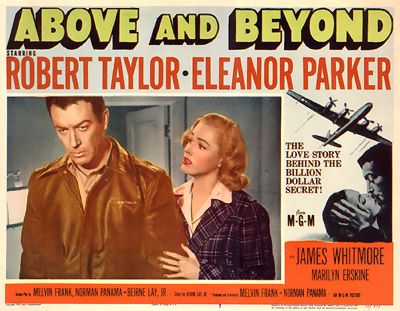
Above and Beyond


TCM is showing something like 30 movies as part of Eleanor Parker's time as Star of the Month. Since they only have four weeknights to do it, that means that the movies, starting at 8:00 PM Monday, tend to continue well into Tuesday morning. Such is the case with Above and Beyond, which is airing tomorrow morning at 11:15 AM.

Robert Taylor gets top billing as Lt. Colonel Paul Tibbets. If that name sounds familiar, perhaps it should: Tibbets' claim to fame is as the pilot of the Enola Gay, the US B-29 bomber which dropped the atomic bomb on Hiroshima, Japan, in August 1945. Above and Beyond is the story of Tibbets and of the program to train bombers for the mission to drop that bomb on Hiroshima. But before they can drop the bomb, we have to go back a few years. Tibbets is serving as a pilot in the North African theater, running bombing raids over Tunisia that he considers pointless. So he tells his superiors this in no uncertain words. It costs him a promotion, but brings him to the attention of Major General Brent (Larry Keating). Brent is in charge of part of the atomic bomb mission, although at first Tibbets has no idea that there's any sort of atomic bomb being developed. For now, Tibbets' mission is to pilot test flights of the B-29. Part of the proposed atomic bomb mission involves a very long flight to the target, and then back from the target, which means that a new bomber capable of handling such long range flight, as well as the aftershock, is neccessary. And Tibbets is the right man to test whether the B-29 will be that suitable bomber.

So Tibbets heads out west, much to the dismay of his wife Lucey (Eleanor Parker), who is left behind in Washington with their son. The testing goes well enough that the generals decide the B-29 will be OK for the atomic bomb mission, and it's at this point that they finally let Tibbets in on the real purpose of his mission, which will ultimately be to drop a bomb of such hitherto unimaginable destructive force that the Japanese will have no choice but to beg for surrender. It's Tibbets' job to find the suitable crew to fly the plane that will drop the bomb, and to train them. There's one catch: he's not allowed to let any of them in on what's really going on, as security is understandably exceedingly tight. Tibbets and the rest head out to Wendover Air Base, on the Utah-Nevada border, to train for the mission. Eventually, to try to make Wendover appear more like a regular air base, the men's wives are allowed to join them, although the women are obvoiusly not allowed in on the real point of what's going on at Wendover. As you can imagine, this would be pretty big strain on a marriage, as Tibbets has to look like the bad guy a lot of the time in order to keep things secret.

It's no surprise that the question of whether dropping the atomic bomb was the right thing to do became a point for debate among historians decades after the war. (Charlton Heston, in his Private Screenings interview with Robert Osborne, argued that it saved his life: he was stationed in Alaska at the time, but was certain to be part of the force that would presumably have had to invade Japan's Home Islands had the bomb not been dropped on Hirsohima.) However, Above and Beyond was only made a half dozen years after the bombing, so it's understandable that there's no question that dropping the atomic bomb could be anything less than completely morally just. To be honest, I think skipping that question makes for a better movie. Considering all that had previously gone on in the war, it's not as if the people fighting at the time, not having any clue about the long-term radiation consequences of dropping the bomb, would have had any moral compunction about using it.

So, Above and Beyond gives us a more straightforward look at the people involved. I wouldn't be surprised if all of the main people in the film are portrayed even more positively than they were in real life, but that's Hollywood for you. Still, Taylor is quite good as the man who has to keep a really difficult secret, with Parker does well as the woman who must, unless she's a complete idiot, realize there's something big going on, but also knows she can't ask about it. As much as it must have been tough for the military wives to deal with their husbands being abroad fighting the war, I can't imagine it would have been much easier to follow their husbands to some God-forsaken place like Wendover, only to discover that they're being kept out of the loop as to what's going on. James Whitmore, who plays the security officer who informs Tibbets of the real nature of the mission in the first place, while also ensuring everything remains a secret.

I don't know quite how accurate Above and Beyond is, but even if it does get any of the personal history wrong, it's still a very well-made film. It's received a release to DVD from the Warner Archive.

Tuesday, June 4, 2013

When Ladies Meet (1941)

Back in February, I recommended the 1933 movie When Ladies Meet. I made a point of including hte year in the title of the blog post for a very good reason: that's not the only version of the film. In fact, the movie was remade in 1941, again with the title When Ladies Meet, and that version is airing at 2:00 PM tomorrow (June 5) as part of a salute to Robert Taylor, who doesn't get a regular birthday salute of his own since he was born in August.

Now, I have to admit that I don't think I've ever seen the 1941 version, so I can't compare the two versions of the movie much further than giving you all a heads-up. All I can do is give you the link to the post I did on the 1933 version if you want a plot synopsis, and mention who played the various roles in the two versions:

Mary, the author, was played by Myrna Loy in the original; her part is taken over by Joan Crawford.
Mary's friend Jimmie was played by Robert Montgomery in the 1933 version; it's Robert Taylor who takes on this role in tomorrow's showing.
Rogers Woodruff, the Mary's publisher and lover, was played first by Frank Morgan and then by Herbert Marshall.
Claire Woodruff was portrayed by Ann Harding in the original; that role is given to Greer Garson in the remake.
Finally, Bridget, the friend with the house in the country, was played by Alice Brady in 1933 and Spring Byington in 1941.

According to TCM's website, the 1941 version of When Ladies Meet has received a DVD release courtesy of the Warner Archive collection.

Apologies for any odd posting; for some reason Blogger has been showing most of my post on Young Jesse James and a bit of this post under the When Ladies Meet title. I had to delete the post and repost it before I noticed that Blogger has stopped notifying me of any HTML errors.

Friday, June 29, 2012

The Bribe

I mentioned The Bribe a few weeks back when it was getting an overnight airing on TCM. It's airing again this evening at 6:15 PM, and deserves a viewing if you didn't watch or record the last showing.

Robert Taylor plays Rigby, a US agent investigating an international smuggling ring that's taken him to some God-forsaken Central American banana republic, where he's fallen in love with another of the expats, Elizabeth (played by Ava Gardner). The only thing is, she's married, and Rigby is investigating her husband. Not only is an illicit affair a big problem; she just might be guilty too. How did Rigby get himself into this? Well, a flashback will tell us all.

As I said, Rigby is investigating smuggling, specifically smuggling surplus US Army gear that's no longer needed now that World War II is over, but which presumably any number of groups in Latin America would love to have. Rigby was sent to meet Elizabeth precisely because the US government suspected her husband, Tug, played by John Hodiak. (They presumably didn't expect their agent to fall in love with the guy's wife. They should have watched Notorious first.) Anyhow, Rigby goes down to Central America where he meets Elizabeth, but also gets waylaid by the mysterious Mr. Bealer (Charles Laughton). Somehow, Bealer knows the real reason Rigby is down there, and offers Rigby a cool $10,000 to stop the investigation -- that was a lot of money back in the late 1940s, especially in some banana republic.

Obviously, there has to be somebody else in on this whole thing. But who? One obvious place to look would be at the other expats, which is where the businessman Carwood (Vincent Price) comes in. Rigby suspects him and, posing as a vacationer here for some serious sport fishing, goes out on a boat trip with Carwood. Carwood rather dumbly tries to knock Rigby overboard "accidentally", which is a sure sign that he must be guilty of something else. And I don't think we'd get this movie over with in under two hours if that something weren't the same arms racket that Tug is involved in.

Alfred Hitchcock said that the "uranium ore" that Cary Grant and Ingrid Bergman were investigating in Notorious was really just a macguffin -- they could have been investigating anything, as long as there was some excuse to use her as a spy to get at Claude Rains. To be honest, a lot of what happens in The Bribe feels the same way to me. Investigating arms smuggling is really a pretext to have a movie about... well, I'm not quite certain what it's about. Forbidden love, of the sort that Dana Andrews felt toward Gene Tierney in Laura? Or maybe it's a character study. Or perhaps my feelings about there being a macguffin in The Bribe are simply wrong, and MGM was trying to make a crime movie without any ulterior motives.

As far as crime stories go, The Bribe is moderately entertaining. Robert Taylor feels mildly miscast here, much the way he was as Johnny Eager several years earlier. I supose that could just be a problem with the fact that The Bribe is MGM's attempt to make a high-minded crime picture. Ava Gardner and John Hodiak are also OK. I've never really thought of Hodiak as the greatest of actors, so his being just serviceable is not a problem. Gardner, I suppose, should have been better. Vincent Price is always enjoyable to watch, and Charles Laughton is the real treat. His character is somewhat reminiscent of the one played by Sydney Greenstreet in Flamingo Road, only with a little more vitality. As you can see from my constant mentioning of other movies, The Bribe feels a lot like something that's been done a dozen times before, but is done reasonably well.

The Bribe got a release to DVD as part of the Warner Archive collection, so you can still see it if you miss today'showing.

Tuesday, March 20, 2012

My husband's dirty secret

I was just thinking about how many movies there are in which a wife comes to discover that her husband has been keeping a big secret from her. Not something like a Christmas present, but rather more serious things. Think, for example, about how Ingird Bergman learns in Gaslight that husband Charles Boyer is trying to drive her crazy. Or, how Joan Fontaine comes to suspect that husband Cary Grant is trying to kill her in Suspicion. In Dark Victory, Bette Davis learns a rather different secret that her doctor/husband George Brent has hidden from her. Barbara Stanwyck learns a secret in a rather different way in Sorry, Wrong Number, while Shelley Winters never learns the secret that husband Robert Mitchum has in Night of the Hunter. Another wife who doesn't learn her husband's secret until it's OK for everybody to learn it is Eleanor Parker in Above and Beyond, although in this case it's understandable, since the secret is a matter of national security: the atomic bomb.

Why am I thinking about all these secrets? The answer to that question isn't a secret; it's that I was reminded of all these movies when I noticed that TCM's schedule for tomorrow contains the movie Conspirator, at 8:00 AM. In this case, the wife is a young Elizabeth Taylor, who was only about 18 when she made this movie. She's visiting friends in England (pay attention to Joyce, the adult daughter of the family; that's Honor Blackman, who would go on to play Pussy Galore in Goldfinger). While in England, she goes to a dance, where she meets dancing army major Michael (played by Robert Taylor). She falls in love, and the two soon get married.

Of course, we know that things aren't going to be a bed of roses for the two of them. Indeed, the director lets us in on the major's secret: he's passing secrets to the Communists! This is interesting, in that it's something that makes Conspirator different from a lot of the other secret-keeping films I've mentioned. With the exception of Above and Beyond (and to a lesser extent Dark Victory), the husband keeping the secret is keeping it from everybody, and not just the wife. Here, though, Robert Taylor's army major has people above him who are in on the secret. Unlike Above and Beyond, though, the Communists have feelings about the major's marriage that the army bigwigs wouldn't have had. They would rather have vetted Elizabeth Taylor's character, since they feel an unknown woman could be a threat to their organization. (Indeed, this is much like the Laraine Day character in The Woman on Pier 13.) Anyhow, Elizabeth Taylor eventually finds a piece of intelligence that her husband has been hiding, one which shows that he's a Communist. This naturally causes a conflict for both of them. For her, she wonders first what to do about the man she loves. For him, it's a question of whether the British authorities are going to arrest him because his wife turns him in, or whehter Communists are going to get him first because they discover he's caused a threat to them. One way to solve both these problems would be to kill his wife....

I don't really want to call Conspirator formulaic, even though the plot device of the husband keeping a secret from his wife is one that's been used far too much. Still, this movie does feel a bit like a road we've been down a dozen times already. That having been said, Elizabeth Taylor was really quite a good actress before she became a sort of parody of herself in the 1960s and beyond. Robert Taylor is handsome and menacing enough here, even if he's outshone by Elizabeth. Not that this is much of a surprise; a lot of great actors were outshone by Elizabeth Taylor in her films. Conspirator is sold enough entertainment, if nothing groundbreaking. It's made it to DVD courtesy of the Warner Archive, which means that you can still catch it if you miss the TCM showing, but it'll be a bit more expensive than a lot of movies.