Monday, December 8, 2008

Reversal of Fortune

You may have missed the news that Sunny von Bülow passed away this weekend, after spending the last 28 years of her life in a coma. She had suffered from hypoglycemia and went into insulin shock, and everybody was led to believe that her husband, Claus, had attempted to murder her, resulting in a series of trials. Renowned attorney Alan Dershowitz handled the defense at the last trial, and wrote the book, Reversal of Fortune, which was turned into a movie.

Reversal of Fortune is quite an interesting movie about a group of very unappetizing people. Jeremy Irons plays Claus, the husband accused of murder, and it's easy to see why, regardless of the evidence, he could be found guilty. He's almost entirely unsympathetic, seeming to show no sadness over his wife's condition. Irons won on Oscar, and is quite good. Glenn Close plays Sunny, in what for me is a not-particularly memorable role. (This isn't to say she's bad; it's just that I don't remember her performance as well as the others.)

For me, the highlight is Ron Silver's Alan Dershowitz. From Dershowitz's public life, he comes across as bombastic, and full of overweening self-confidence, to the point of arrogance. It makes him abrasive, and easy to dislike. All these traits come out in the movie, as he verbally shoots down people in several scenes. There's one exchange in which Claus asks Alan who the man in a photo on the wall of Dershowitz's house is, and he points out that this is one of the pro bono cases that Claus is paying for -- and you can hear the implication that in the normal world, the Claus and Sunny von Bülows of the world wouldn't even think of defending such people. But it swings the other way, too; one particularly memorable scene has one of Dershowitz's law students horrified that he would take on the von Bülow case. How could you defend those evil rich people, when you believe in social justice, she wails. Dershowitz points out to her that if the authorities can do the things they're doing to a rich and powerful person like Claus von Bülow, imagine what they can do to the poor. It's easy to imagine the real-life Dershowitz deliberately putting these vignettes into the book to make himself look better.

Reversal of Fortune is an interesting movie about the lives of the super-wealthy, and is available on DVD.

Sunday, December 7, 2008

Nina Foch, 1924-2008

Nina Foch

Nina Foch, who spent most of her career playing supporting roles, and earned a Best Supporting Actress Oscar nomination for just such a role in Executive Suite, has died at the age of 84.

Much of her later work was for the small screen, and she also taught an acting course at USC. However, she did appear in movies as diverse as the aforementioned Executive Suite; An American in Paris, and The Ten Commandments.

Beverly Garland, 1926-2008

Promotional shot from 'The Alligator People'

Beverly Garland, who starred in a series of B-grade sci-fi movies in the 1950s, and played Fred MacMurray's wife on My Three Sons at the end of the 1960s, has died at the age of 82. I recently blogged about her performance in The Alligator People, a schlocky, but fun, science fiction/horror movie. Garland was well-known for her Fay Wray-style scream, which is probably one of the reasons why she ended doing stuff like The Alligator People.

However, she also got to do more serious work, such as a brief appearance in D.O.A., where she plays a secretary to a dead businessman, telling Edmond O'Brien that her boss committed suicide.

Saturday, December 6, 2008

Introducing Sidney Poitier

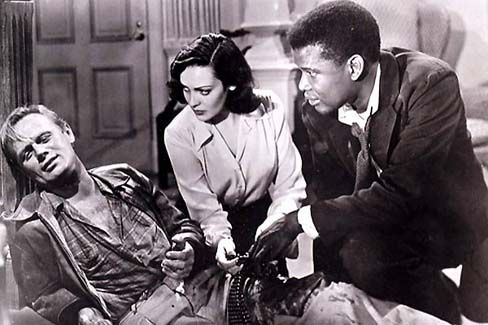
TCM are showing Sidney Poitier's movie début, No Way Out, at 6:00 PM ET tonight. It's a movie that was groundbreaking in its time, and is still fascinating today.

Poitier plays Dr. Luther Brooks, a young resident in the prison ward of the County Hospital. One night, the Biddle brothers are brought in, having been shot during the robbery of a gas station. Dr. Brooks examines them, and determines that one of the brothers has a more serious problem than simply having been shot in the leg -- the young man probably has a brain tumor. Dr. Brooks begins to do the necessary tests, but while performing the tests, the man dies. Unfortunately for Dr. Brooks, the surviving Biddle brother (played by Richard Widmark) is virulently racist, and thinks the black Dr. Brooks has deliberately killd his brother -- and dammit, Dr. Brooks is going to pay for it!

Dr. Brooks tries to prove his innocence, but it's not an easy task. The simplest way to do it would be to perform an autopsy on the dead man, which would reveal whether or not the deceased actually had a brain tumor, but the survivors aren't about to permit this. In the meantime, word has spread amongst the local black population that their black doctor is being given the shaft by The Man, which leads to an entirely different set of problems....

No Way Out is an extremely interesting movie, and one that raises thought-provoking questions to this day. The characters are, for the most part, given believable motivations. Poitier's Dr. Brooks is clearly the hero here, but he's not a pure man, having the natural doubts: what if he were wrong?, he thinks. His immediate boss wants to take his side, but has the understandble problem of trying to maintain funding for the hospital. Despite what this may say about the state of race relations (and the hospital administrators have some of the most badly-dated lines of the movie in that regard), it should be kept in mind that if a similar situation happened today, regardless of the races of the doctor and patient, hospital administrators would have the same thought. The black characters other than Poitier are divided, as well, reflecting the real life difference between the gradualism (of, say, the Booker T. Washington types of the early 1900s, who thought that blacks could advance their situation most effectively by being clean, hard-working, high-achieving types), and the more radical W.E.B. DuBois types who would have felt a more vocal protest necessary. Is this the hill you want to die on? It's not a comfortable question to have to answer. Perhaps the most interesting dilemma is that shown by Linda Darnell, who plays the wife of the deceased. She was clearly born on the wrong side of the tracks, where a bigoted attitude towards blacks was the order of the day, and which has clearly infused all the whites of her social class. As a result, her first thought is what might be in it for her. This leads her to be against the autopsy at first. But, as the surviving Biddle brothers don't treat her well, she begins to be willing to side with those rich people. Interestingly, however, the movie doesn't particuarly look kindly on "those rich people" either, giving them the bad lines about trying to advance race relations. That's one of the things that makes the movie so fascinating.

Everybody is quite good here, especially the three leads. Life is not as clear-cut as it's generally portrayed in the movies, and Poitier and Darnell both do an outstanding job of portraying life's ambiguities. Widmark's character is more one-dimensional, but even his anger at the death of his brother is understandable. People back in 1950 -- especially the less educated -- wouldn't understand why a doctor was checking a gunshot victim for a brain tumor, and when that patient dies, it's not unnatural to think there was something untoward going on on the doctor's part. Still, Widmark's Ray Biddle is portrayed as an unrelenting racist, which is a bit of a shame. Watch also for Ossie Davie and Ruby Dee as Poitier's brother and sister-in-law.

Thankfully, this excellent movie is available on DVD, should you miss TCM's showing. No Way Out was released by Twentieth-Century Fox, which means that it doesn't show up on TCM very often.

Friday, December 5, 2008

A December 5 death

As I mentioned earlier today, I sometimes look at the list of people born on a given day for inspiration for a post. IMDb also lists people who died on the day, but I don't normally look at that list so often. However, there was one name in today's list that stuck out at me: Joseph Breen, who died on this day in 1965.

Breen wasn't an actor; he wasn't a director; he wasn't even a producer. In fact, IMDb's listing for him only lists eight titles, all of them containing archive footage of him. But he probably had more influence than anybody else in the history of Hollywood. That's because he spent twenty years as the head of the Production Code Administration, from 1934 to 1954.

It is from Breen's tenure that we get the term "pre-code" movie, although it's technically a misnomer. The Production Code had been promulgated several years earlier, and the group that was supposed to enforce it was headed by Will Hays, who had been the Postmaster General in the Warren Harding administration. However, enforcement was lax, and in what are now called the pre-code movies, quite a bit of racy (at least for the early 1930s, although by today's standards most of it is very mild) stuff made it onto the screen. This infuriated a lot of people, especially Catholic groups, who had the power as a more centralized church to organize boycotts of movies they thought weren't decent enough. This, combined with the threat of government control, led to Breen's appointment, and a very strict enforcement of the Code.

The ironic thing, of course, is that some of the effects this had on the movies were arguably quite good. Although writers couldn't discuss certain topics, the restrictions imposed by the Code also forced moviemakers to come up with intelligent stories. Love, for example, actually had to be romantic, and not smutty, which makes the romantic comedies of the 1930s and 40s sparkle in a way that today's movies just don't. Bad language was strictly off limits (remember, there was a huge uproar when David O. Selznick wanted to be faithful to the book Gone With the Wind and have Rhett Butler say, "My dear, I don't give a damn"), but at the same time, the filmmakers couldn't use it as a crutch the way it seems language is used today. Of course, as I've mentioned early, the Code certainly had a deleterious effect on a movie like The Great Lie.

The vagaries of birthdays

When I can't think of anything to write about, I go to IMDb and look to see if there's anybody with a birthday. Some days, there aren't many famous people; other days there are few. Today happens to be one of those days with a whole host of well-known names. We could start off with director Otto Preminger, born on this day in 1906. He received an Oscar nomination for one of the great movie mysteries, Laura, but also directed such horrible mistakes as Skidoo.

There's also director Michael Powell's screenwriting partner Emeric Pressburger, of movies such as 49th Parallel, he was born December 5, 1902.

Another director is Fritz Lang, born on this day in 1890; Lang is of course well known for M, and I've recommended another of his movies, Fury.

Finally, who could forget animator Walt Disney? Apparently, he drew a little mouse with oversized ears, and became famous for it. His birthday is December 5, 1901.

Fond birthday memories for all!

Thursday, December 4, 2008

The Rocking Horse Winner

TCM showed The Rocking Horse Winner last night, as part of a night of movies featuring British actress Valerie Hobson. I had not seen the movie before, so I couldn't recommend it, but was favorably impressed with it. Thankfully, The Rocking Horse Winner has been released to DVD, so I can recommend it now.

The aforementioned Hobson plays the mother in a British middle class family in the years immediately following World War II. (The movie was released in 1949.) The family is living beyond its means, mostly due to her overspending, and it's causing the sorts of strains that family overspending usually does. Mom and Dad are constantly bickering, and the oldest kid, who is old enough to understand that something is wrong, worries, although he doesn't want to let his parents know this.

Things change one Christmas when the kid gets a rocking horse for the holiday. It seems as if the horse is whispering to the boy, and one of the efects that this has on him is that he rides it very feverishly. At the same time, the family's handyman (John Mills) lets on to the boy that he likes to bet on the horses, and so our kid wants to bet on the horses in order to win some much needed money for his profligate mother. After a while, the boy, the handyman, and the boy's uncle discover that the boy has a seeming knack for picking winners. However, that's not entirely a good thing....

The Rocking Horse Winner is a pretty good and interesting movie. It's notably dark where it needs to be, but also quite evocative of post-war Britain. There are a lot of little movies like this that were made in the UK in the late 1940s and early 1950s, before the advent of the New Wave, and for the most part they're not very well-known on this side of the Atlantic. Granted, I'm sure that there were some stinkers made over in the UK -- after all, there are a lot of pretty lousy B movies made in the States in those days. But movies like The Rocking Horse Winner, or the previously-recommended The October Man, are up there with some of the better American movies. The one big difference is that the British studios couldn't get the budgets they had in Hollywood, so the production values look more like a Hollywood B movie at times than one of MGM's prestige movies. Don't let that take away from the movie, however; The Rocking Horse Winner is well worth seeing.

Wednesday, December 3, 2008

In praise of B scifi

TCM aired The Killer Shrews, this morning, an incredibly low-budget movie about people trapped on an island with mutant shrews that are the size of wolves, and need to eat NOW! or else starve to death. Fun, fun, stuff, although truth be told, it's really bad.

Having said that, the low-budget B-grade science fiction movies of the 1950s and early 1960s can be a lot of fun, precisely because they're so bad. I can strongly recommend The Killer Shrews; I've already recommended Panic in Year Zero!, and another good one is The Alligator People.

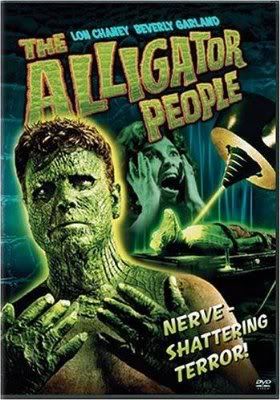
In The Alligator People, Beverly Garland stars as a newlywed woman. She's married to a man (played by Richard Crane) who was a pilot in World War II, but suffered a serious accident breaking most of his bones. However, he apparently had some experimental treatment that's given him a full recovery. They're on their honeymoon, when Crane gets a telegram. He gets off the train at a stop to make a phone call to answer the telegram, and disappears, leaving his wife high and dry. She's determined to find him, and find out what happened to him, so she goes to his last-known address, an antebellum-style mansion in the bayous of Louisiana. There, she finds a clinic with nurses and doctors who seem to know more than they're letting on to her. The title (as well as the box art) gives away quite a bit of what they know, but that in and of itself doesn't take away from the movie.

The Alligator People is chock full of the sci-fi clichés of the era: a moody mansion, along with the fog and mist; a well-meaning, but mad, scientist (played by George Macready, taking quite a step down from movies like Gilda); the creepy hired hand (Lon Chaney, of all people!); genetic mutation; radiation (thank you nuclear hysteria); and really large, outlandish scientific equipment that glows and makes wonderful noises. The ending is ludicrous, with horrible special effects, but then, that's another staple of the genre. In fact, the whole story of The Alligator People is a head-scratcher in terms of its plausibility. But don't let that stop you from watching. It's the sort of movie that shouldn't be taken seriously, and deep analysis should probably be avoided. Just sit back and have a reasonably good time, preferably with friends.

The Alligator People was released by Twentieth Century-Fox, and doesn't seem to be in the Fox Movie Channel's current rotation. However, it is available on DVD.

Tuesday, December 2, 2008

Star of the Month Joseph Cotten

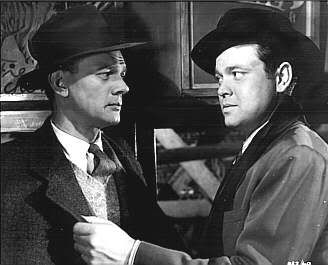
TCM are finally getting around to honoring Joseph Cotten as their Star of the Month; Cotten's movies will be airing every Tuesday in prime time in December. The first night of the retrospective looks at a number of the movies Cotten made with Orson Welles. The Third Man, from which the picture here is taken, will be showing up later in the month, as part of a night of Cotten mystery and suspense movies. Tonight, however, we get the well-known Citizen Kane at 8:00 PM ET, followed by The Magnificent Ambersons at 10:15 PM. A lesser-known movie that I'd like to highlight is Journey Into Fear, which starts just after midnight.

Cotten stars as a munitions expert in Istanbul for a conference. It's World War II, and the Nazis know that Cotten is here, and obviously want him dead! Of course, they try to kill him in Istanbul, and fail -- otherwise the movie would end forthwith. Cotten, having narrowly escaped death, is taken to the local police inspector (Welles), who decides that the best thing for Cotten to do is get out of the country. Welles promptly arranges passage on a steamer traveling across the Black sea from Istanbul to Batumi, in the friendly Soviet Union (this is World War II, after all); what happens thereafter is up to Cotten.

Getting on the ship is not the end of the story, either. Once cotten boards the ship, he is faced with the usual motley assortment of oddballs, one of whom is bound to have been sent there by his pursuers from Nazi Germany. Cotten eventually arrives in Batumi, and....

This is one the lesser-known movies Welles was involved in. It certainly isn't quite up to the level of some of the other things he did, but it's still an enjoyable movie to watch in its own right. It's only about 70 minutes, making it the perfect movie to watch on a cold, rainy or snowy night, when all you want to do it sit back with a bowl of popcorn and be entertained. It's got adequate suspense: even if it's not on the level of Hitchcock's Foreign Correspondent, it's still entertaining. It's also got Welles' fingerprints all over it, even if he didn't get directorial credit. The stars of his Mercury Theater appear in droves. Not only is there himself and Cotten; Ruth Warrick, who plays Cotten's wife, and Agnes Moorhead show up, too. Watch for Dolores Del Rio as the femme fatale about the steamer.

Monday, December 1, 2008

Dick Shawn, 1923-1987

TCM are spending today honoring director Woody Allen on his 73rd birthday. I'm not the biggest fan of Woody Allen's movies, so I'd prefer to spend the day honoring another birthday boy: the late Dick Shawn, who was born on this day in 1923.

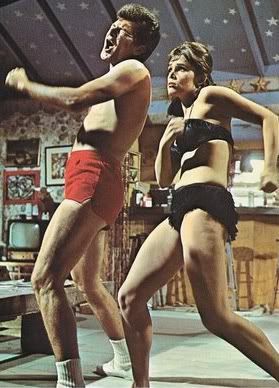
Shawn was a comedic actor who did more of his work on stage than in Hollywood, and as such doesn't appear in quite as many movies as one might like. He's seen in the picture at left in one of his classics, the beach-bum son dancing with his girlfriend in It's a Mad, Mad, Mad, Mad World, oblivious to the fact that his mother (Ethel Merman) is trying to call him to let him know there's $350,000 buried under that Big W. Eventually, of course, he hears the phone ringing, and when he finds it's his mother, he thinks she's in terrible danger, and transforms from a beach-bum into the ultimate mama's boy. There's a lot to recommend about It's a Mad, Mad, Mad, Mad World, but Shawn's character might just be the best.

However, it's not Shawn's best movie; that would probably be The Producers, where Shawn plays the actor hired by Gene Wilder and Zero Mostel to play Hitler in their sure-fire failure Springtime for Hitler. Shawn's portrayal of Hitler, drawing from the flower-child days of the late 1960s, is outstanding and probably the high point of the movie.

Another interesting movie of Shawn's, which unfortunately hasn't been released to video, is Way, Way Out, in which Shawn plays a Soviet cosmonaut stuck on a lunar base with his girlfriend, American astronaut Jerry Lewis, and Lewis' girlfriend. Shawn and Lewis are both way, way over the top, making for a movie that may not be so great, but is certainly intriguing.

Shawn's death is a sad one: he was performing in one of his one-man shows, doing a skit about being a politician, and how he wouldn't "lie down on the job". At this point, he suffered a massive heart attack and fell to the stage, leading the audience and crew to believe that he was in fact lying down on the job and this was the point of the joke. By the time that everybody realized this was no joke, it was too late, and Shawn eventually died of the heart attack.