Thursday, July 25, 2013

Oh, those evil suburbs!

I was born in 1972, so I'm too young to remember any of the things that were the formative experiences for all the Baby Boomers. That having been said, there's a good portion of the Boomers who seem to want everything looked at through a prism of what happened in the 1960s. One such thing is the continuing trope that the suburbia that grew up after World War II is nothing more than a conformist den of iniquity, and that anything that stands up and says "No!" to suburbia is somehow automatically virtuous. A good example of this would be many of the IMDb reviews of No Down Payment. The movie is airing tomorrow morning at 9:10 AM on the Fox Movie Channel (and will be getting repeat airings in August and September), so you can judge for yourself.

The movie starts off with young couple David and Jean Martin (Jeffrey Hunter and Patricia Owens) driving in their car over the freeways of southern California, and passing billboards advertising new housing developmens, since California was growing rapidly at the time. The couple, unsurprisingly, is moving into one of those developments themselves: David is a successful engineer; successful enough to move into the suburbs. Soon after moving in, the Martins meet their new neighbors: used car salesman Jerry Flagg and his wife Isabelle (Tony Randall and Sheree North); hardware store manager Herman Kreitzer and his wife Betty (Pat Hingle and Barbara Rush); and frustrated veteran who would be police chief Troy Boone (Cameron Mitchell), who's married to Leole (Joanne Woodward).

We see fairly quickly that suburbia isn't all that it's claimed to be, if indeed anybody ever tried to claim that sububria was this flawless place. Our new couple move in on a Sunday morning, and Mrs. Kreitzer is concerned because her husband would rather wash the car on Sunday than go with her and the two children to church! As if anybody would care about that today. Anyhow, the Kreitzers hold a barbecue that night and invite all three of the neighbor couples, which is where Mr. Flagg has too much to drink -- he always has too much to drink -- and practically propositoins Jean. Troy Boone, for his part, is still trapped in World War II, and wants to show off his shrine to his service that he keeps in the garage to Jean.

If you think that's all, you're not even close. The film hits some of the other social problems that were beginning to become more prominent in the late 1950s (No Down Payment was made in 1957) and especially the 1960s. Chief among these is racism, as Herman's Asian-American employee Iko (Aki Aleong) would like to live in their neighborhood since it's a lot closer to work, but there's that problem of his not being white. There's also the simmering issue of the Flaggs' not having any children.

There's a lot going on, almost as though director Martin Ritt had a checklist of issues he wanted to touch upon. The result is a film that's wildly uneven. Tony Randall and Sheree North both give good performances. His character is an alcoholic who doesn't want to be a used-car salesman, instead having wild get-rich-quick schemes that his wife knows are never going to work. She could love him and have a very nice life as a family who are never going to rise above middle class, so she's "resigned" herself to this fact. But her husband won't admit this, and Randall does a find job of portraying a man who's been beaten, but can't bring himself to acknowledge it. The low point are the Flaggs. Joanne Woodward was born in Georgia, and brings what is presumably her original accent to the role, but this only serves to make her sound, if not naïve, then something utterly unrealistic. Carmon Mitchell, meanwhile, is playing a character probably like what Dana Andrews' character in The Best Years of Our Lives would have turned into if Virginia Mayo hadn't left him and he hadn't found Teresa Wright. (Yes, I know Fred Derry didn't want to think about his medals. But once everything else in his life had failed, what would have been left for him?) The only problem is that Mitchell is terribly unsubtle, more or less shouting his way through the part and being a major irritant. The Martins and Kreitzers are almost ciphers, with their conflicts added in because Ritt needed to touch upon certain issues.

All in all, I personally find more not to like in No Down Payment than to praise. Reading the IMDb reviews, however, reveals several posters who seem to think the movie is great simply because it presents suburbia as a dystopia. Perhaps I shouldn't be quite so hard on the movie for its message, seeing as it was made back in the day: Martin Ritt might have been standing athwart history yelling, "Stop!", but he couldn't have been engaging in revisionist history as there was no history to revise at that point. The modern-day reviewers, or all those more recent movies looking back at the 1950s and 1960s, on the other hand....

No Down Payment has, as far as I know, not been released to DVD.

The Explosive Generation, now on DVD

I've twice given brief mention to the 1961 movie The Explosive Generation, starring William Shatner. The last time was on Shatner's 80th birtdhay back in March 2011. I didn't realize then that just a week later, it was going to get a MOD DVD release. It's also airing again on TCM, overnight tonight or early tomorrow morning at 4:00 AM.

Shatner plays Peter Gifford, a high school teacher teaching seniors a class about life skills: what the students are going to do after high school, since college wasn't so common back in those days; and how to make ones way in life. The students start asking him questions about... relationships, with the obvious implication that they want to know about the sex part of the relationship. Or, at least, how far is too far. Even though these are hormone-filled teenagers, they're not asking the sort of questions one would have asked of Dr. Ruth Westheimer a generation later. Shatner figures the best thing to do is to let them ask their questions in the form of anonymous essays.

The parents find out, and are understably unhappy, since they get the impression that their children are going farther than they should, and that Gifford might be encouraging it. So, they start a campaign to get Gifford suspended. The students, meanwhile, like Gifford and feel they can trust him. So when their parents try to get rid of Gifford, they rebel.

It's all very early-1960s stuff. What we think of as the rebellious, upheaval-filled 1960s, is I think really more down to the years after President Kennedy's assassination. So everything here is presented in a fairly tame way. Shatner, for his part, is more than good enough; he was really a capable actor before Star Trek came along. The kids are OK, although their rebellion is portrayed in a rather unrealistic way. The Explosive Generation isn't great by any standard, but it is an interesting time capsule.

Wednesday, July 24, 2013

Mel Brooks salute

Mel Brooks was honored last month by the AFI; I don't really follow those things. At any rate, TCM is following the AFI's lead and honoring Brooks with an entire night on the TCM schedule, althoguh it's only three movies. The rest of it is non-movie programming. That starts at 8:00 PM with the AFI tribute, which was recorded for TV and will be getting a repeat airing as well, at 12:30 AM. If TCM was showing a three-hour movie, having only one film between the two airings of the AFI tribute wouldn't be so bad. But, the one movie is The Twelve Chairs at 9:30, which only runs 94 minutes. In between is a re-airing of the Carson on TCM interview and a documentary on the "2000 Year-Old Man" routine. To be fair, though, the Carson on TCM piece is the sort of thing I would expect to show up as a time-filler the way the vintage one-reelers are.

The other two feature films are Young Frankenstein at 2:00 AM and The Producers at 4:00 AM, which will be followed by an interview Brooks did on the Dick Cavett Show. The Cavett interviews were the length of the entire program and not individual segments as on Carson, so it's a different type of interview.

I suppose part of the reason for there being so few Brooks movies on TCM tonight is that he did a lot of his stuff at Fox. TCM has been having more success at getting movies from Fox to show on TCM, which is a nice thing. Tomorrow night, for example, they've got The Prime of Miss Jean Brodie on which, like Young Frankenstein has been in heavy rotation on FMC in the past. TCM seems to be having more luck with Fox than with Universal, but not as much as with Columbia.

Tuesday, July 23, 2013

Gloria DeHaven turns 88

July 23 marks the 88th birthdy of actress Gloria DeHaven, who did some fine movie work in the 1940s, before going to TV and doing steady guest work for much of the rest of her career. One of her very first movies was as a teenage friend of Joan Crawford's daughter in Susan and God, followed by one of Lionel Barrymore's granddaughters in The Penalty, a movie which really deserves a fuller posting if only it were on DVD.

But MGM wanted DeHaven to be a musical star, casting her in several musicals in the 1940s and early 1950s, although one of the only ones in which she was actually the female lead would be Summer Holiday, the musical remake of Ah, Wilderness!. In Summer Holiday, she plays the girl opposite Mickey Rooney, so you could argue even here she wasn't really the star. I can understand why Gloria might have wanted to try TV if her movie career wasn't really going anywhere.

DeHaven's final film was 1997's Out to Sea, a gentle little comedy where she plays an older woman on a cruise who become the love interest of Jack Lemmon.

There's a "Word of Mouth" piece that appears on TCM in which DeHaven talks about washing her hair at MGM, and getting helped by Marlene Dietrich, who was making Kismet at the time; that help involved Dietrich pushing DeHaven's face down into the bowl of water, with DeHaven having no idea who was doing the pushing. DeHaven probably would have been making Step Lively at the time, as she isn't in Kismet. I haven't been able to find that "Word of Mouth" segment either in the TCM Media Room, or on Youtube, however.

Monday, July 22, 2013

The Story of Vernon and Irene Castle

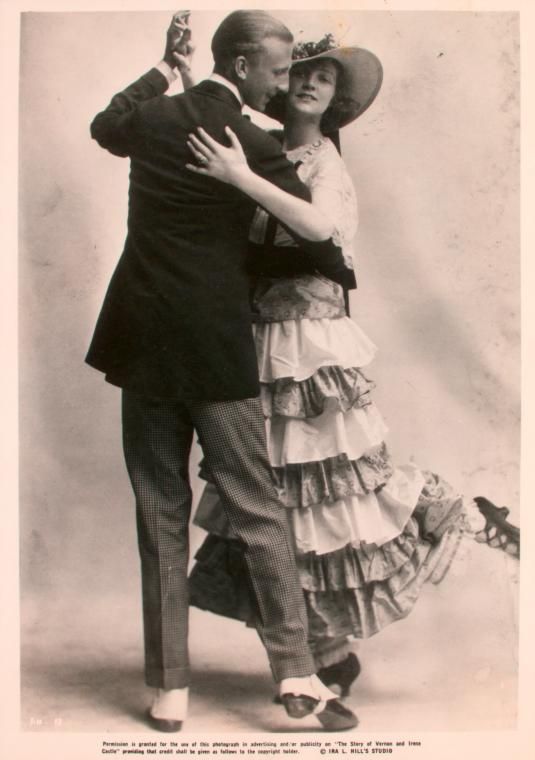
The last of the interviewees in this week's lineup of Carson on TCM is Fred Astaire, in an interview from 1973. TCM will then be spending the rest of the evening with films that Astaire made in the 1930s with Ginger Rogers, the two being such a famous screen team. The night ends with what was their last movie for ten years, The Story of Vernon and Irene Castle, at 5:00 AM Tuesday.

The movie is a biopic about the Castles, with Astaire playing Vernon and Rogers playing Irene. (The real-life Castles, not Astaire and Rogers, are pictured at left.) Vernon was a British-born comic who by 1910 was working as a second-rate vaudeville comic doing the tourig thing. His travels take him not to the big cities, but to smaller places like New Rochelle, NY, which is where he meets Irene, the daughter of a middle-class doctor. Things click between them, and eventually Vernon winds up back at Irene and her familiy's house, which is where she shows off her talent, which is a raw, untrained dance number. Vernon sees that Irene's got talent, and since the two love each other, they wind up getting married and trying to make it in the clubs as a couple doing their dance routine.

This eventually takes them to Paris, where they believe they've got a gig lined up at one of the famous nightclubs, although they're wrong; the manager wanted to see Vernon's comedy number. However, English agent Maggie Sutton (Edna Mae Oliver) is able to get them a chance at another of the nightclubs. This chance proves successful, as their dance, the Castle Walk, takes Paris by storm, with the Castles in demand everywhere, and women wanting to look just like Irene. (In real life, Irene Castle was a famous brunette and had her hair famously short; in the movie, Ginger Rogers keeps her blonde hair and keeps it long, which is one of the big departures from real life.) The two continue their fame and career together until 1914, which, if you know your history, you'll know is when World War I began.

I mentioned at the beginning that Vernon was British-born, so once World War I came he decided to support the British war effort, doing so by becoming a distinguished pilot. If William Wellman had directed a movie like this, he could have told you that World War I air action was dangerous, but amazingly Vernon Castle survived all of the dogfights, even winning a Croix de Guerre along the way. He was sent back to North America to become a flight instructor for the Americans, who had recently entered the war. Ironically, being out of the theater of action ended up being less safe, as Vernon was killed in a training accident. (I don't think I'm giving too much away, since this is a biopic.)

I'm generally not a big fan of musicals. The Story of Vernon and Irene Castle is different, though, because it's not so much a musical as it is a biopic about people who danced. As such, the dance numbers fit well into a realistic plot; one of the problems with other Astaire/Rogers movies is that the plots seem contrived at best, serving as a hook upon which to hang the dance numbers. Astaire and Rogers are both quite good; Oliver is enjoyable; and Lew Fields, who in real life was the star of the vaudeville review that led to Vernon's meeting Irene. Walter Brennan plays the Castles' servant, which is another departure from real life, as the Castles has a black servant. Irene Castle was a technical advisor for the film, and apparently didn't like some of the difference Hollywood made, such as the casting of Brennan or Rogers' keeping her natural hair. But for those of us today who don't know every little detail about the Castles, this isn't such a big deal. The main facts all seem to be more or less correct, and the ending scene is inentive.

TCM lists The Story of Vernon and Irene Castle as being part of an Astaire/Rogers DVD box set. I'm not certain if it's available individually.

Sunday, July 21, 2013

Mrs. Soffel

An interesting movie from the early 1980s that I didn't know much about until the last time it showed up on TCM is Mrs. Soffel. It's getting another airing today at 5:45 PM, and is certainly worth a viewing.

The titular Mrs. Kate Soffel is played by Diane Keaton. She's the wife in an upper-middle-class family in turn of the last century Pittsburgh, which is where her husband Peter (Edward Herrmann) is the warden of the penitentiary. Life for the Kate Soffels of the world circa 1900 was fairly constricting, as married women weren't expected to go out into the working world. At least, not the portion of the working world that involves making money; as I understand it upper-class wives had a lot to do with the charity sector. Mrs. Soffel's fulfilling work, such as it is, is to go go into the prison where her husband is warden and read the bible to the condemnded prisoners on the belief that faith in Jesus will set them free spiritually, if not on this world.

It's here that she meets the Biddle brothers, Ed (Mel Gibson) and Jack (Matthew Modine). The Biddles are unlike anyhting Kate has ever seen before, which makes me wonder how long Kate was doing her prison ministry. Ed is one of those charismatic evil types, and he doesn't believe in God; at least, certainly not God as envisioned by the Mrs. Soffels of the world. I mean, what sort of God would create a world like the one that led to the Biddles winding up on death row? They, of course, profess their innocence, and to be fair, the movie never really gets into whether the two are guilty of the crime for which they're in prison. Ed, meanwhile, takes a liking to Mrs. Soffel's physical presence, which is also understandable since it would have been a while since he had conjugal relations.

Eventually, Mrs. Soffel snaps. Ed suggests a plan for him and Jack to escape, but it's one that's going to require her help by smuggling in a hacksaw blade. Amazingly, she eventually agrees, and brings a blad into prison under all those pantaloons that made up women's outfits back in those days. All that restrictive clothing is apparently good for something. Ed and Jack eventually carry out their escape plan over the Christmas holidays, while Mr. Soffel is at the prison and the Soffel kids are away visiting relatives. They get out of prison and stop by the Soffel house on the prison grounds, where Ed asks Mrs. Soffel (who's home alone) to come with her....

Mrs. Soffel is an interesting story that's based on real events. As I mentioned years ago back when I discussed Girl With a Pearl Earring, one of the good things that came with the demise of the studio system was that period movies look much better, no longer being bound to the studio back lots. That's certainly true here, with a vintage prison building being used, as well as location shooting in Wisconsin and Ontario for the escape scenes. I have a feeling that Gibson and Modine are much too glamorous-looking to be prisoners from around 1900. I did volunteer work in a prison back when I was in college, and those prisoners looked nothing like Hollywood's portrayal of prisoners. But that's a minor flaw in an otherwise fairly good film.

Mrs. Soffel is, I think, out-of-print on DVD. It's another of those films where you can find it on Amazon, but not at the TCM shop.

Saturday, July 20, 2013

The Brain That Wouldn't Die

Coming up on TCM Underground tonight is one of those sci-fi/horror movies that were a staple of the late 1950s and early 1960s: B-levet best, and often so bad that they're actually a hoot to watch because you'll be laughing at how unbelievably bad the stuff is. This one is The Brain That Wouldn't Die, and is airing overnight at 3:15 AM.

Jason Evers plays Dr. Bill Cortner. He's a surgeon who, in his spare time, is working on ways to transplant human organs. Transplantation was in its infancy at the time the movie was made, with there never having been a heart transplant in real life. As such, there are people who would have had problem with such medical experimentation. Especially if it's not being done officially, the way that Dr. Bill is circumventing protocol. Among the people who aren't so sure of Bill's work is his girlfriend Jan (Virginia Leith). And if she isn't a fan of it now, she's really about to start developing problems with it!

Bill and Jan go off to the country for a weekend, but that weekend is cut short (no pun intended) when Bill crashes the car, and the accident results in Jan being decapitated! What's a good doctor to do? Well, one who's engaged in medical experimentation is certainly going to experiment. Dr. Bill comes up with a way to keep the decapitated head alive, which he does in a laboratory pan in his secret basement laboratory. Bill vows that he's going to find a body onto which he can put Jan's head.

Jan, unsurprisingly, isn't particularly happy with this. Where she had qualms about her boyfriend's medical experimentation before, now she's downright snarky about it. But then, if you were reduced to being stuck in a big metal pan in a basement laboratory, you'd probably be mighty irritated too. It doesn't help that Jan is surrounded by Bill's other experiments, which includes on in a locked closet. Jan also seeming starts to develop a bit of an aptitude for telepathy.

Meanwhile, Bill is looking for the body to which he'll attach Jan's head. The only thing is, he's not about to go looking through the morgues. Bill is much too pervy for that. Instead, he looks at models and the women working in "gentlemen's clubs" as we'd euphemistically call them today, trying to find a body that's sufficiently hot to go with Jan's head. It goes without saying that Jan isn't going to like it when she finds out what's really going on.

If the plot sounds ludicrous, well, it is. That fits in with the poor acting and the low-budget production values, however. Everything in The Brain That Wouldn't Die suggests that it should be a terrible movie. And yet, it's a lot of fun, in no small part because it's so terrible. As with many low-budget horror films, this one got a cheapie DVD release along the way.

Friday, July 19, 2013

Keep Jerry Lewis a quarter million miles away!

I've mentioned before that the Fox Movie Channel's programming philosophy seems to be one of taking movies out of the vault, running them a whole bunch of times over a period of a few months, and then putting them back into the vault. One that's in the middle of this process, having already recieved a half-dozen or more airinga over the past couple months is Way... Way Out. It's scheduled for two more showings over the weekend, at 11:40 AM Saturday (July 20) and 4:00 AM Sunday.

The scene is the US space agency, at some indeterminate point in the future. At least, the future as it would have been seen through mid-1960s eyes; the date would probably be in the past compared to 2013. The USA and the Soviet Union (remember them?) each have a base on the moon not too far from each other so that everybody can spy on everybody else. The Americans haven't been quite so successful with their lunar base, however. The problem is, they've been sending up a bunch of male astronauts, not having any female astronauts. The men wind up sex-starved. (With the film having been made in the 1960s, using a bunch of gay astronauts was not a realistic proposition.) In real life the Soviets had already launched Valentina Tereshkova into space, and they wanted the outward appearance of being advanced on sexual equality issues. So the Soviets don't seem to care whether a lone man and woman out in space decide to satisfy their physical urges by having sex.

The Americans, for their part, aren't so comfortable with such things. The space agency brass decide that, if they're going to send a man and a woman to the moon, the two had better be married so that it'll be OK when they have sex. Of course, there are problems with that. The astronaut next in line to go to the moon, Pete Mattemore (Jerry Lewis) isn't married. And, apparently, either none of the astronauts are married, or they're all deemed unsuitable for a long-term stay on the moon with their wives. (To be fair, having to train a wife for a space mission would be difficult, and if they have children, there's another big complication; see Capricorn One.) So what's a space agency to do? How about finding a wife for Pete, and sending the two of them up to the moon. With that, Pete gets put into a marriage of convenience with Eileen Forbes (Connie Stevens) and the two are put on a lunar rocket.

Once on the moon, Pete and Eileen meet their Soviet counterparts, Igor (Dick Shawn) and Anna (Anita Ekberg), and in the interests of comity and friendship between nations try to develop a good relationship with their colleagues. But there are more complications. One is that there's still a cold war back on earth, so the Americans and Soviets are officially not supposed to be too friendly with each other, as they're ostensibly trying to secure the moon for their own purposes. (The movie was made before the Outer Space Treaty was ratified, and even if it had been made after, I don't think you could expect the filmmakers to know about a treaty like that.) The other complication is that the Soviet cosmonauts have some rather interesting views on human relationships....

Way... Way Out is a Jerry Lewis movie, so you should know from the start at least part of what to expect. That having been said, he's nowhere near as good as in The Bellboy, but not nearly as irritating as in some of his other comedies. Everything else is stuck firmly in the 1960s, but since it's a film actually made in the 1960s, that's to be expected. I'm not much of a fan of current-day looks back at that turbulent time, but movies actually made then can be quite entertaining. Way... Way Out does entertain at times, and will probably entertain more if you're a Jerry Lewis fan.

I'm not sure whether it's available on DVD here in the States. Amazon lists a streaming video option and an imported DVD from Europe.

Thursday, July 18, 2013

Repeats I should have mentioned

TCM's morning and afternoon schedule for tomorrow (July 19) is baseball movies, which I suppose is appropriate considering that Major League Baseball's All-Star break will be ending. Anyhow, among the movies airing is Death on the Diamond at 9:15 AM, which I last mentioned back in December 2010 when Mickey Rooney was Star of the Month. It still doesn't seem to be available on DVD, which is why I should have mentioned it earlier in the day.

Also airing tomorrow, although it's not baseball related, is Cruise of the Zaca, which I mentioned a week and a half ago. I hadn't seen it then, so my description is partly wrong. It wasn't filmed in the South Pacific, but along the coast of Mexico and in the Caribbean. Still, it's worth a watch if you missed it last time. It's coming up at about 5:40 PM, just after the 1951 version of Angels in the Outfield, which is on at 4:00 PM.

TCM Guest Programmer: Frank Rich

This month's TCM Guest Programmer, New York Times columnist Frank Rich, sits down with Robert Osborne to present four of his favorite films, and that session is airing tonight. (So, for once, Robert Osborne is back on Thursday.) Anyhow, Rich's four selections are:

The Palm Beach Story at 8:00 PM;
The 1962 version of The Manchurian Candidate at 9:45 PM;
Jean Renoir's 1939 movie Rules of the Game at midnight; and
Petulia at 2:00 AM.

I have to admit that I've never seen Rules of the Game before. I'll also be curious to see to what extent Rich waxes political in his introduction to The Manchurian Candidate.