Tomorrow is the first day of a new month, which means TCM is going to have some new programming salutes, at least once 31 Days of Oscar ends on Sunday: we'll finally get back to having a new Star of the Month and a new season of The Essentials. Before that, however,the Fox Movie Channel is taking a few movies out of its vault that they haven't shown in years. Two of them show up tomorrow, and immediately get repeated on Saturday. The first of these is Five Weeks in a Balloon, which you can see at 9:00 AM tomorrow on FMC, with a repeat at 6:00 AM Saturday.
Based on the novel by Jules Verne, Five Weeks in a Balloon stars Cedric Hardwicke as Ferguson, a Victorian-era balloonist who has invented a new type of balloon that allows for more lift and can stay in the air longer. He's about to take it out for a test flight in the British East African colonies, but Mother England is calling. Apparently there's slave trading in the interior of West Africa (which was mostly French, but don't let that plot hole stop you) that the British government needs to put down, and apparently Ferguson's balloon is the quickest way to get there unnoticed. So, could Ferguson take along a British agent Sir Henry (Richard Haydn)? Also along for the ride is an American journalist, Donald O'Shay (Red Buttons), Barbara Eden as a teacher, and Canadian Jacques (Fabian).
So they head west, and the crew meets with the sorts of adventures you'd expect from a Hollywood movie about Africa, which means stereotypes galore, along with establishing shots. That, and the standard squabbles among the various people in the balloon, and problems with the balloon. Along the way, they pick up slave trader Ahmed (Peter Lorre, looking corpulent and sickly), who's got a woman of his own in tow (Barbara Luna, clearly there as eye candy).
The result of all this is thoroughly mediocre, albeit not without its interesting points. Fabian was clearly cast because the producers thought he'd appeal to the teens, as he'd already been a teen idol a few short years earlier. Bu the same token, the two Barbaras, Eden and Luna, are clearly there to appeal to another segment of the demographic. And the whole plot, being taken from the Jules Verne novel, is something you'd have to think would appeal to kids, at least boys interested in adventure novels. Adults with a discerning eye will get to laugh at the bad parts of the movie, including some truly awful dialog. As Peter Lorre exclaims, "Kismet! We are doomed!" You might unfairly think the movie is doomed, too. At least, you might if you're looking for something more than dated escapist fare.
Five Weeks in a Balloon received a DVD release several years ago, but I'm not certain if it's still in print.
Thursday, February 28, 2013
Five Weeks in a Balloon
Posted by
Ted S. (Just a Cineast)
at
7:49 AM
0
comments
Labels: Fox, Peter Lorre
Wednesday, February 27, 2013
The Fallen Idol
Another wonderful movie I've been meaning to blog about each time it shows up on TCM, but never got around to doing before, is The Fallen Idol. It's received a DVD release courtesy of the Criterion Collection several years ago, but it seems to be out of print and ridiculously overpriced. It's coming up again tonight at midnight (ET; that's late this evening for those of ou in North America's more westerly time zones), so this would be a good chance to get it.
Philippe (Bobby Henrey) is the son of an Ambassador to the UK, living in the embassy quarters on one of the upper floors in what looks like rather luxurious circumstances. But, it's really more of a gilded cage. Mother is ill; and father has all his duties to carry out while also returning home to see to his wife. So Philippe has been left, more or less, in the care of the butler Baines (Ralph Richardson) and his wife (Sonia Dresdel). Mr. Baines is wonderful to Philippe, and Philippe in his turn idolizes Baines. Mrs. Baines, on the other hand, is the disciplinarian of the pair, not letting Philippe have any joy in life, or so he thinks.
The Bainses also have a complicated relationship. It's not a very happy marriage, and Mr. Baines has met and fallen for Julie (Michèle Morgan), who is one of the secretaries at the embassy. Mrs. Baines suspects that there's something untoward that her husband is doing, and dammit, she's going to prove it. She even goes so far as to stand on what is more or less an inside ledge to try to spy on her husband. Unfortunately for her, this results in an accident that results in her falling down the grand staircase to her death.
Mr. Baines and Julie don't know the truth of what happened, and fear that the police are going to conclude that he pushed his wife to her death. Philippe, meanwhile, saw Mrs. Baines' fall, but believes that perhaps Baines did it. The two adults try to come up with an alibi for themselves, and try to get Philippe in on their alibi as well. But this presents another problem in that Philippe is such a liar (reminiscent of Bobby Driscoll's character in The Window) that his lies to the police only serve to get Mr. Baines in deeper trouble. Will the real truth come out?
Ralph Richardson is quite good as always. Supposedly Bobby Henrey couldn't act well, to the point that director Carol Reed had to shot lots of footage of his character, until he got the reaction that he wanted, at which point he'd use the best reaction in the final edit. If that's the case, Reed and his editor did a fantastic job, as it never really intruded upon the movie the first time I saw it, leaving the story to develop naturally.
Posted by
Ted S. (Just a Cineast)
at
2:01 PM
0
comments
Labels: British
Early Color Shorts
TCM has a couple of shorts on today's lineup that ar OK, but more interesting for the fact that they're among the earliest live-action shorts in the three-strip Technicolor process.
The first of them is La Cucaracha at about 7:35 PM, just after That Hamilton Woman. You probably recognize the title as that of a Mexican-sounding children's song, and in fact the song features prominently in the short. The plot, which is a bit wanting, involves a female singer and her male dancer partner in a Mexican club who are visited by a producer from the big time who is looking to sign the dancer, and only the dancer, to a bigger gig. The singer obviously is afraid of losing her partner, so she tries to sabotage things. You can probably guess what happens next. The print I remember seeing on TCM some years back wasn't quite as good as prints of some other early three-strip shorts. The short has been included as an extra on an out-of-print DVD of the Wheeler and Woolsey movie Dixiana. It also appears to be on Youtube.
The second short is La Fiesta de Santa Barbara, at 5:35 AM after The Private Life of Henry VIII. This one has even less of a plot; it's a bunch of Hollywood players -- some stars and some not-yet-stars -- celebrating a fiesta in Santa Barbara with a bunch of novelty performance. Andy Devine is part of a bullfighting bit with, I believe, Buster Keaton; Warner Baxter, Robert Taylor, and Gary Cooper show up in the audience. Ida Lupino wasn't a star yet, but she shows up as a cowgirl. Really. The short is probably best known for Judy Garland and her sisters singing "La Cucaracha". Multiple people have posted this one to Youtube. There's a version split into two parts, and one that seems to be in its entirety, although a caveat is that I didn't watch the Youtube videos at any of the links.
Posted by
Ted S. (Just a Cineast)
at
7:31 AM
0
comments
Labels: Buster Keaton, Early Color, Judy Garland, Short
Tuesday, February 26, 2013
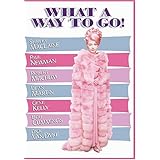
What a Way to Go!
What a Way to Go! is airing tomorrow morning at 8:00 AM over on the Fox Movie Channel.
Shirley MacLaine stars as Louisa, a woman who at the start of the movie wants to donate all of her wealth to the US Government. The IRS thinks she's crazy, and send her to a psychiatrist, Dr. Stephenson (Bob Cummings) to have her head examined. (In real life, the government actually has an address for those who want to make donations to the Treasury. I don't think they would have turned her down. But then we wouldn't have much of a movie.) It turns out that she's a widow worth a good $200 million, left to her by a series of husbands who died. So, obviously, we're about to have a flashback to how Louisa became wife to all these men and how they left her that fortune....
Louisa spent her childhood in one of those typical for the movies Midwestern towns, with a mother (Margaret Dumont) who claimed to follow the Christian precepts about the love of money being the root of all evil and all that stuff. In fact, she was a hypocrite, berating her husband for not being financially successful and recommending that Louisa get married to the man pursuing her. That man is Leonard Crawley (Dean Martin), who owns the local department store and making a fortune because none of the other stores in town can compete. Louisa doesn't like him, and instead falls for Edgar Hopper (Dick Van Dyke), who owns a not very successful store but is happy with the simple life. That is, until he marries Louisa. For a while they live happily together, like in one of those old silent movies, but when he gets humiliated by Crawley one time too many, Edgar gets the idea that he needs to provide better for Louisa, and proceeds to start working. He works and works and works, which makes Hopper's a successful business to the point of driving Crawley's out of business, but it takes all of his time away from him so that he's only at his job and never with Louisa. In fact, all of this work will be the death of him, as he drops dead on the job, leaving Louisa with a couple million dollars.
Louisa puts the money in a bank, living off a small allowance which she uses to take a trip to Paris. There, she meets Larry Flint (Paul Newman), who doesn't do porn but is instead a starving artist who, like Edgar initially was, is happy with his station in life. Louisa, seeing this as a change from Edgar, makes Larry Husband #2. You can probably guess what happens next. A series of coincidences leads to Flint's art being shown at a fine gallery and made the toast of Paris, which means that Larry gets rich too, just like Edgar. However, it also means that he has to spend more and more time with his art and not with Louisa, which, as with Edgar, eventually leads to his untimely death, but also leaves Louisa with more millions.
At the airport on the way back to the States, Lousia meets the man who is about to become Husband #3, Rod Anderson (Robert Mitchum). Rod is already rich, which is obviously a turnoff to Louisa. But you know that they're going to get married anyway. In fact, once Rod and Louisa marry, Rod becomes less interested in his business and more in lavishing Louisa with whatever she wants. Of course all this backfires, and Rod eventually dies young too. Ditto Husband #4, Pinky (Gene Kelly) a failed nightclub actor who's only got a job because his act is a failure -- that is, until Louisa unwittingly does something to make it a success. Pinky then goes on to become a big success until he too dies, which takes Louisa to the present day, back to Dr. Stephenson's couch.
What a Way to Go! is advertised as a black comedy, and while there are certainly a lot of comic elements, both black comedy as well as parody, the movie is just as much a fantasy in that the lives with the four husbands are thoroughly unrealistic and presented that way. Louisa describes each of the four marriages as being idyllic, like a certain genre of movie. I mentioned the silent movie for Edgar; there's also a French movie for Larry, one of those lavish 1950s Technicolor dramas with Rod; and a musical (choreographed by Gene Kelly, of course) with Pinky. The movie-within-a-movie for her marriage with Rod is particularly fun, as Louisa is shown in dress after dress after dress, which are increasingly over the top in their frilliness and garish colors.
Does the movie work? For the most part yes, as long as you know what you're in for. There are times when the comedy is just a little too wacky. But if you know that there's parody coming in spades along with the homages to filmmaking of the past, the movie does a good job with those things. MacLaine and Van Dyke both do a good job acting in the silent movie style; Newman and Mitchum do well as a foil for all the comic stuff going on around him, while Kelly is more or less playing himself. There's nothing deep about the movie, but it's entertaining enough.
What a Way to Go! has receieved a DVD release, but I'm not sure if it's still in print.
Posted by
Ted S. (Just a Cineast)
at
8:36 AM
0
comments
Labels: Bob Cummings, Fox, Paul Newman, Robert Mitchum, Shirley MacLaine
Monday, February 25, 2013
I really need to start numbering these "briefs" posts
I noticed in the opening credits to In Cold Blood, which aired today, that one of the credits reads "Print by Technicolor". Of course, In Cold Blood was filmed in black and white, and a very good job of B&W cinematography it was. There's actually a reason for that, as mentioned in an article at Reel Classics. What w think of as the brilliant Technicolor movies from the late 1930s through the 1950s were produced using an "imbibition" process, roughly filtering the negatives through several sets of dyes. Less expensive printing processes care around in the 1950s, and apparently the Technicolor company made prints even for some black and white movies.
I never knew any of the Joe McDoakes shorts were nominated for an Oscar, but apparently one was, as TCM is showing So You Want to Be on the Radio overnight tonight at 12:19 AM, or just after Dead Poets Society.
Iran is complaining that the Academy selected Argo as this year's Best Picture, calling it politically motivated. If the Academy were that politically motivated, you'd think they would have nominated Ben Affleck for Best Director too. I suppose the Iranian government should be comforted by the thought that some of the Americans who dislike Iran the most were probably irritated by the fact that Michelle Obama was the person who announced the winner. Politics makes strange bedfellows, indeed.
Posted by
Ted S. (Just a Cineast)
at
2:26 PM
1 comments
Sunday, February 24, 2013
Divorce American Style
About a month ago, TCM ran Divorce American Style as part of a salute to actor Dick Van Dyke on getting the Screen Actors' Guild (I think) lifetime achievement award. The movie has received a DVD release, but it seems to be out of print based on the ridiculous price Amazon is asking, as well as TCM's on-line schedule not listing it as available for purchase from their online shop. It's receiving another airing on TCM tomorrow morning at 6:30 AM.
The movie starts off with a montage of couples bickering in their suburban tract housing, because, well, that's what American middle-class married couples do. Cut to one particular couple, Richard and Barbara Harmon, played by Dick Van Dyke and Debbie Reynolds. They hold a dinner party for their friends one night, but things don't go well, because afterwards, the two wind up at each other's throats as they clean up and then get ready to go to bed. Their adolescent son Mark (Tim Matheson in his movie debut) has obviously heard this all before, as when he hears the argument through the ventilation ducts, he's got a checklist of the things Mom and Dad use against each other.
What's a bored housewife to do? Barbara goes to her therapist, who has gotten Richard to agree to come in to one of the appointments in an effort to patch up the relationship, but that doesn't work, at which point Barbara calls her lawyer cousin who suggests a separation. Separation turns into divorce, with Barbara getting the house and everything in alimony, leaving Richard with the princely sum of $87.50 a week. Trying to put together the pieces of his life, Richard meets divorcée Nancy Downes (Jean Simmons). She's on relatively good terms with her ex-husband Nelson (Jason Robards), and likes Richard. This is wonderful for Nelson, since he'd love to see Nancy get remarried: there go his alimony payments. Of course, there's a problem wih the fact that even if Richard gets remarried, he still has to pay alimony. The only way he can get out of alimony is if Barbara remarries.
So, Nelson and Nancy immediately proceed to try to find a suitable husband for Barbara. Eventually the see an advertisement from used-car dealer Al Yearling (Van Johnson), whom Nelson had tried to hook up with Nancy, except that Al had a mother he was looking after. Mom has since died, so that means Al would quite possibly be good for Barbara, if the two can hit it of together. So, it looks as though everybody is going to live happily ever after: Richard with Nancy; Barbara with Al; and Nelson with his fiancée. Or will something come about to prevent the various couples from hooking up this way?
Divorce American Style has some potential. Parts of it come across as reminiscent of The Awful Truth, as you -- and Barbara and Richard -- wonder whether it was such a good idea for the two of them to get divorced in the first place. But this is not meant to be a screwball comedy; instead, it's trying to be more like a Paddy Chayefsky dark comedy. And there are times where that works too, as in the opening montage. There's also a very well choreographed sequence in the bank, when both Richard and Barbara have been advised by friends to clean out the joint bank account and remove the contents of their safety deposit box. Both go to the bank at the same time, with one going to empty the safety deposit box and the other going for the bank account, neither ever noticing the other.
Ultimately, though, Divorce American Style comes across as a bit of a mess; not quite sure of what it really wants to be. There's also something about the movie that seems firmly dated in the 1960s as opposed to The Awful Truth or Chayefsky's The Hospital or Network, all of which come closer to timeless. Debbie Reynolds comes across as a bit unappealing; the relationship between Nelson and Nancy seems a bit hard to believe; and the movie resolves its problems in a way that seems decidedly like a deus ex machina. It's a bit odd that the movie winds up as a mess, considering how much talent there is in it. In addition to all the actors, the screenplay was written by Norman Lear, while the director is Bud Yorkin: two men who went on to achieve great success together with the TV show All in the Family.
Posted by
Ted S. (Just a Cineast)
at
1:29 PM
0
comments
Labels: Debbie Reynolds, Jason Robards, Jean Simmons, Van Johnson
Saturday, February 23, 2013
The Man Without a Country
I've mentioned on a couple of occasions that Warner Bros. made a number of two-reel shorts in Technicolor in the second half of the 1930s with themes from US history. Along the same lines is The Man Without a Country, airing tomorrow morning at 9:08 AM, right after The Guns of Navarone.
John Litel stars as Lt. Philip Nolan, the man who gets stationed on the US frontier and, believing it to be a backwater, takes up with Aaron Burr, who after having killed Alexander Hamilton in the duel, was part of a conspiracy that may or may not have plotted against the US. Lt. Nolan gets tried for desertion, and says he doesn't want to hear about he United States any more. So the authorities humor him by putting him aboard navy ships for the rest of his life, where the crews are forbidden from talking about the US to him.
What's more interesting is that John Litel shows up in several of these WB shorts. I believe TCM showed Give Me Liberty a week or two ago, in which Litel plays Patrick Henry. There's also 1938's The Declaration of Independence, in which Litel makes an appearance as Thomas Jefferson. Sadly, I haven't been able to find any of these on Youtube.
Posted by
Ted S. (Just a Cineast)
at
2:54 PM
0
comments
Another Old Movie Blog
Yesterday, when I was looking for photos of Nacio Herb Brown, one of the photos was on a blog that hasn't been updated since last August. The blogger, however, had as part of his blogroll a blog calling itself Another Old Movie Blog. As of this writing, her latest post is a very good one on Resisting Enemy Interrogation, a training film made by the First Motion Picture Unit to try to show the devious techniques Nazis would use in their attempts to glean vital information from American POWs. There are a lot of Hollywood actors to watch out for.
I briefly mentioned Resisting Enemy Interrogation last Memorial Day weekend, and commented that it wasn't even available on Youtube. (Having been made by the government, it's in the public domain.) Jacqueline over at Another Old Movie Blog, however, kindly points out at the end of her post that it has now been posted to Youtube, something which only happened a few weeks after my post from last May.
At any rate, Jacqueline's blog is interesting, so I've added it to my blog roll.
Posted by
Ted S. (Just a Cineast)
at
7:56 AM
1 comments
Labels: administrative
Friday, February 22, 2013
Nacio Herb Brown, 1896-1964
Nacio Herb Brown (center, seated at the piano) flanked by Marion Davies and Arthur Freed
Today marks the birth anniversary of composer Nacio Herb Brown, who was born on this day in 1896. He started his career on Broadway in the 1920s, but when sound came to moving pictures, the studios needed not only people who could talk well on screen, but people who could make music for the screen. So Brown wound up at MGM in 1928, where he promptly wrote music for songs that showed up in MGM's two big hits of 1929, The Broadway Melody and The Hollywood Revue of 1929 (IMDb claims Brown shows up playing the piano in one number in this one); the lyrics, of course, were written by Arthur Freed. Probbaly the most famous song from The Broadway Melody might be "You Were Meant For Me", while from The Hollywood Revue of 1929 it's definitely "Singin' in the Rain".
Brown and Freed went on to write a whole bunch of songs together during the 1930s and 1940s. If I had to pick one song from this era that people might be most likely to remember, I think I'd pick "Good Morning", which premiered in 1939's Babes in Arms performed by Judy Garland and Mickey Rooney. "Good Morning", like "Singin' in the Rain" are remembered, of course, because of the Freed unit at MGM deciding to make the musical Singin' in the Rain, which was conceived as a way to reuse those great old songs by Brown and Freed.
Posted by
Ted S. (Just a Cineast)
at
7:50 AM
0
comments
Thursday, February 21, 2013
Seven Days in May
Burt Lancaster and Kirk Douglas in Seven Days in May (1964)
Another movie that I have surprisingly never blogged about before is Seven Days in May. It's showing up overnight tonight at 2:15 AM on TCM, so now would be a good time to blog about it.
The movie starts off with scenes of people picketing outside the White House for and against President Jordan Lyman (Fredric March). It seems as though he's negotiated a controversial nuclear disarmament treaty with the Soviet Union, and gotten it through the Senate, with the result that it's had a disastrous effect on his popularity. Apparently, the people who opposed the treaty believe that the Soviets won't honor it. To be honest, the premise may be a plot hole, in that there would have been a very low chance of ever getting a treaty like this through the Senate, since a lot of the Senators would rightly understand that it would get them voted out of office. They, after all, can see how unpopular this is making the President. But ignore that gaping plot hole, and you're in for a pretty entertaining movie.
Anyhow, after the establishing scene, we meet our two other main characters. Col. Casey (Kirk Douglas) is the adjutant to General Scott (Burt Lancaster), who is presumably on the Joint Chiefs of Staff. Casey, in his job, sees some odd things cross his desk. First is a betting ring on the Preakness Stakes; there's talk of odd troop transfers and a base in Texas; and something called "Ecomcon", which is obviously an acronym for something, and whatever that something is, it's got to be nefarious. Col. Casey decides to do some discreet investigating, and he discovers enough to realize that there is indeed something serious, and that General Scott is trying to keep him in the dark. Eventually, Col. Casey suspects that the generals are planning a coup for the coming Sunday, and that the President is obviously in grave danger!
What's a colonel to do? Good loyal American that he is, he goes to a commanding officer. No, not his own commanding officer in the form of the General, since that would give the game away, but the Ultimate Commanding Officer, the Commander-in-Chief himself. The President and his advisers himself are obviously reluctant to believe that there could be a coup being plotted, since this means there are some serious consequences. But, they're not imprudent, and they decide to do some subtle investigation of their own, as well as taking steps to ensure that President Lyman won't be where the generals can keep him hostage. One presidential aide gets a confession from an admiral who is now stationed off Gibraltar, but unfortunately he's killed in a plane crash trying to return from Spain. Another Lyman supporter, Senator Clark (Edmond O'Brien) goes to Texas to investigate the new base, and gets held on a trespassing charge. It's becoming more and more clear that there is a coup being planned, but can the President and his advisors prevent it?
There's one other thing that could stop it, which is indiscretions on the part of General Scott. It turns out that he had had an affair with socialite Eleanor (Ava Gardner), and that she's got a bunch of love letters that, if they were ever made public, would doom the General. Col. Casey knows Eleanor, and tries to get the letters for her, even though it's going to mean possibly ruining the friendly relationship he has with her.
Seven Days in May is a movie that is immensely engrossing and entertaining, set against the unsettling unasked background question of whether any plot like this is possible in the real America. Just consider how many people believe in nonsense conspiracy theories about the assassination of President Kennedy, or the birth certificate stuff about Barack Obama, or the phony documents about George W. Bush's National Guard service. With the exception of hanging all the events on the hook of a treaty that I think would never have gotten passed by the Senate, the story is well-done, and the cast is uniformly excellent. Career supporting actor names I haven't mentioned are Martin Balsam as the aide who dies in Spain; John Houseman as the admiral from whom Balsoam extracts a confession; and Whit Bissell as a senator who seems in on the machinations of the generals.
Seven Days in May is part of a Burt Lancaster box set that the Warner Archive put out.
Posted by
Ted S. (Just a Cineast)
at
8:18 AM
0
comments
Labels: Ava Gardner, Burt Lancaster, Fredric March, Kirk Douglas