Showing posts with label Alec Guinness. Show all posts

Friday, February 20, 2026

Lawrence of Arabia

It may be a surprise, but one of those movies that I never sat down to watch all in one go, largely because of the length, is Lawrence of Arabia. Partly for that reason and partly because of my reluctance to do posts on extremely well known movies, I've never done a full-length post on it here. But to rectify that, the last time it showed up on TCM, I recorded it in order to be able to watch it in advance of the next showing. That next showing is tomorrow, February 21, at 11:30 AM as part of a day devoted to epics.

Peter O'Toole stars as T.E. Lawrence, and as the movie opens, he's riding his motorcycle to his death in England in the mid-1930s. His was a well known name, so a lot of people gather for the funeral, and a couple, such as reporter Jackson Bentley (Arthur Kennedy), basically intimate that Lawrence was an SOB, but our SOB. Since Lawrence is dead, we're obviously going to get a flashback to when he was alive.

The scene shifts to 1916/1917, which is smack dab in the middle of World War I. Britain is one of the Allies while the Ottoman Empire are one of the opposing Central Powers. The Ottomans are Turks, but a fair amount of the territory they govern is Arab, such as the Hejaz which is now a province on the Red Sea coast of Saudi Arabia. Prince Faisal (Alec Guinness) is one of the potentates who is leading an Arab revolt against the Turks, and the British realize supporting the Arabs is a good way to destabilize the Ottoman Empire. They've already got an advisor there in Col. Brighton (Anthony Quayle), but aren't certain of what the situation is really like, so they want to send a second man in Lawrence, an army lieutenant (ultimately promoted to colonel) who speaks Arabic and has good knowledge of the region, to get more information.

Lawrence is supposed to meet Faisal, but first meets Sherif Ali (Omar Sharif), who will take Lawrence to where Faisal is. However, along the way, Ali and his men run into Auda Abu Tayi (Anthony Quinn), who is from a different tribe from Ali. Sadly, the two tribes have a blood feud that threatens to derail the whole uprising until Lawrence puts it to rest by carrying out an execution himself. Worse, he finds that he doesn't dislike killing people. In any case, the result of this is that many of the Arabs act like they've got a lot of respect for Lawrence.

Lawrence's plan is that the Arabs should attack the port city of Aqaba, now at the southern tip of Jordan. Of course, the port is well defended, but only from the sea, since on the other sides lies a desert that's thought to be impassable. Except that Lawrence figures they can cross it and surprise the Ottomans that way, which works. It brings Lawrence more glory, but to go any further he's going to have to get more help from the British back in Cairo.

The British seem none too pleased that Lawrence looks as though he's going native, as it were, and supporting the Arab desire for total independence which would clash with what the British and French have decided should be done with the Middle East after the defeat of the Ottomans. The Arabs, for their part, are looking to get to Damascus, while General Allenby (Jack Hawkins) of the British will be going to Jerusalem as that area even during the 1910s had a substantial Jewish population. (Not every Jew had left in the various diasporas, while Zionism had begun with some European Jews already moving to the region, which south of Beirut had a fairly sparse population.)

Lawrence keeps attacking, but there's some question of whether he's getting too big. Also, there's the question of whether the Arabs are going to be able to govern anything modern if they do take Damascus. The leaders of the revolt are tribal and suited to desert warfare, but Damascus is a fairly modern city. They could easily use western engineers, but that might keep them from being truly independent.

It's easy to see why Lawrence of Arabia won so many Oscars. The acting is quite good, as is the cinematography and other parts of the production design. Maurice Jarre's musical score is also memorable. However, I'd have to say that Lawrence of Arabia is another of those movies where, while it's very good, I'm not certain I agree with it ending up near the top on lists of all-time great movies. The movie runs over three and a half hours plus the intro/entr'acte/exit music; the print TCM ran is 227 minutes. And frankly, in the last hour or so the movie really loses steam. Some historians take serious issue with some of the ways history is presented here. Certain of the characters are composites (such as the diplomat played by Claude Rains), a movie which is often necessary when trying to distill a story like this down to a reasonable length, but apparently some of the timeline is wrong and the movie glosses over Lawrence's knowledge of the region before the war.

Sunday, January 12, 2025

The Promoter

A movie that I think I briefly mentioned a couple of times in conjunction with planning to record it on my DVR is an early Alec Guinness movie from his native UK called The Card. IMDb and Wikipedia both say it was retitled The Promoter for its first American release, but the print TCM ran was titled The Card. The last time TCM ran it, I finally got the chance to record it, and recently watched it.

Alec Guinness plays Denry Machin, although as the movie opens we don't see Guinness because the opening scenes are with Denry as a child. Young Denry is an average at best student, but he's able to get access to the report cards to change his grade to something much better. This allows him to get accepted to the sort of school when where the scions of better families attend, although obviously not actual upper-class Britons since the movie is set at the turn of the last century when Britain's class structure was even more rigid than it is today. Poor Denry is the son of a washerwoman, and worse, one who seems happy with her lot in life and has no desire to have a life of luxury and convenience In any case, once Denry graduates from school, he gets a job working as a clerk for the solicitor Duncalf, which is where we first meet Guinness as the adult Denry.

On one of his first days at the job, the Countess of Chell (Valerie Hobson) comes in. She's engaged Duncalf for the job of sending out admissions to the big charity ball, something which is strictly by invitation only and something to which a man of Denry's station is never going to receive an invite. However, Duncalf has Denry fill in and address all the invitations, a job that should keep him up half the night. Denry ends up with several invitation blanks, and decides to use one to send himself an invitation. Since it's an invitation ball, he's going to need learn how to dance, and goes to the dance school run by Ruth Earp (Glynis Johns), albeit not successfully. However, the two begin to develop a romantic relationship.

Denry gets fired from his job with Duncalf for his stunt, but taking this sort of initiative gives him ideas, as he gets himself hired into one job after another that requires a person with the sort of go-getter attitude that I get the impression was decidedly frowned upon in the Britain of the era. Denry eventually becomes reasonably wealthy and offers some of his money to his mother, but she feels like it's somewhat ill-gotten, and besides, she couldn't stop working as that would be immoral. The relationship with Ruth begins to go a bit sour, but she's got a lady's companion in Nellie (Petula Clark), who also likes Denry, although she too isn't from the highest class of family.

The Card is yet another of those movies where you see the basic idea and the source material (it's based upon a novel from 1911 that I haven't read), and you can obviously understand why filmmakers would believe there's a good story here. However, something in the making of The Card doesn't go quite right. I think it's that the screenplay makes Alec Guinness' character out to be a bit too much of a grasper when the material really calls for lighter comedy. I'm not quite certain, however, how the screenplay could square that circle.

Still, all of the cast do a a professional job, and it's nice to see all the location shooting, even if it's all in black and white. The Card isn't a bad movie; it's just a bit of a shame that it's not quite up to the level of some of Guinness' other work from this era.

Monday, December 2, 2024

Catholic boy meets Catholic girl

Another of the movies that I have on my DVR which is getting another airing soon on TCM is A Majority of One. That next airing comes up tomorrow, December 3, at 10:00 AM.

In late 1950s brooklyn, Bertha Jacoby (Rosalind Russell) is a Jewish widow living in Brooklyn and displaying all of the stereotypes Hollywood had about Jewish mothers in those days. Her husband died some time back while her adult son was killed in action in the Pacific theater of World War II. She's got an adult daughter, Alice (Madlyn Rhue), who is married to Jerry Black (Ray Danton); he works for the US Foreign Service.

Jerry's job has the young couple moving from country to country as US foreign service officers do, and he's just about to get a new posting: to Japan, where he's going to be serving as a junior member of a committee negotiating a major trade deal with Japanese industrialists. Now that Jerry's mother-in-law is getting up in years, he and Alice suggest that she come along to the young couple with Japan. In the 2020s this would make no sense since Bertha can clearly support herself, but the past is, as they say, a foreign country.

The three fly to the west coast and then take a boat for the voyage across the Pacific. Among the fellow passengers on the boat is Koichi Asano (Alec Guinness). He's a Japanese businessman who meets Bertha and her family, and enjoys Bertha's company. Except that there's a catch, which is that Bertha still has a major issue with the Japanese, what with them being responsible in her mind for her son's death. Then again, Koichi lost his daughter when the Americans dropped that atomic bomb on Hiroshima, so the two are equal, in a way. A bigger problem, however, is for Jerry and Alice. Bertha doesn't work for the foreign service, so she may not be aware of how taking gifts from someone you'll be doing business with might be an issue. Bertha doesn't think anything of Koichi's kindess, but Jerry sees the possibility of Koichi trying to influence the negotations as Koichi is one of Japan's bigger industrialists.

So Bertha drops all contact with Koichi and arrives to Japan a very lonely woman since she doesn't know the language or the culture, and has no reason to be going out to diplomatic functions the way Alice would at least. And then things get far worse when the negotiations on that trade treaty go south and Koichi intimates that Jerry is responsible for the failure of this. Eventually, Bertha realizes that she has to try to put things right again in the name of international frienship.

Her gesture works in one way, but in another produces an even bigger personal problem. Koichi and Bertha like each other enough that Koichi is willing to suggest that the two "keep company" together, which is a euphemism for the first steps toward a marriage proposal. That seems utterly out of the blue, and Jerry and Alice are shocked, because this sort of cross-cultural relationship just isn't going to work, is it?

A lot will have been written in more recent reviews of A Majority of One of the utter horror of having a British man like Alec Guinness playing a Japanese man: yellowface, and all that. Perhaps the screenwriter (Leonard Spiegelglass, based on his stage play) could have written Koichi as the son of a Japanese diplomat who married a western while posted abroad; think Carroll Baker in Bridge to the Sun, which was based on a true story. Surprisingly, much less mention -- and certainly not offense -- is given to one of Hollywood's old arch-Catholics playing the Jewish mother.

In any case, the problems I had with A Majority of One weren't because of the casting, but more down to the writing. The issue that causes the whole diplomatic rift between Koichi and Jerry turns out to be something unrealistically petty. And Koichi and Bertha fall for each other much too quickly. Another problem is that the movie is much too long at 148 minutes; it probably should have been trimmed by a good 40 minutes or so as it's way too slow.

A Majority of One may be interesting as a period piece, but it's not a terribly great movie.

Saturday, October 12, 2024

India from a passage

I've mentioned quite a few times before in passing the "Blind Spot" blogathon, where the point is to select a dozen "essential" movies you haven't actually seen, and blog about them over the course of a year. I've never taken part it it, largely because I don't know what movies I'm going to be watching over the course of the following year, and whether movies that are one of my blind spots are going to show up on TV for me to watch. In any case, a movie that had been one of my "blind spots" was David Lean's A Passage to India, which TCM ran during 31 Days of Oscar and which I finally watched.

Judy Davis plays Adela Quested, a young woman in 1920s England. As the movie opens, she's booking passage to India, together with a much older traveling companion, Mrs. Moore (Peggy Ashcroft). Mrs. Moore has a son, Ronny, who's part of the British administration, and Adela is set to marry Ronny at some point in the future. Mrs. Moore books a round trip, but Adela only books one way, as she is uncertain when she's going to come back.

Adela and Mrs. Moore get to India, where they find that the British have mostly tried to bring a piece of Britain to India, living as rich feudal lords and using the local Indians as hired help. Some of the local Indians, however, are taking the opportunity to get into the good graces of the British colonial authority, from where they'll try to agitate for independence. One example is the widower Dr. Aziz (Victor Banerjee), whom we first see being very obsequious to a British school headmaster, Fielding (James Fox).

Fielding is a bit different from the other British in that, while he certainly hasn't gone native, seems to have more sympathy towards the Indians. And, of course, they certainly have legitimate grievances. Fielding even has a friend in the form of the guru/scholar Godbole (Alec Guinness), whose presence in the film seems to serve the purpose of being the detached person who can look at events from both sides and with the view of someone never directly involved.

It's through Fielding that Adela is introduced to Dr. Aziz, which Adela is happy for as she doesn't want to be part of an insular British community. Aziz, ever eager to do the needful and curry favor with the British, takes Adela and Mrs. Moore on a tourist excursion to some local caves.

But something happens in the caves, something that's never made quite clear. Adela seemingly gets separated from Aziz in the relatively dark cave, before running out of the cave, down the hill, and winding up terribly bloodied. But what actually happened? To save her honor, Adela says that Aziz attempted to rape her. (I think the plot would make a bit more sense if Adela had accused the local guide, who may or may not have met up with her again after being separated.) The rape trial becomes a sensation as the local Indians start showing their nascent political awakening. At the same time, however, they feel like they can't really get justice from British courts, who are always going to stand with one of their own.

A Passage to India is a visually beautiful movie, largely because director David Lean did a lot of location shooting and had access to very lovely places to film. The movie is also well acted, although 40 years on some people will argue whether Alec Guinness should have been playing a non-British character. The movie, however, runs at a very leisurely pace, lasting 163 minutes for what really isn't all that much story. Some people may find it a bit too slow.

Overall, however, it's easy to see why critics and the Oscars loved A Passage to India, ad why it generally gets positive reviews to this day. It's definitely worth a watch if you can block out the 160-plus minutes it lasts.

Saturday, August 24, 2024

The Swan of no particular color

I mentioned yesterday that there are two Grace Kelly movies on my DVR that I hadn't blogged about before that were coming up as part of her day in Summer Under the Stars. (A search of the blog suggests I haven't done a full post on The Bridges at Toko-Ri either, having briefly mentioned it a few times. But I don't have that one on my DVR yet.) Running relatively early in the day was The Country Girl; showing overnight at 12:15 AM -- so technically on August 25 on the east coast but still August 24 in the rest of the time zones -- is The Swan.

A title card tells us that the action takes place in 1910, somewhere in Central Europe, in one of those minor royal houses. Grace Kelly plays Princess Alexandra, the eldest daughter in the house. She's got two much younger brothers, who are still young enough that they need a tutor, Dr. Agi (Louis Jourdan). The matriarch of the family, Princess Beatrix (Jessie Royce Landis), is a widow, and worried about both marrying her daughter off to someone suitable and getting the family line back into real royalty, as this branch no longer rules any lands, having lost everything to Napoleon a century earlier.

Then news comes that from a monarchy rather farther west, the Crown Prince, Prince Albert (Alec Guinness), will be coming for a visit. Beatrix realizes this is a perfect opportunity to try to play matchmaker and set up Alexandra with Albert. Not only that, but the two are cousins from a few generations back, so keeping everything in the extended family also seems like a great idea. And who couldn't resist somebody as beautiful as Princess Alexandra?

Apparently, Prince Albert can. He seems more interested in all the things the kid brothers are learning, and getting out in the fresh air around where the family lives, than in Alexandra herself. It should go without saying that this greatly distresses Alexandra, but even more so Beatrix. How to get Albert to notice Alexandra? Beatrix has the brilliant idea to try making him jealous.

There's going to be a going-away ball for Prince Albert, and Beatrix suggests to Alexandra that she might try inviting Dr. Agi and making it look to Albert as though Alexandra is interested in him. That would seem scandalous, since Agi is of course a commoner and in those days the higher-ranking princes and princesses. But desperate times call for desperate measures. Things get complicated, because Dr. Agi has long held a flame for Alexandra despite knowing he could never take the initiative because of the commoner/royalty divide. Worse is that this ruse doesn't seem to get Prince Albert interested in Alexandra.

The Swan is based on a play by the great Hungarian playwright Ferenc Molnár, from whose works a bunch of great movies have been made. Indeed, this was at least the third filming of The Swan, although I haven't seen the first two. This version of The Swan tries to open things up from the stage origins in part by having the duck-hunting scene as well as Agi and Alexandra going for a carriage ride together. I don't think the movie is quite successful in overcoming the staginess, however.

Not that The Swan is a bad movie; the performances are all competent. The production values are, being an MGM movie, quite good, with lovely color and beautiful sets and locations for the establishing shots. It's just that the material feels like it would work better with the spontaneity of a live stage performance and an audience to laugh where appropriate. Watch and judge for yourself.

Friday, February 2, 2024

The hotel of free exchange

One more of the movies that TCM had as part of its tribute to Gina Lollobrigida and that I had never seen before is Hotel Paradiso. It's another one that sounded interesting, so I recorded it and am now finally getting around to doing the review, having decided to space out the reviews on all of the Lollobrigida movies I recorded.

The movie informs us that it's set in Paris of la belle époque, that elegant era at the turn of the century that we would probably think of today in terms of the upper classes being upper-class twits in comedies of manners. After idyllic scenes, we see a man checking into a room at the Hotel Paradiso, that man being based on Georges Feydeau (the playwright who co-wrote the play on which the movie is based). He sits down to write, and writes... nothing, really.

Cut to a fashionable district not in the center of Paris. Henri Cotte (Robert Morley) is a building inspector, married to Marcelle (that's Lollobrigida). She considers herself a long-suffering wife even though she hasn't been married as long as her neighbors, the civil engineer Benedict Boniface (Alec Guinness) and his wife Angelique. Henri informs Marcelle that he's going to have to go away on a late-night inspection to the aforementioned Hotel Paradiso, on the grounds that one of the rooms may be haunted, and due to a contract dispute, Henri has to figure out what's really going on. Benedict is outside ostensibly working in his garden, and overhears the dispute, as does Angelique, who tells the couple to wait until they've been married 20 years.

In any case, it gives Marcelle the idea to visit Benedict, who has no small amount of sympathy for her, because he's just as long-suffering as Marcelle. In theory it would be nice if they could spend some time alone together. And wouldn't you know it, but the two of them are both going to be alone tonight, as Angelique finds out her sister is sick and needs her to visit. Angelique then complains about some junk mail they've gotten, which just happens to be for... the Hotel Paradiso! What a great place for Benedict and Marcelle to spend an evening together with nobody noticing them.

But things are going to get a lot more complicated. We know that Henri is going to the Paradiso ostensibly for work. And then up shows a Mr. Martin with his four young daughters fresh out of the convent school, taking the Bonifaces up on an offer to come and visit sometime. Marcelle shows up and Benedict suggests the Paradiso. But Martin overhears it, and heads off there with his kids, not knowing what kind of a hotel it really is.

Finally, there's Henri's nephew Maxime (Derek Fowlds a dozen years before Yes, Minister. He's got a think for the Bonifaces' maid Victoire, and they decide that since everybody else is out, why not finally have some alone time themselves as well. Of course, they pick the Hotel Paradiso as well. You can guess all the havoc that's about to ensue as everybody tries to keep from being seen with and by everybody else.

Hotel Paradiso is the sort of comedy of manners that was popular in the first half of the 20th century, but which for me isn't my favorite genre. It's supposed to be an elegant farce, but for me it's really the sort of movie that's closer to mean than funny, in that the characters don't come across as really likeable. Still, for people who enjoy this genre, they'll probably like it

Thursday, January 25, 2024

HMS Defiant

I recorded several movies from when Dirk Bogarde was TCM's Star of the Month, and now I'm getting around to watching another of them that I had never seen before it showed up: that movie is Damn the Defiant!.

The movie starts off with a title card informing us that the action is taking place in Spithead, England, in 1797. We then see a small landing boat heading from the HMS Defiant anchored just offshore to the harbor. On that boat is the captain, Crawford (Alec Guinness) and his second-in-command, Lt. Scott-Padget (Dirk Bogarde). If you've seen the 1935 version of Mutiny on the Bounty, you'll know that this is a press gang, looking for innocent people to be forced into serving on a ship that doesn't have enough of a crew. As you can guess, the good people in town are absolutely not thrilled to see a press gang showing up.

Meanwhile, hiding out in the basement of one of the taverns is a group of sailors, some part of the Royal Navy's Channel Fleet and some part of the Mediterranean Fleet. One of the leaders of this group, Vizard (Anthony Quayle), informs us that the sailors are looking for better conditions at sea, and that they're willing to "strike" if necessary, which really means a mutiny. Vizard and the rest of the cabal obviously don't want it known what's going on.

Back to the officers of the Defiant. It's really Scott-Padgett's job to impress those sailors into duty. Crawford is ashore because his wife and son live in Spithead. The younger Crawford is hoping to follow his father into service, being fast-tracked into the officers' corps unlike those poor seamen who were pressed into service. These scenes also serve to set up part of the dramatic conflict, which is that Crawford is the "humane" officer while Scott-Padget is an absolute dick, even though one does need quite a bit of discipline to be able to go out to sea and then fight the upcoming threat of the French.

The Admiralty has indeed allowed the younger Crawford to join his father as a midshipman, and the Defiant soon sets sail for the Mediterranean. Capt. Crawford doesn't want Scott-Padget to show any favoritism to the younger Crawford, so the lieutenant responds not only by not showing favoritism, but by showing anti-favoritism, treating him so badly that the captain starts looking for ways to get his son off the ship.

Matters come to a head when Capt. Crawford falls ill, and has to give command over to Scott-Padget. He's so bad to the sailors that they finally decide to mutiny in a move not related to the more general mutiny Vizard and his men had been planning at the beginning of the movie and that, as far as they know since there was no good way to communicate with other ships in those days, has not yet taken place.

Damn the Defiant! is a well-made entry into the historical naval genre. I don't know that there's anything terribly original. I made a comment once about one of the submarine movies that there's only so much you can do in the confined spaces of a submarine. Likewise, there's only so much you can do on a Napoleonic era ship, both because of the confined spaces and because of the historical limitations. Not that there's anything particularly wrong with these constraints; it's just that if you're looking for something truly original, you'll be hard-pressed to find it in pretty much any naval movie.

Despite those constraints, Damn the Defiant! is one that absolutely deserves a watch, in no small part thanks to the fine performances from its leads. It's definitely one to look out for.

Sunday, October 1, 2023

Our Man in Havana

I've stated on several occasions before that I'm not the biggest fan of those "serious" 1960s spy movies. One (well, technically not a 1960s film) that's not quite so serious, although also not a spoof like the Matt Helm movies, is the 1959 film Our Man in Havana. I had actually never seen it before, so when I noticed it was available on one of the streaming services, I decided to watch.

The movie informs us that it was set before the "recent" revolution in Cuba finally succeeded -- the movie was made on location in Cuba but based on a 1958 book by author Graham Greene. It tells the story of James Wormold (Alec Guinness), who is working as a vacuum cleaner salesman for a British company's Havana office. You would think that this is a job that doesn't pay all that much money, and to make matters worse, James is a widower with a teenaged daughter Milly (Jo Morrow) who has expensive tastes.

Somebody in MI6 back in London, most likely spymaster "C" (Ralph Richardson) has come up with the brilliant idea that they should recruit spies from among normal people, because apparently the professional spies aren't getting the job done and all the professionals on the other side know who the British professionals are, anyway. So the head spy in the Caribbean, Hawthorne (Noël Coward), code number 59200, approaches Wormorld with a proposition to do some spying for his motherland. Wormold isn't so sure, but he could use the extra money, so he takes up the offer.

Of course, part of what is supposed to be the humor in the movie is that Wormold has no idea what he's doing, since he hasn't been given much instruction by Hawthorne. And Wormold is expected to recruit his own spies, like some sort of twisted multi-level marketing scheme. So after a bit of picking the mind of a friend, the American doctor Hasselbacher (Burl Ives), Wormold decides that he's just going to make crap up.

But for better or worse, Wormold is good at coming up with plausible secrets. The folks back in London believe the secrets, while the Cubans think Wormold has come up with something even though he hasn't. With that in mind, the British send a secretary, Beatrice (Maureen O'Hara), out into the field to assist Wormold. The Cubans, meanwhile, assassinate of one Wormold's underlings, and the Cuban authorites in the form of Segura (Ernie Kovacs) start to put the pressure on Wormold. Wouldn't it just be easier to declare him persona non grata and deport him back to the UK?

The big problem I had with Our Man in Havana is that it felt like one of those stories that was trying to be too clever by half, and as a result winds up not being all that great, despite the presence of a pretty good cast. It's not as bad in that regards as the grimmer spy tales of the 1960s, but it still didn't work for me. But because of the cast, Our Man in Havana is one of those movies you're definitely going to want to watch and judge for yourself.

Wednesday, June 28, 2023

Raise the Titanic

With the Titan submersible accident being in the news, I found myself thinking of movies that might be relevant. If I wanted to be dark bordering on offensive, I'd probably suggest "The Morning After" from The Poseidon Adventure as the theme song. There's also The Neptune Factor, which I blogged about five years ago. But then I noticed that Raise the Titanic is on some of the streaming services, so I decided to watch that and do a review on it here.

The movie has a bit of a prologue with a man someplace in the Arctic who, in a cave, finds a dead body that's been saved because it's been frozen for 65 years and undisturbed. That body was of a US Army officer, surprisingly enough. And then as the man coms out of the cave, is pursued by another man who shoots him before a third man rescues him.

Cut to Washington DC, where we learn about exactly why everybody was on that island. Apparently, there are places in that part of the Arctic that are disputed territory, with the strongest current (at least in the view of the movie, which was released in 1980) claim being that of the Soviets. The Americans are trying to build a defense system that would make them invulnerable to nuclear missiles, but need a big power source for that. The only source that could do it would need some mineral called "Byzanium" (totally made up for the purposes of the movie), and the man who was shot was trying to determine whether there was any Byzanium on the island.

Now, where that dead American comes in is interesting. Apparently, he was part of an expedition all those years ago that was looking for Byzanium, a mineral little known even to scientists in the movie's world. More importantly, they apparently found it, although it's no longer on the island. Some research determines that they got it off the island and down to Britain, where they were pursued by the Russians, the Soviet Union not yet being a thing back in 1912. And as you can guess from the title of the movie, they got all the way to Southampton, where they put the mineral in shipping crates bound for America. They put those crates on a ship called... the RMS Titanic.

Jason Robards plays Admiral James Sandecker, who is part of the Navy's plan to build that defense system, together with defense contractors like Gene Seagram (David Selby). When they learn what happened to the Byzanium, they realize that the option is not to look for a new source of Byzanium, but to get the one that they already more or less know the location to... on the bottom of the Atlantic where the Titanic sank all those 70 years ago. Unfortunately, because of the depth at which the Titanic rests, they can't send divers to get the Byzanium. They also don't have submersibles that can use a mechanical arm or whatnot to retrieve it from the ship. So their ridiculous plan is... to raise the ship all the way off the seabed and then tow it to the US where they'll salvage the Byzanium.

Even though they're the Navy, they're going to need somebody who knows about complex salvage operations, and that someone is Dirk Pitt (Richard Jordan). He eventually agrees to the mission, and everybody heads to roughly where the Titanic was last known to be (apparently, the two ships that rescued the survivors and the Titanic itself in its distress calls all reported slightly different positions that are a few dozen miles apart, making finding the ship even more complex). Meanwhile, it's pretty damn obvious what the Americans are looking for when they send a flotilla out to that particular location, and the Soviets, being no dummies send a ship to monitor the situation. They don't want the Americans to get that Byzanium....

Raise The Titanic presents a scenario that's interesting, but wildly implausible. At the time the movie was made, it was still a half dozen years before researchers found the exact location of the Titanic on the seabed, at which point it was conclusively determined that the ship did not go down quietly, but broke up into a pretty large debris field, making raising the ship an impossibility. But author Clive Cussler, who wrote the book, and the filmmakers, had no way of knowing this. But even if the ship hadn't broken up in the sinking, raising it two and a half miles is highly unlikely.

The bigger problem the movie has, however, is that the script is unbelievably slow. The start of the movie presents a reasonably good espionage thriller idea, but then the movie gets bogged down in the technical details of trying to salvage a ship. And it goes on, and on. Eventually they do get back to the Cold War thriller aspect, but the way that's handled is perfunctory at best.

So it's easy to see while watching it why Raise the Titanic was panned by critics and a box-office bomb in its day. However, there still are things to recommend it. The visuals are surprisingly good for a movie from 1980, and if you're interested in the idea of the deep ocean and salvage, there's that. But Raise the Titanic really gives off the vibe of being a movie that could have been so much better than what we actually have on screen.

Wednesday, February 15, 2023

You are not Number Six

Another of the box sets that I picked up some time back was an set of "war movies" released by Columbia. One of them isn't really a war movie, but it's a movie that really deserves more attention: The Prisoner.

In an unnamed eastern European country sometime after the end of World War II and the Communist takeovers in those countries, an unnamed Roman Catholic cardinal (Alec Guinness) is presiding over Mass. The Communists were officially atheist, although the extent to which various Communist countries suppressed organized religion varied from country to country. It's fairly obvious why the Communists would see the Roman church as a threat, and sure enough, the Communists in this country see the Cardinal as a threat. So after Mass, the Cardinal is arrested.

Now, the government could simply put the Cardinal in prison on trumped-up charges and let him languish there. That, however, presented a substantial political problem. The Catholic church still had a substantial following, and imprisoning the Cardinal would turn him into a cause célèbre at best, or a martyr at worst. This would be even more the case if the government summarily executed the Cardinal on whatever charges. No; the government realizes that they need a show trial in which the Cardinal can be forced to "confess" his "sins" against the state, much like the Costa-Gavras movie The Confession that I blogged about some time back. Now, in that movie, the defendants were all already devoted communists who couldn't understand why they had been put on trial, so it was easier for the state to get the confessions they wanted. With a devout Catholic like the Cardinal, that's going to be much more difficult.

To that end, the government brings in an unnamed Interrogator (Jack Cardiff), a devout communist who can probe the Cardinal's mind and figure out what to use as a wedge to crack it open and get that confession. The Cardinal and the Interrogator also have a past together, having jointly been part of the resistance against the Nazis during the war, although they didn't always resist in the same way. The Cardinal had even been tortured by the Nazis, which is why the government knows they can't simply torture a confession out of the Cardinal. The Interrogator knows all of this, and has to come up with more subtle measures. And, he's a pretty darn smart man himself, so he has a bunch of tricks of his own up his sleeve.

In between all of the verbal sparring between the Cardinal and the Interrogator, the Cardinal is sent back to his prison cell, where he's attended to by a Jailer (Wilfrid Lawson), whose plot purpose is more to be somebody neutral and release the tension of the plot. (I have a feeling that in real life, the government would have used a jailer who was more or less spying on the Cardinal, much like in the US Army's World War II training film Resisting Enemy Interrogation.)

That's pretty much all there is to the plot of The Prisoner, as the movie is as much a character study of the two main characters (and especially the Cardinal) as it is a traditionally-plotted movie. And if The Prisoner has one weakness, it's in that scanty plot. It feels a lot like a plot that starts somewhere a bit past the beginning, and ends somewhere before the end. The characters know each other and know what was going on before the events of the movie, but we don't.

The movie also requires a bit of knowledge of history above and beyond what I mentioned about the anti-clerical nature of the eastern European regimes. It's based on a play (if you couldn't tell from the relatively small number of sets) that was loosely based on real events. The Cardinal is most likely based on Hungarian Jószef Cardinal Mindszenty. He was arrested in 1948 after the Communist takeover of Hungary; at the time of the play and movie he was languishing in prison. He would be released in the abortive revolution of 1956, but after the Soviets invaded Mindszenty was forced to take refuge in the US embassy in Budapest, where he'd spend the next 15 years. European audiences of the 1950s probably would have recognized Mindszenty as a human rights prisoner; modern-day audiences, especially an ocean away, perhaps not so much.

However, the plot we do have works, and the performances are outstanding. I don't think anybody should be surprised by Guinness' performance. But those who don't know Jack Hawkins, since he isn't as well remembered by people who aren't film buffs, might not realize just how good an actor he could be. And The Prisoner is one of his best roles.

If you want a thoughtful movie with good acting, The Prisoner is one I can recommend in spades.

Tuesday, December 8, 2020

Oliver Twist (1948)

Tonight's lineup on TCM is a bunch of adaptations of the works of Dickens, which includes a chance to see MGM's 1938 version of A Christmas Carol at 8:00 PM, this being the Christmas season after all. But the movie I'd lik to mention is the 1948 British version of Oliver Twist, which comes on overnight at 2:15 AM, which is still late this evening if you're out on the west coast.

The movie starts off with a woman who's apparently heavily pregnant, but able to move surprisingly well for a pregnant woman. She shows up at a parish workhouse, which serves as an orphanage for all the lower-class children without parents, gives birth, and dies soon after, leaving behind the kid and a locket.

Fast forward nine years, and the kid, little Oliver Twist (John Howard Davies) is suffering in the orphanage under the cruel treatment of the administrator Bumble (Francis L. Sullivan), especially because Oliver is slightly more foolhardy enough to stand up for himself than all the other kids. One day the kids draw straws to see who's going to have to ask the adults for a second helping of gruel, and Oliver gets the short straw. For his impertinence, the administrators send Oliver to be apprenticed to an undertaker, Mr. Sowerberry

The undertaker isn't much better, and thanks to more bad treatment, Oliver eventually runs away, making his way to London, the great city of the day where there are a million people and nobody will ever be able to find him, not that he's got any marketable skills or anything like that. In London, he's espied by a teenaged urchin nicknamed the Artful Dodger (a young Anthony Newley), who is part of gang of criminal youths, mostly pickpockets, led by the adult Fagin (Alec Guinness). The Dodger takes Oliver in, and Fagin starts teaching Oliver the tricks of the trade.

In an attempted robbery gone wrong, Oliver is wrongly accused of trying to pick the pocket of wealthy Mr. Brownlow (Henry Stephenson), when he was just watching. So technically he's guilty of being an accomplice although there's no evidence of that. When a witness states he saw two other kids doing the actual deed, Oliver is released to the care of Brownlow, who turns out to be an incredibly nice guy.

Unfortunately, Oliver has a bit of a past, and not just being an orphan, thanks to that locket that would reveal a big secret. A guy named Monks (Ralph Truman) suspects something, and asks Fagin to get Oliver while he tries to get the locket. Fagin's men, in the form of Bill Sykes (Robert Newton) and his girlfriend Nancy (Kay Walsh) do kidnap Oliver.

There are more twists (no pun intended) and turns, of course, this being based on a Dickens novel, and Charles Dickens having written precious little that's actually short. (If memory serves, most of his novels were originally published as serializations, which would explain the length -- Dickens needed to keep writing more installments for the money!) But little Oliver winds up having a happy ending as you can probably guess.

There were a couple of things that really stuck out at me when watching this adaptation of Oliver Twist, directed by David Lean at the start of his career. One is that the production values seemed slighlty off, at least certainly nowhere near those of the Korda brothers or Powell and Pressburger. I'm not certain how much this has to do with the fact that there was still post-war rationing going on in the UK. But watching Oliver Twist felt more like watching an RKO movie than watching a glossy MGM literary adaptation. Not that this makes the movie bad; it just didn't seem to have that shine. I don't recall having that feeling while watching Lean's earlier Great Expectations (on at midnight), which I think came mostly from the same studio.

The other obvious thing was Fagin. Not only is Fagin supposed to be Jewish, he's a very obvious and negative stereotype, complete with the thoroughly unnatural hook nose. Guinness is so made up that this, along with the anti-Semitism, may be disconcerting to some viewers. Overall, though, this adaptation of Oliver Twist is definitely worth watching, especially since it doesn't have the cloying musical numbers of the 1960s musical. (There's a traditional song or two sung in a dive bar.)

This version of Oliver Twist has received a DVD release courtesy of the Criterion Collection, so it's a bit pricey.

Friday, August 7, 2020

Glorious tunes


I mentioned the other day that I watched several movies recently that all happen to be on DVD courtesy of Criterion. Another of those is Tunes of Glory, so today you get the full-length review of it.

In a brief introductory scene, Morag Sinclair (Susannah York, who gets an "introducing" credit here) goes to a Scottish regimental military base sometime not long after the end of World War II, where her father Jock (Alec Guinness) is the commander. However, she's not going there to meet him, but Piper Ian Fraser (John Fraser), who is her boyfriend, although Dad doesn't know that.

As for Dad, he's currently the commander, but that's not the case for long. He's about to be replaced by Lt. Col. Barrow (John Mills), who comes from a long line of commanders and is expected to show up tomorrow for the change-of-command ceremony. With that in mind, Maj. Sinclair is holding a get-together for all of his men, who mostly love him; it's the sort of shindig filled with food and, more importantly, whisky.

But Lt. Col. Barrow shows up that night. Not that he's going to take over the command now, but his actions make it very clear that he's going to be a different sort of commander than Maj. Sinclair was. Now, some of it is probably might be necessary; you never know when you'll need military discipline, and having the officers being too chummy with the men can be a problem too.

But Barrow turns out to be much worse. Not only is tea time at a very specific time -- not five minutes early if there's nothing else to be done -- but Barrow complains that the men dance uncouthly. Things like that, and a million other little things. So for the most part, the men are naturally predisposed not to like Barrow, while Sinclair in particular feels like he's lost a part of what has made him who he is.

That dance drilling was in service of a cocktail party with the civilians. After that party, Sinclair decides to take some of his men to a pub. But also there, in another room, is Morag, who is again secretly meeting with Fraser. Dad finally finds out about the relationship, and for no good reason (I'm assuming Morag is 18, but I don't think her age is mentioned). Dad responds by punching Fraser, which would be bad enough among civilians -- but both men are in their uniforms, which makes it something worthy of court-martial. This brings about a change of fate for both Sinclair and Barrow.

Tunes of Glory is a movie that generally gets very high reviews, at least from all the reviews I've seen. Although there is a reasonably deep story here, the film is still more of a character study of both Maj. Sinclair and Lt. Col. Barrow. With that in mind, I have to admit that I had some problems with the movie. It's a bit slow, but the bigger problem is that once Barrow starts putting out the feelers for a court-martial, both he, and even more so Sinclair, start having a substantial change in personality. In Sinclair's case, it comes across as cartoonish and unrealistic.

I suppose, however, that Guinness and Mills were both only dealing with what the script gave them. In that regard, both of them give quite fine performances, which is nothing less than you should expect from them. Tunes of Glory isn't going to be a movie for everybody, but I think it's one that definitely deserves a viewing.

Tuesday, October 9, 2018

A Run for Your Money

Another of those cheap DVDs of vintage British movies I picked up was of the early Ealing (and Alec Guinness) comedy A Run for Your Money

Dai (Donald Houston) and Twm (Meredith Edwards) are a pair of coal miner brothers in the sort of small town in Wales that probably hasn't changed much since a couple of generations before the action in How Green Was My Valley. One day, however, their lives are about to change when they get word that they won a contest run by one of the big London newspapers, for which the prize was tickets to a England v. Wales rugby match in London, as well as the princely sum of £200 (this was the late 40s, so it was still a pretty good amount). They're going to have to hurry to catch the train to London.

You'd think the newspaper would have run the contest better, in that they would have known exactly which station and platform the two brothers would be getting into London on. This especially because they want to do a story on the two brothers -- in that case, I'd have thought the prize would include train tickets to London. Somehow, however, the reporter and photographer from the newspaper miss the two brothers like ships passing in the night.

It's just the first of a series of adventures the two brothers are going to have. One of their hats is an identifying feature and they nearly lose it in a cafe, along with some of the money they came to London with. That latter leads them to be met by Jo (Moira Lister). ny normal person would think that she's out to scam somebody who's just come into a bunch of money, but Dai is too much of a naïf to know better. The only saving grace for him is that Jo is able to lead him to the paper, and the reporter who was assigned the story on the brothers, Whimple (Alec Guinness). The only thing is, he writes the gardening column and has no particular desire to do this tory.

As for Twm, he runs into an old acquaintance, Huw (Hugh Griffith). Think every stereotype of the lovable drunk ethnic type, and that's Huw. Huw leads Twm on a wild goose chase around London, with the two of them never getting to the rugby match, and only meeting up with Dai in the last act. Still, everybody has a day to spend in London....

A Run for Your Money has one of those premises that sounds like it should be a lot better than it is. I think part of the problem for me was that the filmmakers really laid on the stereotypes. There's Welsh choral singing (not my thing), the preternaturally stupid country boy, and as I mentioned, the "lovable" drunk who is actually irritating. Couldn't Twm smack Huw and get to the newspaper?

I really wanted to like A Run for Your Money more than I did. But may some of you will like it.

Wednesday, July 18, 2018

Frankly, my defiant....

A few weeks back, TCM ran a night of movies set in the British navy of the Napoleonic war era. One that was new to me was Damn the Defiant! It's available on DVD, so I'm OK doing a full-length post on it.

The movie starts on shore in Spithead, England in 1797. There's a scene reminiscent of the 1935 Mutiny on the Bounty, with a press gang going around to all the local hangouts to get able-bodied men to serve aboard the British navy ships. Right away, you can understand why nobody would want to serve in a navy like that. But beyond that, we hear some of the people in a cellar already talking about a mutiny that's being planned for all the British ships in the Channel fleet.

One of those British ships is the HMS Defiant, captained by Capt. Crawford (Alec Guinness). He's got orders from the Admiralty, which involve going to the Mediterranean and meeting up with some ships there. His second-in-command, Lt. Scott-Padget (played by Dirk Bogarde and always referred to as Mr. Scott-Padget) is angling for a command of his own, not knowing that the men under his command are planning to take that away from both him and Crawford. Scott-Padget treats all the men terribly, with dozens of lashes for even minor offenses. Not only that, but Crawford's young son is serving in a junior capacity, and Scott-Padget treats him badly, too.

Meanwhile, there's a problem with the mission. Apparently, Napoleon's power in the Mediterranean has grown to the point that most of the British ships have left for the Atlantic, which means that Crawford's mission to rendezvous with a particular ship at a particular point isn't going to succeed: the ship has already left. Scott-Padget wants to change the mission, which could be a problem if the original mission turns out still to be feasible. But in the late 18th century with its limited communication, who knows?

Further complicating matters is that in the first skirmish with the French, the Defiant captures a French officer who claims that Napoleon is planning an invasion of England. (Bloody likely that is.) Will the involuntary sailors want to go on a mutiny if it makes it more likely that such an invasion will go ahead, hurting their families back home?

Damn the Defiant! is a movie that seem to me to cover a lot of the same ground as any of the other movies I've seen about that era of the British navy. And yet, the whole time it seemed to be doing what it did very well. I also found something interesting in the inversion from Mutiny on the Bounty of having the first officer be the martinet instead of the commander. Guinness and Bogarde are quite good, and the technical aspects are well-done too, with the possible minor quibble that I highly doubt British ships of that era were that well-lit. (But that's probably a problem with movies in general considering how much light they needed to shoot scenes.)

For anybody looking for a lesser-known movie about the navy in that era, I can highly recommend Damn the Defiant!

Saturday, June 3, 2017

The Captain's Paradise


Alec Guinness in The Captain's Paradise (1953)

About a year ago, I mentioned this five-movie Alec Guinness set. It still seems to be available, but I don't know if they're running out of stock since it says there are only three left. Anyhow, I watched The Captain's Paradise off of it this morning.

The opening scene has Guinness being taken to a firing squad for execution, although it doesn't exactly say where. Cut to his funeral aboard a ship, with a Mr. St. James (Miles Malleson) interrupting. St. James asks the captain Ricco (Charles Goldner) about a nephew, one Henry St. James, who was supposedly the captain of the ship. Ah, but he was, and it turns out that it was Capt. St. James for whom they were holding the funeral.

Mr. St. James was asking about his nephew Henry because Henry was apparently searching for the secret to happiness, and Rico claims that Henry had in fact found that secret. So why the execution? Well, you'll have to watch the rest of the movie for that. At any rate, Henry's ship, the Golden Fleece, is a ferry running from Gibraltar to a place across the Strait of Gibraltar the name of which I didn't recognize. (Tangier would be the obvious choice since that's the big city, although the nearest port of call would actually be the Spanish exclave of Ceuta, and this would also explain the fact that the customs agents all speak Spanish.) In port, Henry has a wife in Nita (Yvonne de Carlo). She enjoys the night life, going out with Henry every time he's in port.

But then he goes back to Gibraltar. And when he gets back to Gibraltar, he goes home to his wife Maud (Celia Johnson). Yes, that's right, Henry has two wives, one in each port. And Maud is the exact opposite of Nita, in that she seems to be extremely domestic and the other half of what Henry wants in a wife. Now, as you can probably figure from a guy having two wives, you have to assume that somehow this is all going to be found out. And as it turns out, Ricco already knows about ti, but he seems to be the only person who knows. One day, Maud decides to go across the strait to Africa and suprise Henry, which is most certainly a surprise! It's up to Ricco to keep the two wives from finding out about each other.

I have to admit that I found The Captain's Paradise to be the weakest of the five movies in the set. In part that's because the other four are all so good, but the other part is that I found the movie to be meandering, with the type of main character I don't find particularly sympathetic. I've stated quite a few times that I don't really care for the plot line that has a character lying and then telling ever bigger lies to keep people from finding out. The Captain's Paradise isn't quite like that, but is a main theme. Something about the whole production just comes across as not quite right to me.

Of course, the box set contains those other four movies, so if it's still in stock for you, you could do worse to get those four movies at a good price. And who knows; maybe you'll enjoy The Captain's Paradise a lot more than I did.

Monday, March 2, 2015

The Mudlark

FXM Retro showed The Mudlark this morning. It's going to be on again early tomorrow morning at 3:00 AM in case you missed any of the previous showings.

The movie starts off by telling us that there's a legend of an event that supposedly had an effect on Britain in the 39th year of Queen Victoria's reign, so that places us at 1875. Cut to a shot of the London waterfront, where there are a lot of docks as well as muddy shorelines. It's those muddy shorelines that give rise to the term "mudlark", referring to orphans who would scroung through the muck, looking for whatever they could trade for food, I suppose. Wheeler (Andrew Ray) is one such mudlark, and he finds a medallion with a nice picture on it. So nice, in fact, that he's willing to dive back into the Thames to find it, that's how interested he is in this thing. Anyhow, one of the older men along the waterfront tells Wheeler that the woman depicted on the medallion is none other than Queen Victoria, and that she is figuratively the mother of the country. So Wheeler wants to see this mothre, since he doesn't have a mother of his own. He's told that Victoria lives in Windsor Castle, which is 20 miles or so upstream from where they all are. Wheeler sets out for Windsor Castle, and almost in the next shot he's outside the gates, looking at one of the palace guards standing at attention in front of the gates.

Wheeler of course doesn't have a way to get in, but Benjamin Disraeli (Alec Guinness) certainly does. Disraeli is, after all, the Prime Minister, and has to see the queen on a regular basis. But it's more than just the regular laws that need royal assent that have brought Disraeli to see Her Majesty on this particular occasion. Victoria (Irene Dunne) has been mourning the death of her husband, Prince Albert. People mourn when they become widows or widowers, but Victoria has been in mourning for something like 15 years, which is thoroughly abnormal. She's decided that because Albert loved Windsor Castle, she's going to honor him by spending the rest of her life there. Her subjects haven't seen her in public, and they're beginning to get restless. You can see why Disraeli would like Victoria to make a public appearance.

But back to the title character. Somehow the gate didn't get properly locked after Disraeli was admitted, and Wheeler just pushes the gate open and walks into the palace grounds! He walks through the grounds on a foggy night, until he falls into a hole that must be the open door of the coal chute, for the next thing we see, Wheeler is in the basement dirty from coal. He makes his way upstairs, amazingly escaping detection for the longest time. Eventually, though, he gets caught under the table in the queen's dining room by an Irish maid and then her boyfriend, who makes jokes about how easy it would be to burn down the castle. The more senior servants show up, so they have to hide the kid quickly, which they do behind a curtain. He falls asleep, and his snoring catches Victoria's attention at dinner, leading to Wheeler's being found. Wheeler mentions an adult man who said something about burning down the castle, and that leads everybody to think that there's n Irish plot about.

The Queen has problems, Wheeler has problems, and Disraeli has problems. And yet there are even more characters with problems. The script tacks on a story about Emily, one of Victoria's ladies-in-waiting (Beatrice Campbell), and her military boyfriend (Anthony Steel) who isn't appropriate for a daughter of the nobility. Rounding out the cast is Finlay Currie as John Brown, Prince Albert's old manservant who is still in service of the Queen. (He's the Mr. Brown who is referred to in the title of the Judi Dench movie Mrs. Brown, about Victoria's relatoinship with Brown.)

There's a lot going on in The Mudlark, and none of it really gets resolved satisfyingly. Emily and her boyfriend presumably elope as she tries to do that on multiple occasions, and then Victoria drops a hint about Emily's mother sometimes being a handful herself. Currie's John Brown is a lovable Scottish drunk, as opposed to the stereotypical lovable Irish drunk that somebody like Barry Fitzgerald might have played in movies set in America. Victoria is a frigid jerk for most of the movie, and then suddenly has a change of heart when she meets Wheeler? Disreali makes a speech in the House of Commons, but we don't really care much about the other events that are going on in Britain. As for Wheeler himself, it's ludictous to believe that he could have gotten as far as he did. Everybody tries, and the movie is mildly entertaining, but it's nowhere near greatness.

I'm not certain whether The Mudlark has ever received a DVD release, so you'll have to catch the FXM Retro showings.

Wednesday, April 2, 2014

More Alec Guinness photos


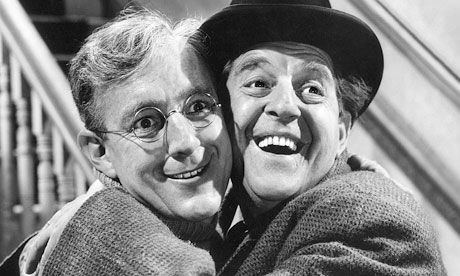
Alec Guinness with Stanley Holloway in The Lavender Hill Mob (1951)

Today is the centenary of actor Alec Guinness, about whom I already did a birthday post three years ago. But since it's his centenary, TCM is spending all 24 hours of its broadcast day with Guinness movies. I've blogged about quite a few of them before, but didn't provide photos for all of them, as with my post on The Lavender Hill Mob, which is airing at 3:45 PM.

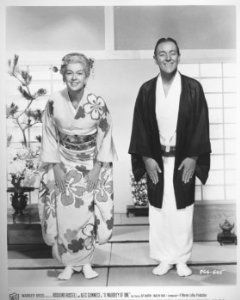
One Guinness movie that I haven't blogged about before but it on today's schedule is A Majority of One, at 1:45 AM. This one has Guinness as a Japanese widower who meets and falls in love with Jewish-American mother Rosalind Russell in Japan in the 1950s; the two teach us some obvious messages about tolerance and forgiveness. Or hits us over the head with those messages, if you will. The movie is in color, but in tring to look for good photos from the movie, I could only find black-and-white photos of Guinness and Russell. The two of them look all wrong, don't they?

I've used this photo from Kind Hearts and Coronets before; that's airing at 1:45 PM this afternoon. I prefer it to The Ladykillers, which kicks off prime time tonight at 8:00 PM, although I think I was a bit too harsh in my criticism of The Ladykillers. Most of the comments I've seen from professional critics have them giving the opinion that The Ladykillers is much the better movie, but I prefered The Lavender Hill Mob for whatever reason.

Friday, January 24, 2014

The Man in the White Suit

Back in December 2010, I briefly made mention of The Man in the White Suit when it was airing on TCM during a night of comedies from Britain's Ealing Studio. I hadn't seen it at the time, but it's been on a couple of times since then, and it's going to be on again overnight tonight at 1:45 AM. If you haven't seen it before, it's well worth watching.

The movie begins with the textile mill run by titan of industry Michael Corland (played by Michael Gough). Or, more specifically, at the mill's research laboratory. There's an experiment going on that looks almost as though it could have fit in an early 1930s horror movie, what with the complex contraption and various bubbling potions, and the odd sound effects that punctuate the experiment's operations. What exactly is going on here? Well, that's going to be explained later, but the experiments are being carried out by janitor-turned-research chemist Sidney Stratton (Alec Guinness). They're also being carried out somewhat surreptitiously, as when Corland finds out how much money is being spent on these experiments that nobody seems to know what purpose they serve, he has an apoplectic fit and orders the person in charge of them fired.

Stratton goes to Corland's rival Alan Birnley (Cecil Parker) and worms his way into Birnley's laboratory in order to continue his experiments. Stratton doesn't really care which company reaps the benefit; he's trying to do something that's going to be for the benefit of all mankind. So the experiments continue, punctuated not only by the odd soundtrack, but by a series of explosions every time one of the experiments fails. You'd think that would have been a good reason to fire Stratton, but no.

Eventually, Stratton's experiments succeed! It turns out that Stratton was trying to create a new synthetic fabric, and what he's produced is a white fiber that's so white it seems to glow in the same way as that glass of milk Cary Grant carries upstairs to Joan Fontaine in Alfred Hitchcock's Suspicion. But the point of this fabric isn't its seeming glow, but the fact that it's extremely resistant to dirt, and extremely resistant to wear. Imagine the boon to mankind: everybody, and not just the upper classes, will be able to afford a fine suit, as they won't continually have to pay for dry cleaning or getting a new suit when the old one wears out.

Ah, but here lies the problem. Never mind whether the stuff Stratton invented is about as stylish as a 1970s polyester tie; the bosses see a bigger problem. If nobody ever needs a new suit because the old one wears out, that's going to kill the textile industry by reducing demand to near zero. Sure, things don't really work that way, but the term Luddite comes from a real person whose name was appropriated for an early 19th century campaign against new industrial machinery in the belief that it was going to destroy jobs. The modern day Luddites depicted in The Man With the White Suit (eventually including not only the business owners but the labor unions) may be foolishly short-sighted, but they weren't unpredictable. About the only person who supports Stratton is Birnley's daughter Daphne (Joan Greenwood), and the industrialists try to use her to get Stratton to sign a contract granting them the rights to produce this new fabric, although the industrialists are really only planning to buy him out and never actually produce the fabric or release any information that it's actually been invented.

The Man in the White Suit covers some of the same ground that the later British comedy I'm All Right Jack did, alhtough the style of humor is radically different. I'm All Right Jack is nothing but farce, while The Man in the White Suit is much more subtle. There's good visual humor in the sciencey stuff when Stratton is doing his experiments, but when it comes to industrial relations, the humor, while there, is somewhat more understated. Both movies work, and I don't know that you can say one is necessarily better than the other. By the time I'm All Right Jack was made in 1960, British society was, I think, really beginning to change, although that's a topic that British posters would be better able to discuss. The Man in the White Suit is more gentle in any social commentary it's trying to make, but does it in a very entertaining way. Alec Guinness is just as good here as he is in all those other Ealing comedies, and the rest of the cast supports him well. For whatever reason, The Man in the White Suit isn't as well known as some of the other Ealing comedies, and that's a shame. It deserves more recognition.

The Man in the White Suit is available on DVD is you miss tonight's overnight showing.

Saturday, August 3, 2013

Alec Guinness day on TCM

Today's featured star on TCM's Summer Under the Stars is Alec Guinness. Perhaps I should have blogged about him yesterday, since the day's first movie, Great Expectations, would be worth a post. But by the time this gets posted to the blog the movie will be over, although you can catch it on DVD. Hollywood may have had better production values when it came to adapting the great works of British literature for the screen, but the Brits had acting, as well as British authenticity.

I think I've stated before that I'm really not a fan of Doctor Zhivago, which is airing at 4:30 PM. That's probably because I read the novel before seeing the movie, which gives the story away at the beginning by taking material from the book's first epilogue and putting it as an expository opening scene. (The book starts with the funeral of Zhivago's mother.)

Doctor Zhivago is followed by the even more tedious Lawrence of Arabia, which is this week's Essential at 8:00 PM. Give me ten minutes of Maurice Jarre's score; that's more than enough.

And then there are the repeats. The Ladykillers, which I was a bit too harsh towards in September 2010, airs at noon. It's not that I disliked the movie so much as I don't think it lives up to its reputation as one of the great British comedies of all time. Heck, two of Guinness' movies today are better in my opinion. The Lavender Hill Mob, which I find fun and less forced than The Ladykillers, airs at 10:15 PM. And at midnight is the wonderfully inventive Kind Hearts and Coronets.

One thing I've mentioned a couple of times before that doesn't have Alec Guinness in it is the short All Eyes on Sharon Tate, which is coming up overnight at about 3:50 AM.

Saturday, April 2, 2011

Alec Guinness, 1914-2000

I'm too darn lazy to look for another Alec Guinness photo!
Alec Guinness in Kind Hearts and Coronets (1949)

I don't think I've done a birthday salute to Alec Guinness before. TCM won't be honoring him today, largely because they generally don't do birthday tributes on the weekend. But it's interesting to see just how broad a range of movies Alec Guinness starred in. His first role was in a British period piece, David Lean's version of Great Expectations, followed by another Dickens adaptation as Fagin in Olvier Twist. It's a far cry from the Ealing comedies like Kind Hearts and Coronets. But then, both of those are a ways away from his Oscar-winning role in Bridge on the River Kwai, in which Guinness plays the British commander of the POWs who build a bridge for Sessue Hayakawa.

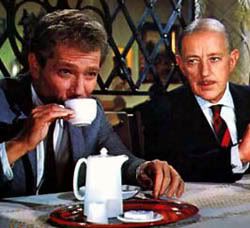
Love that groovy retro tea serviceAnd none of them compare to the role for which younger viewers might remember Guinness, that of Obi-Wan Kenobi in the original Star Wars movies. Or an epic like Lawrence of Arabia. Or George Segal's boss in The Quiller Memorandum. (That's the photo at left.) So, whatever type of movie you like, there's probably an Alec Guinness movie in the genre for you.