Showing posts with label David Niven. Show all posts

Monday, August 31, 2026

55 Days at Peking

This year's Summer Under the Stars concludes today with a day of films devoted to actress Ava Gardner. And concluding her day, in the wee hours of tomorrow morning at 3:00 AM (so even if you're on the west coast but only have the east coast feed it's still technically on Sept. 1) is 55 Days at Peking.

After the opening titles, voiceover narration informs us that it is the summer of 1900, a restles time in Chinese history: the Manchu/Qing dynasty was weak, having been forced to give a lot of economic concessions to the various western powers that wanted to trade with China. Originally, the Chinese government had been in a powerful enough position to bar whole families from coming over and keep the westerners isolated in special communities much like the Japanese did with the Dutch in Nagasaki. But by the end of the 19th century the west had the upper hand. This combined with a bad harvest emboldened more radical Chinese forces, in a group commonly called the "Boxers" because of their closed-fist salute. They were trying to drive the west out wholesale, and the government was in a bind because trade duties with the west and taxes on the concessions were actually bringing in a sizeable chunk of money to the Chinese treasury.

It's against that restive background that the Americans rotate in a fresh platoon of marines to the American legation in the diplomatic quarter of Peking, under the leadership of career Marine Maj. Lewis. He shows up looking for rooms at the hotel just as a Russian, Baroness Natalie (Ava Gardner) is being evicted because her visa was revoked by her brother-in-law (Kurt Kasznar) for family reasons. Maj. Lewis doesn't know much about the local politics, but he's about to learn, and fast.

The day after he arrives, the Boxers assassinate the German ambassador to China, leading to an ultimatum from Dowager Empress Cixi (Flora Robson): all of the westerners must leave. The assembled ambassadors take a vote, with all of them voting to leave except for the American who is absent because he's dying in hospital, and the British ambassador, Sir Arthur Robinson (David Niven). The other countries, however, decide that they can't afford to give up all of their concessions to the British, so they change their minds and stay. And that causes the Boxers to start besieging the city.

The westerners are badly outnumbered, but all they have to do is hold out long enough for relief to arrive, which is supposed to get to Beijing fairly soon. Except that Imperial forces are mustered to prevent this from happening, and the westerners have to hold out longer until they can somehow get someone out of the area from below and get word that relief is still needed. Against the backdrop of all this, various personal dramas play out. These include a mixed-race child, Sir Arthur's family, and the relationship between Maj. Lewis and the baroness, which is turning romantic because apparently a movie like this needs a love interest in it.

The technical aspects of 55 Days at Peking are quite good, although it's Spain substituting for China in the backgrounds. This isn't terribly important, since the besieged quarter is all sets anyhow and mostly doesn't need large vistas. The sets and costumes work well as does the music. The weakness, however, is the story, which runs over 2½ hours and sags quite a bit, especially with the baroness character who's not really needed to advance the plot. There are also enough Hollywood-style reimaginings of the history that are probably going to bother some viewers. So it's easy to see why a movie like 55 Days at Peking got mixed reviews and hurt the career of its director, Nicholas Ray.

Sunday, February 22, 2026

David Niven's crisis

Yet another of the movies that I recorded off of TCM because of how it sounded interesting, but only got around to watching not long before it expired from my DVR, was the previously unknown to me Guns of Darkness. As always, having watched it, it's once again time to write up a review.

David Niven stars as Tom Jordan, who is working as a manager at a British plantation in the fictional Latin American republic of Tribulación. There's some hints that Tom was a bit of a screw-up in his previous professional life which is why he's working a job like this. It doesn't exactly please his wife Claire (Leslie Caron) either. She'd like to have a family but hasn't been able to have kids to this point, and she's getting to the point that she's thinking of packing up and heading back to Europe.

All of this is happening against the backdrop of a New Year's Eve party all the expats and some local elites are at. What none of the expats know, however, is that outside a bunch of rebels are planning to overthrow the current government of El Presidente Rivera (David Opatoshu). The coup is successful in that Rivera winds up out of power, but somewhat unsuccessful in that Rivera escapes, if with an injury.

Amazingly, the following morning none of the expats seems to have learned that there was a coup the previous night! And they should be relatively close to the capital city considering that one of last night's party guests, Hernandez (Derek Godfrey), shows up on the balcony with the new leader to serve as the Minister of Justice in charge of finding Rivera. The expats, meanwhile, all go to work the next day and act as though they're just going to keep going to work every day with the new regime not even resulting in a temporary disruption as order gets restored!

Eventually they learn about the coup and suffer some inconveniences themselves as there are roadblocks looking for Rivera and some summary justice as the new authorities deal with the people who aren't quite on board yet with the new regime. But if everybody suffers minor inconveniences, the Jordans are about to suffer a major one. Rivera was shot and needs medical treatment, and he's found hiding in the Jordans' car! He doesn't just want medical treatment, he wants Jordan to help him escape across the border where a neighboring country will presumably accept him into exile.

Husband, wife, and ex-president set out, and find that the road to the border, or at least the one that the authorities aren't watching, involves crossing a dryish riverbed. Unfortunately it's not quite dry, and what moisture there is left has turned the area into quicksand! Worse, as part of getting across, they're spotted by a young boy who Rivera is convinced will rat them out to the authorities. So he want to kill the boy, which is brutal but understandable and even logical. Jordan doesn't want to. The road ahead is going to require them to go on foot and go through difficult terrain to keep from being found by the new president's men.

Guns of Darkness is another of those movies where there's the basis of a pretty good movie in the plot, and you can see why the stars involved might want to take on this project. The finished product, however, is surprisingly inert. The conflict between Mr. and Mrs. Jordan doesn't feel authentic, and it doesn't seem at all likely that someone as injured as Rivera would be able to make it as far as he does. So it's all a bit of a tepid misfire, but one of those movies where you'll want to watch and judge for yourself.

Friday, February 14, 2025

Around the World in 80 Days

Another of those movies that I had actually never seen before even though it was a studio-era Best Picture Oscar winner and all that was Around the World in 80 Days. It aired recently on TCM, I think for George Raft's turn as Star of the Month since he's got a cameo in it, and it's airing again as part of 31 Days of Oscar, tomorrow (Feb. 15) at 4:45 PM.

It's based on the novel by Jules Verne, and I would assume that most people know the basic story. Phineas Fogg, played in the movie by David Niven, is the sort of quintessential Victorian-era British gentleman that in the invertening years has become a spoofed character type. Fogg is wealthy but of unknown (and I think never explained) means, and notoriously specific in his desires, having dismissed his previous valet for serving toast two degrees too cold. This causes him to look for a new valet, selecting the Frenchman Passepartout (Mexican comic actor Cantinflas), who is a jack of all trades who's never actually worked as a valet before.

Anyhow, at the gentlemen's club, Fogg tells some of the other memebers that he's been doing a bit of calculation, and figured out that with the current-day (1872) advancements in technology, it should be possible to complete a voyage around the world in eighty days, at least with enough lag time built in for connections since timetables were still not exactly precise in those days. So some of the other members bet it can't be done. Fogg has £20,000 in an account at Barings Bank and puts that up, with four of the memebers wagering against him eaching putting up £5,000. The wager becomes a cause célèbre and news story around the world as Fogg and Passepartout set out on the voyage. You may already know how the wager plays out.

One major plot line that is in both the book and the movie is the character of Princess Aouda (Shirley MacLaine). She's a princess in one of the Raj states where the princes tried to curry the favor of the British empire, except that her husband has just died. In that state, the custom is that then the prince dies, there's suttee, in which the widow is also sacrificed at the state. Aouda most definitely doesn't want to die, so Fogg and Passepartout rescue her and take her on the rest of the journey around the world since she can't go home again.

A good portion of the movie, however, is not really in the book. I knew from a fairly young age that a good proportion of the promotion surrounding the movie involved a balloon flight, but reading the book that's not in the book at all. Producer Michael Todd wanted a big spectacle, and also situated the camera in many scenes to serve as a sort of travelogue: think cameras on the front of the train as location shooting has the train going down a track. The balloon ride over France is an excellent example of this, as is a subsequent bullfight. Apparently in the book, although I don't remember it since I was a kid when I read the book, is the Scotland Yard detective Fix (Robert Newton). Just before Fogg set off on the voyage there was a heist at the Bank of England, and Fogg vaguely looks like the description of the bank robber. So Fix follows Fogg around the world, trying to come up with a reason to arrest him.

Around the World in 80 Days is, as I said, an excuse for producer Michael Todd to make a spectacle of the sort that TV couldn't do, in color and wide screen, and bringing as many stars to that screen as possible. As a result, there's a ridiculous number of cameo appearances, and no opening credits to clue you in beforehand of who the cameos are. There's also a pre-plot scene of reporter Edward R. Murrow (in 4:3) talking about advances in technology and Jules Verne discussing that in his books, with a bit of help from clips of the Georges Meliès silent A Voyage to the Moon.

This version of Around the World in 80 Days doesn't really work as a plotted story, in that it goes on much too long and has some plot holes. One thing that only struck me watching now all these years later is Passepartout's leaving the gas in his room on inadvertently. This eats up the £500 he earns for the voyage, but that would come out to £6/5/- a day on gas, which seems obscenely high. In any case, all the cameos keep everything interesting, and the location cinematography is nice, if at times in stark contrast to studio sets. However, I definitely don't think it was deserving of its Best Picture Oscar.

Monday, July 29, 2024

Murder By Death

Quite a fair bit of Neil Simon's work has been turned into Hollywood movies, although it should be added that he wrote several screenplays directly for the screen. One of the latter, as far as I can tell, is the movie Murder by Death, which has been sitting on my DVR for several months now.

The movie starts off with an unseen hand signing the name Lionel Twain (when we eventually see Lionel, he's played by Truman Capote) to a bunch of invitations. These go out to, in order:

Dick and Dora Charleston (David Niven and Maggie Smith respctively), and Pet Terrier in New York;
Inspector Sidney Wang (Peter Sellers), in Catalina;
Monsieur Milo Perrier (James Coco), Brussels;
Mr. Sam Diamond (peter Falk), San Francisco; and
Miss Jessica Marbles (Elsa Lanchester), Sussex, England.

Considering the names of these characters, and the title of the movie, it doesn't take much to figure out that this is going to be a spoof of the detective story/movie genre. Lionel then calls in his bulter Jamessir Bensonmum (Alec Guinness), who is blind, to stamp and deliver the letters. Although one of the jokes is that his stamps miss the letters, the characters all get their invitations, as the next scenes show the various characters trying to make their way to the house. Everybody comes more or less in pairs, as the Charlestons come togther; Wang comes with adopted #3 son Willie (Richard Narita); Milo has a chauffeur Marcel (James Cromwell); Diamond has his secretary Tess (Eileen Brennan); and Miss Marbles has an exceedingly elderly nurse, Miss Withers (Estelle Winwood).

They all get to the house in the thick fog, where they've ostensibly been invited for dinner cooked by a mute maid/cook (Nancy Walker). Of course, once again considering the title, we can guess that's not the real reason Twain invited everybody. Indeed, at dinner he tells them that he knows they're supposedly great detectives, but he's the greatest criminologist of them all. He's going to prove it by there being a murder committed at the house that they will be unable to solve because the mystery behind the murder is so diabolical that only a real mastermind can solve it And if any of them can, they'll win a million bucks. Yeah right.

But wouldn't you know it, the great detectives of the world eventually find a dead body, and one that certainly looks like it's been murdered. And they're in a stereotypically old dark house, so it may threaten them if they split up. Then again, it's not as if they're going to be able to solve it just sitting there together. And there's that big money for solving it.

To make things more complicated, when each of the pairs go to their bedrooms for the night, each of them finds they're also the target of a murder attempt in a way that's as stereotypical but also cinematic as the old dark house. Eventually each of them comes up with their own theory on whodunit and why, but who is right?

Murder by Death is another of those movies where it's very easy to see why everybody involved with it would want to make it. The idea of spoofing all of these literary/cinematic detectives is appealing. Add in the comic writing of Neil Simon, and there's a lot that most people are going to find hilarious.

To me, I have to admit there was a bit of an air of trying just a little too hard. Not that Murder by Death is a bad movie at all; it's more that at times the parody feels way too broad, and therefore not quite as funny as it ought to be. Still, most people are probably going to like this more than I did (and it's certainly not that I didn't like it), so it's absolutely worth watching.

Tuesday, April 4, 2023

The Zenda prisoner

A movie that, for whatever reason, I had never gotten around to watching, in fact not any of the versions of it, is the 1937 version of The Prisoner of Zenda. It was on TCM in March for 31 Days of Oscar, and so I recently watched it off the Watch TCM app.

To be honest, I sort of knew the basic story. In that great romantic age of the decades just before the Great War, a British gentleman named Rudolf Rassendyll (Ronald Colman) goes on the sort of trip to mysterious central Europe that only the idle rich could afford to do in those days, winding up in some unnamed kingdom roughly where the border of Hungary and Romania would be today. He gets an odd reception, which isn't explained to him until he meets some higher-up military men. Col. Zapt (C. Aubrey Smith) informs Rudolf that he looks amazingly like their country's crown prince, also named Rudolf; apparently, the two shared a common ancestor five or six generations prior.

Curiosity gets the better of everybody, and the two Rudolfs are introduced to each other. British Rudolf does look surprisingly like the Crown Prince, which isn't that much of a surprise when you understand that the continental Rudolf is also played by Ronald Colman. His coronation is supposed to be the next day, but he parties into the night with his new best friend Rudolf.

That's a mistake though, as Prince Rudolf's half-brother Michael (Raymond Massey) has given the prince a drugged bottle of wine. Rudolf drinks all of it and is unable to be roused for his coronation the next day, something that means Michael would be in line to take the throne. So you can understand why Michael would want to commit such a dastardly deed. Zapt understands that having King Michael would be a terrible thing, so he convinces the British Rudolf to stand in for the prince, as nobody will notice the difference. I suppose it's the reverse of Richard Basehart taking off his glasses and putting on contact lenses in Tension.

Michael, of course, knows there's a ruse, since he's the one who drugged his half-brother. Worse than that, he kidnaps the crown prince, so that when the British Rudolf thinks the hare-brained scheme of being a body double for a prince is just about over, it really isn't: nobody can find the prince who is technically a king now.

Even more complicated is the fact that Prince Rudolf has a personal life, and somehow nobody close to British Rudolf who isn't aware of the ruse is able to figure out that these two aren't the same people. This is especially true of Princess Flavia (Madeleine Carroll), another cousin. She's betrothed to Prince Rudolf, but it's more one of those royal marriages of convenience. She was willing to marry the prince out of duty, but she didn't really love him. British Rudolf, on the other hand is different, and while Flavia notices a change, she can't figure out what caused it.

Meanwhile, there's still the little problem of Prince Rudolf having been absconded with and being held somewhere. His supporters are going to have to rescue him, but Michael is no dummy and has made it very difficult for anybody to rescue him.

The plot to The Prisoner of Zenda is frankly a bit daft. But it's one of those movies where you should just sit back and not try to think too much about all the plot holes. If you can do that, you'll find that it's fairly grand entertainment, at least in the fashion of 1930s Hollywood. Everybody involved does a good job, and the story never really stops moving. It's definitely worth a watch.

Wednesday, March 31, 2021

The dark around a kiss

Ronald Reagan made several light romantic comedy programmers for Warner Bros. after returning from World War II. Another Warner Bros. movie in that genre that Reagan didn't make is A Kiss in the Dark.

David Niven plays the male lead, a concert pianist named Eric Phillips. He's gettin a bit neurotic, having been a pianist for ages and feeling like he can't remember any of his music and thus really can't go out there on stage. This is a prospect that frightens his manager, Peter Danilo (Joseph Buloff). Danilo is making good money off of running Phillips' career, and if he had to step away from that career for any period of time, well, who knows what would happen.

Danilo has also been getting his boss into things that Eric is being left more or less in the dark about. For example, Eric owns an apartment building. But the superintendent of the building, Horace Willoughby (Victor Moore) has been neglecting upkeep on the building, to the point that the building inspector has repeatedly issued code violations, and it to the point of putting out a warrant for the arrest of the building's owner if nothing is done to fix the violations.

Eric, realizing what a bad situation he's in, goes down to the apartment building to see what's up. What he finds is a series of quirky tenants. Most notably, there's Polly Haines (Jane Wyman), an advertising model whose usual photographer loves the piano music of one Eric Phillips. She's engaged to insurance salesman Bruce Arnold (Wayne Morris). There's also a tenant Mr. Botts (Broderick Crawford) who works an overnight shift and wants to sleep in the day, and thinks everybody is out to stop him from sleeping. So he harasses them to no end, nd all the other tenants want him out of the house.

Eric has some sympathy for most of the tenants, wants to fix up the building and put in all sorts of idiotic things there's no room for and that most of the tenants in real life would never wind up using, like a greenhouse. The one thing that's incredibly predictable is that Eric is going to fall in love with Polly, which is a problem since she's already got a fiancé. nd, of course, it's also going to be a problem for Danilo.

There are several movies that revolve around apartment buildings and the ensemble cast of tenants; Love Nest really came to mind while I was watching A Kiss in the Dark. However, I found A Kiss in the Dark to be a pale shadow of the other apartment movies, and the Ronald Reagan romantic comedies. Broderick Crawford is way too loud and obnoxious here; I'm not certain if it's the fault of the script or the director. Moore is someone you'd want to fire, and the whole interlude with the camping trip doesn't work in this movie. The one real bright spot in the movie is Maria Ouspenskaya, not long before her tragic death, as Eric's original piano teacher.

A Kiss in the Dark is available on DVD courtesy of the Warner Archive collection.

Sunday, February 28, 2021

It's gonna be all right

Tomorrow is the birth anniversary of British actor David Niven, so it's unsurprising that TCM is spending the morning and afternoon with Niven's movies. One that I haven't blogged about before is Tonight's the Night, which will be on at 11:45 AM.

Rathbarney is one of those typically whimsical small villages in Ireland that populate the mind of John Ford and, apparently, some parts of the British entertainment industry. The village is more or less owned by General O'Leary, who seems to own all the land in the area but who is very generous with his tenants. He runs an annual hunt and has let everybody run up substantial debts.

But this year's hunt is different. The General is past 80, and rides a horse that's getting as elderly, in equine terms, as the General. He foolishly tries to take a jump that he'd done every year in the past, but this time around, the horse balks, throwing the General over a stone wall and down a small embankment. It's not an immediate death, although it is terminal. But before he dies, he gets to dictate some final wishes, among them being that all debts should be cancelled.

The General, having lived more or less alone, only with his servand Thady (Barry Fitzgerald) and no family, has as his nearest relative a great-nephew, Jasper O'Leary (David Niven). Jasper shows up in Rathbarney, apparently never having seen the place before. Also returning to the village is Serena McGlusky (Yvonne De Carlo). She's one of the two daughters of second-tier landowner Major McGlusky (Michael Shepley), and she left to go to Canada with her husband, who has since died and left her flat broke. Before she left, there was some talk that she might wind up with the local doctor, Michael Flynn (Robert Urquhart), although after her departure there was suggestion the good doctor might marry Serena's sister Kathy (Noelle Middleton).

At any rate, when Jasper arrives, he's shocked at what he finds. The General wasn't much of a property manager, although his generosity helped the village function. Jasper isn't very well off despite being an heir, and he has no intention of living in Rathbarney. His plan is to bleed the townsfolk dry, at least as much as he can get out of the town, before moving on to greener pastures. Complicating things is that the General's dying wishes somehow never made their way into the will, despite there being quite a few witnesses to those wishes. So Jasper is probably within his legal right to do what he's doing.

The townsfolk, understandably, resent it. Perhaps they were taking advantage of the General, but he was the only person with any means in the area, and it was those means that allowed the village to function in what seems to have been a symbiotic relationship. (How much longer the place could have gone on is never mentioned.) But now, there's no way they'll have either any prosperity, or even any fun in life. So they want to drive Jasper out, by violent means if necessary. They draw lots, and getting the short straw is the barkeep's assistant, Terence (George Cole).

There are a lot of elements here that should lead to a very fun comedy, but I have to admit that in watching it, it wound up being less than the sum of its parts. I think part of it has to do with the characters being unnaturally quirky, to the point of obnoxiousness at times, not being helped by the presence of Barry Fitzgerald. I can't blame Jasper for wanting to get rid of Thady. Niven does well with the material he's given, as does De Carlo. All of the non-Hollywood people do an adequate enough job, although everybody's brought down a notch by the material. And, according to IMDb, none of the movie was filmed in Ireland.

Still, as always, this is the sort of movie you should probably watch and judge for yourself, since it's the sort of quirky movie that some people will probably really like. It doesn't seem to be available on DVD here in North America, so you'll have to catch the TCM showing.

Saturday, August 4, 2018

Eternally Yours

1939 is commonly referred to as Hollywood's greatest year. A movie from that year that is generally overlooked is Eternally Yours.

Anita (Loretta Young) is the granddaughter of Episcopalian bishop Peabody (C. Aubrey Smith), and is having a luncheon with some of her girlfriends when her boyfriend Don Burns (Broderick Crawford in a very early role) shows up to pick her up for an afternoon out. They go to see a show from master magician Arturo the Great (David Niven). He's so magical that he's able to steal Anita's heart right out from under Don.

Fast forward a year and a half, and Anita is working as her husband's partner in those illusions that need a lovely woman as the magician's assistant. They're currently performing in London, which one assumes is home for Arturo, although it certainly isn't for Anita. She's decided that she'd like to settle down, and to that end has had plans drawn up for a small country house in the middle of nowhere in Connecticut, or at least as middle of nowhere as you can get there. She's especially unhappy that Arturo talked himself into an escape act involving being handcuffed and thrown out of a plane!

Not that Arturo wants to do that. Arturo feels he needs to keep making money to make Anita happy, and to that end he's signed the two up for a two-year tour. (The movie was released in October 1939, after World War II had already begun, so presumably this world tour wouldn't take them to Europe.)

At any rate, they set out on the tour, but when they get to South America, Anita decides that she's had enough, and that she's going to go home to get a divorce. (Well, actually, she has to go to Reno and serve Arturo the divorce papers, but Arturo could only get the slow boat back to the States.) Anita gets the divorce and marries Don, while Arturo is stuck doing vaudeville-type shows. Until a charity function winds up with his meeting Anita again, giving him a chance to win her back.

Eternally Yours is one of those competently-made movies that unfortunately winds up adding up to less than the sum of its parts. I think that's in part because so much of the material feels formulaic, in that we've sen this type of story before. A big entertainer falls in love, and then has to decide whether the love can survive a life on the road. I think the most recent post I did on such a movie was for There's No Business Like Show Business a few months back, but I can think of a bunch of movies in the genre. Eternally Yours feels like everyobdy is going through the motions, which is a bit of a shame because it actually has quite a bit of star power in the supporting roles: C. Aubrey Smith is criminally underused, and when you see names like Billie Burke, ZaSu Pitts, and Eve Arden on the second card, you might expect a lot.

Not that Eternally Yours is bad; it just feels like it could have been better. The movie is available on DVD, though, so you can watch and judge for yourself.

Saturday, March 10, 2018

Bluebeard's Eighth Wife

I recently watched Bluebeard's Eighth Wife off my DVR, and with it being available on DVD courtesy of Universal's MOD scheme, I'm also comfortable doing a full-length post on it.

Gary Cooper plays Michael Brandon, a wealthy American businessman currently working on the French Riviera, for reasons that are never really explained. He goes in to one of those old-time department stores where you have to deal with the clerks, wanting to buy some pajamas. Well, he only wants to buy the pajama tops, since he uses those as a sort of night shirt and doesn't wear the pajama bottoms. The store only wants to sell them as a set. Into all this walks Nicole (Claudette Colbert). She solves everybody's problems by offering to buy the pants.

Michael immediately falls in love with Nicole, and starts pursuing her. Nicole, meanwhile, has a father who is a Marquis (Edward Everett Horton), although French titles of nobility no longer meant anything. That lack of meaning probably has a lot to do with why the Marquis is heavily in debt. He's been trying to do a business deal with Brandon, and then when he finds that Brandon has been pursuing Nicole, he gets dollar signs (or probably franc symbols) in his eyes. After an on-again, off-again thing, Nicole finally decides to marry Michael.

And then she finds out about Michael's past. Michael has been married seven times (who wants to deal with that many mothers-in-law?), and always winds up divorcing, leaving his ex-wives with a substantial settlement as he's agreed with them before the marriage. Nicole, for her part, decides that she wants to wangle more money out of him.

As you can guess, the kicker is that the two are going to wind up falling in love, although neither of them wants to admit it. They lead separate lives, with each becoming jealous of the other, leading to the predictable divorce and then a reuniting.

Bluebeard's Eighth Wife is a movie that I found to be a lesser one in the careers of all the major people involved with it. Colbert and Cooper both made much better movies. So did the director, Ernst Lubitsch, and the screenwriters, Billy Wilder and Charles Brackett. I think it has a lot to do with the plot that seems all over the place. It's not really Wilder and Brackett's fault, since they were adapting a French stage play. Still, the characters aren't particularly likable and a lot of their actions make no sense.

Some of the supporting players do well in their smaller parts. David Niven, early in his career, plays Albert, a friend of Nicole's and one of Brandon's employees, and gets a good scene as the wrong man. Horton is quite good, as are Herman Bing as a private eye and Elizabeth Patterson as Nicole's "aunt".

If you want a good movie of any of the main people involved, you can do better than Bluebeard's Eighth Wife. But if you want a comedy from the 30s you might not have seen before, you could do a lot worse.

Monday, October 12, 2015

Spitfire

David Niven returns to TCM tonight for a second night in his turn as TCM's Star of the Month. This week I'm going to recommend him in a supporting performance in The First of the Few, also known as Spitfire, airing at midnight.

The star here is Leslie Howard, who also directed. Howard plays R.J. Mitchell, an aerospace engineer back in the days when such people didn't have such fancy titles but were were working in the fledgling field of aviation. Mitchell worked for a company called Supermarine, which you might be able to guess from the name developed seaplanes. But that wasn't Mitchell's biggest interest. In fact, he liked developing racing aircraft. These were still the days when there were air races, and various designers entered their prototypes in these races. Mitchell is seen in the movie partaking in such races along with his test pilot Geoffrey Crisp (that's Star of the Month Niven).

Mitchell was having a quite successful career, to the point that the company that bought out Supermarine specifically wanted him to stay on. But things began to change in the early 1930s. Specifically, it was the Nazis coming to power in Germany that changed the course of Mitchell's life. In the movie, he is presented as visiting Germany to talk shop with German airplane designers, since as you can imagine in a young industry the pursuit of invention can lead people from divergent backgrounds who might otherwise dislike each other to have a sense of camaraderie. But what Mitchell hears on his trip to Germany frightens him. The German airplane designers are coming up with some great designs, but it's in the service of an air force that, so the plan is, should make Germany strong again. And it's obvious that the force would be used against a country like the UK if the need ever arose.

So Mitchell realizes that the UK needs to take a prophylactic step to try to deal with the coming German menace. For Mitchell, this means building a new fighter for the UK's own air force that would be able to take on any possible German invaders if it should come to that. Now, in real life the British government was already looking for a new plane to replace one of their older fighters, and what Mitchell was designing was something that would fit the bill nicely. The movie, I have a feeling, dramatizes this a bit and makes Mitchell more prescient in seeing the possible German threat. But in any case, he did design the plane that would become known as the Spitfire, and that plane did take the major part in Britain's air defenses against the Nazis in the Battle of Britain.

However, Mitchell wouldn't live to see the ultimate success of his Spitfire. He had been diagnosed with cancer, and despite knowing that his days were numbered, continued workign on his prototype Spitfire almost until the end.

I have to admit to not knowing how much liberty the movie takes with the real events. (The Wikipedia article on the movie, however, does list several.) But in any case The First of the Few is a fine dramatization of those events. Leslie Howard obviously had a lot of love for the subject, both in terms of aviation and in terms of the people defending Britain; see From the Four Corners. The supporting cast, including Niven, are fine, but this is really Howard's movie.

The First of the Few is available on DVD if you should miss the TCM showing.

Monday, October 5, 2015

TCM Star of the Month October 2015: David Niven


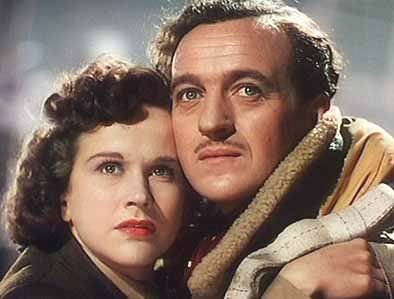
David Niven and Kim Hunter in A Matter of Life and Death (airing 8:00 PM Oct. 12)

After a slight break due to a calendar quirk, we get back to having another star of the month on TCM. This month it's British actor David Niven, who graced the screen with his suave presence for close to 40 years. Niven won a Best Actor Oscar for Separate Tables, which amazingly doesn't seem to be on the schedule. TCM must have had a rights problem. That having been said, TCM were able to get enough movies that the four nights of Niven films continue well into Tuesday mornings.

As for tonight's schedule, the highlight probably depends upon what sort of movie you like. I'm not a particularly big fan of Wuthering Heights (1:00 AM), in which Niven plays Edgar, the good but unexciting guy in Cathy's (Merle Oberon) life. Partly it's the story; partly it's the ludicrous death scene when Cathy dies, sorry for giving away the plot. But that having been said, a lot of critics and just plain old movie buffs love the movie, so a lot of you probably will, too.

More up my alley is a nice comedy like Bachelor Mother, at 9:30 PM. This one stars Ginger Rogers as the woman who has a foundling come into her life, and David Niven as her boss having to deal with the mess caused by all of this. Needless to say the two leads wind up falling in love too as the story goes along....

Niven has a small part in Dodsworth (6:15 AM tomorrow) as Capt. Lockert, although I don't remember him showing up. That only says more about the size of the part; I'm not saying IMDb is wrong. But this is another well-made drama, and one I do like a lot more than Wuthering Heights.

Tuesday, April 21, 2015

Four Men and a Prayer

FXM Retro ran Four Men and a Prayer today at lunchtime, and is repeating it again tomorrow morning at 4:32 AM for anybody who missed today's airing.

C. Aubrey Smith plays Col. Loring Leigh, who at the beginning of the movie is stationed in British India and being court-martialed for giving an order that led to a bunch of British soldiers being massacred. The only thing is, he's convinced the order is a forgery. He gets dishonorably discharged, and sends telegrams to his four sons: Geoffrey (Richard Greene) is working at the British embassy in Washington; Wyatt (George Sanders) is a barrister in London; Christopher (David Niven) is in the flying corps; and young Rodney (William Henry) is studying at Oxford. The four sons return to the old family home, where Dad is goign to show them the evidence that will clear his name. Except that before he can do so, he's shot dead in his study!

Fortunately for the four sons, Dad gave them a couple of names as leads before he was shot. One of them, Capt. Drake, is in London and is going to visit Geoffrey at the Leigh estate in the country; Capt. Loveland (Reginald Denny) has retired from the service and is in Buenos Aires where Christopher heads; and a Mulcahy (Barry Fitzgerald) is still in India, which is where Wyatt and Rodney go. Also showing up at the Leigh place is a woman Geoffrey knew in Washington, the lovely and well-dresses Lynn Cherrington (Loretta Young). She claims she's got something important to tell him, but he brushes her off because the meeting with Drake is so much more important. Except that Drake shows up at the Leigh estate dead and with the taxi driver missing. Geoffrey heads off to Buenos Aires, and Lynn, having figured out that's where Geoffrey is going, arranges to get a boat to New York and fly from there to Buenos Aires so that she can beat the boat from the UK to Argentina.

Eventually, there's a complex conspriacy theory that involves arms smuggling, a coup d'état in some backwater island just off the coast of South America, and people in India and Alexandria, Egypt who know more about what's going on than they're letting on. And just how much does Lynn know, anyway?

The idea behind Four Men and a Prayer is a good one, but the execution winds up being less than the sum of its parts. The movie doesn't spend enough time in any one place for that part of the movie to be interesting. Why Lynn knows so much about what's going on but not about the key plot point at the climax is never explained. How everybody flits through the island where the coup happens strains credulity: once they found out there was arms smuggling going on they would have been detained then and there unless you've got a preternaturally stupid bad guy. And Lynn leaves everywhere terribly quickly but has no problems moving her Kay Francis wardrobe around. There should be more to the film, but it never quite gets anywhere.

Four Men and a Prayer was directed by John Ford, and as such has wound up on one of the box sets of his work. I'm not certain if that set is still in print, although there do appear to be a few copies available at Amazon.

Sunday, September 26, 2010

Doris Day builds her dream house

I'm always worried about doing a repeat full-length post on a movie I've already blogged about. However, both Blogger's search function, and Google, claim that I haven't blogged about Please Don't Eat the Daisies, airing this evening at 6:00 PM ET.

Doris Day stars as Kate Mackay, the wife of prominent New York theater critic Larry Mackay (David Niven). They live together with their four bratty sons in an apartment that's getting too small for the six of them. Sound like a familiar plot? To add to all this, Kate is jealous, thinking that too many actresses are making eyes at her husband. So, she gets the brilliant idea to move the family out to Connecticut.

What could go wrong? Well, if you've seen the movie Mr. Blandings Builds His Dream House you can probably guess, although the house the Mackays buy isn't nearly as decrepit as what Cary Grant's Mr. Blandings bought. Meanwhile, there's conflict between husband, who would rather have stayed in the city, and wife, who is beginning to find that life in the country isn't quite as good as she had first imagined. She tries to throw herself into the local life, helped by one of her husband's rivals: before becoming a critic, Larry was a failed playwright. Producer Richard Haydn knows this, and when Larry criticizes one of Haydn's plays, Haydn convinces Kate to do a school production of one of Larry's horrid plays from years back.

Please Don't Eat the Daisies is a gentler comedy than Mr. Blandings Builds His Dream House, in that it doesn't depend on the construction humor to anywhere near the extent that Cary Grant and Myrna Loy do. Instead, this is a more mature comedy about a couple who have a real conflict over what life should bring them. I'm normally not a fan of Doris Day, but she's quite good and believable here. David Niven, of course, was understated in a role like this where he's playing the foil, something he's just as good at doing as Day was at her thing. It's not a particularly special movie, but it's more than nice enough.

Please Don't Eat the Daisies has also been released to DVD.

Saturday, May 8, 2010

TCM's Mothers' Day schedule

Tomorrow is the second Sunday in May, which as always means Mothers' Day. TCM is showing an entire day of movies about mothers, and some of the movies are ones I've recommended in the past, such as Mildred Pierce at 1:15 PM ET, and To Each His Own at 3:15 PM. The first movie of the day, however, is one I haven't recommended before: Bachelor Mother, at 6:30 AM ET.

Ginger Rogers stars as Polly Parrish, a temporary sales assistant at a department store hired as extra help for the Christmas rush. Management doesn't keep her on after Christmas, so, having been fired, she starts walking the streets of town. As she's passing an orphanage, she meets a mother who's leaving her child there. But, the infant is in danger of falling down the front steps, so Polly props it up -- just as the orphanage's employees are opening the front door. They obviously believe Polly is the mother, and do everything they can to convince her not to give up the child. Eventually, Polly winds up taking the child, and giving the department store as her last known place of work.

The administrators of the orphanage naturally send word back to the department store that one of their employees had tried to deposit a baby there, and the son of the president, David Merlin (played by David Niven) is given the task of dealing with Polly. Naturally, he doesn't believe Polly's story about how she got the child. Worse, thanks to a series of misunderstandings, other people start to believe Merlin is the father of the baby. This includes Merlin's own father (Charles Coburn), who's been tipped off by Polly's fellow worker and would-be suitor Freddie (Frank Albertson), who is angling for a promotion. Dad's wanted a grandson all along, so he encourages David to take a more active role in the baby's upbringing....

You have to expect in a romantic comedy like this that Polly and David are going to wind up together, with the baby as well. What makes a movie like Bachelor Mother worth watching, however, is the way they get there. Ginger Rogers was adept at almost anything, and handles the material easily. Niven is charming, which is just the right note his character needs to hit. Charles Coburn does a fine job as well; he was closer to the beginning of his career in playing ultimately kind-hearted rich old men.

It's very surprising, but Bachelor Mother has yet to receive a DVD release.