Showing posts with label Billy Wilder. Show all posts

Saturday, July 25, 2026

For some values of spirit

Another movie that was sitting on my DVR when I noticed that it was about to get another airing on TCM is The Spirit of St. Louis. That airing comes up tomorrow, July 26, at 5:30 PM, so once again I made a point to watch it in order to be able to schedule a review for the TCM showing.

As you probably know The Spirit of St. Louis is the name of the plane that Charles Lindbergh (played by James Stewart) flew across the Atlantic Ocean in the first non-stop transatlantic flight in May, 1927. This right away brings up two issues with the movie. One is that we know how the movie is going to end, which is that Lindbergh is going to succeed in his attempt to cross the Atlantic, which removes much of the dramatic tension. The other is that Charles Lindbergh was a young 25 when he completed his fight, while James Stewart was 47 at the time of filming, and looks it for the most part despite the horrendously dyed blond hair. It's worse than Peter O'Toole as Lawrence of Arabia.

The movie opens about a day before Lindbergh takes off. He's already on Long Island, where the flight started, waiting for the weather to clear for take-off. Having time and nothing else to do, Lindbergh starts thinking both about the upcoming flight, and about how he got here. This is the lead-in to the requisite flashback, although since the second half of the movie is the actual flight, the flashbacks don't take up the entire movie. There are, however, multiple flashbacks to various points of Lindbergh's flight.

Lindberg was working as an airmail pilot around 1926 or so when he's forced to land in bad weather and reads a newspaper article about a couple of pilots who had an even worse flight trying to do that transatlantic flight. For several years there had been a prize offered to the first pilot (or pilots if a plane wasn't manned by one person) to make that non-stop transatlantic crossing. This gives Lindbergh the idea that perhaps he could be the pilot to make that flight. Except that he doesn't have enough money to buy a plane of his own and modify it so that it can carry enough fuel to make it all the way across the Atlantic.

The next section of the movie deals with Lindbergh getting the financial backing to buy a plane, although the contract with the plane manufacturer falls through since they want to pick the pilot. This leads to a different manufacturer being selected, but one based in San Diego. So they have to fly the plane cross country before it can make the actual flight to Paris.

The flight to Paris is going to take about 36 hours and, as there's no autopilot, it means Lindbergh is going to have to stay awake the entire time, which is a significant plot point. Worse is that Lindbergh didn't get enough sleep before taking off. To try to stay awake, Lindbergh has more flashbacks to other points of his flight career, whcih in the movie included a stint in the military as well as stunt flying. In addition to lack of sleep, there are other technical issues that threaten the success of the flight. But as we know, and it's not much of a spoiler, Lindbergh succeeds and becomes a hero.

For me, the big problem with the movie is the fact that we know fully well how it's going to turn out. Also, with half the movie being Lindbergh on the titular plane, there's not a whole lot that can be done to open up the action. Stewart and writer/director Billy Wilder try, but fall into a bunch of Hollywood tropes. I've seen worse, but then again I've also seen better.

Friday, March 20, 2026

Billy Wilder's Bad Seed

Now that we've finished 31 Days of Oscar for another year, it's time for TCM to get back in to its various spotlights. One of them is going to be a prime time night of TCM Imports tonight. One of the movies is one that's already on my DVR and that I hadn't blogged about before is Mauvaise graine, early tomorrow at 2:00 AM (so March 21 in Eastern time, but still March 20 out on the west coast if you don't have the west coast feed). With that in mind, I watched the film in order to be able to put up this post in conjunction with tonight's airing.

Henri Pasquier (Pierre Mignand) is a playboy living in Paris with his doctor father. Dad makes a reasonably good living as a fashionable doctor, but it's not enough to be able to support Henri in the manner to which he has become accustomed. Henri drives a nice car and can't be bothered to work. So one day when Henri gets home, Dad asks if he's got the car keys and registration. That's because Dad decided to sell the car. Henri can join the 7/8 of Parisians who don't have their own car.

Henri is none too pleased about it, and then one day he happens to come across the old car. The people who bought it left it parked with the keys in the ignition, this being the 1930s when people were much more trusting. So Henri decides he's going to "borrow" the car since he was hoping to meet up with a woman in one of Paris' many parks for a date. The two start driving around, until Henri discovers that he's being followed.

The reason the men are following him is that they are part of a ring of car thieves who steal high-value cars and sell them off to people looking to get a good car on the cheap. However, the ring considers Paris their territory, and they don't want anybody horning in on it. Henri's quick thinking convinces the leader of the ring, against his better judgment, to let Henri into the ring. There, Henri meets two of the other members, Jean (Raymond Galle), a kleptomaniac who steals neckties, and Jean's sister Jeannette (Danielle Darrieux). Jeannette is the bait for a lot of the men thanks to her looks. These two become Henri's friends in the ring.

Henri screws up the theft of one of the cars, losing the rear license plate which is picked up by a little kid who rides one of those pedal replica cars. Eventually, the rightful owner of that car spots the kid, which brings the police on to the ring. But before that, the head of the ring has decided to get rid of Henri, sending him to Marseilles where the plan is to have Henri killed along the way by having him drive a car with a busted axle. The two make it to Marseilles where they plan to escape to Casablanca. Except that Henri doesn't want to leave Jean behind, which is why he goes back to Paris and arrives just in time for the police pinch.

Billy Wilder, along with any number of people involved in the German-language cinema, fled Germany and Austria after the Nazis took over. Wilder wound up in Paris briefly becure making his way to Hollywood, and it's in Paris that he directed Mauvaise Graine. Another refugee was Franz Waxman, who provided the score. This was the first time Wilder directed a movie, having done screenwriting up until now, and continuing to write for several years more once he got to Hollywood.

As an early directorial effort, it's obviously not yet to the level that Wilder would reach once he became an established diretor, but Mauvaise Graine is still an interesting movie and one that's definitely worth a watch.

Sunday, June 9, 2024

Irma the Sweet

TCM ran a night of Shirley MacLaine's films not too long ago. One of the films they ran then but that I hadn't posted on before is coming up again: Irma La Douce, tomorrow (June 10) at noon.

A narrator (apparently an uncredited Louis Jourdan) tells us about a particular working-class section of Paris that's up all night as opposed to some of the more well-to-do parts; the reason it never sleeps is because, well, the women there sleep for money. (OK. Sorry for the terrible pun.) Intersperesed throughout the opening credits is one such prostitute, Irma (Shirley MacLaine), whom we see giving different clients different reasons on why she became a prostitute.

The prostitutes are able to ply their trade mostly because the cop that patrols the beat looks the other way. Well, at least he looks the other way for a price, being on the take. He goes to the café run by Moustache (Lou Jacobi), where a lot of the prostitutes and their pimps, including Irma's pimp Hippolyte, gather; it's there that the cop gets his bribes paid. At least, until the police commanders go through the regular schedule of assigning rookie cops to their beats.

Nestor (Jack Lemmon) has been assigned to this particular part of Paris, and he's a decidedly honest cop. But one who's also a bit of a naïf, as he seems to believe Irma's excuses when he asks her about what she does. When he figures out what the women do, he has a whole bunch of them arrested and taken down to the station. Things don't go quite the way Nestor expects, however, as somebody higher up apparently wants to use the prostitutes as a safety valve. Nestor gets framed for bribery and summarily fired.

And yet, Nestor decides he's going to return to the neighborhood where everything went wrong. Then, in a wacky twist, he becomes friens with Irma, and tries to "save" her from her pimp. He does, but at a price of becoming a kept man. He moves in with Irma, but she insists that it's unbecoming for a prostitute not to be able to support herself, or even the man she's with. She very much believes that Nestor shouldn't have a job.

So Nestor comes up with a bizarre scheme of his own. He'll take an overnight job at the butcher's market, while also coming up with an alter ego, the British "Lord X". As Lord X, he'll become the sole client of Irma, with the money he makes at the meat market going to pay for Lord X's dalliances with Irma. Of course, Hippolyte is still in the background, and Irma wonders why Nestor is always so tired. And Nestor has not yet thought of a way to end this scheme. The way he picks, however, doesn't quite work....

It's a wonder how director Billy Wilder was able to get Irma La Douce made, since the Production Code was still in effect, even though it was beginning to weaken. It's based on a French stage musical, and you can see why Wilder would have liked the material, although the songs were more or less excised from the movie. (My understanding is that composer André Previn's musical themes here are based on the songs from the musical, but there's no singing of note.)

However, Irma La Douce is a bit of a one-joke movie, and unlike Some Like It Hot where the joke is only stretched to two hours, and the joke doesn't really begin until a good 20-30 minutes in, Irma La Douce runs over 140 minutes and the joke gets staler much more quickly. It also doesn't help that both Lemmon and MacLaine seem a bit miscast here. They both try hard and are definitely professional, but I'm sorry to say that Irma La Douce is not one of Billy Wilder's greatest movies.

Monday, May 16, 2022

Midnight (1939)

A search of the blog reveals that I've never blogged about the Claudette Colbert film Midnight before. It was on TCM not too long ago, so I recorded it in order that I could do a review of it, not having seen it in ages.

Colbert plays Eve Peabody, who at the start of the movie shows up in Paris on a train from Monte Carlo and Nice. She's asleep in third class when the train stops, and the railyard worker who checks to make certain all the passengers have gotten off has to roust her to get her off the train. She also doesn't have any luggage with her, just the very fine gown on her back. Eve, you see, is a chorus girl who likes to gamble, and lost everything she had in Monte Carlo, to the point that she had to pawn her belongings to get to Paris.

Tibor Czerny (Don Ameche) is a Hungarian émigré living in Paris and working as a taxi driver. Eve sees him, and makes him an offer. He'll drive her around to all the nightclubs listed in the want ads as looking for singers, and if she gets a job, she'll pay him double the fare; otherwise, he'll have to eat the fare since she doesn't have any money. We get a montage of nighclub neon signs, as Eve finds herself unable to procure employment. But Tibor is already smitten with her, as he buys her dinner and offers her a place to crash for the night as he works the night shift.

Eve has other plans. She escapes to a hoity-toity classical music recital that's by invitation only. Well, she escapes to the outside of it, as she doesn't have an invitation, of course. So when she gets in line to enter, she presents her ticket from the pawn shop, since the guy handling admittance isn't checking the invitations so quickly. They check after everybody is in, and Stephanie, the woman running the concert (Hedda Hopper in a small role) spots the deception, asking if anybody is Eve Peabody, or knows her. The real Eve, of course, says nothing, but another man spots her trying to leave, and takes her into another room.

These are actually several people who would prefer to play bridge than listen to this classical music, among them Marcel, who brought Eve into the room; Georges Flammarion (John Barrymore); Georges' husband Helene (Mary Astor); and Helene's lover Jacques Picot (Francis Lederer). George knows fully well that Helene and Jacques are lovers, but he's not going to grant his wife a divorce, instead looking for a way to break up the relationship. Meanwhile, Eve loses 4000 francs playing bridge, money she doesn't have. Eve, of course, hasn't told these people she's Eve Peabody; instead she claims to be the Baroness Czerny, taking Tibor's name.

Georges, however, does have many, and slips some into Eve's pocketbook. He even books a suite for her at the Ritz so that Jacques won't discover the deception. Of course, he's got a plan for her, and my synopsis giving a bit too much away, you might have figured it out, which is that Georges wants Eve to get Jacques to fall in love with her so that Georges will be able to get Helene back for himself. Eve accepts the offer, because she doesn't really have much choice.

Complicating things is that Tibor would like to find Eve. And he's got the power of thousands of Parisian taxicab drivers on his side, having put up a pool wherein everybody who antes up can get the whole pool by finding Eve. Eventually, he learns that Eve has gone to the Flammarion place out in the country for one of those weekend-long parties in a movie like Gosford Park. And when he goes out there, and finds that Eve is using his name....

If Midnight suffers from one problem, it's one that's not of its own making, but of having been released in 1939. Old movie buffs tend to consider 1939 Hollywood's greatest year, and there are a lot of movies from that year that are better remembered than Midnight, with probably the most notable one for the purposes of this blog post being another Paris-set movie, Ninotchka. It's a bit of a shame, because Midnight is generally a fine movie, although at times the production values feel just slightly less glittering than Ninotchka.

But, in general, the actors all do quite well for themselves, including Monty Woolley as a judge in a divorce-court finale, and the script is excellent too. This later even though the screenwriters, the pair of Billy Wilder and Charles Brackett, apparently had some problems with Mitchell Leisen's direction -- not that I found anyhing notably wrong with it.

In short, Midnight is one of the underrated films of 1939, and if you haven't seen it, definitely do yourself a favor and watch it.

Monday, August 23, 2021

Afternoon Delight

Coming up on Tuesday, August 24, TCM is giving us a day full of the movies of Maurice Chevalier. One that I haven't blogged about before is Love in the Afternoon, and since I had that one on DVR, I decided to watch it to do a post on now.

After a brief prologue on how love blooms in Paris (which is unfortunately in black-and-white here), we're introduced to Claude Chavasse (that's Chevalier). He's a very discreet private investigator in Paris, widowed with an adult daughter in Ariane (Audrey Hepburn) who studies cello at the conservatory with possible boyfriend Michel (Van Doude). Coming to visit Claude is an unnamed man called Monsieur X in the credits, played by John McGiver. Monsieur X thinks that his wife is stepping out on him and has hired Chavasse to prove or disprove the allegation.

Claude has been peering into a suite at the Hotel Ritz every night, where American playboy Frank Flannagan (Gary Cooper) has been meeting a woman who comes there in a veil to avoid being identified. Every night they listen to a gypsy combo and eat and dance unti the band leaves, leaving the couple alone. Monsieur X decides that he's going to catch them in flagrante delicto and then shoot Flannagan!

Ariane, meanwhile, has been taking an interest in her father's profession, going through the files that Dad has and even eavesdropping on conversations with clients, which doesn't seem good for Dad's reputation, but nobody seems to realize what's going on. But the upshot is that Ariane hears about Monsieur X's plans and is shocked, since she doesn't want anybody to be shot. So she decides to break into Flannagan's room through the balcony to get Madame X out of the room such that Monsieur X will find Flannagan together with Ariane.

This also results in Flannagan deciding to spend the evening with Ariane, and the next day with her, but that will be it because Flannagan is a businessman who travels the world and has a girl in every port, or would if his business took him to ports. Still, Ariane follows Flannagan through the news clippings, and since the movie is maybe halfway through its 130-minute running time, we know it's not over by any means.

Sure enough, same time next year more or less, Ariane and Michel are going to the Paris Opera House to see a production. They've got cheap balcony seats, being poor students, but when Ariane looks through her opera glasses she sees Flannagan with another woman. He's back! And sure enough, they run into each other in the foyer during intermission, leading Ariane to go back to Flannagan's suite at the Ritz, since he takes the same suite every time he's in the city.

One catch is that Flannagan doesn't know anything about Ariane. And she's not about to tell him the truth that she's just a poor music student, since she probably expects Flannagan to reject her if that truth were known. Since she's been reading Dad's case files, she has all sorts of stories to make up about having been "the other woman" in various men's lives, none of which are true, of course, at least in the sense that Ariane was never the other woman.

Ariane jilts Flannagan when she discovers just how much he's been lying, leading him to go on a bender and try to shake it off at a steam bath, which is where he meets... Monsieur X. Monsieur X thinks the best thing for Flanagan to do is to seek help from a detective to find out about this mystery woman, and boy doesn't Monsieur X know just the right detective....

Quite a few of the reviews over on IMDb have a problem with Love in the Afternoon on the grounds that Gary Cooper seems to be much too old for Audrey Hepburn here (their real-life age difference was 28 years), exacerbated by the fact that Cooper was beginning to age rapidly and looks older than he really was. I actually didn't have that problem. We know from the beginning that Cooper is a playboy, so if any of his actions seem creepy they're no more so than any of the other screen playboys we've seen. And I'm amazed that Hepburn's character couldn't figure this out, considering how she'd been going through her father's case files. If the movie had a problem for me, it's that it runs over two hours, and really could and should have been trimmed by a good half hour (I'm thinking of Indiscreet here).

On the bright side, the performances are good, and we don't have to hear Maurice Chevalier sing, other than a bit of incidental music, since music is so important to the movie, both with Ariane's character and the gypsy band. The old standard "Fascination" plays constantly in various arrangements.

Love in the Afternoon was directed by Billy Wilder, who made several all-time classics. This one isn't one of his best, but it's better than some of the reviews would have you believe. If I were trying to get people interested in the films of Billy Wilder, there are a bunch of other things I'd pick first, but for anyone who already likes Wilder, Love in the Afternoon isn't a bad watch.

Saturday, November 21, 2020

The Front Page (1974)

The movie His Girl Friday is fairly well known, especially among fans of classic movies. The fact that it's a remake of the 1931 movie The Front Page, but with a gender switch in one of the key roles, is also well known. Having fallen somewhat through the cracks is the 1974 remake, again called The Front Page and reverting to the gender roles in the original play and movie. That 1974 remake is going to be on TCM tonight at 6:00 PM.

It's 1929 in Chicago, and anarchist Earl Williams (Austin Pendleton) is scheduled to be executed tomorrow morning for the murder of a cop, a crime Pendleton insists was an accident. All of Chicago's newspapers are covering the story. But Walter Burns (Walter Matthau), managing editor of the Examiner, is in a spot. His star reporter Hildy Johnson (Jack Lemmon) would be perfect for the story, especially to try to get a last-minute interview with Williams. But Hildy is unavailable.

The reason for that is because Hildy is schedule to leave Chicago on the midnight train for Philadelphia, together with one Peggy Grant (a young Susan Sarandon), on their way to get married with Hildy then taking a job at an advertising agency in Philadelphia. Hildy is insistent that he's done with the newspaper business, but if you've seen either of the two earlier versions of the movie, you know that's not quite the case....

Walter tries every trick in the book to get Hildy to do this one last story, from the mild of pointing out that Hildy would have the time to do it before getting on the train, to the more extreme of trying to drive a wedge between Hildy and Peggy by posing as a probation officer and telling Peggy that Hildy is on probation as a sexual deviant! Frankly, if I found out my boss did something like that to me, there's no way I'd ever work for him again, but then we wouldn't have a movie, would we.

The actual story Walter wants Hildy to cover gets more complicated when a psychiatrist, Dr. Eggelhofer (Martin Gabel) is brought in to interview Williams to see whether he's competent to be executed. Eggelhofer's unorthodox methods give Williams a chance to get the sheriff's (Vincent Gardenia) gun and shoot his way out of custody, eventually winding up in the pressroom, hidden by Hildy in a roll-top desk. Williams knows a prostitute with a heart of gold, Mollie Malloy (Carol Burnett), who also shows up looking for Williams.

But then, you've probably seen one (or both) of the earlier movie versions of the story so know more or less what's going to happen. Director Billy Wilder did change things up a bit, in part by adding a cub reporter (Jon Korkes) to cover the execution for the Examiner, which really serves as Walter's means of playing on Hildy's pride -- this young reporter is so unfit for covering the execution that Hildy is just not going to be able to countenance the kid doing it, and take over himself. I think the Mollie Malloy role is also made bigger and given a resolution I don't remember from either of the previous two versions.

If Billy Wilder had found an old 1920s play and dusted it off to make an original movie out of The Front Page, what we get on screen wouldn't be a bad little movie, although some fans of studio-era movies might be less than pleased with the language. However, there's the well-known and deserved classic His Girl Friday sitting there, and that's a problem for any subsequent movie version. As a result, this 1974 version pales somewhat and it's easy to see why it hasn't stood the test of time the way His Girl Friday has. Wilder allows Carol Burnett to play her part too broadly, and Martin Gabel's antics don't work at all.

Overall, however, this version of The Front Page really isn't bad, and it's also the chance to see Allen Jenkins in his final film role, along with some other veterans getting smaller parts. It is available on DVD should you miss the TCM showing.

Thursday, March 14, 2019

More journalism movies


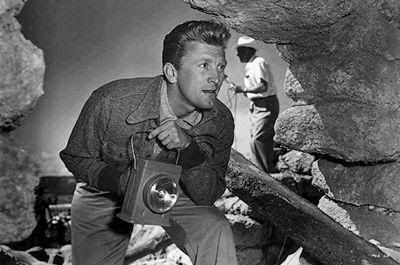
Kirk Douglas in Ace in the Hole, tonight at 8:00 PM

The March spotlight on journalism and the movies continues with a night of what TCM is calling "Newspaper Noir". It kicks off at 8:00 PM with Ace in the Hole, in which Kirk Douglas plays an unethical reporter who gets a big story and decides to draw it out. It's a great movie, although I'm not certain I'd call it noir. I'd call The Blue Gardenia (overnight at 1:30 AM) the most noirish of the movies airing tonight.

To be honest, though, I'm really mentioning Ace in the Hole because I knew I had that photo of Kirk Douglas. I had posted it many years ago back when I was hosting all of the blog's photos at Photobucket. Of course, they went and got rid of hotlinking, trying to charge a ridiculous sum to allow it, and then changed to have a watermark when you hotlink your photos. So every time I think of a movie where I'm pretty certain I posted a photo, I look to repost it, hosting the photo on Blogger/Google. I haven't gotten around to editing the old posts, and frankly don't know that I will. I haven't been using quite so many photos recently, but still there are a lot of them to go through.

Saturday, March 10, 2018

Bluebeard's Eighth Wife

I recently watched Bluebeard's Eighth Wife off my DVR, and with it being available on DVD courtesy of Universal's MOD scheme, I'm also comfortable doing a full-length post on it.

Gary Cooper plays Michael Brandon, a wealthy American businessman currently working on the French Riviera, for reasons that are never really explained. He goes in to one of those old-time department stores where you have to deal with the clerks, wanting to buy some pajamas. Well, he only wants to buy the pajama tops, since he uses those as a sort of night shirt and doesn't wear the pajama bottoms. The store only wants to sell them as a set. Into all this walks Nicole (Claudette Colbert). She solves everybody's problems by offering to buy the pants.

Michael immediately falls in love with Nicole, and starts pursuing her. Nicole, meanwhile, has a father who is a Marquis (Edward Everett Horton), although French titles of nobility no longer meant anything. That lack of meaning probably has a lot to do with why the Marquis is heavily in debt. He's been trying to do a business deal with Brandon, and then when he finds that Brandon has been pursuing Nicole, he gets dollar signs (or probably franc symbols) in his eyes. After an on-again, off-again thing, Nicole finally decides to marry Michael.

And then she finds out about Michael's past. Michael has been married seven times (who wants to deal with that many mothers-in-law?), and always winds up divorcing, leaving his ex-wives with a substantial settlement as he's agreed with them before the marriage. Nicole, for her part, decides that she wants to wangle more money out of him.

As you can guess, the kicker is that the two are going to wind up falling in love, although neither of them wants to admit it. They lead separate lives, with each becoming jealous of the other, leading to the predictable divorce and then a reuniting.

Bluebeard's Eighth Wife is a movie that I found to be a lesser one in the careers of all the major people involved with it. Colbert and Cooper both made much better movies. So did the director, Ernst Lubitsch, and the screenwriters, Billy Wilder and Charles Brackett. I think it has a lot to do with the plot that seems all over the place. It's not really Wilder and Brackett's fault, since they were adapting a French stage play. Still, the characters aren't particularly likable and a lot of their actions make no sense.

Some of the supporting players do well in their smaller parts. David Niven, early in his career, plays Albert, a friend of Nicole's and one of Brandon's employees, and gets a good scene as the wrong man. Horton is quite good, as are Herman Bing as a private eye and Elizabeth Patterson as Nicole's "aunt".

If you want a good movie of any of the main people involved, you can do better than Bluebeard's Eighth Wife. But if you want a comedy from the 30s you might not have seen before, you could do a lot worse.

Monday, July 8, 2013

The Forutne Cookie

I have apparently never done a full-length post on The Fortune Cookie before. That was certainly surprising to me, but I suppose that not having done so before means that at least I've got something to blog about today. The Fortune Cookie is airing tonight at 11:15 PM on TCM.

Jack Lemmon stars as Harry Hinkle, who works as a TV cameraman for CBS covering the NFL. While working behind a camera as part of the crew at a Cleveland Browns game, the play comes in Harry's direction, and like any good professional camera operator, Harry keeps filming away, even though the play comes so much in Harry's direction that he gets bowled over by the player with the football, Luther Jackson (Ron Rich). (I'm not certain how true-to-life this is; I'd have thought even in the 1960s TV cameramen were further away from the field and on stationary platforms. But that's a minor quibble.) Harry is taken to the hospital for observation even though he doesn't think he's too badly injured, suffering nothing more than a minor concussion. Those of course were the days when head injuries weren't considered as severe as they are now.

That trip to the hospital is fortuitous, as it's about to change Harry's wife. Among the people who find out about Harry's incident are his ex-wife Sandy (Judi West), and his brother-in-law Willie Gingrich (Walter Mathau). Harry knows he's going to be OK, but Willie has other ideas. Willie is a lawyer, and sees that with this accident, he can sue everybody in sight for big bucks. But those big bucks are really only going to come if Harry is actually seriously injured, which of course he isn't. If only he could appear to be seriously injured, however.... That, of course, involves a lie, and Harry and Willie both know it's a lie, but Wilie doesn't care, and Harry is weak-willed enough that he eventually acquiesces and goes along with Willie's plan. Sandy sees the dollar signs as well, and she comes back into Harry's life, even though she was the one who had left him in the first place. Harry still has feelings for her, and if this bogus injury can bring her back, well, perhaps that's a benefit.

There are, unsurprisingly, people affected negatively by Harry's "injury". First off are all the people who are going to have to pay out those big bucks: Willie plans to sue the NFL, CBS, and the people who own the stadium. They don't want to, and suspect that there might be something untoward going on, so they hire a pair of private investigators to stalk Harry and catch him on film when he shows, as he's inevitably going to, that he's not really injured. But there's also Luther, who feels a terrible sense of remorse over how he "injured" Harry. Luther develops a friendship with Harry, although his play on the field is also deteriorating....

The Fortune Cookie is a comedy, but it's a fairly dark one, as director Billy Wilder is using the movie as a bitter satire on the state of American lawyers. Matthau, unsurprisingly, is excellent as the sleazy lawyer, and indeed won an Oscar for it. Lemmon is good too, as the man dragged kicking and screaming into this crazy scheme, much the way he was by Tony Curtis in Some Like It Hot (which is airing just before, at 9:00 PM). Ron Rich is believable in his decidedly supporting role. If anything, all of the cast is aided by a wonderful script, but you'd probably expect that from a script by Wilder and frequent collaborator I.A.L. Diamond.

The Fortune Cookie is available on DVD. There are some standalone releases available on Amazon, althoguh I'm not certain if they're still in print. TCM, for its part, is offering the movie as part of a box set.

Saturday, October 16, 2010

Marlene Dietrich night

TCM is showing several movies this evening starring the always wonderful Marlene Dietrich. One that I haven't recommended before is this week's TCM Essential, A Foreign Affair, which kicks off the night at 8:00 PM ET.

The scene is Berlin, not long after the end of World War II. A delegation from the US House of Representatives, including Representative Phoebe Frost from Iowa (Jean Arthur), has flown to West Berlin to investigate the morale of the American troops stationed there; namely, are they fraternizing too much with some of the Germans? After all, in those days West Berlin was filled not only with Germans who would still have sympathized with the Nazis, but spies for the Communists as well. (Berlin Express, which deserves a post of its own one of these days, is another good period example of this; one that's a straight-up thriller.) Rep. Cates is pretty quickly put in touch with US Army Capt. John Pringle (John Lund), who just happens to be one of Cates' constituents. Together, the two are supposed to determine the real truth about the US soldiers and particularly, their relationship with nightclub singer Erika von Schlütow (Marlene Dietrich), who under the previous regime had had some romantic dalliances with high-ranking Nazis.

The investigation develops some predictable problems at this point. We quickly learn that von Schlütow is a woman who will romance almost anybody for the purpose of survival; now that the Nazis have been defeated, that means cozying up to the occupation forces, specifically in the person of one Capt. John Pringle. It's not the only problem John has; he finds that some sparks are beginning to form between him and Rep. Frost. That's just as big a problem for Frost, who is supposed to be no-nonsense. It, however, is not her only problem; she's getting stonewalled from the military higher-ups and the rest of the congressional delegation.

Billy Wilder directed and as often happened co-wrote the screenplay, so you can see how the plot gets so complex and intertwined. Wilder isn't just telling us a good story; he's also giving us some subtle social commentary. As for the performances, Jean Arthur gets to let her hair down once again, singing an "Iowa Corn Song" in the nightclub where Dietrich's character works. Dietrich probably has the tougher task, playing a woman who is at heart amoral and just trying to survive, but does a good job not only of that, but of entertaining us during her musical numbers. I've mentioned before that I'm not a huge fan of John Lund, and while he's adequate here, that's all he is. Still, with Billy Wilder and the two female leads, it's tough to go wrong.

A Foreign Affair does not seem to have gotten a DVD release yet, which is surprising. So you'll have to catch it on TCM.

Saturday, May 1, 2010

Billy Wilder speaks again!

I mentioned the documentary Billy Wilder Speaks about 18 months ago, when it aired as part of a night of Billy Wilder's movies. TCM is showing another night of Wilder's movies; this time, Billy Wilder Speaks concludes the night, at 4:30 AM ET. It's a testament to Wilder's output that there's only one repeat among the films showing tonight compared to those that were aired 18 months ago:

A Foreign Affair is this week's TCM Essential, and kicks off the night at 8:00 PM;
Some Like It Hot follows at 10:15 PM;
The Fortune Cookie (which was one of last year's Essentials) is third, at 12:30 AM; and last is
The Major and the Minor, airing at 2:45 AM.

Friday, April 23, 2010

Five Graves to Cairo

TCM finally got the broadcast rights to the little-sees Billy Wilder movie Five Graves to Cairo at the beginning of the year, and have run it once or twice already. It's airing again tomorrow afternoon at 2:00 PM ET, and, like anything else Wilder made, is well worth watching.

Franchot Tone stars as John Bramble, a corporal in the British Army in North Africa in World War II. His tank has been shot by the Nazis, killing everybody inside but him. Somehow, he manages to escape, and eventually follows a trail which leads him to a partially bombed-out hotel that still has a skeleton staff working. He's saved.

Or maybe not. Although the owner of the place (Akim Tamiroff) and the one other worker, a French maid named Mouche (played by a young Anne Baxter) look after John a bit, they suddenly have to deal with the return of those nasty Nazis, specifically a group led by Field Marshal Rommel (Erich von Stroheim) himself. If the Nazis find out there's a British soldier here, they're definitely going to kill him. And, they might just kill the hotel staff as well for harboring him. Fortunately, however, there was one other staff member at the hotel, a man with a limp named Paul Davos, and he died in the bombing attack. So, all Bramble has to do is play the part of Paul and serve the Nazis much the way any bellboy would do in a regular hotel. He's saved again.

Or again maybe not. What John fairly quickly learns about Paul is that Paul was a spy -- and Paul was working for the Nazis! Paul obviously knew information that John clearly doesn't, so keeping up the masquerade isn't going to be that easy. Things get even worse when John learns from Rommel that there's a plot about "five graves to Cairo", which has something to do with the Nazis' plan to overrun Egypt, and that Paul was supposed to be sent to Cairo as part of the plot. Can John keep his secret from Rommel, and learn enough about the "five graves to Cairo" to help the British foil Rommel's plans? Along the way, John falls in love with Mouche, despite the fact that she's not such a fan of the British. Then, the British start bombing again, which could threaten to reveal the original Paul's body....

Five Graves to Cairo is one of those films to watch for the great Billy Wilder's plot. The acting is capable, but it's the story here, and that story is quite a good one. It's tense when it needs to be, and also contains a good deal of dark humor on the part of Rommel. There's also some lighter humor, provided by an Italian general whom the Nazis really don't like (Fortunio Bonanova). The only possible negative is that, since historical events provide the backdrop, we know Rommel's plan ultimately won't succeed. But, as with The Day of the Jackal, that really doesn't take away from the movie.

Unfortunately, Five Graves to Cairo doesn't seem to have been released to DVD.

Tuesday, February 9, 2010

Sadie Hawkins Valentine's Day, Part 3

TCM is showing another of those military movies with no real war tonight: Stalag 17, at 10:00 PM ET. It's another of those movies that, because of its military setting and its lack of female characters makes it very much a stereotypical "man's movie", but because of the characterization and lack of violence also makes it pretty good for those who would like the stereotypical "women's movie".

The title Stalag 17 refers to a prisoner of war camp, namely one in Germany during World War II, with a bunch of American POWs. There's been an escape attempt which is to be expected; but, it's gone wrong, in that the escapees are caught by the Nazi guards, who conveniently know just where to look. It's clear that one of the POWs is a stool pigeon, and the POWs know just where to look, too: in the direction of William Holden. Holden is a fellow POW, but also the same sort of character Tony Curtis played in Operation Petticoat: the guy who can finagle almost anything out of anybody, by begging, borrowing, stealing, or wheedling people into giving him what he wants. He's the sort of guy who seems to profit on every deal, and that, combined with his naturally standoffish personality, makes him the obvious choice for the other Americans to suspect as being the informant. Holden, of course, knows that he's not the informant, and sets out to prove his innocence, which he can really only do by finding the real informant. And so, Stalag 17 turns from being a dark comedy about the war into more of a mystery/thriller.

Stalag 17 was directed by Billy Wilder, who was a master of making dark, cynical movies. Wilder was also excellent at getting great performances from his actors, and Stalag 17 is no exception. In addition to Holden, there's also Wilder's fellow director Otto Preminger, playing the German commander of the POW camp; and future director Don Murray as a new POW who is in danger because of how much he did to the Nazis before being captured, and whom Holden tries to help escape when Holden creates a diversion by exposing the informant.

Wednesday, January 14, 2009

Multitalented directors

Jack Lemmon is TCM's Star of the Month for January, and tonight, TCM are showing the movies that he made with director Billy Wilder. Although some truly great movies are being shown, starting off with The Apartment at 8:00 PM and Some Like It Hot at 10:15 PM, it's interesting to think about many of the great Billy Wilder movies that aren't airing tonight, and span a bunch of genres: mysteries like Witness for the Prosecution; romantic comedies like Sabrina, wild farces like One, Two, Three, and hard-hitting dramas like Sunset Blvd. or The Lost Weekend.

Wilder himself, however, said that he wasn't quite the greatest director, largely because he felt he couldn't do a musical. Indeed, Irma La Douce (airing overnight at 12:30 AM) was based on a musical but doesn't have songs. Other directors, however, were just as broad as Wilder, and directed musicals too.

Michael Curtiz was under contract to Warner Brothers for years, making back-to-back movies out of 20,000 Years in Sing Sing and Mystery of the Wax Museum early on in his career. Two different genres you may not find, until you consider that he won the Oscar for directing Casablanca -- which he made immediately after the musical Yankee Doodle Dandy.

Or, consider Howard Hawks. Early in his career, he made the hard-hitting crime drama Scarface. Usually, of courses, he's remembered for his comedies like Bringing Up Baby or His Girl Friday. But he also did a pretty good job on movies with lots of musical numbers, like A Song is Born, or Gentlemen Prefer Blondes.

Having said that, Wilder did have a talent that Curtiz didn't (and Hawks had, but only to a lesser extent): he was a great screenwriter. In addition to co-writing the scripts to most of his own movies, Wilder was responsible for some of the great movies of the late 1930s like Ninotchka.

Monday, November 24, 2008

The producers kindly ask that you not spoil the ending

This week sees the last night of Charles Laughton's time as TCM's Star of the Month. Laughton made many great movies, and one of those near the top of the list would have to be Witness for the Prosecution, airing at 10:15 PM ET tonight.

Laughton plays a prominent London barrister who's had a heart attack, and is about to go off to Bermuda for a well-deserved retirement. However, fate intervenes in the form of Tyrone Power, who's been charged with murdering a rich old lady. There are a lot of discrpeancies in the case, and in many ways it doesn't look so good for Power, but Laughton agrees to take the case.

What follows is a stand-out legal drama, even if it does contain some of the clichés of Hollywood movie-making. Laughton's man who's fighting against time goes back to at least the Warner Baxter producer of 42nd Street a quarter-century earlier. The vacillation between whether we should think Power is guilty or innocent is also a staple of lawyer movies, as is the dark humor.

The cast includes Elsa Lanchester as Laughton's nurse, and Marlene Dietrich as Power's wife, and the movie was directed by the great Billy Wilder, based on a play by the equally talented Agatha Christie. If seeing all those famous names in the cast and crew makes you think this is going to be a good movie, well, you'd be right.

You'll note that I haven't gone into that much of a description of the plot. That's because when the movie was made, it was well-known that the ending was going to be something to watch out for. Indeed, in the trailers for the movie, the producers deliberately asked people not to reveal the ending to their friends, as that would spoil the movie for them. And so I too won't spoil that ending, if you haven't seen it before.

Sunday, November 16, 2008

The Seven Year Itch

One of the commendable things the Fox Movie Channel does is its weekly Fox Legacy series, where, on Friday nights, Fox executive Tom Rothman introduces a well-known movie from the Fox studio, including some of the classics. The movies air three times in succession on Friday evenings, with a movie repeated the following Sunday. Last week's Friday selection, which will be shown again tonight at 8:00 PM ET, is The Seven Year Itch.

Marilyn Monroe stars, but we'll get to her in a bit. The movie starts off with faithful husband Richard Sherman (played by Tom Ewell) saying goodbye to his wife and son as they leave New York City for a summer vacation out in the country. Unfortunately, he has to stay behind and work. That's bad enough, but there are two other problems he has. First, he's got a vivid imagination, resulting in what are almost delusions of grandeur. Worse, is that that imagination is about to be let loose on his new upstairs neighbor, played by Marilyn Monroe.

Monroe is her typical steaming hot stuff, and Mr. Sherman naturally begins to believe that perhaps she's falling in love with him. Certainly, she needs a man. She's new to the city, and thoroughly incompetent, and so, she consistently ends up in Sherman's apartment, ultimately testing his marriage. The Seven Year Itch is, of course, the movie with the very famous scene of Monroe standing over a subway grate, while the air forced out by the train causes her dress to billow up around her, revealing her panties. It's still sexy today; it must have been shocking in the mid-1950s when the movie was released.

There's really not much to the story other than The Man, The Girl, and The Overactive Imagination, but this is still a pretty darn good farce. Much of that credit is due to Billy Wilder, who directed the movie, and just as importantly, co-wrote the screenplay from George Axelrod's play.

The folks at Fox should be thanked for showing this, and really ought to be encouraged to put more of their older classics on in prime time. They have quite a bit of good stuff, that's prestigious enough that they wouldn't have to play obscure movies that "regular" people wouldn't recognize. Fox Legacy has already shown Gentleman's Agreement, and they have other Oscar-winning movies like The Grapes of Wrath and How Green Was My Valley that they could show, to name just two.

Monday, October 6, 2008

Sensationalism

Anybody who thinks journalists are a paragon of objectivity is probably deluding himself. Anybody who thinks today's state of affairs is any worse than it was in the past is, however, also deluding himself. Journalists have been bending the rules for decades if not longer, as we have already discussed regarding 1933's Picture-Snatcher. One of the best movies about dishonest resporters is airing on TCM at 10:00 AM ET on October 7: Billy Wilder's Ace In the Hole.

Kirk Douglas stars as Chuck Tatum, a drunken reporter whose lack of ethics has gotten him fired from or made persona non grata at, all the important papers in major US cities. Tatum is passing through the Albuquerque of the early 1950s, a time when New Mexico was even more sparsely populated compared to the rest of the US than it is today. The editor of the newspaper there gives him a chance, and Tatum takes it to go quickly back to his old ways.

While driving around the more out-of-the-way parts of New Mexico, Tatum comes across a man who's trapped inside an abandoned mine that caved in. When Tatum investigates and finds out that the man seems to be OK for the time being, he decides to engineer things such that the rescue will take much longer than it should, in order that he may draw out the rescue and have it be a major news story for longer. Anybody who remembers Jessica McClure will recognize that such a story presents more than enough opportunity for a media circus. In the case of Ace In the Hole, a literal carnival forms at the mine entrance, complete with bright lights and amusement-park rides.

Tatum, meanwhile, grows even more scheming, deciding to try to bribe the trapped man's wife (the impossibly gorgeous Jan Sterling; one wonders how on earth she got stuck in the middle of New Mexico) and getting the local sheriff to sign off on his plans because there's an upcoming election. Of course, everything eventually goes wrong: we find out that the wife really doesn't love her husband, and was planning to divorce him, and the poor trapped man eventually dies. But who cares about him? To the media, he was just a story. At the time the movie was released, it was a commercial failure, so much so that they tried re-releasing it under a more friendly title, The Big Carnival. That didn't help.

Normally, I don't care to hear that a movie is "relevant" half a century on. However, things haven't changed in the media, and that's true regardless of one's political views: reporters seem to have no qualms about trying cases in the media, or about exploting children, for example. (Every time you hear a reporter say that "ten people died in a fire; three of them were children", ask yourself why they don't mention that seven of the dead were adults.) Ace In the Hole is a pretty damn good indictment of all this, yet remains a highly entertaining movie in its own right.

Saturday, August 9, 2008

Alfred Hitchcock and the Oscars

TCM's Essential for tonight is Billy Wilder's The Apartment, airing at 8:00 PM ET. Wilder won another Best Director Oscar for the movie, beating out, amongst others, the great Alfred Hitchcock, who had received his fifth and final Best Director nomination for his masterpiece Psycho. I'd have to think long and hard about which of the two had the better directing job, but suffice it to say, either one would have been a worthy winner, and there's no shame in being beaten out by a movie as good as The Apartment.

But spare a thought for Hitchcock: despite those five nominations, he never actually won a competitive Oscar. (He later received an honorary Oscar in 1967.) Worse for him, regarding Psycho, is that this wasn't the first time he had been nominated, but beaten by Wilder. In 1945, Hitchcock had been nominated for Spellbound (which is airing on August 25 as part of TCM's Summer Under the Stars salute to Ingrid Bergman), but had the bad luck to be beaten out by Wilder's truly remarkable movie The Lost Weekend. This time, at least, Hitchcock probably didn't deserve the Oscar.

You can say the same thing about Hitch's first and fourth nominations, too. The first came in 1940, when Hitchcock was nominated for Rebecca. It won the grand prize, beating out classic movies like The Philadelphia Story to win the Best Picture Oscar, but for direction, Hitchcock had to settle for watching the great John Ford take home a statuette for another all-time classic, The Grapes of Wrath. Likewise, in 1954, Hitchcock directed another outstanding movie in Rear Window. Unfortunately for him, he had the tremendous misfortune of being up against one Elia Kazan who had directed a thing called On The Waterfront.

Hitchcock probably did deserve to win one competitive Oscar, though. In 1944, he was nominated for Lifeboat which, being set entirely in and around a ship's lifeboat, shows a remarkable display of direction. But the Academy had some really warped thinking in 1944. The movie that won a lot of the major prizes was the dreadful Going My Way. It wasn't just the direction where worthy nominees got the shaft. Bing Crosby won the Best Actor Oscar, and thanks to a screw-up by the Academy, co-star Barry Fitzgerald was also nominated, meaning that one of the acting snubs was Fred MacMurray, who was the male lead in... Billy Wilder's Double Indemnity.

For the record, Wilder himself lost to some remarkable movies. The aforementioned On The Waterfront beat out Wilder's direction in Sabrina, while his even better directing job in Stalag 17 was beaten out by another even more outstanding movie, Fred Zinneman's From Here to Eternity.