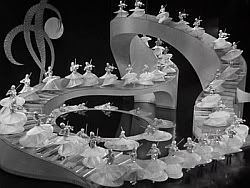
Showing posts with label Dick Powell. Show all posts

Thursday, March 5, 2026

Jeepers Creepers

Actor Dick Powell made Murder, My Sweet in no small part because he wanted to be able to show himself to be more than a light comic actor crooning away in pictures. Powell of course had that reputation going back to some of the great early musicals like 42nd Street, but watching a late 1930s musical like Going Places makes it so much easier to see why Powell wanted to do "serious" work.

Powell plays Peter Mason, who works as a clerk in a creaky old New York sporting-goods store under Franklin Dexter (Walter Catlett). It's one of those places that comes across as old-fashioned even by the standards of the 1930s, with one of the few customers being Col. Withering (Thurston Hall), who goes on fake safaris and buys stuff from the store to display as his catches to the society set who attend his lectures.

The store needs more business, but it's also the sort of store that finds advertising to be terribly gauche. They hit upon an idea, however, which is to have a famous horseman endorse their goods and mingle with the society set that would attend polo matches, the summer racing season at Saratoga, or in the case of this movie, a steeplechase in Maryland. And they even have just such a horseman under contract, Peter Randall. Unfortunately, Randall is currently racing down under, but since information traveled slowly in those days, they can just have Peter Mason impersonate Randall and none of the Maryland horse set will figure out the ruse. (Yeah, right.)

The first thing Peter and his boss find when they get to Maryland is a wild horse that only responds to the musical stylings of extremely musically talented groomsman Gabriel (Louis Armstrong) singing the standard "Jeepers Creepers" which here is the original. One of the next things the find is Col. Withering, who knows the ruse but has his own reasons for not revealing it: namely, that his sister-in-law who funds the safaris, has been threatening to cut him off. Another of the rich set is Ellen Parker (Anita Louise), and she and Peter immediately hit it off. But that's because Ellen thinks of Peter as the horseman, not as a lowly clerk there to imitate the horseman and advertise the store. Ellen is also pursued by Col. Withering's nephew Jack (Ronald Reagan).

Eventually the big race comes up, and there's going to be a lot of betting on who's going to win. Trying to influence the betting, albeit in a decidedly less-than-legal way, are the professional gamblers Maxie (Harold Huber) and Droopy (Allen Jenkins). Eventually Peter winds up having to ride the wild horse we saw at the beginning, even though he's barely able to ride a horse at all.

As I said at the beginning, watching a movie like Going Places, it's obvious why Powell had started to chafe having to make all these musicals with increasingly lesser music and even worse plots. Still, Warner Bros. had a lot of talented musical people, so the song and dance numbers mostly work for those who enjoy musical movies. Going Places is not a great movie by any means, but I suppose it could have been much worse considering some of the much more dire horse racing movies I've seen.

Saturday, October 11, 2025

We're not quite in the money

Another of those classic movies that TCM shows often enough because it's part of the old Turner library, but that I'd never actually seen before, is Gold Diggers of 1935. So, the last time it showed up on TCM I made the point of recording it so that I could do a post on it eventually.

The movie opens up with a ridiculous number of staff members making final preparations for what seems to be the grand opening of a new hotel, except that it's not new but only open for the summer which is why you wonder how it can support such a large staff. Among the staff are desk clerk Dick Curtis (Dick Powell), who is taking on this summer job in his years between college, as he's really hoping to complete his studies to become a doctor and marry his girlfriend Arline (Dorothy Dare).

Coming to the resort are the ultra-wealthy who have decamped from New York or Boston, one supposes, since this is mentioned as being New Hampshire. One such family is the Prentiss family, led by a matriarch widow (Alice Brady) with two adult children: Humbolt (Frank McHugh) and Ann (Gloria Stuart). Humbolt is a playboy who has already been through four wives and cost Mom a ton of money to get out of the marriages as a result. Ann is set to be married to T. Mosley Thorpe (Hugh Herbert), which is in many ways more of a marriage of convenience since Thorpe is even more fabulously wealthy than the Prentiss family. Ann certainly doesn't seem thrilled with the idea of this marriage.

And then we see why. Thorpe will also be spending the summer at this resort, working on his book, a monograph on snuff boxes. He has the hotel send up a secretary to take dictation, getting sent young Betty (Glenda Farrell) who falls for him and also sees dollar signs. You can already guess how part of the romantic conflict is going to be solved. The other half comes when Mrs. Prentiss hires Dick as a chaperone for Ann. Those two fall in love, which seems a bit mean to Arline but things are going to turn out OK for her in the end too.

Mrs. Prentiss is asked to put on a charity show, something the family has apparently been asked to do every year, and it's at this point that we learn that she's no longer as fabulously wealthy as she used to be, thanks to the Depression cutting the dividends her late husband's business interests yield. Stage producer Nicoleff (Adolphe Menjou) shows up; he's heavily in debt and gets the idea of taking Prentiss for as much as he can while putting on that show. The show is, of course, the big excuse for all the musical numbers the movie has around the wafer-thin plot, with the highlight musical number being "The Lullaby of Broadway".

The plot of Gold Diggers of 1935 is even sillier than some of the previous musicals Dick Powell had made, although again one doesn't watch a Busby Berkeley musical for the scintillating plots. Hugh Herbert is playing such a drip that it's only logical the only thing anybody really sees in him is his money. Dick Powell is appealing, although he doesn't have much to do. It's no wonder he wanted to do a movie like Murder, My Sweet so that he could be considered a more "serious" actor.

Having finally seen Gold Diggers of 1935, I understand why it's not as well known as its predecessor Gold Diggers of 1933. It's watchable, and the "Lullabye of Broadway" number is worth the price of admission, but it's not an all-time great either.

Friday, November 22, 2024

Murder, My Sweet

A few months back I did a review of the Robert Mitchum movie Farewell, My Lovely, based on the novel by Raymond Chandler about the detective Philip Marlowe. I mentioned at the time that the book had been turned into a movie 30 years earlier with the title Murder, My Sweet. That earlier version shows up on TCM tonight (Nov. 22) at 11:45 PM, so I recently sat down to watch the movie so I could do a review here.

The story is mostly the same between the two movies, although Murder, My Sweet does a bit less in part because of the Production Code. Here, it's Dick Powell playing Philip Marlowe, and as the movie opens he's blindfolded in an investigation room of a police precinct being questioned about the things that have happened to him in the last few weeks as part of cases both he and the police have been investigating. Flash back to some time ago, and "Moose" Malloy comes to Marlowe asking for information about the whereabouts of former nightclub girl Velma Valento. Moose has just done a seven-year stretch in prison and, having been released recently, wants to find the girl he loved. She apparently doesn't love him enough to have kept writing, although her old boss at the nightclub claims she's dead.

The following morning, Marlowe receives a call from a Mr. Marriott, wanting him to work as a go-between. Marriott is paying a sort of ransom to get back a jade necklace that was stolen. He doesn't want to go alone because of the danger, and he's right to be afraid. At the rendezvous, somebody hits both of them over the head, knocking Marlowe out (and giving him the sort of concussion you'd think would make his memory an issue) and killing Marriott.

Also interested in the neckless is the Grayle family: elderly father Leuwen (Miles Mander), trophy second wife Helen (Claire Trevor), and Leuwen's adult daughter from his first marriage Ann (Ann Shirley). Ann shows up at Marlowe's plays with a phony identity trying to get information; in fact the necklace belonged to Ann's stepmother. Ann and Helen at various points in the story each want to hire Marlowe, so he's naturally unsure of which of the two to trust, or even if either of the two he can trust. And there are other shady figures here. Somebody's putting words into Moose's ear that Marlowe knows where Velma really is, and then someone who may or may not be the same person as the previous someone basically kidnaps Marlowe and drugs him up for three days.

Eventually, Marlowe is able to put everything together, although as with that other Philip Marlowe story The Big Sleep, how well everything winds up fitting together is an open issue.

Obviously, as this wasn't the first version of the story I watched, I found myself thinking about the Robert Mitchum Farewell, My Lovely as I was watching Murder, My Sweet. I think each of the films has its advantages and disadvantages. In the case of Farewell, My Lovely, having been made in the 70s works in that there's more that can be discussed, such as Velma's nightclub now serving a predominantly black clientele. There are also a few other subplots. But what works better for Murder, My Sweet is that it has a contemporary setting during World War II. Farewell, My Lovely is done as a flashback to the summer of 1941 and a lot of the time the movie has the look of something that's too Hollywood clean for a simulation of the 1940s as they really were.

Mitchum was a natural as Philip Marlowe; Dick Powell wanted the role (well, really he wanted Walter Neff in Double Indemnity) precisely because everybody thought he wasn't a natural to play a hard-boiled private detective. Powell pulls it off well, and it changed his career; for the rest of his career he was able to get meaty dramatic roles.

Both versions of Raymond Chandler's story are worth watching, and tonight's your chance to catch the Dick Powell version.

Sunday, September 1, 2024

Shipmates Forever

A couple of months back, I did a post on the Dick Powell/Ruby Keeler movie Flirtation Walk, mentioning that it was going to be airing in a double feature with another Powell/Keeler movie, Shipmates Forever; in fact I had both on my DVR from a previous double feature. Going through the long backlog of movies on my DVR, I've finally gotten around to watching Shipmates Forever, so now would be a good time to do a post on it.

This time around, Dick Powell doesn't start off in the US military. Instead, it's his father, a man named Richard Melville II and played by Lewis Stone, who is in the military. Specifically, he's an admiral who has reached the age where they can't really use him on a ship any more so that he'd be better for the Navy as the commandant of the Naval Academy in Annapolis. He's about to have his last watch ceremony on board ship, and would really like his son, Richard III (that's Dick Powell, as implied above) to come down and see it.

Dick III, being played by Dick Powell, is a radio crooner who loves his father, but would really rather continue being a radio crooner since his heart isn't anywhere near the navy and besides, his radio work really pays the bills in a way serving in the navy wouldn't. But since he loves his father, he travels to port to see his father's retirement ceremony. Dad uses this as an opportunity to try to manipulate his son into trying out for the Academy. Interestingly, Dad's rather selfish treatment of his son is consistently portrayed in Shipmates Forever as a good thing.

At the ceremony, Dick III meets a lovely young woman, June Blackburn (Ruby Keeler), and immediately falls for her. In talking about joining the Navy, June mentions that she's not so certain she wants a husband in the navy, since she lost her father and a brother in the war (which of course refers to the first World War, since the movie predates the European theater of World War II). But young Dick finally caves to his father's pressure, and takes the entrance exam with the intenion of refusing his commission when he graduates.

We then get introduced to a couple of other men who also want to enroll at the academy. Coxswain (John Arledge) is already in the Navy but wants to become an officer, which necessitates getting into Annapolis. Cowboy (Eddie Acuff) is joining from Arizona, while Sparks (Ross Alexander), who has a way with the radio, is also not from a navy family.

As you can guess, all for get in, and become roommates together, at least during their first year. But young Dick is still insistent on going back to crooning after graduation, refusing the commission, so he makes himself distant from those who would otherwise be his friends. This includes even Coxswain, who really wants Dick's help in not flunking out of the Academy. Once again, Dick's actions are presented as being a bad thing. And then, to make matters worse, June tells Dick that she can't marry him if he drops out of the Academy or refuses his commission!

Of course, as you might guess, Dick is going to get a chance to "redeem" himself at the end, and given what's transpired in the first 90 minutes or so, you can guess how that's going to go. Shipmates Forever is supposed to be a feel-good movie.

For me, however, Shipmates Forever doesn't work as well as Flirtation Walk, for several reasons, and I say that as someone who didn't think Flirtation Walk holds up as well as the Warner's musicals from 1933. One is that, as I strongly implied above, Lewis Stone is just downright nasty here at times as the father trying to cajole his son into following his footsteps, and not what the son wants -- especially considering what the son wants is in no way unrespectable or immoral. Worse, however, is that Powell and especially Keeler are somewhat misused here. Shipmates Forever is somewhat of a musical, and Powell certainly gets to sing. But Keeler, known as a dancer (cue the jokes about the quality of her dancing), gets precious few opportunities to dance. And there aren't any Warner Bros.-style musical numbers here.

Shipmates Forever comes across as the sort of movie where the studio bosses saw the success of Powell and Keeler as a screen couple and wanted to put them in another movie together, but didn't really have anything ready to put them into. The result is a movie where the component parts don't really jell.

Sunday, July 21, 2024

The Hardy Family Noir

I mentioned a few months back upgrading my home "theater", not that it's much of a theater, by buying a 40" TV for the upstairs room and getting a Blu-ray player for the TV. The player, it turned out, was misconfigured out of the box in that it was set up to show everything in full-screen, so when I put in a DVD of an old movie not in a wide-screen format, it filled up the screen with no pillarboxing. I couldn't figure out how to change the aspect ratio on the TV until I figured it might be an issue with the Blu-ray player. So that's part of the reason I haven't gotten to my rather severe backlog of DVDs that I have. Well, that, and the fact that stuff only stays on the DVR for nine months while the DVDs are closer to permanent. But recently, I finally decided to watch another movie out of my Will Rogers box set: Too Busy to Work.

A brief establishing sequence shows something that's going to come up again later in the movie: a small town where a hold-up takes place one night, and there's shooting when the getaway car tries to get away. An older guy named nicknamed Jubilo (Will Rogers) witnesses all this. The next morning, we discover the guy is actually a hobo, and one who is very averse to work. He gets involved with another tramp trying to catch a rabbit, before coming upon a swimming hole where a third man has left his suit jacket hanging on a tree. So Jubilo exchages jackets, before walking to a house where we see on a mailbox, "Judge Hardy".

Now, this isn't the Judge Hardy from MGM's popular series of the late 1930s and early 1940s; that's just a coincidence albeit a rather humorous one. Jubilo gets treed by a dog, before the Hardys' maid (Louise Beavers) shows up. Jubilo charms her with stories about being from Alabama, even calling her "Mammy", and basically cons her into giving him some food. As for the man whose jacket he took, that's Axel, who works as a ranchhand on the Hardys' spread since the Hardys have a bit of a soft spot about helping out Depression-era hobos in exchange for doing work around the place.

But Jubilo is work-averse, and tricks Axel into doing what should be Jubilo's jobs, in a way that makes Jubilo seem like a very unsympathetic character. Then again, that's not the reason why Jubilo decided to stop at the Hardy place. He asks Mammy about the Hardy family history, and learns that the judge (Frederick Burton) lost his first wife ages ago and married another woman who had a young daughter Rose who is now an adult (Marian Nixon). Rose's mother died a few years back, and she's in love with the judge's son from the first mother, Dan (Dick Powell, yes, that Dick Powell before he did those Warner Bros. musicals).

That family is actually why Jubilo is here. Jubilo claims that he served honorably in World War I, although considering how we've seen him con Mammy and Axel, one wonders whether this is a made-up story as well. However, Jubilo also says that when he returned from the war, another man had run off with his wife, and that broke him, which is why he's now a tramp, having spent a long time going around the country looking for the man who did this to him. It doesn't take much to guess that Jubilo has concluded that it's Judge Hardy who married Jubilo's wife, and based on conversations the two men have, Judge Hardy knows it, too.

And then Dan returns home, telling Rose that he's going to have to run off. Dan and Jubilo actually saw each other the previous night, as Dan was tricked into serving as the getaway driver from that hold-up. Dan, seeing Jubilo, figures that Jubilo is there to rat him out to the authorities, not knowing anything about Jubilo's real reason for being here. Rose, similarly, doesn't know anything, and doesn't remember her biological father.

This is all rather strange for a Will Rogers movie, since he's generally more remembered for his folksy, homespun wisdom. In fact, this strangeness is why I had some difficulty warming up to Too Busy to Work. Rogers seems terribly miscast for a man with this sort of dark past, and his dark past turning him into a petty confidence man makes him unsympathetic for much of the movie. Also odd is that this is based on a story by Ben Ames Williams, a name you might recognize from one of his most famous works, Leave Her to Heaven.

I'm glad that a box set included Too Busy to Work, but it's definitely a bit strange and not to everybody's taste.

Wednesday, May 8, 2024

Flirtation Walk

There are several movies coming up on TCM in the next two or three days that are on my DVR and that I haven't blogged about before. Two of them are part of a double bill of Dick Powell/Ruby Keeler musicals that I think were on the same double bill when I recorded them some months back. The first of those movies is Flirtation Walk, which shows up overnight between May 9 and 10 at 1:45 AM (so that's technically early May 10 in the Eastern time zone, but still May 9 in the Pacific). The second one is Shipmates Forever, but that's not getting a post of its own just yet because I've never been the biggest fan of doing multiple posts on movies from the same person or in a closely similar genre in close succession if I can avoid it. That, and there are two movies overnight between May 10/11 which aren't really related, so one of them gets a post tomorrow, May 9, with the other getting a post on May 10.

Dick Powell plays Dick Dorcy, an enlisted man in the Army who is stationed in Hawaii (this being a dozen years or so before World War II) serving under Sgt. Thornhill (Pat O'Brien). Ruby Keeler plays Kit Fitts, who is the daughter of a general who is only passing through Hawaii on his way to a posting in the Philippines, since that was a US colony at the time. Gen. Fitts is traveling with his daughter, as well as an adjutant, Lt. Biddle (John Eldredge) who also happens to be Kit's boyfriend, something you'd think might be a problem considering Biddle might be serving under his future father-in-law.

Now, since Dick Powell and Ruby Keeler are top billed, you might guess that they're going to get romantically involved, and might just even wind up together in the final reel, although it's going to take several reels for them to get together for that requisite happy ending. The two characters are brought together courtesy of Sgt. Thornhill, who assignes Dorcy to be Miss Fitts' driver while she's on Oahu. Kit wants to see the island, so she orders Dorcy to take her off base to some of the more scenic spots, with the two of them winding up at a luau where it seems Dorcy already knows some of the ethnic Hawaiian locals, even singing "Aloha Oe".

But Dorcy is an enlisted man, and Fitts is not only the daughter of an officer, but a young woman who already has an officer pursuing her. So he doesn't quite understand it when he gets accused of wrongdoing and Kit says she didn't really love Dorcy. Dorcy first thinks about desertion, but ultimately decides that the way to get the respect of people like Kit and Biddle is to become an officer himself. I don't know if they had an Officer Candidates' School back in those days, but in any case Dorcy eschews this, applying to West Point instead!

Dorcy somehow gets accepted, and is good at the military stuff, to the point that by the time senior year comes along, he's considered a leader among men in his class. He's even given the job of writing the class revue for senior spring. But a monkey wrench gets thrown into the works when West Point gets a new commandant: Gen. Fitts! He brings back his daughter, who is still involved with Biddle although they're still not engaged. Nobody else at West Point knows about Dorcy's previous involvment with Miss Pitts, so when the cadets all meet her, everyone else is taken with her while Dorcy feigns complete indifference.

The other cadets, thinking Kit is so charming, decide that they want to break with tradition and include a female part in the revue, with Kit being just the woman for the part. Dorcy, of course, is mortified, and this leads to the complications that eventually get resolved in the standard-issue happy way in the final reel.

Flirtation Walk somehow got an Oscar nomination for Best Picture, although that was the first era of having 10 Best Picture nominees before it got cut to five in the early 1940s. Looking through the list of nominees (this was the year It Happened One Night won), it also looks like a fairly weak list of nominees. It's not that Flirtation Walk is bad; it's more that it pales in comparison to Warner Bros.' musicals of the previous year, and feels a lot more like a programmer than a prestige movie. I'm not the biggest fan of Ruby Keeler, but the movie doesn't give her enough to do. Ditto Pat O'Brien, since the movie in many ways seems like two movies grafted together, the Hawaii half and the West Point half.

Still, everybody is more than professional with the material they're given, and nobody really hits a wrong note. So Flirtation Walk winds up being something more than pleasant enough, and certainly entertaining for fans of musicals or romantic dramedies. But there's a reason why Flirtation Walk is less well-known than a lot of other musicals out there.

Tuesday, November 21, 2023

Johnny O'Clock

One more movie that's currently available on Tubi through the end of November is Johnny O'Clock. Since it's leaving soon, I wanted to make certain I could watch it and give you enough of a heads-up to catch it yourself.

Dick Powell, having made the transition to darker movies, plays the titular character, a man who runs a casino and lives in what seems like one of those apartment hotels adjacent to the casino. As the movie opens, we learn of an alleged gangster who was shot to death resisting arrest, something that brings police detective Koch (a young Lee J. Cobb, although this movie hows he never looked young) into the case, and eventually closer and closer to Johnny's life.

Johnny manages the casino for his business partner Guido Marchettis (Thomas Gomez, who for some reason gets credited as S. Thomas Gomez). Their relationship is a bit more complicated, however, as at some point in the past Johnny had been in a relationship with Nelle (Ellen Drew), who is now Mrs. Guido Marchettis. Nelle still holds some sort of torch for Johnny, however, as she sends him a fancy fob watch that's engraved on the back. Johnny, fairly horrified by this, gives the watch to the hat-check girl, Harriet Hobson (Nina Foch), so that she can arrange to have it returned to Nelle.

The watch never gets returned to Nelle, however. Harriet is found dead of a suicide in her apartment, having stuck her head in the gas oven and turned it on. She was in a relationship with Chuck, a cop who turns out to have been corrupt, and also goes missing. Eventually, he too is found dead, and that gives Koch the idea that either Johnny or Guido must be responsible for the killing. Worse, it's later discovered that Harriet had poison in her stomach, leading Koch to believe she was murdered too, with the oven thing designed to make it look like she had committed suicide.

As has happened several times in movies, especially in movies of the 1940s, the dead girl has a sibling who suddenly comes to the big city to try to find out what happened to her sister and hopefully win justice in the case. In this movie, that sister is Nancy Hobson (Evelyn Keyes). Making things more complicated, Nancy finds herself falling in love with Johnny. Johnny eventually finds the same is happening with him, not that he wants it, as he's smart enough to know how much danger this will put Nancy in. So he tries to put Nancy on a plane out of town for her own safety, only to become a victim of a drive-by shooting just as he's heading out of the airport.

It's a bit of a complicated plot that Johnny O'Clock has, and to be honest that's not always to the movie's benefit. Thankfully, everybody in the cast show themselves to be quite good at the sort of material they're given, making the movie better than it probably has a right to be. It's stylish, and definitely a nice entry to the noir cycle, something that Eddie Muller should probably show if he hasn't done so already.

Sunday, November 8, 2020

Hard to Get

Olivia de Havilland died at the end of July, and TCM replaced an entire day of their original Summer Under the Stars with a day of de Havilland's movies, which gave me the chance to record a couple of movies that I hadn't seen before, and certainly hadn't blogged about. One of them is Hard to Get.

De Havilland plays Maggie Richards, elder daughter in a wealthy New York family of the sort that would go off to Newport for the summer. Except that for whatever reason, she decides she's not going to go this year, staying behind with her father (Charles Winninger) while Mom (Isabel Jeans) and her sister Connie (Bonita Granville) head off the Newport only to show up again in the final reel.

Maggie goes off for a drive, stopping to get gas at a service station somewhere in the suburbs which is run by Bill Davis (Dick Powell). Bill is an architect who is running the station because he has plans that the company should be setting up a bunch of Interstate-style service areas with attached motels (although there were no Interstate highways back in those days, of course), somewhat like the desert station we see in Heat Lightning. Anyhow, Maggie doesn't have any money on her, simply expecting to be able to put any purchases on a tab or to be able to come back and pay the next day. Yeah, right, says Bill, who makes her do chores around the station to pay off the debt.

Maggie is irritated by this, so she comes up with a plan for revenge after Dad tells her that Bill was right to do what she did. She finds out about Bill's plans for the service stations, which works to her benefit as Dad is an oilman who knows the people who could put the plan into motion. So she gives Bill Dad's nickname as a password to get in to see him, knowing fully well that Dad only gives that nickname out to his closest friends and is going to be pissed to see this stranger calling him by that nickname. Dad wants to know who gave Bill the name, but Bill isn't going to tell.

Instead, Bill winds up going back and forth between Mr. Richards and Atwater (Thurston Hall), a banker who isn't about to give Bill the time of day either despite Bill's increasingly outlandish schemes to try to get in to see both Atwater and Mr. Richards. Bill gets one of the Richards' maids (Penny Singleton) involved, and as you can probably guess, also starts to fall in love with Maggie along the way. She has fallen in love with him first, but it's going to take until the last reel for the two to wind up together even though we know it's coming.

Hard to Get is predictable but still competently made, which should be no surprise considering the caliber of stars in the lead roles. Watching it, though, I can see why de Havilland is one of those people who tried to break her contract to get better roles. After thinking about her time at Warner Bros., most of her good roles were with Errol Flynn, while her other good roles were at other studios (eg. Gone With the Wind or Hold Back the Dawn). Powell, it feels like, is taking a step down into a programmer with a routine plot and a lot fewer musical numbers for him to sing. However, he did get one classic in "You Must Have Been a Beautiful Baby".

Hard to Get is perfectly passable entertainment, and a movie that's more than worth watching the next time it shows up on TCM. It got a DVD release courtesy of the Warner Archive Collection, although it's another of those movies that would be nice to see in a box set.

Saturday, June 20, 2020

Meet the People


Genres wax and wane over time. And then there are movies that become dated because of events. One of the bigger examples of this is the World War II morale booster. A good example of this is Meet the People.

William Swanson (Dick Powell) works at a shipbulding plant in Delaware building ships as part of the war effort. One day, a war bond drive brings to the plant the prominent musical actress Julie Hampton (Lucille Ball), with the chance to win a date with her. Wouldn't you know it, Swanson wins! And he uses the date with Julie to tell her about the play he wrote. It's one of those everyman dramas that would have been funded by the Federal Theater Project a half-dozen years earlier back when they were paying anybody to put out New Deal propaganda.

Swanson signs a contract to have the play staged in New York, with Julie starring. But there's a catch. Julie wisely doesn't like the play, and wants it turned into a rousing musical. Swanson hates this, since it would strip all the "meaning" from his play. And the contract says the play has to be performed the way he wrote it, or that he has to approve changes. And there is no way he's going to have it staged as a musical. So Swanson takes his ball and goes home, telling Julie that she really needs to "meet the people" and learn what drives them.

She actually takes that advice to heart, sort of. She decides she's going to get a job as a Rosie the Riveter type, becoming a welder even though she presumably has no idea how to do it. And she gets a job at the same plant where Swanson works! Of course, she's really trying to get back into his good graces so that she can get the musical produced.

As you can guess, there are going to be a lot of complications along the way, but that the two leads are going to wind up together in the last reel with both of them compromising somewhat. (It helps that William has a heroic Marine cousin whose songs can get used in a musical version of the play.) But half the fun is getting there.

And there is some fun, especially in a scene with Spike Jones and his band, doing a spoof of Hitler with Hitler being played by a chimpanzee! Paul Regan and his celebrity impersonations are also OK, although he never became a big star. Vaughn Monroe, a popular bandleader of the day, appears, and a young June Allyson appears, ready to fall in love with Dick Powell, marry him, and live happily ever after, or at least until he died tragically young.

But to be honest, Meet the People is a product of its time, and I have to admit that of the World War II-era musicals, I tend to prefer what Fox was putting out. MGM didn't give Meet the People the Technicolor treatment, so while it's certainly competent, it's also quite bland and the songs not particularly memorable.

Meet the People did get a DVD release courtesy of the Warner Archive collection. It's available on Amazon, although it's one of those movies that the TCM Shop oddly claims is on backorder.

Saturday, February 22, 2020

The Enemy Below


A movie that's been in the FXM rotation for a little while now is The Enemy Below. It's going to be on again tomorrow morning at 10:00 AM and Monday at 6:00 AM, so you've got a couple more chances to watch.

The USS Haynes is a destroyer setting off for a tour of the South Atlantic during World War II, on patrol to prevent German ships and submarines from doing whatever it is they do. The crew isn't necessarily certain of their new captain, Murrell (Robert Mitchum), in part because he lost his last command, a Merchant Marine boat, when it got torpedoed in the North Atlantic by the Germans. Some think Lt. Ware (David Hedison, who I think was still credited as Al as he was at the beginning of his career), the second-in-command, should have been promoted, but as he admits, his experience in captaining is limited to yachts in Miami.

But they're all here to patrol, and with the radar on, they quickly find a surfaced Nazi U-Boat, which is captained by Von Stolberg (Curt Jurgens). Von Stolberg dives and sonar from the Haynes starts pinging the U-boat and following it, trying to keep up the same course and speed so that the Nazis might think this is just an echo and not actually a ship following them. But Von Stolberg is no dummy, having been in command of submarines for years, and fires torpedoes at the US ship, narrowly missing.

Thus begins a cat-and-mouse game between the two veteran captains, but of whom are intelligent and have a pretty darn good idea of what the other is thinking and planning to do, which isn't going to make getting out of this sitation easy for either of them.

It's a bit tough to give much more of a synopsis than the above, mostly because this being a submarine pursuit film, there's not much more that can be done. I suppoe you could build up characters' back stories, but that isn't particularly necessary.

Having said that, however, The Enemy Below is quite good. It does move a bit slow at times, but again I think that's part of the nature of a submarine pursuit movie. Since the submarine is hiding out underwater, there's a lot of waiting going on that just can't be helped. I think I preferred The Bedford Incident slightly for adding a reporter character which opened things up a bit, and even Run Silent, Run Deep. But The Enemy Below is still an excellent example of the genre and well worth a watch.

Unfortunately, the print FXM ran is both letterboxed and pillarboxed (at least on my TV I was able to blow it up and as far as I could tell keep the proper aspect ratio). But it's also on DVD if you want to obtain it that way.

Sunday, December 30, 2018

Blessed Event

A movie that I DVRed earlier in the month as part of TCM's Star of the Month salute to Dick Powell is Blessed Event. It's available on DVD courtesy of the Warner Archive, so now you get the full-length post treatment on it.

This was Dick Powell's film debut, so he's not the star here, although he gets a relatively big supporting role. The star here is Lee Tracy, so you should probably already know what to expect. Tracy plays Alvin Roberts, who's working his way up the ladder in the newspaper business. He gets a chance to move up when Moxley (Ned Sparks), the guy who writes the gossip column, goes on vacation leaving Alvin to write it. Alvin has a contact at the maternity hospital to the stars, so he starts dropping hints in the column that various famous people are going to be having "blessed events".

This ticks off a bunch of people who don't want their private lives discussed like this. It also bothers his girlfriend Gladys (Mary Brian), who thinks Alvin should be doing more honest work. On the other hand, the column proves to be a hit as circulation increases massively. With that, he also gets a radio show.

As for Dick Powell, he plays crooner Bunny Harmon, who has a radio show of his own what with his brand of band music being perfect for the radio. Alvin doesn't like crooners, and especially Bunny, for no real reason. So Alvin and Bunny have a rivalry throwing barbs at each other although these aren't just friendly barbs: the two really dislike each other. One final person who dislikes Alvin is the gangster Gobel (Edwin Maxwell), who sends underling Frankie (Allen Jenkins) to try to get Alvin to lay off those notices involving the unnamed gangster.

Of course, Alvin is unable to do so, especially because one of the stories he breaks involves the gangster in a way Alvin doesn't realize at first. But when it does, Gobel has a plan to get Alvin, and the opening of Bunny's new nightclub might be just the way to do it. Bunny doesn't want Alvin there crashing the party, of course, while Alvin knows he's going to be there. Gobel could arrange for Bunny to be there and get killed....

Blessed Event is a fun little movie, although it's in many ways typical of the sort of thing Lee Tracy was doing in the pre-Code (and pre-public urination) portion of his career. So it's not bad by any means; it's more a feeling of having seen it before because it's really not treading any new ground. Sometimes, though, you want something comfortable, and if you want that out of a pre-Code, Blessed Event isn't a bad way to get that. Tracy is as good as always; Powell shows promise for his first film; and Ruth Donnelly is a lot of fun as Tracy's secretary.

Thursday, December 6, 2018

TCM Star of the Month December 2018: Dick Powell


Dick Powell (r.) with Barry Sullivan and Lana Turner at the end of The Bad and the Beautiful

We're in the first full week of a new month, so it's time for a new Star of the Month on TCM, and this time it's Dick Powell, a choice given over to Backlot members (I think the choice was between him and Warren William). Powell's movies are going to be on TCM every Thursday in and around prime time. Powell started off in the 1930s doing light musicals, before abruptly switching in the 1940s to hardboiled detective movies, showing his range and proving he really could act for anybody who think those light musicals aren't much The picture above is from one of my favorites, The Bad and the Beautiful, which will be on at 1:00 PM on December 27.

Of course, this being the first Thursday in the month, we don't get the "serious" dramatic movies just yet; no, we get the 1930s fun. Powell I think really became a star with 42nd Street, another movie I really like, and that comes on at 9:30 tonight. It's preceded at 8:00 PM by what I think is his movie debut, in Blessed Event, where the star is Lee Tracy, playing a gossip columnist who isn't quite orthodox in his methods. Powell is a crooner (surprise, surprise) in that one who is the object of Tracy's poison pen.

Monday, August 25, 2014

I remember the video game

Dick Powell, who is being honored by TCM in Summer Under the Stars today, spent the first half of his career making light musicals, and much of the second half of his career making rather darker movies. One of those darker movies that I've never blogged about before is Pitfall, which comes on at 4:15 PM.

Powell plays John Forbes, who at the start of the movie is enjoying his solid middle-class life in a suburban house with his wife Sue (Jane Wyatt) and son Tommy, eating one of those typical middle-class breakfasts from the middle of the last century that show up on film and TV. Sue drives John to the insurance agency where he's been working the same job for years, and reminds John of that night's dinner date, which has been with the same people they've been having dinner with once a week every week for years. It's a solid, but boring life.

In fact, John makes such an obviously overloud complaint about his boring lot in life that you know his life is going to become much less boring in a reel or two. That excitement starts off when John gets to his office and finds private investigator MacDonald (Raymond Burr) in his office. This was in the stage of Burr's career whne he was playing the bad guys, and even just in that first scene in Forbes' office, we can see that his character is rather creepy. MacDonald had been hired by the insurance company to find out what a convicted embezzler named Smiley did with the money, since Forbes' firm is having ot pay out on the insurance claim to the company from which Smiley had embezzled. It turns out that Smiley had bought a bunch of gifts for his girlfriend Mona (Lizabeth Scott), so the insurance company is going to try to repossess those items. MacDonald has done his job; now it's time for Forbes to take over.

So Forbes heads over to Mona's place. Unsurprisingly, Mona doesn't like him at first -- would you like a guy whose job it was to repossess your stuff? Mona realizes, though, as the rest of us do, that Forbes' job is kind of boring, so she's determined to make it more exciting, fur by taking him out for a drink, and then the next day taking him for a ride on the boat that was one of the things Smiley had bought for her. Forbes is beginning to spend entirely too much time with Mona, and predictably, he's beginning to fall for her. He's about to get that excitement he wanted in life, but who says it's a good thing?

Obivously, Forbes' relationship with Mona is a problem because of the fact that he's already married. But there's another problem: the ever-creepy MacDonald. MacDonald had also fallen for Mona when he was investigated her, and he's not about to have anybody else muscle in on his relationship with Mona. Never mind what Mona wants, which is certainly not a relationship with MacDonald. Heck, she's even willing to break off the relationship with Forbes when she finds out that he's married. But MacDonald is still harassing her, and Forbes is the only person who can do anything about it....

Pitfall is quite enjoyable. Dick Powell is eminently capable as the basically good guy who screws up big time, drawing on his experience making all those musicals to play the good father, and then the experience from those darker movies when he's trying to cover up his mistakes. Lizabeth Scott is more than suitable as the femme fatale; it's easy to see why both Forbes and MacDonald would fall for her. Once again, though, it's Raymond Burr as the heavy who's the most entertaining to watch. He's a manipulative bastard here, and boy is Raymond Burr making his character look like a creepy jerk.

Pitfall did get a DVD release a couple of years ago, in that it's available at Amazon, but it seems to be out of print as it's not available at the TCM Shop.

Friday, November 29, 2013

Christmas in July

Tonight's the last Friday in November, so we're reaching the end of the Friday Night Spotlight on screwball comedies. This week sees a couple of Preston Sturges movies from the end of the screwball era. Of them, the one I haven't recommended before is Christmas in July, which you can see at 9:45 PM.

Dick Powell stars as Jimmy McDonald, a good guy working in the accounting department of some big business, but not really getting ahead in the world. He's engaged to Betty (Ellen Drew), but still lives with Mother in an apartment building in the poorer part of town. Part of the problem is that Jimmy dreams of getting rich, in a way peculiar to the decade or so just before World War II: winning big money in a radio contest. (You'll remember a radio contest being a major part of the plot to The Magnificent Dope.) This particular contest has a grand prize of $25,000, which would have been several years' income back in 1940, and involves coming up with the best new slogan for Maxford Coffee. (Where's Mrs. Olsen when you need her?)

Meanwhile, we get to see the contest in action. Everbody's sent in their slogans, and now it's tim for the jury to select the winners, but there's a problem: the jury can't agree on which slogan ought to be the winner. One juror, Mr. Bidlocker (William Demarest) has one slogan in mind, while everybody else has a different one. With the contest at a deadlock, some of Jimmy's co-workers decide to play a cruel joke on him: they send him a bogus telegram claiming that his slogan has been selected the winner, and he should go see Mr. Maxford (Raymond Walbourn) to pick up his $25,000 check. Some co-workers. Jimmy goes, and because Maxford has been unable to get in touch with any of the jurors, he assumes that the incompentent jurors simply never informed him that they had finally selected a winner. So, Maxford actually cuts Jimmy a $25,000 check on the spot!

Being declared the winner of one of these big radio contests changes Jimmy in that it gives him more confidence, but it really changes other people's perception of Jimmy just as much. Jimmy's boss gives him a promotion, and retailers are more than happy to give Jimmy an advance on his check when he wants to buy an engagement ring for Betty and gifts for all of the people in his apartment building. It's only at this point that the other shoe drops, and Maxford discovers that the telegraph was a phony, and that the jury still hasn't selected a winner. Maxford understandably presumes that Jimmy is trying to con him, and stops payment on the check. What a PR nightmare.

Things look terrible for Jimmy, but this being a Preston Sturges comedy, you know it's going to have a reasonably happy ending for him and Betty. It's more a question of how the characters are going to reach the resolution that allows the viewers to be happy for Jimmy and Betty. In that regard, Christmas in July succeeds fairly well, although I'm not going to give away the ending.

Christmas in July was only Sturges' second movie as a director following The Great McGinty, so even though he had written quite a few screenplays, the full Preston Sturges style isn't quite here yet. Christmas in July isn't quite as zany as The Palm Beach Story or The Miracle of Morgan's Creek, and it isn't as pointed in its criticisms of people in power as Sullivan's Travels or Hail the Conquering Hero. It's fairly gentle, but a nice gentle. And it's still Preston Sturges. Even his mess The Great Moment was worth watching. And Christmas in July is much more successful than The Great Moment.

The TCM shop lists Christmas in July as being available as part of a Preston Sturges box set. It did get a standalone DVD release a couple of years ago, at least according to Amazon, but I don't know if that's still in print.

Friday, July 22, 2011

The Tall Target

A month or so ago, TCM showed The Tall Target, which I hadn't seen before, although it happens to have been released to the Warner Archive collection. It's showing up again tomorrow morning at 9:30 AM, and is worth a viewing

Dick Powell, long since past his days as a star of light musicals, plays John Kennedy, a detective with the New York police in early 1861. This is the time just before Abraham Lincoln was to be inaugurated President (remember, back then, inauguration day wasn't until March), and for obvious reasons, there were a lot of Southerners who would have been more than happy to see Lincoln never become President. Kennedy believes he has good intelligence that there's a specific plot afoot to assassinate the President-elect when he changes trains in Baltimore, but unfortunately, he can't get the right people to believe him. The wrong people, on the other hand, certaingly believe it, because they're part of the apparent plot: Kennedy is supposed to have a ticket for the train from New York to Washington, but when he gets to the station, he finds there are people who don't want him on the train. Eventually, he's taken in by his old friend Col. Jeffers (Adolphe Menjou), who has an extra berth in his compartment. The only problem is, Jeffers turns out not to be much of a friend, as he's in on the plot, and even tries to shoot Kennedy. Jeffersthen uses his power to get Kennedy turned over to the police, and from there The Tall Target becomes a movie along the lines of Alfred Hitchcock's Saboteur, where the hero has not only to foil the bad guys, but stay one step ahead of the police in doing so.

Fortunately, he's able to pick up an ally in the form of Rachel, a slave played by a young Ruby Dee. Her owner's brother (Marshall Thompson) is a southerner claiming he's going to South Carolina, but Rachel knows he's actually planning to get off in Baltimore. There are other people, too, how may or may not have something to do with the assassination plot, which suddenly has to be called off when it's revealed that Lincoln has cancelled his previously scheduled stop in Baltimore. Or is the plot over? There wouldn't be much of a movie if that's how the conflict was resolved, so we know that there is still one more trick up the sleeve of the scriptwriters.

I don't think that The Tall Target is near the level of Saboteur; nor is it as good as the train-based thriller The Narrow Margin But it's entertaining and well-made in its own right. Adolphe Menjou is always worth watching, and Dick Powell is rather an underrated actor. Also, the movie does a fairly good job of maintaining the suspense up until the final denouement.

Sunday, November 28, 2010

And he learned about dames

The birth anniversary of choreographer/director Busby Berkeley (born November 29, 1895) is coming up tomorrow. TCM will be marking the occasion with seven of the many films on which Berkeley worked, creating some of the more outrageous dance numbers you'll ever see on screen. The first of these is one that I don't think I've ever mentioned before: 1934's Dames, at 6:00 AM ET.

As is the case with most Berkeley movies, the plot is secondary, and here it's somewhat reminiscent of the earlier Gold Diggers of 1933 (which is airing at 11:30 AM tomorrow). Hugh Herbert plays a wealthy "reformer" who wants to rid the world of smut, especially that sort of smut you'd see on the theatre stage when presented by showgirls. Herbert shows up at the New York mansion of his sister (ZaSu Pitts) and her husband (Guy Kibbee), not realizing that their daughter (Ruby Keeler) would like to be a showgirl herself, and that she's in love with a man (Dick Powell) who's written a Broadway show and trying to get it produced. Just as the girls in Gold Diggers of 1933 blackmail Guy Kibbee, there's a showgirl here (Joan Blondell) who can blackmail Kibbee, having ended up in his train compartment.

Of course the plot is silly stuff, as people went to see Busby Berkeley's movies for the extravagant musical numbers. Here, you've got Joan Blondell in a "Girl at the Ironing Board" routine, and of course the finale. Plus, Dick Powell introduced the song "I Only Have Eyes for You". Those who enjoy Berkeley's work will love Dames, although I, not being such a big fan of musicals, personally prefer Gold Diggers of 1933 and 42nd Street.

Dames has gotten a DVD release, both individually and as part of a Busby Berkeley box set.

Monday, November 22, 2010

Footlight Parade

Of the various genres to become popular in the 1930s, the musical is near the top. As I've mentioned with 42nd Street, thanks to Busby Berkeley, viewers were treated to ever more spectacular musical numbers. Another of Berkeley's efforts shows up on TCM tonight: Footlight Parade, at 9:00 PM ET.

James Cagney stars as Chester Kent, a vaudeville producer left scrambling for work after the Depression more or less killed off vaudeville. That, and the moving picutres, now that the pictures can talk. However, with the Depression, even the movie theaters need gimmicks to bring in the patrons, and that's where Kent comes in. He's got his old gang who can produce "prologues", live musical numbers that will be performed for the audiences before the picture begins. It's still a cut-throat business, though; he's got a gold-digging girlfriend (Claire Dodd) to deal with, as well as two guys (Guy Kibbee and Hugh Herbert) who would steal his material. He's helped out though, by his able secretary (Joan Blondell) who would be a better match for him than Dodd. Along the way, Ruby Keeler and Dick Powell become the stars of the prologues and fall in love....

In a movie like Footlight Parade, the story is second to the elaborate musical numbers, which bear no resemblance to reality. Nobody has a staircase like the one in Gold Diggers of 1933, and no movie theater could hold all the waterworks needed for the musical numbers in Footlight Parade. Never mind the prohibitive cost of the stuff, either. Audiences wanted escapism, and got it in droves. This also being 1933, they were treated to copious amounts of the mildly racy material that would be gone from movies just a year later thanks to the Production Code.

Even though Footlight Parade was made for its musical numbers, it would be a bit unfair not to mention the acting performances. Most of the folks here were staples of the Warner Bros. lot, and had worked together a number of times. Cagney is great as always, and it's a shame that he got shunted into more "serious" gangster roles than fun stuff like this. Joan Blondell is good as the cynical but no-nonsense secretary, although it would also be interesting to see wisecracking Glenda Farrell in the role. Keeler and Powell are their usual selves, basically reprising the roles they had done in 42nd Street. And Guy Kibbee is always fun to watch.

Footlight Parade got a DVD release as part of a Busby Berkeley boxset a few years back, but also seems to have gotten the individual DVD treatment.

Wednesday, November 11, 2009

Hooray for Hollywood!

You probably recognize the song Hooray for Hollywood. But it was first used in a movie that doesn't get much attention: Hollywood Hotel, which TCM is showing tonight at 8:00 PM ET, as part of the TCM salute to lyricist Johnny Mercer.

Hollywood Hotel is one of those movies that's more about the musical numbers, so the plot is rather scattershot and convoluted. Dick Powell plays a saxophone player in Benny Goodman's band (Goodman is played here by himself) who wins a contest to get a short-term contract in Hollywood. Unfortunately, the female star of the studio Powell will be working at (played by Lola Lane) is currently in a dispute with the studio bosses and doesn't want to do the PR work on her latest movie. With the premiere coming up, the bosses get the idea of hiring a body double to take her place (conveniently played by Lola's real-life sister Rosemary; no wonder they looked similar!), and have Powell be her date to the premiere. Needless to say, Lola finds out about this, and gets Powell fired, leading to him and Rosemary, who by now have fallen in love, to work at a drive-in restaurant. However, you just know that Powell's vocal talents will be discovered, which happens when the studio's male star (Alan Mowbray) is supposed to sing in his next movie, but can't carry a tune.

Does a lot of this sound like Singin' in the Rain? Unfortunately, Hollywood Hotel is inferior in every aspect. Dick Powell is talented, but he's no Gene Kelly. Likewise, Lola Lane is no Jean Hagen, whose character was only an airhead on the surface. But, it's mostly the material. Hollywood Hotel feels like one of those all-star movies, except with the problem of not being able to come up with a good way of tying all the stars together. Still, there are some interesting cameos to watch for, such as the aforementioned Goodman and the rest of his band (which included Lionel Hampton and Gene Krupa, among others); 1930s gossip columnist Louella Parsons; make-up man Perc Westmore; and Ronald Reagan as a radio announcer.

Friday, July 17, 2009

Early Edition

I suppose I should get back to writing more substantial synopses of upcoming movies. So, the next selection is the rarely-seen 1944 film It Happened Tomorrow, which TCM is showing at 8:30 AM ET Saturday, July 18.

Dick Powell, who at this stage of his career was trying to get into more serious roles as a way of changing his image as a musical actor, stars as Larry Stevens, a man who at the start of the movie is seen celebrating his 50th anniversary with his wife Sylvia (Linda Darnell). Sylvia comments that nobody would believe Larry's story of how they met, so we flash back half a century ago to the gay nineties, and the events that brought them together.... (Sadly, the fact that the story is told as a flashback does give away an important plot point later on in the story.)

It's now the 1890s, and Larry is a young reporter at one of the New York City newspapers. He and several of his colleagues are having a celebration in the newspapers "morgue", where the old papers are kept, and Larry makes a point that he wished he knew what tomorrow's news could be, because that would make him a better reporter. The oldest guy there, the morgue's librarian, tells him to be careful what he wishes for, because it may come true and he might not like the consequences. It's easy to see what happens next: Larry is given a copy of the next day's newspaper, and nobody believes that he knows ahead of time what's going to happen.

Along the way, he meets Sylvia, the daughter of a vaudeville psychic (and accomplice in his act), and falls in love with her, although not everything is a bed of roses. When Larry gets news about a gang of bank robbers, and knows the news before it happens, the police department's natural assumption is that Larry is part of the ring of crooks. If that's not bad enough, Larry eventually gets a newspaper in which his own obituary is the banner headline. Of course, we know he can't die, since he has to live for his anniversary all those years later, but it sets up a tense enough climax.

It Happened Tomorrow is a satisfying enough movie. It won't be put up there with the truly great movies of the era, but it tells an interesting story, it tells it well, and it's good for the whole family to enjoy. It was directed by René Clair, a French director who was part of the wave of people who went into exile in the US after the Nazi occupation and made some highly original movies during their years in Hollywood (see Julien Duvivier's Tales of Manhattan). It Happened Tomorrow is just as original, and happily, has been released to DVD.

Friday, November 14, 2008

Dick Powell, 1904-1963

It was on this day in 1904 that actor Dick Powell was born. Powell was probably best known for his singing in a string of musicals in the 1930s, including (but not limited to) 42nd Street and Gold Diggers of 1933. However, later in his career, Powell showed that he was adept at straight drama, too, playing a southern writer whose work Kirk Douglas wants to turn into a movie in The Bad and the Beautiful.

Interestingly enough, it wasn't just into serious acting that Powell broadened his career. He directed a few movies in the 1950s, such as You Can't Run Away From It, the muscial remake of It Happened One Night starring Jack Lemmon and June Allyson in the Clark Gable and Claudette Colbert roles. Not only that; Powell directed a war movie: The Enemy Below, a Robert Mitchum movie in which a German U-Boat tracks Mitchum's destroyer.

With the exception of You Can't Run Away From It (which is nowhere near as good as the original), all of these movies are available on DVD.