Showing posts with label June Allyson. Show all posts

Sunday, May 31, 2026

For some values of good, and 20 years after the news

One of those movies that shows up often enough on TCM but that I'd never really gotten around to watching is the 1947 version of Good News, which I think I'd generally avoided because it's a musical and because the male lead is played by Peter Lawford, who is not one of my favorite actors. But in any case, the last time it showed up on TCM I finally recorded it so that I could watch it before the next showing. That next showing will be tomorrow, June 1, at 9:30 AM.

The movie is based on a 1927 Broadway musical that had already been filmed once before, in 1930, and unsurprisingly set in 1927. As the opening informs us, it's the time of flappers and the Charleston, with college football being a much bigger sport than professional football in those days. Tait College, clearly on the MGM backlot, is one of those movie colleges that look like the smaller schools that dotted the midwest and where football was in fact a big deal. Tommy Marlowe (Peter Lawford) is the quarterback and captain of the football team, and as such all of the girls are interested in him.

One girl, however, who does not show interest in Tommy at first is transfer student Pat McClellan (Patricia Marshall). That's because she's come from the sort of boarding school where one learns French and where one learns to look for a man who's got a lot of money to marry. Tommy isn't loaded, while non-football player Peter Van Dyne III (Robert Strickland) is. You can tell just by the name. Worse, Pat insults Tommy in French, so that he can't understand just how she's insulting him.

Connie (June Allyson), meanwhile, is a more bookish student, working her way through Tati with a job in the school library, but also the sort of student who's just right to tutor the jocks if you're OK with having the jocks tutored by women and aren't worried about the risk that tutor and tutee might become romantically involved. Peter falls for Connie, and in many ways the feeling is mutual.

There's a problem, however, in that everybody cares about the big game, which means one, that Tommy has to be in the right frame of mind and not worried about romantic complications; and, two, that he be in good academic standing. Both of these get complicated. One is by Connie's roommate Babe thinking she's doing a good thing for Tommy by telling Pat that Tommy comes from money so that she'll be interested in him again, never mind what this does to poor Connie. Second is that Tommy fails one of his exams so that there's the question of academic eligibility. The big game comes, and it looks like Tait may lose to their rival, so everybody has to re-arrange things so that the right people can wind up together.

Along the way, there are any number of subplots about various teammates of Tommy's and their romantic issues, as well as the romantic isues of Connie's sorority sisters. Notably among the supporting cast is a young Mel Tormé. Also, this having been based on a musical, there's also a lot of musical numbers in the MGM style, with vibrant Technicolor and energetic dancing.

Having said all that, whether or not you like Good News is going to be dependent upon whether you like Peter Lawford and June Allyson on the one hand, and on the other whether the MGM musical style is your thing. I'm not the biggest fan of a lot of the MGM musicals, and Good News hasn't changed my opinion on Peter Lawford either. It's not that Good News is a bad movie by any stretch of the imagination; it's just that I'm not the sort of person MGM was trying to appeal to. If you like musicals you'll probably enjoy Good News.

Wednesday, May 22, 2024

Words and Music

Yet another movie that's been sitting on my DVR just waiting for another TCM airing so that I could watch it and do a post on it is the musical "biopic" Words and Music. That next showing on TCM is tomorrow, May 23, at 5:45 PM, so with that in mind I sat down to watch it in order to be able to do a post on it in time for you to watch the next showing.

After an opening credits sequence set over a chorus singing one of the songs of the writing team of Richard Rodgers and Lorenz "Larry" Hart, we're introduced to Rodgers. Well, not Rodgers himself, but Rodgers as a character, played by Tom Drake. The fact that a decidedly second-tier star like Drake is playing Rodgers is a good hint that this is much more a story about Lorenz Hart.

Back in 1919, Lorenz Hart was a struggling songwriter who came up with all sorts of lyrics that the smart set might have thought were witty, but didn't have any music to go with them. His friend Herb Fields (Marshall Thompson), realizing that Larry needed a composer to put those words to music, decided to introduce Larry to one of his friends, that of course being Richard Rodgers. Rodgers is mildly confused considering that Larry doesn't really seem to be listening to his music, but some time later Larry tells him he does like one of his melodies and they should put the two together.

However, actually trying to sell any of their songs is much more difficult. Eventually Richard gets to the point that he thinks seriously about giving up trying to become a composer, telling his father that he's going to quit music to go into selling children's apparel. But Larry ropes him back in asking him to give it one last chance, and wouldn't you know it, but the Garrick Gaieties comes along introducing a bunch of new faces to Broadway, with Rodgers and Hart being asked to be among those new faces, even if not on the onstage side.

One person who might make a nice new face is struggling actress Peggy Lorgan (Betty Garrett). Larry does try to get her a starring role in the gaieties, but he's not a producer or casting agent, with the result being that another actress, Joyce Harmon (Ann Sothern) gets the part. Still, the two develop a nice friendship together. It goes far enough that Larry decides he's going to ask Peggy to marry him, but she turns him down. This is where the "biopic" really starts getting sanitized, as if it weren't already being sanitized to this point.

In real life, Lorenz Hart was gay at a time when one couldn't really be gay in public life. Apparently, he did have an actress with whom he was good enough friends that he'd ask her to marry him in what would have been an obvious sham relationship in the Tab Hunter/Natalie Wood vein, but that actress turned him down. Again in real life, being gay and not being able to be so publicly led Larry to engage in heavy drinking and other self destructive behavior that led to his death just before the age of 50, as well as to Richard Rodgers' decision to team up with Oscar Hammerstein when Broadway came calling with what would be the musical Oklahoma. Hart did live long enough to see that become a success, dying not long after.

So while Words and Music really plays fast and loose with the facts, in some ways that's not the reason one would watch a movie like this. In a film about a composer, it's always going to be just as much if not more about the music as about the music. And as we all know, Rodgers and Hart wrote quite a few of the great pre-war songs from the Great American Songbook. Not only is there the music, but MGM took a whole bunch of its musical stars under contract and had them do cameos singing various of the Rodgers and Hart songs. These include Judy Garland, Gene Kelly, Lena Horne, Perry Como, and others.

Words and Music may be utter nonsense as far as the historical facts go. But if you like vintage Broadway music, you'll get that in spades. That, combined with MGM's superb Freed Unit production values. Maybe someday somebody will put the real story of Lorenz Hart on film. But I don't think it would be as vivacious a movie as Words and Music.

Tuesday, March 19, 2024

The Part of Greer Garson is now being played by Claudette Colbert

Once Greer Garson came over the the US and started working at MGM, they teamed her with Walter Pidgeon in a series of movies like the recently-mentioned Mrs. Miniver that the audiences loved. A movie that feels like MGM had it planned for Garson, but which does not in fact star her, is The Secret Heart. I recorded it the last time it was on TCM, and recently watched it.

In an apartment in New York, a young man named Chase Addams (Robert Sterling) is returning home after a stint in the Navy, presumably having served in World War II since the movie was released in late 1946. He's returning to his girlfriend Kay (Patricia Medina) who is likely to become his fiancée. Kay informs Chase that his sister Penny (June Allyson) is also home, and that's a cue for Kay to reveal the first half of the back story. Penny is supposed to be at her boarding school, but she hasn't returned since Easter break. Chase is worried about her, and Kay informs him that Penny has gotten worse, playing the piano to think about her late father and stopping any time anyone else shows up. She doesn't even want to play with her own brother around.

At about the same time, Lee Addams (Claudette Colbert) walks in to the office of New York psychologist Dr. Rossiger (Lionel Barrymore). Lee has the same surname is Penny, but is in fact only Penny and Chase's stepmother. Penny has been seeing Dr. Rossiger, but Lee is worried about her. Meanwhile, Dr. Rossiger sees that some sort of family therapy might be in order so he asks Lee to reveal the other half of the back story.

Ten years earlier, Larry Addams was a widower with two younger children. He met Lee and the two fell in love, but Lee's aunt wasn't so sure the two should get married. After going to England to see her aunt, Lee decides she's going to marry Larry after all. On the ship back to New York, she meets Larry's friend Chris Matthews (Walter Pidgeon), and he falls in love with Lee not realizing that she is going to be married to Lee. They get married, but Penny doesn't seem to like her new step-mother all that much.

Larry, meanwhile, is an alcoholic who wanted to become a concert pianist but couldn't afford it, so he took up work as an investment banker and drinks to dull the pain. But he's also been embezzling money from his clients, and when that catches up with him, he decides to commit suicide by throwing himself off a cliff near their farmhouse in Rhode Island. Larry left his family with a lot of debt, and Lee sets about trying to pay off those debts, not telling Penny the truth about how the father she loved really died.

Back in the present, Dr. Rossiger suggests that if the family goes back to the farmhouse where Mr. Addams killed himself, perhaps Penny would finally be forced to confront the past and finally get over the trauma. Wouldn't you know it, but Chris, being into sailing, has a boat and country house near where the Addams' farmhouse is. Meeting up with Lee again and with her being a widow, it might be a good time to pursue her like in Imitation of Life. However, also like Imitation of Life, Penny finds herself falling in love with Chris. When the truth of whom Chris really loves comes out, that might just drive Penny over the edge....

The Secret Heart is another of those movies that MGM tried to make a Big Important Picture after the war, dealing with new themes in Freudian psychology, even though it's not quite a prestige picture. However, this is MGM, which means that once again we get all the glitz that MGM could bring to such a project even when glitz is not what the material needs.

The Secret Heart isn't a bad movie by any stretch of the imagination; it's just that it's one of those movies that consistently feels as though it's got something not quite right about it. As much as the stars try, than can't quite overcome the saccharine nature of what should be serious material. Everything from top to bottom is professionally made -- but it should have been made in some other way.

Tuesday, October 4, 2022

Wartime Love Triangle #8470351207509

Another of the movies that was on my DVR that I recently watched was Two Girls and a Sailor. Having been produced by MGM, it's unsurprisingly made its way to DVD courtesy of the Warner Archive.

The Deyo sisters -- Patsy (June Allyson) and Jean (Gloria DeHaven) -- are sisters born of vaudeville parents. They've grown up and their parents have died, so they decide to start a double act of their own, singing and dancing. Of course, vaudeville as their parents would have known it had more or less died by this point, but there's still a war on and soldiers and sailors to be entertained. The Deyos would like to open a canteen for the men going off to war, but of course, that takes money they don't have.

You just know somebody with money is going to come into their lives, and you can probably guess right away who that person is. An anonymous benefactor the sisters refer to as "Somebody" sends a lawyer their way to let them know they own the building next to their apartment, a heretofore vacant building that they can refurbish and turn into that canteen. The two sisters try to figure out who their benefactor can be, while dealing with romantic involvments from the servicemen.

John Brown (Van Johnson), about to go back and fight more with the Navy, is one of those servicemen. Patsy is really in love with him and Jean certainly likes him, with John first choosing Jean. It turns out, however, that Jean meets another serviceman, soldier Frank Miller (Tom Drake), and she could see herself with him, except that she doesn't want to hurt poor John. John realizes that he really prefers Patsy, but again, he doesn't want to hurt Jean, and this causes a whole lot of heartache for Patsy before we get to the big finale where the right couples wind up with each other.

Two Girls and a Sailor was released in the middle of 1944, so don't expect an original plot here. Instead, it was designed for the morale of the people on the homefront, combining a Hallmark Channel-type story with a whole bunch of musical acts, the latter being what people would have gone to see above the story. Indeed, there are a lot of people who get more or less their own title card, appearing as themselves. There's José Iturbi and his lesser-known sister doing a two-piano piece; Harry James leading an orchestra; Lean Horne singing; and Gracie Allen, without George Burns, making life a nightmare for José Iturbi and Xavier Cugat. She plays a piano number with one finger, over the objections of the two men, reminding them, "Don't you know there's a war on?"

One person not playing himself is Jimmy Durante, as a fellow vaudevillean whose wife walked out on him ages ago, leaving him to quit the business and live as a squatter in the building that the Deyos convert into the canteen. When everybody finds out who he is, he's going to be cajoled into coming out of retirement....

As I said, the plot is nothing to write home about. The musical numbers, however, are, at least for the sort of people who like movies of the 1940s and are interested in the sort of movies Hollywood was making during World War II to try to brighten everybody's day. People not into that sort of thing are probably not going to enjoy the movie all that much, other than as a sort of museum piece.

Friday, August 28, 2020

The Girl in White


About a year ago, I mentioned that I had intended to DVR the June Allyson movie The Girl in White but instead recorded Two Sisters from Boston. When TCM did its series on biopics of women, they re-ran The Girl in White. Recently I got around to watching it, and since it's on DVD courtesy of the Warner Archive, I'm happy to do a review of it.

Allyson plays Emily Dunning, who at the beginning of the movie is moving into a new place in New York sometime in the 1890s with her heavily-pregnant mother. Mom goes into labor, and Emily has to find a doctor. The only one she can find on such short notice is Dr. Yeomans (Mildred Dunnock), who happens to be a woman doctor, which was almost unheard of back in the 1890s. But meeting Yeomans gives Emily the idea that she too is going to go to college and then medical school and become a doctor. Yeomans is more than sympathetic to Emily, but warns her of the hard road she's going to have ahead.

Still, Emily does go on to college and medical school, studying hard since she feels she needs to be better than all the other medical students, all male, or they won't respect her otherwise. Indeed, most of them tend to make life a bit difficult for Emily, although Ben Barringer (Arthur Kennedy) is a lot nicer to her. The two fall in love, although that's going to cause some problems.

After finishing medical school, Emily plans to go back to New York and hopes to get residency at a hospital there. Ben gets the chance to further his research at Harvard, and there's a conflict over whether Emily should follow as Ben thinks a wife should do. But Emily is firm on going back to New York to help the people she grew up with.

But getting that residency isn't going to be easy, since Emily is a woman. She applies to Gouverneur Hospital, and the chief of staff there, Dr. Pawling (Gary Merrill) is reluctant to accept her. But her grades are so stellar that eventually he's forced to give in. Some accommodations have to be made, of course, since Emily can't actually room with the male doctors. Some of the male doctors try to punish her by changing the duty roster to have her constantly "on call", but this doesn't really stop Emily.

Emily is determined and not always orthodox, as we see when she's theoretically too small to help a very tall sailor (James Arness) with a dislocated shoulder, or when she continues to try to save a patient another intern declared dead (she's successful). She, and ultimately Dr. Yeomans too, gets a chance to shine when there's a typhoid epidemic in the city.

The Girl in White is the sort of programmer that MGM was actually pretty good at making. I know I've criticized MGM here for making stuff that looks too glossy, but a lot of their little programmers and period pieces turn out to be as entertaining as the prestige stuff. The Girl in White is an unpretentious little movie with June Allyson appealing in her role and Kennedy quite good as the man who ultimately has the courage to realize he's got a woman (in real life the two would marry) who's going to have a professional career no matter what. MGM takes liberties with real events for Hollywood purposes, but they work for the story.

If you want a pleasant enough movie about an interesting historical figure, I can definitely recommend The Girl in White.

Saturday, June 20, 2020

Meet the People


Genres wax and wane over time. And then there are movies that become dated because of events. One of the bigger examples of this is the World War II morale booster. A good example of this is Meet the People.

William Swanson (Dick Powell) works at a shipbulding plant in Delaware building ships as part of the war effort. One day, a war bond drive brings to the plant the prominent musical actress Julie Hampton (Lucille Ball), with the chance to win a date with her. Wouldn't you know it, Swanson wins! And he uses the date with Julie to tell her about the play he wrote. It's one of those everyman dramas that would have been funded by the Federal Theater Project a half-dozen years earlier back when they were paying anybody to put out New Deal propaganda.

Swanson signs a contract to have the play staged in New York, with Julie starring. But there's a catch. Julie wisely doesn't like the play, and wants it turned into a rousing musical. Swanson hates this, since it would strip all the "meaning" from his play. And the contract says the play has to be performed the way he wrote it, or that he has to approve changes. And there is no way he's going to have it staged as a musical. So Swanson takes his ball and goes home, telling Julie that she really needs to "meet the people" and learn what drives them.

She actually takes that advice to heart, sort of. She decides she's going to get a job as a Rosie the Riveter type, becoming a welder even though she presumably has no idea how to do it. And she gets a job at the same plant where Swanson works! Of course, she's really trying to get back into his good graces so that she can get the musical produced.

As you can guess, there are going to be a lot of complications along the way, but that the two leads are going to wind up together in the last reel with both of them compromising somewhat. (It helps that William has a heroic Marine cousin whose songs can get used in a musical version of the play.) But half the fun is getting there.

And there is some fun, especially in a scene with Spike Jones and his band, doing a spoof of Hitler with Hitler being played by a chimpanzee! Paul Regan and his celebrity impersonations are also OK, although he never became a big star. Vaughn Monroe, a popular bandleader of the day, appears, and a young June Allyson appears, ready to fall in love with Dick Powell, marry him, and live happily ever after, or at least until he died tragically young.

But to be honest, Meet the People is a product of its time, and I have to admit that of the World War II-era musicals, I tend to prefer what Fox was putting out. MGM didn't give Meet the People the Technicolor treatment, so while it's certainly competent, it's also quite bland and the songs not particularly memorable.

Meet the People did get a DVD release courtesy of the Warner Archive collection. It's available on Amazon, although it's one of those movies that the TCM Shop oddly claims is on backorder.

Saturday, September 14, 2019

What happens when you DVR the wrong movie

June Allyson was part of this year's Summer Under the Stars. One of the movies I thought about putting on the DVR was The Girl in White. Unfortunately, I recorded the wrong title, instead getting Two Sisters from Boston. They're both on DVD courtesy of the Warner Archive collection, so I sat down to watch Two Sisters from Boston to do a post on it.

June plays Martha Chandler, one of the two titular sisters along with Abigail (Kathryn Grayson, so you should know from seeing her name in the cast what sort of movie you're getting) at the turn of the last century. Their family is one of those Boston Brahmin types like in The Late George Apley, very proper and doing things like sponsoring musical recitals. They've also helped support Abigail in her desire to become an opera singer in New York.

But word comes to Martha and Abigail's uncle Jonathan (Harry Hayden) that Abigail has been seen working in a burlesque house in the Bowery! That's bad enough for any patrician family, but Uncle Jonathan is running for mayor, and if the news comes out it would torpedo his candidacy. So they go to New York to find out if this is true, and get her back to Boston if so.

Abigail is in fact working as "High C Susie", at the Golden Rooster, a club run by Spike (Jimmy Durante), although she's not about to tell any of her family this. Her family's support money ran out, and she needed to support herself, after all. She insists that she's had small roles in legitimate operas, and even makes the claim that she's got one tonight. So of course the rest of the family plans to stay on to see her in the opera, which is going to blow the ruse.

Except that Spike is a Jack Carson-level schemer, and knows who the biggest patron of the opera is, Mr. Patterson (Thurston Hall). He uses this info to get Abigail backstage, and from there she works her way not only on stage, but to upstage the lead tenor, Olstrom (Danish opera singer Lauritz Melchior), in a way that causes a whole lot of consternation. Olstrom would like to black-ball this unknown member of the chorus, while Mr. Patterson's son Lawrence (Peter Lawford) thinks she's carrying on an affair with Dad since she used Dad's name to get into the chorus.

Complications ensue, but in the end Abigail gets her chance to be a star while the Lawford and Allyson characters wind up together as you could probably guess. It's the sort of story that offers nothing groundbreaking, but in the right context can be more then entertaining. Unfortunately for me, this time the context is opera, something which in the movies I really don't care for. Grayson isn't bad here when she's not singing, and I suppose opera singers would like her singing. I also have to admit I've never really been a Peter Lawford fan.

Still, this isn't meant to pan the movie. It's more that it's going to be an acquired taste, appealing much more to people who like opera than to people who don't care for it so much. To be fair, I also find Grayson less irritating that Jeanette MacDonald, and either of them far less irritating than Nelson Eddy And Durante is as good here as he always is, although I'll admit that there are probably people who don't care for his shtick. So Two Sisters from Boston is one I'll give a qualified recommendation to -- if you know in advance what it's about.

Wednesday, May 14, 2014

Star of the Month June Allyson, night 2


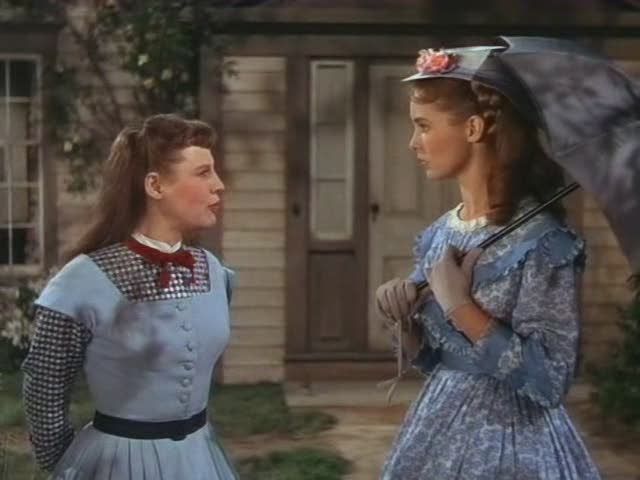
I'm not a huge fan of any of the film versions of Little Women, but I think that has a lot to do with the fact it's more of a story for young girls than for a man my age. Well, I'm not a huge Peter Lawford fan either, and that definitely clouds my view of the June Allyson version of the movie, which kicks off tnoight's salute to her as TCM's Star of the Month, at 8:00 PM.

That's followeb at 10:15 PM by The McConnell Story, which has Allyson as the wife of a Korean War-era fighter pilot.

Then there's a smaller role in Meet the People at 12:15 AM, starring Dick Powell and Lucille Ball.

Allyson plays the redhead in The Reformer and the Redhead at 2:00 AM; it's an underwhelming comedy about Allyson trying to enlist the help of mayoral candidate Dick Powell to keep her father's (Cecil Kellaway) zoo open. Along the way, Allyson and Powell fall in love.

The Girl in White at 3:45 AM has Allyson playing a pioneering lady doctor;

Her Highness and the Bellboy, which comes on at 5:30 AM, sees June Allyson as an invalid whose boyfriend the titular bellboy (Robert Walker) gets mixed up with princess Hedy Lamarr.

Finally, Allyson shows up in Till the Clouds Roll By at 7:30 AM tomorrow; that's a musical biopic of composer Jerome Kern.

Wednesday, May 7, 2014

TCM Star of the Month May 2014: June Allyson


The Stratton Story (1949), on tonight's lineup at 10:15 PM

TCM is finally back to having a tradition Star of the Month, with one night a week every week for a month, aftre the John Wayne marathon in April, and as late as you can start a Star of the Month salute. TCM has selected June Allyson, and will be showing her movies during prime time on Wednesdays, continuing into the early hours of Thursday. Tonight's schedule is as follows:

The Glenn Miller Story at 8:00 PM, in which Allyson plays the wife of the famed swing bandleader (played by James Stewart);
The Stratton Story at 10:15 PM, in which ALlyson plays the wife of one-legged baseball player Monty Stratton (James Stewart again);
The Secret Heart at midnight, which has Allyson as a young woman trying to deal with the loss of her mother;
The Gene Kelly version of The Three Musketeers at 2:00 AM;
Boxing/love triangle movie Right Cross at 4:15 AM;
The Sailor Takes a Wife at 5:45 AM, with Allyson as wife to sailor Robert Walker;
Girl Crazy at 7:30 AM Thursday, which has Allyson in a bit part dancing with Mickey Rooney early in the movie; and
Words and Music at 9:15 AM Thursday, a biopic of Richard Rodgers and Lorenz Hart which overlooks some key facts (Hart's homosexuality).


Little Women (1948) shows up next week, in case you're wondering, but here's a gratuitous photo from that movie

Tuesday, January 14, 2014

Toscanini, Iturbi and Me

As part of the birthday salute to Margaret O'Brien tomorrow, January 15, TCM is airing Music for Millions at 2:00 PM.

O'Brien plays "Mike", a young girl who arrives in the big city alone, having been sent on the train by her aunt up in Connecticut and expecting to be met by her sister Barbara (June Allyson). However, Barbara must not have gotten the telegram, because there's nobody at the train station to meet Mike. Eventually somebody takes pity on Mike and takes her to the symphony hall, since Barbara plays the double bass in the orchestra. What with the war going on, the men have all been drafted to fight, leading poor put-upon Spanish conductor José Iturbi (playing himself) to lead an all-lady orchestra and wonder whether he's going to lose anybody else. Mike screws up the rehearsal by going on stage, which unsurprisingly gets Iturbi angry, but dammit, Mike is just so charming that nobody who doesn't have a heart of stone like I do can't help but fall for her charms.

Mike goes to live with Barbara, who rooms with several other members of the orchestra at a rooming house, where a seven-year-old like Mike isn't wanted, at least not by the landlord. (The question of what she's going to do during the day is pretty much left unanswered.) Barbara is happy to see her sister, since it brings some joy to an otherwise hectic life. In addition to all the stress of being in the orchestra, Barbara is also pregnant, by her husband Joe who knocked her up just before going off to fight in the war -- the Code wouldn't have let her get knocked up out of wedlock, especially not in what was supposed to be a movie for the whole family.

And then Joe goes missing in action. Granted, that's not necessarily family-friendly, but then Music for Millions was released in late 1944, at a time when families all over America would have had to deal with such things in their own lives and would be sympathetic to somebody on screen who had this happen to her. All of Barbara's friends try to keep the news from her, but she already suspects something, not having heard from him for a couple of months.

There's a lot of schmaltz in all of the above. Added to the movie to reduce the schmaltz quotient is Jimmy Durante, who plays Andy, the orchestra's manager. He provides the welcome comic relief, doing things like singing the song "Toscanini, Iturbi, and Me", in which he parodies Iturbi, only for the conductor himself to enter the room without Durante's knowledge. The schmaltz, however, eventually overpowers even Durante, as the movie chugs on to its improbably happy ending.

Music for Millions is a movie that's not badly made; it's just not exactly my sort of movie. People who like Margaret O'Brien, however, will probably enjoy it. It's gotten a release to DVD from the Warner Archive, too, so you can watch it any time you want.

Tuesday, March 5, 2013

Hal LeRoy and June Allyson

Hal LeRoy and June Allyson weren't one of Hollywood's most memorable dance pairs, but you have a chance to see them together in a couple of shorts running on TCM this evening.

First up, at about 7:35 PM, is Ups and Downs, which has Hal as a tap-dancing elevator operator meeting and falling in love with stockbroker's daughter Allyson, even though he's not of her social class. Perhaps giving a good stock tip to her father might help. The second of the shorts, The Knight Is Young, comes on at about 9:35 PM, following Good News. (Good News also stars Allyson, is in the 8:00 PM slot, and runs 93 minutes. It's the first of "Bob's Picks" for this month.) In this second short, Allyson plays an out-of-work girl who talks to the billboard outside her apartment who falls in love with dancing sign-painter LeRoy when he shows up to paint over the current billboard. He invites her to the Sign Painters' Ball (yes, they had a big dance for the sign painters!), and live happily ever after, one presumes.

The movies have next to no plot, which is mildly forgivable considering that you're dealing with two-reelers: there's just not that much time for plot or character development. But if you watch the Crime Does Not Pay shorts or Warner Bros. Technicolor history shorts from the late 1930s, you'll seee that they're so much better than these. Part of that might be down to Hal LeRoy. About the only time I've mentioned him before was in Too Many Girls. Even in that he's the decided weak link. The poor guy has no charisma, and perhaps it should be unsurprising that after Too Many Girls, LeRoy returned to Broadway and the nightclub scene. June Allyson tries, bless her heart, and you can see that she had the makings of a likeable actress in these shorts. But she's not given anything to work with.

In Ups and Downs, watch also for Phil Silvers as a tailor. It's one of his first screen appearances.

Wednesday, June 4, 2008

What is so rare as a day in June?

June Allyson and James Stewart
June Allyson (1917-2006) and James Stewart (1908-1997) later in life

Not having anything else to write about, I figured this June 4 would be a good chance finally to get around to writing that blog entry on June Allyson. Known as "The Girl Next Door", Allyson played a string of nice, likeable women, and wives who would be nice to come home to if you were the husband, especially in musicals. Allyson's acting imbued her characters with an affability that made you want to root for her character (and, in most cases, for her screen husband, too). One of her best wifely roles is opposite James Stewart in the 1954 musical biopic The Glenn Miller Story.

Stewart plays Glenn Miller, the trombonist who can hear a "new" sound in his head, that of an orchestration which would later become one of the hallmarks of the "big band" sound of the 1930s and 1940s. But life is always difficult for a struggling musician, so Miller has to get a whole host of gigs on the road in which he tries to hook everybody on his sound. This being a biopic, we know more or less what happens. America does get hooked on big band music, Miller becomes one of America's most famous musicians, joins the Army in order to entertain the troops abroad, but dies tragically at Christmas 1944 when his plane goes missing. (The best guess as to how he actually died is that a plane returning from a bombing mission dropped its excess payload on a foggy night, inadvertently hitting the plane in which Miller was a passenger.) Allyson plays Miller's wife Helen, being not only a source of steadiness and comfort in Glenn's life, but also an inspiration for some of Miller's finest songs. And indeed, Miller being a musician, composer, and arranger, The Glenn Miller Story is all about the music -- and very fine music it is. Most of Glenn's well-known standards are included, from "Moonlight Serenade" to "String of Pearls", "Chattanooga Choo Choo", "In the Mood", and, in the movie's most poignant moment, "Little Brown Jug".

I'll admit that I don't know exactly how honest the movie is; Hollywood biopics of the era tended to whitewash change or omit a lot of events in people's lives for dramatic effect. However, the music of Glenn Miller is always lovely, the story is a good one, and the performances are all first-rate. Stewart was a natural for this sort of role, as his earnestness and small-town man qualities project easily onto the personality of a man with ideas. Allyson was expert at being the domestic rock and voice of reason, and hits those notes without missing a beat. The supporting roles are also competent, although the best of these are the jazz cameos, including Louis Armstrong and Gene Krupa. The Glenn Miller Story is available on DVD. It might not hold some kids' interest, being a biography of a man playing "old-fashioned" music, but there's nothing family-unfriendly about it. And of course, it's great for any adult who enjoys big band music.