Showing posts with label Fred Zinnemann. Show all posts

Monday, October 21, 2024

Cross No. 7

I've got a couple of World War II movies that I haven't blogged about before on my DVR. One that's technically not a war movie, although it was released during the war and is set in Nazi Germany, is the Spencer Tracy movie The Seventh Cross.

The movie opens up with a shot of several crosses outside one of the old concentration camps inside the borders of Nazi Germany as it was before they annexed any territory or other countries declared war on them; these were not quite the same as the extermination camps set up in present-day Poland to kill the Jews, and had a bunch of political prisoners. Seven men escape from the camp, and one of them, Wallau (Ray Collins), narrates their story, even though he gets captured early on and killed. Since most of them get caught, and Wallau is narrating from beyond the grave, it's mostly the story of one escapee, Georg Heisler (Spencer Tracy).

Heisler along with the others, escaped, but doesn't really have anywhere to go. At least, not many places that could offer him any amount of safety. However, Wallau had been talking about going to Mainz since he had a friend there who is part of the anti-Nazi resistance and might be able to help the men get forged documents that would allow them to travel somewhere, hopefully out of Germany. So Heisler heads there even though he's got a badly injured hand.

The Nazis are making a big deal out of trying to find Georg, no surprise, and are watching as many people who knew Georg as they can think of. As a result, those people who would like to help Georg find themselves unable to do so since they can't reach Georg. The best he can do is see an old girlfriend Leni (Kaaren Verne), but she's no longer able to help him. He's able to get help from a couple of Jews who already know what's coming for them in Nazi Germany, but that is once again only temporary.

Eventually, Georg can only think of one person left who knew him and who, as far as Georg knows, doesn't have any political views, which seems astonishing in a country like Nazi Germany: factory worker Paul Roeder (Hume Cronyn). Paul now has a wife Liesel (Jessica Tandy, who was of course Paul's real-life wife) and kid, and doesn't seem to know anything about Georg's wanted status or why he just suddenly dropped out of society. Paul, however, is fundamentally decent, so he decides that he's going to try to come up with some way to help Georg, even though it's going to put himself in great danger.

There's still a good ways to go in the movie, however, so Georg has a lot more hiding to do until he can either get out of the country or be caught. Considering when the movie was made, I think you can guess how the movie ends.

The Seventh Cross is one of the earliest movies directed in Hollywood by Fred Zinnemann, who does a fine job here. Unsurprisingly, Tracy is also quite good even though I don't think of him as realistically German. Neither is Hume Cronyn, who got an Oscar nomination for his part. If the movie has any flaws, it's in the script which doesn't really get to be subtle since the movie had to be something that would please American audiences during the war. In that regard it succeeds in spades. The Seventh Cross is a fine example of a World War II-era suspense movie.

Tuesday, September 24, 2024

Oklahoma

Hollywood has a long history of finding properties from the Broadway stage to turn into movies, both dramatic plays and musicals. Making roadshow versions of big Broadway musical hits really became a thing in the 1950s, I presume as a way to try to get people away from their new television sets and to a place where they could see something BIG on a big screen and in bright, vibrant colors. Fitting very well into this cycle is the 1955 version of Oklahoma!, which will be on TCM tomorrow, September 25, at 8:00 PM.

Gordon MacRae is the male lead here, playing Curly McLain, a cowboy in the late stages of Oklahoma's being a territory, so around the turn of the last century. He rides onto the scene singing "Oh What a Beautiful Morning", as he's heading to see Laurey Williams (Shirley Jones in her film debut), whom he loves. He wants to invite her to the big box social, but she plays coy because of how slow he's been in trying to woo her. As a bit of revenge, she actually thinks of going to the social with Jud Fry (Rod Steiger), a farm hand on the farm where Laurey lives with her Aunt Eller (Charlotte Greenwood).

Laurey has a friend, Ado Annie (Gloria Grahame), and she's the woman in a love triangle as well. Will Parker (Gene Nelson) is a cowboy like Curly, and wants to marrie Annie, but her father (James Whitmore) isn't so sure as he wants someone with a not so stable profession to marry his daughter. Perhaps if he can go to the big city and show himself to be a success. Will has done that, and his first appearance in the movie is his coming home on the train from Kansas City. However, in the meantime, a peddler, Ali Hakim (Eddie Albert), has come to town, and Annie has an interest in him too.

But the main story is the Laurey/Curly/Jud storyline. Curly and Jud are entirely different, as if you couldn't tell from the casting of Rod Steiger as Jud. Jud is decidedly from the wrong social class, and you get the feeling that in a different sort of western he's be the outlaw, if you can really cast Rod Steiger in a western. He lives in little more than a shack on the farm, and he and Curly get into an argument in the smokehouse that leads to them firing their guns, although at least not at each other. We know, however, that Laurey and Curly are really right for each other, but Laurey has a really bad dream about marrying Curly and how Jud is going to react if that happens.

She was right to have that bad dream. Jud gets even nastier, leading to Curly offering to marry Laurey for protection, which sends Jud over the edge. But this is a musical, so we're going to get a happy ending that also satisfies the Production Code.

I've stated before that I'm not the biggest fan of musicals, so I'm not quite the write blogger to look to for a recommendation on a movie like Oklahoma!. The production is exceedingly well made, and according to the articles I read (I haven't seen any stage version of the musical), it preserves most of Rodgers and Hammerstein's songs, many of which have become standards. MacRae and Jones are also an appealing couple, as they can both sing as well as play convincing pioneer types.

For me, however, the movie did have some problems. One is that the movie runs a bit too long at 141 minutes (and TCM didn't run the roadshow version which has an intro/intermission/exit music). Part of that is down to the dream sequence, which reminded me of the Cyd Charisse number near the end of Singin' in the Rain: it may be well done, but it feels tacked on, and runs so, so long. Some of the casting is also interesting. I mentioned Rod Steiger who I think is out of place as a circa-1900 Oklahoman, although he could certainly play hair-trigger temper types. And then there's Gloria Grahame. IMDb's soundtrack page for the movie doesn't list anybody dubbing her, and it certainly sounds like her voice. Except that she can't sing. Her musical number, "I Can't Say No", brings the production to a screeching halt.

But fans of musicals will most likely love this adaptation of Oklahoma!, and it's easy to see why.

Thursday, September 5, 2024

What if Stanley Kramer did The Best Years of Our Lives?

In looking at the movies that are on my DVR, I notice that I've got quite a few from April when Marlon Brando was TCM's Star of the Month. So even though I've got some older stuff on my DVR, especially foreign films, I decided to fire up one of the Brando films. This time, it was his first feature film, The Men.

The movie begins with one of those prologues that in the earlier days, especially with historical films, would scroll up over the screen. This time, the prologue informs us that the movie is about the struggles men face after returning home from war, and how these can be greater than the actual struggle of combat. We then are presented with an establishing scene of urban combat in which a man is shot by a sniper, leaving him paralyzed. That man, Lt. Ken Wilocek (Marlon Brando), is then overlooked for several minutes while we get to scenes to introduce some of the other characters.

Probably most important here is Dr. Brock (Everett Sloane). He's been doing research into paraplegia, and is working at a veterans' hospital since World War II gave doctors a lot of injured soldiers to treat. Again, however, before we meet the soldiers, we meet the women in the soldiers' lives, wives, mothers, and girlfriends, as Dr. Brock gives them a lecture on what to expect and answers their questions, including some fairly frank questions for a film from 1950 about the regularity of the urinary and intestinal tracts, as well as the ability to father children.

As for the soldiers, they're housed in wards since there seems to be so many of them. The important ones for our movie are Norm (Jack Webb, sporting a ridiculous goatee that Sgt. Friday would have railed against for being the sign of a beatnik druggie), who is a bit of the boss of the ward and head of the hospital's branch of the Paralyzed Veterans of America; Leo (Richard Doolin), who since the war seems to care more about playing the ponies; and Angel (Arthur Jurado, a paraplegic in real life), a Mexican-American who wants to be able to build a better house for his widowed mother and younger siblings. Lt. Wilocek is still in a private room, which is where the more serious cases go, although it really feels as though what's serious about his case is that he, like Dana Andrews in The Best Years of Our Lives has greater psychological problems than physical.

It's easy to think of Dana Andrews here, not just because both characters needed to get wise to themselves. In addition, Ken's old girlfriend from college before the war, Ellen, is played by Teresa Wright. She's still in love with Ken, and she thinks she can make things "better" in some amorphous way. But Ken is trying to block her at every turn. To add to the Best Years of Our Lives comparison, there's a scene later in the movie with actor Ray Teal, who picked on Harold Russell about what good came of his injuries. Here, he picks on the paralyzed veterans at a bar and gets punched for his trouble.

I mentioned several months back when I reviewed Not As a Stranger that, watching a Stanley Kramer movie, it sometimes feels as though the point that he's trying to make is sometimes more important than the story itself. There's a fair bit of that in The Men, starting with the lecture scene. There's also a bit of a feeling that in discussing the relationship problems Ken and Ellen would go through, Kramer and scriptwriter Carl Foreman might have had a laundry list of issues they wanted to discuss.

On the whole, however, The Men does work, thanks in part to a strong performance from Brando, which is unsurprising given what his career would go on to be. Much more surprising, however, is the performance from Jack Webb, who most definitely is not the wooden stereotype he'd go on to be especially in the 1960s Dragnet days.

So even though The Men is not without its flaws, it's one you should probably watch if you get the chance.

Monday, July 13, 2020

Fred Zinnemann's dud


I've mentioned before that pretty much every actor and director has at least one dud in their oeuvre. For director Fred Zinneman, that would be Teresa, which is going to be on TCM tomorrow morning at 7:00 AM is you want to watch and judge for yourself.

John Ericson is technically the star here, although he's obviously not Teresa. He's Philip Cass, a World War II veteran who is without a job and, when it comes to dealing with the unemployment office, he finds that he's unable to, running away when he gets to the front of the line.

Clearly something is wrong with him, so he goes to see the psychiatrist provided him by the Veterans' Administration for some talk therapy, played by Rod Steiger in an early role. Philip has problems with his parents, and says that the one person who could truly make him feel "safe" is Sgt. Dobbs.

Flash back to the war. Philip served in Italy, and one day he and some other stragglers wind up in a small village where the most senior officer is Sgt. Dobbs (Ralph Meeker). Dobbs has Philip and a couple of other men billet with one of the families, which is where they meet Teresa (Pier Angeli). Philip takes a liking to her, but there's still that war to fight. But when it comes time to fight, Philip chickens out, not even being able to light a flare, a mistake which kills Dobbs, as Philip learns in a military hospital where he's been taken for combat fatigue, since it's clear he's got something wrong with him.

The Allies go on to win the war, of course, and Philip is able to return to the village where he met Teresa. She's still there, and he decides to marry her, although he's going to have to leave her behind in Italy for a while until all the paperwork for bringing a war bride back to the States can be worked out.

Philip is such a coward that when he returns home, he can't even bother to tell his family (sister Peggy Ann Garner, mom Patricia Collinge, and dad Richard Bishop) that he's gotten married! Mom only finds out because Philip hid the license and a picture from the wedding up on a china cabinet, and Mom dusts like a good housewife and finds it. Boy is she going to be pissed, and frankly with good reason. But she's also such a passive-aggressive bitch about it once Teresa actually arrives in America.

All of those war marriages were tough once people had to adjust to the war being over and finding out that the person they married in haste might not be quite the same person now that it's peacetime. Teresa certainly didn't have any way of knowing what a coward Philip is, or why, while Philip really needs to get his head on straight.

The box guide synopses I've seen of Teresa suggest that it's a movie about Philip and Teresa's struggle to adjust to married life after the war and having to live with Philip's family. If it had been that, it might not have been a half-bad movie. But it's really about Philip and his psychological struggles, and that causes serious problems for the movie. First Ericson is entirely too lightweight for the role, which really needed somebody like a Gregory Peck. He's also unsympathetic for most of the picture.

The other problem the movie has is that it jumps around way too much, handling a whole bunch of difficult topics, and never giving enough attention to any of them. The ending also feels tacked on and entirely phony, as if they didn't know how to resolve the problems they set up for themselves. At least Virginia Mayo had the good sense to walk out on Dana Andrews in The Best Years of Our Lives.

Teresa doesn't seem to be on DVD, so you're going to have to catch the TCM showing.

Sunday, July 14, 2019

The Sundowners

Another of my recent movie watches was The Sundowners.

Robert Mitchum plays Paddy Carmody, an Irish-Australian sheep drover (a driver of sheep the same way cowboys drove cattle on cattle drives), going around the various sheep ranches of rural Australia in the 1920s together with his wife Ida (Deborah Kerr) and son Sean (Michael Anderson Jr.). It's a lifestyle that Paddy loves, although his wife wouldn't mind settlin down, especially because with an adolescent son they probably should have settled down some time back. So when the next sheep drive starts in Bulinga and Ida sees a farm for sale there, she suggests buying it.

Paddy says no and in any case they have a job lined up and currently not enough money to put a down payment on the farm, so they head out on the next job. The only thing they need is one more assistant drover, which they find in the form of British-born adventurer and raconteur Rupert Venneker (Peter Ustinov). They set out for their destination, Cawndilla, with a good 1200 sheep. They all make it to Cawndilla without that much incident besides a dingo, and Ida gets the brilliant idea of getting jobs for all of them, forcing them to stay a while and hopefully save enough money for that down payment.

The Carmodys and Venneker have various incidents relating to work on a sheep ranch, and often involving money, something which Paddy is singularly irresponsible with. Local innkeeper Mrs. Firth (Glynis Johns) meets Rupert and falls in love with him, while, surprisingly, there's no love interest for Sean. Money remains an issue until Paddy wins a racing horse which could be the family's meal ticket to earning the money for the down payment on that farm back in Bulinga.

The Sundowners is an extremely well-made movie, if you're interested in the subject material. It doesn't help that I'm not a particular fan of Peter Ustinov, even though he's relatively muted here. Mitchum and Kerr are both excellent as the married couple who clearly still love each other despite having a big disagreement on what they want out of life. The cinematography is quite good, since they used a fair amount of location shooting in Australia. The movie is a bit long at 133 minutes and could probaby have been edited down to under two hours.

The Sundowners is available on DVD courtesy of the Warner Archive.

Sunday, December 11, 2016

The Search

Over the weekend, I watched The Search off of my DVR, having recorded it during Summer Under the Stars when there was a day of Montgomery Clift's movies. It was released to DVD courtesy of the Warner Archive, and can be purchased at Amazon, although surprisingly, the TCM Shop has it listed as being on backorder. (Other Warner Archive movies aren't listed as being on backorder.)

The scene is Germany, 1946. The Allies have won World War II and are occupying Germany, and also dealing with all the problems that the war caused. Specifically, there are a lot of refugees from those people who survived the concentration camps, and most tragic of all are the children, most of whom probably lost their parents. Mrs. Murray (Aline MacMahon) works for the UNRRA, the United Nations agency dealing with the refugee problem, and finds that a lot of the children are terrified, simply because any time they see somebody in uniform, they immediately think concentraton camp guard. One young refugee (Ivan Jandl) seems to have no name and doesn't say much of anything, so they can't even figure out what his native language is. And then, when the UNRRA is shuttling children from the reception center to their next refugee camp, this kid and one of his friends make a break for it. The other kid drowns but this kid escapes, although the authorities see his hat floating on the water so they presume he drowned too.

Enter Ralph Stevenson (Montgomery Clift). He's a GI working with his superior Fisher (Wendell Corey), waiting to be demobbed because he's got a good engineering job waiting for him back in the States. He spots this lone little kid, and takes him in. It's difficult at first, since the kid won't speak at all, and wants to make an escape attempt every time he gets the chance. Eventually, though, Ralph begins to form a bond with the kid, whom he names "Jim", and even hopes he could take the kid to the States with him, although there's all sorts of red tape inherent in that.

Meanwhile, there's Mrs. Maliková (Jarmila Novotná). She survived the Holocaust and lost her husband and daughter, but is certain that her son survived. So she's been going from one refugee camp to another, looking for that son. Now, of course, we know that the kid survived. The name Karel Malik is briefly mentioned in the opening sequence, while the movie wouldn't be focusing so heavily on "Jim" having survived if he weren't in fact Mrs. Maliková's son. And we can also presume that the two are going to get together in the end, mostly because if the movie had any other ending, the audiences would have rioted.

So, as many movies in other genres (romantic comedies), we know where the journey is going to wind up. Watching this one is about how the movie gets to that ending, not what the ending is. And in that regard, the movie succeeds in spades. Montgomery Clift does well as the nominal star, even though we don't see him until almost a third of the movie has gone by. He was Oscar-nominated, even though I don't think the role has him do enough for that. Aline MacMahon really deserved a Supporting Actress nomination, although she didn't get it. I think she's even better than Clift, playing a woman who has a fairly thankless job of dealing with hordes of traumatized children and trying to find a future for them. It's a job that could harden anybody, and MacMahon shows the right mix of weariness and tenderness. Best of all is young Ivan Jandl. He wasn't a professional actor, and he's never cloying. It's a naturalistic and believable performance, and one that got Jandl a special juvenile Oscar.

One other thing worth noting is that a good portion of the movie was filmed on location in the bombed-out parts of Germany, just a few years after the end of the war. It was one of the first movies to do so, although this would happen several more times over the next few years before a lot of the ruins disappeared.

All in all, The Search is a movie that's highly worth watching.

Sunday, April 28, 2013

Eyes in the Night

I believe I have never blogged about the film Eyes in the Night before. It's airing tomorrow morning at 6:00 AM on TCM.*

Edward Arnold stars as Duncan MacLain, a blind detective with a seeing eye dog, an assistant Marty (Allan Jenkins), and butler Alistair (Mantan Moreland). Into Duncan's life walks an old friend, Norma Lawry (Ann Harding). She's got a step-daughter Barbara (Donna Reed), who doesn't exactly appreciate her step-mother for having gotten married to dad Stephen (Reginald Denny). As such, Barbara is rebelling against Dad and stepmom by going out with older men who, Norma realizes, aren't right for Barbara. Specifically, it's an actor in a traveling theater troupe who many years ago was also Norma's boyfriend. (What a way to rebel.) Is there anything Duncan could possibly do to prevent Barbara from making a big mistake? Later that evening, Norma and Barbara each separately go to the actor's apartment and find him dead, a murder which is never quite fully explained.

Norma tries to get away from it all by going to her house in the country, which is where the real action of the story begins. Duncan follows her there to investigate, using the ruse that he is Norma's uncle. Barbara shows up with the director of the theater troupe who, it turns out, has other reasons for wanting to be there. The murder was almost a Macguffin. Stephen, in fact, is working for the US government as part of the war effort, having developed a secret formula for something that obviously has to be important in the fight against the Nazis, because the Nazis want it, and have gotten a whole bunch of spies in that big house trying to get the formula. Can Duncan save the day? Well, thanks to the Production Code, you know the answer is "yes", so seeing how he saves the day, with some help from that seeing eye dog, is what makes the movie worth watching.

Eyes in the Night is quite entertaining, despite a plot that's rather problematic. I already mentioned that the murder is never really cleared up. How the Nazis were able to get so many spies working as Stpehen and Norma's servants, or how they got the one other spy, all to show up together and get involved with the various parts of the Lawry family, is also left as an exercise to the viewer. And how did this blind guy get so wealthy? (Presumably he was wealthy before going blind.) What makes the movie entertaining is a strong performance from Edward Arnold as the blind man. He's assertive, and quick-witted: in one scene where he gets stowed in a basement, he foils a gunman by taking his cane and smashing all the lightbulbs to make the gunman just as blind as him; it's an idea that would be used a generation later in Wait Until Dark.

Eyes in the Night has received a DVD release, but from one of those low-budget companies, implying that it entered the public domain at some point and wound up with a crummy print.

* (Eyes in the Night is listed as having a running time of 80 minutes, which means that the next film ought to begin at 7:30 AM. However, TCM's on-line schedule has the following film, Kid Glove Killer, as starting at 7:15 AM, and having a running time of 74 minutes, which makes the day's third film, Little Mister Jim scheduled to begin at 8:30 AM. Even my satellite box guide has the same schedule. Either the running time for Eyes in the Night is wrong, or the other movies are going to get pushed back.)

Sunday, April 29, 2012

Fred Zinnemann, 1907-1997

Today marks the birth anniversary of director Fred Zinnemann, who won two Oscars for his directing. The first was for From Here to Eternity in 1953, with the second for A Man For All Seasons 13 years later. Zinnemann was apparently a producer on the latter film as well, as IMDb lists him as having won for Best Picture that year. And we haven't even gotten to the several times where Zinnemann was nominated but lost.

Zinnemann's Hollywood career started with him directing shorts at MGM in the late 1930s. I don't recall if I've specifically mentioned any of Zinnemann's shorts here, you might want to look for the Crime Does Not Pay short Forbidden Passage, about illegal immigration. This particular short has gotten a DVD release on one of the Warner Home Video noir box sets.

After toiling in shorts, Zinnemann got to direct B movies, which I suppose is a step up. Still, I've recommended Kid Glove Killer before, and Zinnemann and the cast all do a professional job, making a fun trip along the way which today is just as worthy for its historical value as it is for its entertainment value.

It wasn't until The Search in 1948 that Zinnemann really got credit for prestige films, along with his first Oscar nomination. Zinnemann remained active throughout the 1950s and then really slowed down after The Sundowners in 1960; after that he only directed five more films. Still, two of those -- the aforementioned A Man For All Seasons as well as Julia earned him Oscar nominations. Surprisingly, he didn't get a nomination for The Day of the Jackal, where I thought Zinnemann did an excellent job.

Thursday, January 27, 2011

Gotta love those '50s soap operas!

Movies like A Summer Place may be overwrought, but they can be a hell of a lot of fun precisely because they're overwrought. A movie with a very different plot which has the same qualities is A Hatful of Rain, which is airing at 2:00 PM ET tomorrow on the Fox Movie Channel.

Don Murray stars as Korean War veteran Johnny Pope,who is living in a one of those 1950s concrete New York City apartments with his wife Celia (Eva Marie Saint). Unfortunately, Johnny was injured in the war, and probably thanks in part to the painkillers he got from Uncle Sam, he's become a narcotics addict, with an expensive habit and a pusher (Henry Silva) he can't pay. He's also got trouble holding down a job thanks to the heroin habit. But his wife, not knowing about the habit, loves him, and he's got a brother Polo (Anthony Franciosa) who is willing to be co-dependent and try to keep Johnny's nuts out of the fire. It's not much, but it's a sort of a living.

This equilibrium is about to be spoiled, however, by the arrival of Johnny and Polo's father John Sr., played by 1940s Fox stalwart Lloyd Nolan. Dad knows nothing about his son's drug habit, thanks to a complex and strained relationship between the father and his two sons that leads neither of them to want to tell him about it: Johnny because he doesn't want to tell anybody, and Polo because he's always felt Dad loved Johnny more than him. It's going to be tough to keep the habit a secret from Dad, especially because Johnny has the pusher coming after him.

Now, there are good movies about addiction. The Lost Weekend, about alcoholism, is excellent, and The Days of Wine and Roses is almost as good. As for heroin, you can watch the very good The Man With the Golden Arm. However, there seems something not quite right about A Hatful of Rain. I think it's the fact that the movie tries to include the family drama in with the drug addiction story. There are quite a few family drama movies out there from the 1950s and 1960s, and they're all a bit over the top, even supposed classics like Rebel Without a Cause. Indeed, I think it's the same thing that makes movies like the Lana Turner version of Imitation of Life things that I laugh at. That having been said, A Hatful of Rain benefits from location shooting: those ugly post-war housing projects, cramped and with the cold, steril concrete stairwells and white walls, are brought out very well.

A Hatful of Rain hasn't made its way to DVD yet, and despite all its flaws, is a movie that deserves at least one viewing.

Thursday, November 4, 2010

Ava Gardner in CSI: 1942

This being the first week of a new month, we get a new Star of the Month: Ava Gardner, whose movies will be seen every Thursday in prime time on TCM. Tonight's first Ava Gardner movie, at 8:00 PM ET is The Killers, and its presence in the salute to Gardner is why it wasn't used as part of the birthday salute to Burt Lancaster the other day. I'm not quite certain how far through the night the Gardner movies continue, although there are are least four of them, through the Arthurian legend Knights of the Round Table overnight at 2:15 AM. However, Gardner also shows up in a very tiny bit part later on Friday morning, in Kid Glove Killer, at 10:30 AM.

Van Heflin is the star of this movie, playing Gordon McKay, the head of a police investigative unit that's much like the CSI units of today, using his knowledge of such things as strands of fabric, paint chips, and things caught under fingernails to help track down killers. He's helped by his lovely assistant Jane Mitchell (Marsha Hunt), although he thinks she should just become a housewife and get married to boyfriend (and local rising political star) Gerald Ladimer (Lee Bowman). Unfortunately, McKay's investigations into the criminal underworld are about to hit Ladimer, as he's actually on the payroll of the mobsters. (We learn this fairly early on, and the movie is more of a suspense movie than a mystery as we know who the bad guy is.) Ladimer responds by making a car bomb, and our investigators have to figure out he's the one who did it, even though he, as a prosecutor, is in on the inner workings of the investigation.

Kid Glove Killer was designed as one of those B-movies to fill out a double bill, but it's really quite fun. This was Van Heflin just before he became a star, and he's good as the somewhat hard-boiled and cyincally sarcastic investigator. Marsha Hunt is nice, but nothing particularly special, as is Lee Bowman. What makes Kid Glove Killer interesting, though, is the 1940s look at crime investigation. I mentioned the fiber analysis and looking under fingernails already, but there's also spectrography to determine the chemical composition of an explosive; as I understand it the presentation of this isn't too inaccurate (although I don't know how much of a database of the composition of commercial explosives they had back in 1942). More humorous is a plot point involving incriminating particles caught in the guilty party's hair: Heflin looks for these by putting a Flowbee-like over the suspects' heads and vacuuming their scalps!

As for Star of the Month Ava Gardner, she appears briefly as a car hop at a drive-in restaurant scene. One other name to watch for is the director: that's Fred Zinnemann, making one of his earliest movies. Kid Glove Killer doesn't seem to be on DVD, though, so you're going to have to watch the TCM showings.

Thursday, September 9, 2010

Vengeance is mine; I will repay

By now you've probably seen the TCM promos for their September look at movies in which characters try to gain revenge for things that happened to them in the past. TCM is airing the movies every Thursday night in prime time. Even though I didn't have my modem up and running last week, to be honest, the highlighted movies were westerns that I didn't particularly care about. This week, though, sees some more interesting movies, even if they have their flaws. One of them is Act of Violence, airing at 9:30 PM ET.

Van Heflin stars as Frank Enley, whom we don't quite see at the beginning of the movie. The beginning deals with Joe (Robert Ryan), who we quickly find is stalking Frank and would like to kill him! In fact, Joe has come all the way west to California to find Frank. Frank, for his part, realizes that Joe is onto him, and tries to keep one step ahead of Joe, although this involves acting secretively and alarming his wife Edith (a young Janet Leigh), who knows Joe wants something with Frank, but doesn't know what.

Eventually, Frank tells Edith: he and Joe served in the war together, and with their unit wound up in a Nazi POW camp. Most of the soldiers wanted to escape, but Frank figured that if they did, the Nazis would discover the plot and kill all the attempted escapees. That, it turns out, is precisely what happened, although Joe knows it happened with a bit of help from Frank. Frank returned home from the war a "hero", but is nothing of the sort.

Of course, Joe is still on Frank's tail, and nearly catches Frank in the lobby of a hotel, forcing Frank to run for his life, where he quickly winds up with a prostitute with a heart of gold (Mary Astor). Our PHG has some friends with shady mob-like connections who could help Frank by eliminating Joe, but it's for a price....

Act of Violence is an interesting movie, but certainly not a perfect one. The beginning of the movie jumps around too much, but the ending is much too neat and tidy, as if the writers didn't know how to come up with a satisfying ending that the folks administering the Production Code would approve of. The characterizations are quite good. Robert Ryan was excellent at playing the bad guy, as he did in Crossfire a year earlier. Heflin's character is morally ambiguous, of a kind that Heflin would go on to play quite well in Shane or 3:10 to Yuma. Astor is a revelation as the thoroughly unglamorous woman. The atmosphere is surprisingly dark when you consider that the movie was made at MGM, the studio known for its glitz. However, MGM was nearing the end of the Louis B. Mayer era, and the man who would go on to succeed Mayer as head of production, Dore Schary, wanted movies to go in a more socially conscious direction. Indeed, it was also around this time that MGM made Border Incident. Most of these movies weren't MGM's A product, however, which remained the musicals and other prestige movies.

Act of Violence has gotten a DVD release, so you don't have to wait for TCM's showings.

Thursday, March 20, 2008

Paul Scofield, 1922-2008

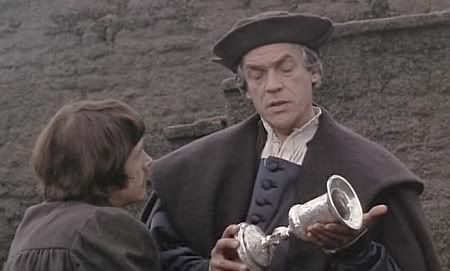
Paul Scofield handing a chalice to John Hurt in A Man For All Seasons
Paul Scofield hands a silver chalice to John Hurt in A Man For All Seasons

Paul Scofield, the actor who won a Best Actor Oscar for portraying Sir Thomas More in the 1966 movie A Man For All Seasons, has died at the age of 86.

The plot of A Man For All Seasons is fairly simple: Scofield plays Sir Thomas More, a devout Roman Catholic serving as Lord Chancellor to English King Henry VIII (played by Robert Shaw). Henry's marriage to Catherine of Aragon has failed to yield any surviving sons, and Henry has fallen in love with young Anne Boleyn (played in a brief cameo by Vanessa Redgrave). Of course, the Catholic Church has a thing against divorce, and His Majesty is trying to find some way to get around this problem.

This is set against a backdrop of a corrupt political establishment (there's nothing new under the sun), in which many people are perfectly willing to abandon their faith and bow to the King's wishes, if only because it will allow them to get ahead. More, however, being devout, will have nothing of this; considering the King's marriage to Catherine licit under Catholic Canon Law, he will not under any circumstances sanction the divorce and remarriage to Anne Boleyn, instead being willing to resign his post as Lord Chancellor when Henry creates his own (Anglican) Church.

Unfortunately, More is not allowed to live out the rest of his days quietly, as the King is forcing everybody to take a loyalty oath; the oath would require More to reverse publicly his stance on the King's marriage to Anne Boleyn, or else be in violation of the oath by continuing to be a Catholic. More, consequently, refuses to take the oath, and is arrested and put on trial for high treason. More, in his defense, delivers a blistering indictment of the King's actions and the political and religious establishments' willingness to abandon their moral values for political expediency, but the defense is obviously all for naught: the whole oath and trial was little more than a sham to get everybody to come to the King's position, or else get rid of those who did not agree with the King. More is sentenced to be executed, and dies for his beliefs.

The cast is excellent; in addition to Scofield, Wendy Hiller plays his wife, Alice; a young and lovely Susannah York plays his daughter, Margaret; Vanessa Redgrave's brother Corin plays Margaret's betrothed, William Roper; John Hurt appears in his first major movie as Richard Rich, a man looking to get ahead at the royal court; Leo McKern plays Thomas Cromwell; and Orson Welles has a small role as Cardinal Wolsey. Directing duties were more than capably handled by the great Fred Zinnemann, in a job that must have felt like a reprise of High Noon.

A Man For All Seasons is available on DVD and is well worth watching.

Saturday, March 1, 2008

The Day of the Jackal

TCM's prime-time offering for February 29 was Fred Zinnemann's 1973 thriller The Day of the Jackal. To be honest, I had never seen this movie before, and enjoyed finally being able to watch it. Despite it being about a historical event to which we know the outcome, Zinnemann's direction makes this an excellent and gripping film.

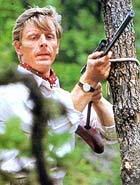
The basic synopsis is that in 1963 France, a group of army officers unhappy with Charles de Gaulle's handling of the situation in Algeria hire an contract killer to assassinate de Gaulle. The assassin, played by Edward Fox is an efficient, ruthless killer. The first half of the movie takes place predominantly outside France, as we see the assassin's detailed preparations -- obtaining multiple false identities, disguises, and a high-powered sniper's rifle he'll be able to smuggle into France.

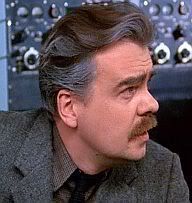
Meanwhile, French intelligence figures out that something is up, but they have no idea exactly what: the man they seek has to them no known name, face, or fingerprints. It could be any of fifty million people. There's only one man in France who has the investigative ability to find the killer the authorities seek: Inspector Lebel, played by Michel Lonsdale (looking rather like Oskar Homolka). Lebel's dogged pursuit, combined with a massive dragnet and some pure dumb luck, gets him to within a few hours of the assassin on numerous occasions, but our antihero always manages to stay one step ahead of the authorities, as he has informants of his own.

We know what will happen at the end of the movie: the attempt on de Gaulle's life will fail; in real life de Gaulle resigned the French presidency after the student riots of 1968, and died quietly in 1970. And there's not a whole lot of action. With the exception of one scene at the beginning and the assassin's practice session with his sniper's rifle, we don't get explosions. Nor do we get a French Connection-style car chase. Still, there's always dual tensions. How is the assassin going to get out of the latest tight situation he's in, and how is Lebel going to find him and foil the assassination plot? And by playing these tensions off of one another, Zinnemann is able to create an atmosphere of suspense that keeps us glued to our seats right up until the final bullet is fired.

The Day of the Jackal is available on DVD, in case you missed TCM's recent showing. Although it runs just over two hours, twenty minutes, at no point does it feel like a long movie.