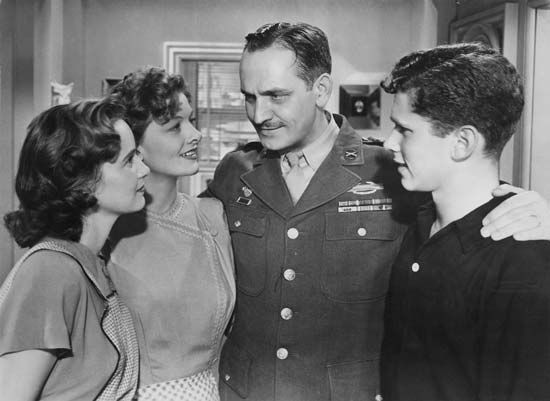
Showing posts with label Teresa Wright. Show all posts

Saturday, February 28, 2026

Somewhere in Time

Another of the movies that's been sitting on my DVR for quite some time that I only recently got around to watching is Somewhere in Time.

Christopher Reeve, fresh off Superman, plays Richard Collier. As the movie starts, it's 1972, and Collier is a college senior drama major who has just written a play and is getting it presented on stage. Sitting in the audience is a mysterious old lady, who approaches Collier and gives him an expensive pocket watch and makes a comment that implies they've met before or will meet again.

Fast forward to the present day, in 1980. Collier has moved from the small college town to Chicago, where he's become a published playwright who has had several of his plays staged. But his personal life remains unfulfilled, and that's beginning to screw up his professional life too. So Richard decides what he needs is a break from Chicago, going back to his old college town. He's also earned enough that he can finally stay in the Grand Hotel that served wealthy tourists in the summer and, one might guess, wealthy alumni in the other three seasons.

A small museum in the hotel celebrates actress Elise McKenna (Jane Seymour), who gave her final performance at the hotel's summer theater back in 1912 before retiring like Greta Garbo. But for whatever reason, Richard is intrigued, and decides to study up on her career, leading to the startling conclusion that this must have been the woman who gave him the pocket watch several years ago. Laura Roberts (Teresa Wright) worked for Elise in her later years and literally wrote the book on her, and still lives in town, rather conveniently. Richard goes to see her, showing her the pocket watch which is a pretty good way of showing he really does have a connection. Richard also learns that Elise had an interest in time travel, and had a book by one of Richard's old college professors.

Richard talks from the old professor and learns the professor's theory that through the power of self-hypnosis, time travel just may be possible. Richard gets obsessed with doing the same sort of self-hypnosis experiment that his college professor did, but with the difference that he's going to wake up on that day in the summer of 1912 when Elise retired from the stage, as Richard now believes he's fated to meet Elise again even though in the real world she's been dead for eight years already.

After the first experiment goes wrong, Richard wakes up from a second experiment to discover that it seeming is 1912! And young Elise is there, looking just like she did in the photos at the Grand Hotel. However, meeting her is going to be a bit difficult, as the 1912 version of Richard doesn't have any relations or good excuse for seeing Elise. She's also got a somewhat complicated personal life. Her manager William (Christopher Plummer) holds a fairly tight rein over her career, as he's grooming her for stardom. When he finds that Richard is in his view harassing Elise, he's none too happy.

Needless to say, Richard continues to pursue Elise, and perhaps it really is because of Richard that Elise retired from acting, staying here to look for him. But then how did young Richard wind up being reborn in time to graduate from college in 1972?

Upon its original release, Somewhere in Time got fairly poor reviews, although in the intervening years it's developed a cult following for various reasons. The good reason for that is the location shooting on Mackinac Island, a resort located on an island between Lake Michigan and Lake Huron. James FitzPatrick did a Traveltalks short on the island, since even in the early 1940s it was known for not allowing motorized vehicles. The location shooting is lovely, and it's easy to see why people with a love for Mackinac Island would have a soft spot for the film. As for other people, I'm not quite certain why. I don't think Somewhere in Time is as bad as the critics of 1980 thought, but it's still a movie with a ridiculous premise and for me a ton of plot holes that aren't well explained. But it's definitely another of those movies you'll want to watch for yourself and draw your own conclusions.

Friday, November 21, 2025

Roseland

Some months back, TCM ran a spolight on Merchant-Ivory productions, which gave me the chance to record a couple of movies that I hadn't seen before. One of those movies was a film that predated the later sterertype of Merchant-Ivory being about British period pieces for which the pair became famous: Roseland.

The title Roseland refers to the Roseland Ballroom, a dancing spot in Manhattan that operated for about 90 years before it was finally closed in 2014 and demolished to build a high-rise apartment building. But even by 1977, when the movie was released, it felt like the Roseland had seen better days, with a clientele of disproportionately older people who would have enjoyed going dancing when they were younger decades earlier, think the old Kinks song "Come Dancing". Roseland the movie is more or less an anthology film telling three stories.

The first one is called "The Waltz". Teresa Wright plays May, a relatively recent widow, who goes to the Roseland to have someone to dance with and not feel so lonely now that she's a widow after all these years. She likes to dance with Stan (Lou Jacobi), who is a widower, although is story is a bit more tragic as is revealed at the end of the segment. The main thrust of the story deals with the fact that when May dances in front of one particular mirror at the Roseland, she sees herself as she was back in the day, together with her late husband as he was all those years ago. But nobody else can see this.

The second story, "The Hustle", is the longest and most complicated. Christopher Walken, before becoming a star with The Deer Hunter a year later, plays Russell. He's a gigolo to Pauline (Joan Copeland), a childless woman who likes to dance at the Roseland. As the segment opens, she's celebrating her birthday at the Roseland, together with Russell and Cleo (Helen Gallagher) who gives dancing lessons in a small studio on an upper floor to make extra money. Invited to the party it Marilyn (Geraldine Chaplin), a divorcée who's between jobs but looking for a good one. She falls in love with Russell and may even be willing to make sacrifices to help Russell win the big dance contest. Russell makes intimations that the feeling is mutual, but he's got all those attachments to other women, too.

Finally comes "The Peabody". Lilia Skala is Rosa, an older widow who started coming to the Roseland and found a platonic dance partner in Arthur. The story is told in flashback, however, as Arthur has recently died. Rosa's big dream was to win the dance contest dancing the Peabody, although this contest has the reputation for having a contestant die since it's a tough dance for the mostly older people who enter the competition. Poor Rosa never seems able to enter for one reason or another, and then Arthur suddenly dies threatening to scupper things permanently.

I was mildly surprised to see Roseland get largely mediocre reviews. I found it to be a fairly well-done movie, albeit one that might not be to everybody's tastes thanks to a decidedly elegiac tone. As I mentioned above, the Roseland Ballroom shown here feels decidedly like it's full of faded glory. But the stories are interesting enough and not overly long, with the acting definitely worth watching. So definitely Roseland is one that's worth looking out for and watching, even if you disagree with my judgment on it.

Tuesday, April 29, 2025

Count the Hours

Back in March, TCM's Noir Alley ran a movie that was surprisingly new to me considering the fact that it was distributed by RKO and, as such, ought to be part of the old Turner library that's made up the bulk of TCM's programming. That movie is Count the Hours, and it's getting another airing tomorrow (April 30) at 7:30 AM.

The movie opens one night in the house of a man named Fred Morgan. Somebody breaks into the house and breaks open a locked desk, looking for money. Fred is asleep in the next room but this wakes him up, so he gets his rifle to confront the burglar. Unfortunately, the burglar is quicker, shooting Fred dead, and that wakes up Mrs. Morgan, who also gets shot for her trouble. They're not discovered until the following morning when Morgan's nephew and heir shows up and finds his aunt and uncle dead.

The first person the police talk to is George Braden (John Craven), who works as an itinerant farm laborer and is currently renting a small house on Morgan's property. When George hears that Morgan was shot with a .32 caliber bullet, he's scared since he has a .32 gun of his own, and lies about it. His pregnant wife Ellen (Teresa Wright) overhears the conversation with the police and does something terribly stupid. She gets her hands on the gun and tries to destroy the evidence by throwing the gun in a lake. She's spotted doing this but dragging the lake doesn't find the gun, so husband and wife are both taken in for long questioning.

The questioning is so long that George finally gives in and confesses, even though he soon after regrets this and insists he didn't do it. Ellen realizes she has to find the gun so a ballistics test can be done and exonerate her husband, and this is what gets local attorney Doug Madison (Macdonald Carey) to take George's defense. However, without the gun, there's so much circumstantial evidence that it could still convict George. And then the gun is found -- but it's been underwater so long that they can no longer get a good ballistics report from the gun to prove whether it was or was not the murder weapon.

So with that, George is convicted and sentenced to death, and nobody lives happily ever after. Except that we're maybe halfway through the movie if that, so there's going to be an appeal, especially after Madison learns of a man named Max Verne (Jack Elam) who has a criminal history as well as a connection to Morgan. Proving George's innocence isn't going to be so easy.

Eddie Muller, when he presented Count the Hours, commented that professional lawyers are probably going to have big problems with the movie considering how it takes serious liberties with the criminal process. I'm not a lawyer, but I'd have to agree that if the movie has a problem, it's that the plot doesn't seem so tight, or at least not so realistic. That is, I think part of a bigger issue for the movie, which is that it was a very low-budget affair. Teresa Wright, despite being the star, isn't given much to do other than act like the poor suffering spouse. John Craven as the husband doesn't exude much personality, and the rest of the movie feels perfunctory.

That's all a bit of a shame, as the movie feels like it had some potential. With a bigger budget and some polishing, it could have been, if not a classic, at least a gem of a B movie.

Thursday, October 10, 2024

The Pride of the Yankees

We're into the baseball playoffs now, and I don't think that I've done a post on a baseball movie in a while, so it's time to watch one that I recorded during 31 Days of Oscar: The Pride of the Yankees.

The Pride of the Yankees is, actually, a bit tough to do a good full-length post on, in part because most people are already going to know the story. Lou Gehrig (played here by Gary Cooper) was the son of German immigrants who found baseball as a kid and played professionally after college, eventually making it to the big leagues on the big team of the day, the New York Yankees. When he made it into the lineup, he didn't give up his spot, playing every game for nearly 14 seasons, until... he was diagnosed with ALS, which is still commonly referred to in the US as "Lou Gehrig's disease".

Complicating matters is that apparently Gehrig wasn't the most exciting person. Not that I mean this in a bad way; it's more that he was clean enough that he didn't get himself involved in the sorts of things that made, say, his teammate Babe Ruth (who plays himself) a larger-than-life figure. (Or, in a later Yankees generation, someone like Mickey Mantle.) In short, Gehrig's life seems relatively cinematically boring. There's no real plot conflict here of the sort that might drive other Hollywood biopics.

So the scriptwriters have to try to create something, which here is a conflict between baseball and family, if you will. A young Gehrig is seen finding a sandlot game at the opening of the film, and we pretty quickly get to Gehrig's college days at Columbia. His parents (played by Elsa Janssen and Ludwig Stossel), like a lot of immigrant parents, want him to go into something professional, much like his unseen uncle Otto did, becoming an engineer. Mom for the longest time can't understand why her son loves baseball.

There's another conflict, which isn't really that much of one, involving Gehrig's devotion to his mother and the fact that, well, he's going to grow up and find a woman to be his wife. That woman is Eleanor Twitchell (Teresa Wright), a Chicago socialite who first sees Gehrig when he's in town to play the White Sox. He trips over a bat and she calls him "Tanglefoot". They eventually meet again and ultimately get married, with Eleanor scrapbooking Lou's career. After his retirement and young death, she would preserve and safeguard his legacy until her own death; she never had children and never remarried.

If you haven't noticed, there's actually precious little baseball action in the movie, as a lot of it is done with montages and shots of pennants with the different American League cities on them. There's also a subplot about two sportswriters with opposite views of how to cover the players. Sam (Walter Brennan) is more protective of Lou and one of his best non-baseball friends, while Hank (Dan Duryea), while not an iconoclast, doesn't seem to want to be a hagiographer.

The acting in The Pride of the Yankees is all well done; the problem with the movie is that there's just not a dynamic story to be told from the material. And certainly not one that runs over two hours. Still, The Pride of the Yankees is a beloved movie, probably in part because of Gehrig's tragic story. So definitely it's worth a watch.

Thursday, September 5, 2024

What if Stanley Kramer did The Best Years of Our Lives?

In looking at the movies that are on my DVR, I notice that I've got quite a few from April when Marlon Brando was TCM's Star of the Month. So even though I've got some older stuff on my DVR, especially foreign films, I decided to fire up one of the Brando films. This time, it was his first feature film, The Men.

The movie begins with one of those prologues that in the earlier days, especially with historical films, would scroll up over the screen. This time, the prologue informs us that the movie is about the struggles men face after returning home from war, and how these can be greater than the actual struggle of combat. We then are presented with an establishing scene of urban combat in which a man is shot by a sniper, leaving him paralyzed. That man, Lt. Ken Wilocek (Marlon Brando), is then overlooked for several minutes while we get to scenes to introduce some of the other characters.

Probably most important here is Dr. Brock (Everett Sloane). He's been doing research into paraplegia, and is working at a veterans' hospital since World War II gave doctors a lot of injured soldiers to treat. Again, however, before we meet the soldiers, we meet the women in the soldiers' lives, wives, mothers, and girlfriends, as Dr. Brock gives them a lecture on what to expect and answers their questions, including some fairly frank questions for a film from 1950 about the regularity of the urinary and intestinal tracts, as well as the ability to father children.

As for the soldiers, they're housed in wards since there seems to be so many of them. The important ones for our movie are Norm (Jack Webb, sporting a ridiculous goatee that Sgt. Friday would have railed against for being the sign of a beatnik druggie), who is a bit of the boss of the ward and head of the hospital's branch of the Paralyzed Veterans of America; Leo (Richard Doolin), who since the war seems to care more about playing the ponies; and Angel (Arthur Jurado, a paraplegic in real life), a Mexican-American who wants to be able to build a better house for his widowed mother and younger siblings. Lt. Wilocek is still in a private room, which is where the more serious cases go, although it really feels as though what's serious about his case is that he, like Dana Andrews in The Best Years of Our Lives has greater psychological problems than physical.

It's easy to think of Dana Andrews here, not just because both characters needed to get wise to themselves. In addition, Ken's old girlfriend from college before the war, Ellen, is played by Teresa Wright. She's still in love with Ken, and she thinks she can make things "better" in some amorphous way. But Ken is trying to block her at every turn. To add to the Best Years of Our Lives comparison, there's a scene later in the movie with actor Ray Teal, who picked on Harold Russell about what good came of his injuries. Here, he picks on the paralyzed veterans at a bar and gets punched for his trouble.

I mentioned several months back when I reviewed Not As a Stranger that, watching a Stanley Kramer movie, it sometimes feels as though the point that he's trying to make is sometimes more important than the story itself. There's a fair bit of that in The Men, starting with the lecture scene. There's also a bit of a feeling that in discussing the relationship problems Ken and Ellen would go through, Kramer and scriptwriter Carl Foreman might have had a laundry list of issues they wanted to discuss.

On the whole, however, The Men does work, thanks in part to a strong performance from Brando, which is unsurprising given what his career would go on to be. Much more surprising, however, is the performance from Jack Webb, who most definitely is not the wooden stereotype he'd go on to be especially in the 1960s Dragnet days.

So even though The Men is not without its flaws, it's one you should probably watch if you get the chance.

Monday, March 4, 2024

Mrs. Miniver

Another of those movies that I'd seen bits and pieces of over the years, but had never seen all the way through, was the Best Picture Oscar winner for 1942, Mrs. Miniver. I put it on my DVR the last time it showed up on TCM. Now, it's getting another airing, tonight at midnight (well, with the intro, a few minutes into March 5, or still late in the evening of March 4 in more westerly time zones). With that in mind, I made certain I could watch my DVR copy in order to do a post for the upcoming airing.

The movie starts off in the summer of 1939, looking at a supposedly middle-class (really, more upper-middle-class at the very least) family in Belham, a village in one of the Home Counties just south of London: the Minivers. Kay (Greer Garson), the matriarch of the family, lives a relatively carefree life, going to London to do some "extravagant" shopping, which means buying a new hat. And how is she going to tell her husband about it? Of course, her husband Clem (Walter Pidgeon), an architect, has decided on a big-ticket purchase of his own: a new car.

Kay returns home on the train, where the station-master, Ballard (Henry Travers), has been breeding roses. He's even come up with a beautiful rose he wants to name after Mrs. Miniver and enter in the local horticultural contest. But this is where the class issues of pre-war Britain start to rear their ugly head. Lady Beldon (Dame May Whitty) also breeds roses, and she wins the trophy every year simply because she's "Lady" Beldon. Heaven forfend somebody on the class level of a station-master should win.

At dinner that night, Lady Beldon's granddaughter Carol (Teresa Wright) stops by the Miniver place, presumably not prompted by Grandma, asking Mrs. Miniver to do what she can not to get the Miniver rose entered in the competition since Grandma wins every year and it would kill her not to win. Not that Kay can do much about it. But even more miffed is Kay and Clem's adult son Vincent (Richard Ney), a student at Oxford. He's gotten some "radical", at least by 1930s standards, ideas on class and is none too pleased with Carol's showing up. But it's obvious that the two are soon going to fall in love.

Soon is darn right, because September 1, 1939 is about to come up. Germany invaded Poland that day, and on the following Sunday, September 3, the UK declared war on Germany, with everybody in the village learning of the declaration as they're at church from their local vicar (Henry Wilcoxon). Clem, being in his 40s, with an adult kid and two younger children at home, isn't going to be asked to fight, but Vin probably is, so he preempts this by trying to get into the RAF, which eventually does happen with him getting stationed at an airbase near Belham.

At this point Mrs. Miniver becomes a sort of pastiche of all the things that would befall a family on the home front during the early stages of the European theater of World War II between the UK and Germany. There's the Battle of Britain, with the Nazis trying to bomb the UK, leading to the requisite air-raid scenes. France would fall, resulting in the evacuation from Dunkirk. Since Clem has a boat, he's asked to set out on his boat to help evacuate Dunkirk. Vin and Carol have a quickie wedding, with Lady Beldon finally relenting. One of the Nazi pilots is shot down but survives, winding up injured in the Minivers' garden, with Kay finding him. And on and on, leading to the climax set against Belham trying to hold their garden show while the war is going on....

Mrs. Miniver is, like Boys Town yesterday, one of those movies where it's easy to see why it was such a huge success upon its release in the summer of 1942. The movie had been conceived earlier, while the US was still not in the war, with the aim of engendering sympathy among US audiences for the plight of the fellow English speakers on the other side of the Atlantic. But then Pearl Harbor happened, and now American audiences could see themselves facing the same issues as the Minivers and other cast members of the movie.

This being MGM, you can also the see the sentimentality that some critics, out of step with the public as always, would criticize. But there were British movies such as Millions Like Us that dealt with a lot of the same themes, just with a more hard-nosed look. In the drive to build morale, I think both approaches are needed, and with MGM behind it, the more sentimental approach makes the scenes of destruction a bit more surprising. That, combined with the high production values MGM always had, makes for a very well-crafted movie.

Best Picture of 1942? I'm not so certain; I think that if Yankee Doodle Dandy had been done in Technicolor it might well have won. But it's easy to see why Mrs. Miniver did ultimately win. It's also a movie that you should definitely watch if you haven't seen it before.

Friday, September 18, 2020

Casanova not of color

Gary Cooper was pretty good at comedy, as can be seen in movies like Ball of Fire. But like many other actors, there are movies where his comedy doesn't quite work. In Cooper's case, that movie is Casanova Brown.

Cooper plays the title character (nicknamed Cass), a professor of English who, at the start of the movie is returning home to his small town in Illinois from New York City after having done research for a book on his namesake, the famous lover. However, he's apparently returning home an unhappy man.

Some time later, he's about to get engaged to Madge Ferris (Anita Louise), the daughter in a family where the wealth apparently goes from one daughter to the next, as she and her mom have control of the family wealth, much to the chagrin of Madge's father (Frank Morgan), who has been trying to get money out of them to no avail other than a small weekly allowance. Cass claims to have no need of the money and can support Madge on his professor's salary.

But something comes up. Mr. Ferris is at Cass' house shortly before the weding, and when Cass' mail is delivered, Ferris looks through the mail for Cass should there be anything important. Of course there is; a cryptic message from a maternity hospital up in Chicago, telling him he really needs to get his ass up there and see one of the doctors. Cass says at first that it's probably some sort of bizarre advertising campaign to intimidate people into contributing, before eventually he tells the true story.

Back in New York, he made the acquaintance of one Isabel Drury (Teresa Wright), also the daughter of wealthy parents, and fell in love with her. The two get married right away, somethinmg Isabel's astrology-believing mother (Patricia Collinge) thinks is a disaster. Worse for Cass, Isabel's mom hates smokers, and Cass smokes. He decides to hide his cigarette, and when he does it, the foreshadowing is pretty obvious. The cigarette butt in his pocket is going to ignite to comedic effect. Except that in this case the cigarette butt burns the entire house down, leading the Drurys to get Isabel to annul the marriage.

No wonder Cass was unhappy when he returned home. But apparently Cass and Isabel were married long enough for them to have sex, and just that one time having sex would have been enough for Isabel to get knocked up in a way that the Production Code would approve of. But why would Cass be getting a letter from a maternity hospital in Chicago, when the Drurys are from New York? In any case, Cass is going to have to go up to Chicago to resolve the situation before he can get married to Madge.

What Cass finds is that, indeed, Isabel had a baby; her rationale in having it in Chicago is that it was much more likely Cass would come up to deal with the situation. The hospital wants Cass' medical information as a formailty in putting the baby up for adoption. When Cass finds that out, he's horrified: this is our baby, Isabel, not just yours.

In order to keep the baby from being adopted, what does Cass do? Why, kidnap the baby and take it to a hotel, something that I thought would have violated the Production Code and required Cass to spend time in jail, even if he is the little girl's father. But he insists on being a good father, even though this being a movie from the mid-1940s, a single man knows nothing about parenthood.

It's an interesting premise, and one that's based on a play from 15 years earlier that had already been turned into a movie. But in Casanova Brown, the premise winds up falling flat. I think that's because I found the film rather uneven in tone. There's a fairly slow and long buildup to Cass kidnapping the baby, and then the movie becomes much wackier, giving the hotel maid (Mary Treen) and bellhop (Emory Parnell) who help Cass take care of the baby no realistic character motivations for why they'd help Cass in a scheme that at first glance looks criminal.

Gary Cooper does about as well with the material as one could hope for, not being helped that his character too turns on a dime. Teresa Wright is underused, and Patricia Collinge is just irritating. It all adds up to a movie that in my mind is a bit of a misfire. Casanova Brown really needed somebody like Preston Sturges to make the material work. But, as always, you should probably watch and judge for yourself.

Tuesday, March 19, 2019

The Foxes not of Harrow

One of tonight's Fredric March movies is Another Part of the Forest (11:00 PM), based on the play by Lillian Hellman. The family in this story is the same one in Hellman's earlier play The Little Foxes which was also turned into a movie, so I'm doing today's post on The Little Foxes.

Bette Davis plays Regina Giddens, married sister in an Alabama family from the turn of the 20th century which includes the Hubbard brothers: married Oscar (Carl Benton Reid) and unmarried Ben (Charles Dingle). Regina married the town banker Horace (Herbert Marshall), but he's been sick with a heart issue and seeing specialists up north in Baltimore. Regina wants Horace to return home, so she's gong to send their daughter Alexandra (Teresa Wright), nicknamed "Xan", up to Baltimore.

Regina has good reason to want her husband home. The Hubbards have been negotiating a business deal with Marshall, an industrialist from Chicago. He wants to open a mill down south to handle the cotton, but he needs a deal with the people who have the cotton, which means the Hubbards. The problem is that the Hubbards have to put up money, and it's going to come one-third from each sibling, more or less. The "more or less" is because Regina being a woman doesn't have the control over the family money that her brothers have. She needs Horace to approve of investing.

When Horace returns, we learn that he has no intention of investing the Giddens money. More alarmingly, we learn that he's going to die because his heart condition is untreatable. He's relatively OK with dying, too, because he and Regina have been at each other's throats for years thanks to a whole bunch of issues. Among them is the question of whom Alexandra should marry. Alexandra has been seeing, in an oh-so late 19th century way, David (Richard Carlson), who works at the local newspaper and is a nice young man but not of the Hubbard's financial class. Horace worries that the rest of the family is going to try to marry Xan off to her cousin (Oscar's son) Leo (Dan Duryea), who is in Horace's mind a nasty piece of work.

Horace is right to fear Leo. Leo works in Horace's bank, probably because he wasn't able to get any other job. Leo has been thoroughly unethical, to the point of rummaging through Uncle Horace's safety deposit box. He's found that Horace has $90,000 in bonds convertible as cash, which would be more than enough to cover that one-third of the investment in the cotton mill. Leo knows that Horace only looks at his safe deposit box twice a year or so, and isn't going to look at it again until the autumn, so Leo could "borrow" those bonds for five months, which would be enough time to raise the money to replace them. Leo, however, tells his father so much about them that we just know Horace is going to discover that his bonds are missing....

The Little Foxes is a really fun little movie, a sort of light version of Tennessee Williams' southern Gothic. I think not going all the way to Williams' level makes it better, since I tend to find Williams to go way over the top. Davis is ruthless but actually also tones it down from some of her other movies, again to the benefit of the movie. Wright is good as the young woman who has to grow up; Reid and Dingle are more than passable in supporting roles. Duryea nearly steals the show as a thoroughly nasty man in his first real role (IMDb claims he had an uncredited role in one movie before this). It's an obvious precursor to those noir heavies he'd play. The one weak link is Patricia Collinge as the crazy aunt. She's more obnoxious than possibly insane.

I was very favorably impressed by The Little Foxes, and I think you'll be, too.

Sunday, October 12, 2014

The Steel Trap

A movie that's got an interesting premise but which unfortunately goes wrong in the execution is The Steel Trap, which is on TCM this evening at 10:00 PM.

Joseph Cotten stars as Jim Osborne, a man whose life seems somewhat reminiscent of the character played by Dick Powell in Pitfall. Osborne is a middle class (by early 1950s standards) bank assistant manager, married to a lovely wife Laurie (Teresa Wright) and father to an infant daughter. Now, if you saw Pitfall, you know there was a femme fatale. There's a femme fatale of sorts in The Steel Trap, too, but it's an inanimate one: the almighty dollar.

Jim Osborne suggests that if you work for a bank long enough, it's only logical that once in a while, your thoughts are going to wander to whether or not you can get away with getting any of that money for yourself. The only thing is, there are all sorts of security measures to try to keep people from stealing that money. The bank vault is on a timer; the assistant manager knows only half the combination, with the other half being entrusted to a second person; there's no place to go with all that money; and so on. But Jim decides that it would be easy to look over the shoulders of the people who have the other halves of the various combinations, and starts doing research into how he can get around the other dificulties. The most difficult one is not getting extradited back to the United States. Theoretically, I assume the communist countries of the day might not have extradited him, but getting into those countries would have been a problem. But Jim discovers that there's a loophole in the extradition treaty with Brazil, so he's going to steal the money and hop on a flight to Brazil with his wife and kid!

This is where the movie starts to go wrong. Jim has to steal the money after the close of business on a Friday, so that he can get on that plane and make it to Brazil before Monday morning when the bank opens, it's discovered that a lot of money is missing, and the suspicion points to Jim. (Remember, this is in the era before jet travel, when even plane travel was a good deal slower than it is today.) This isn't a crime of keeping people from figuring out who did it; it's a crime of getting oneself outside the scope of law and who cares who neat or messy the crime is. However, there's one catch. The bank has seasonal opening hours that include a couple of hours on a Saturday morning, and that season is just about to begin next week. If Jim doesn't pull off the job This Friday, he's going to have to wait months to pull it off. Any logical person would spend those months preparing for the job, but stupid Jim takes the other option of committing the deed now.

And with this, Jim starts to reveal himself not as a suave criminal who could con people, but as a bullying jerk who commits one blunt lie after another that everybody should be able to see through. Jim and Laurie don't have passports, because international travel wasn't so common back in the early 1950s and you didn't need a passport to travel to Canada or Mexico back then. Some of those six months could have been used to get those passports: since Jim works for the Bank of Italy, he could make up a smoother lie about being interested in getting into the international banking part of their business, and getting the passports for him and his wife to prepare for that. But no; Jim has to get na emergency expedited passport for him and his wife, which is where the scheme should fall apart. It doesn't, and the film goes on for another 40 or 50 minutes with Jim compounding his lies and being exceedingly dislikeable in doing so.

Or, at least, that's the impression I got watching this movie. A lot of other reviewers have much kinder things to say about the film, so this is definitely one you'll want to watch for yourself to judge. Cotten and Wright are generally quite good actors, too, so that should make it easier to like the film.

Saturday, August 30, 2014

The Steel Trap

So The Steel Trap was on yesterday as part of the Summer Under the Stars salute to Joseph Cotten. Looking at the reviews on IMDb, I must be one of the few people who didn't care for it. But it's been released to DVD courtesy of the Warner Archive, so you've got a chance to judge for yourself.

Cotten stars as Jim Osborne, a family man who talks about his family life almost the same way Dick Powell does at the beginning of Pitfall which I mentioned at the beginning of the week. Jim works as the assistant manager at a bank. In a voice-over narration, Osborne tells us about his work at the bank, and the security measures that greatly lessen the chance of a bank robbery: the tellers only know half the combination to their little safe inside the vault where they keep their money after the bank closes; the managers (including Osborne) know the other half. Unsurprisingly, Osborne has daydreamed about whether it would be possible to look over the tellers' shoulders to steal their combinations and then steal their money. Of course, there's a problem, which is the question of where you're going to go after you've stolen all that money. So Osborne actually starts doing research on the topic, discovering that Brazil is the one country with a flaw in the extradition treaty that would allow Osborne to make an escape -- and he could get from Los Angeles to Brazil over a weekend, from Friday afternoon when the bank closes to Monday morning when the bank reopens and the money will be discovered missing.

It's here that the film hits its big problem. Jim has to lie to his wife Laurie (Teresa Wright) about what he's doing. Now, there are interesting liars on screen, such as Charles Boyer in Gaslight, whose lies are so chillingly smooth as to make him a compelling character. Unfortunately for The Steel Trap, however, Jim Osborne is just a whiny jerk of a liar. And his lies get compounded one upon the other the way they do in one of those bad early 1930s drawing room comedies. The other thing that makes the movie have a big problem is the plot holes of nobody catching any of these lies. Osborne notes that the bank is going to be going to its winter hours next week, which means the bank will be open on Saturday, so the plot to steal the money has to be done this Friday. No! Why not use the winter to perfect your plan? Also, going to Brazil requires a passport, which is something most Americans didn't have back in those days, since you didn't need one to go to Canada (or, I think, Mexico). So he has to get the passports in like two days when, if he bided his time over the winter, he'd have the passports ready for whenever. And the guy at the consulate doesn't catch his lie about needing the passport in an emergency.

The idea behind The Steel Trap is a good one. But somewhere along the way, the script goes wrong, leaving me at least with something rather unappealing. But everybody else seems to have high praise for the movie. So watch it for yourself and judge.

Wednesday, February 5, 2014

The women of "The Best Years of Our Lives"

There's a big snowstorm heading for the Catskills which will probably disrupt my Internet access all day today, so I've had to come up with a post early. With yet another airing of The Best Years of Our Lives on tonight at 8:00 PM as TCM honors all of the Best Supporting Actor nominees from 1946, I figured I'd look at the movie again from another angle, this being a movie that stands up to so many repeated viewings. When I blogged about the movie for it airing exactly six years ago, I did a piece contrasting Fredric March's character, Al Stephenson, and the struggles his character faces, with the much greater struggles faced by Dana Andrews' character, Fred Derry. This time I'll spend some time looking at the women in the movie.


Virginia Mayo as Marie Derry I think the easiest of the major female characters. Marie Derry, played by Virigina Mayo, is ultimately a good-time girl who married Fred because he was just so handsome in his uniform, a theme which shows up quite a bit in World War II era movies without really exploring the consequences of what's going to happen to these people after the war. (Judy Garland and Robert Walker in The Clock, I'm talking to you.) Marie Derry probably would have been living it up more or less on the combined payment from her work at the nightclub, and the allotment check she would have received from the military department. After all, it's made quite clear at the beginning of the film that she's earning more than enough to move from the wrong side of the tracks where Fred grew up and where his parents still live, to what looks like a reasonably nice apartment in the center of town. Her character wants to keep living the high life, and when Fred can't or won't provide it, she's perfectly willing to divorce him in favor of somebody who can. And to be fair, since theirs was a quick marriage, it's really for the best for both of them that the two divorce. No offense to Virginia Mayo, but her character is written a bit too one-dimensionally. We're supposed to have sympathy for all Fred went through, and one of the ways to engender that sympathy is to make the wife he comes home to seem like even more of a jerk.


Myrna Loy (second from left) at Milly Stephenson Milly Stephenson was married for years to banker husband Al before World War II came and he went off to fight -- married long enough that by the time he comes home, he's got an elder daughter who's at least in her early 20s even if her exact age isn't given. I stated when I blogged six years ago that I thought Fredric March had the easier character to play than Dana Andrews, something by which I'll still stand. Milly might be tougher to play than Marie Derry, but only because the character isn't as one-dimensional. If the screenplay of The Best Years of Our Lives had wanted to focus on Fred and Marie wanting to make their marriage work, the Marie character would probably be much more complex, on the level of Judy Holliday's character in The Marrying Kind. Still, Milly is a character that has two roles. First and foremost is as the wife to Al. They've been through most of it all, falling in love, having times where they would have thought the marriage was on the rocks, and coming out on the other side with a deep abiding friendship and love. Even though the war changed Al Stephenson, it looks as though he's going to have less of an adjustment than Fred Derry, and a long-term wife to make it all the easier. Milly, though, has a second role, as housewife (which we see at the beginning when she points out that it's been the maid's night out since 1943), and mother, especially to a daughter Peggy (more on her later) with her own problems. This gives Milly a lot more to do, and it's unsurprising that her character is more of a glue to the movie than Marie Derry.

Teresa Wright as Peggy Stephenson Peggy, as I mentioned in the previous paragraph, is the adult daughter of the fairly well-to-do Al and Milly, and did her part for the war effort by becoming a nurse and ministering to sick soldiers. This again is something we see fairly early on. After the Stephensons have to take a drunken Fred Derry home with them, Fred has a nightmare obviously brought on by post-traumatic stress disorder, although back then they didn't know what it was called. Peggy, however, knows the basics of how to deal with it, as she's obviously seen it before, as she tells Fred the next morning. She begins to fall in love with Fred, even though this is a serious problem since he's already married. Peggy is a bit naĂŻve, as she thinks she's just going to be able to go in and save Fred from Marie, a notion of which her parents disabuse her. This even though Peggy is quite right about the state of Fred's marriage, and we viewers can quite clearly see that it would be in Fred's best interests to be with Peggy and not Marie. I can't really imagine the emotional difficulty this must mean for Peggy. After she and Fred see each other again in the movie's finale, viewers are left with a hopeful note, which is helped by the fact that having helped soldiers in the past as a nurse, Peggy might be able to deal with the setbacks that are going to come when they get married.


Cathy O'Donnell as Wilma Cameron Cathy O'Donnell isn't given the biggest role in The Best Years of Our Lives, and the challenges her character Wilma is going to face are presented in the movie as possibly not as big as those faced by any of the men, or even Peggy Stephenson when Dad forces Fred Derry to break off all contact with her. Wilma Cameron is the quintessential girl next door, who grew up with boy next door Homer Parrish (Harold Russell), who is realistic because he was a real World War II veteran with no acting experience who lost both his hands in the war. Wilma's role is to serve as a rock for Homer; that is, somebody who will stand by him and constantly tell him that she loved him for something more than his hands, and so even though he no longer has any hands, she can still love him just as much. She doesn't get all that many scenes, although she gets one of the most important, when Homer invites her up to his bedroom at night to show her what his nightly routine is, how it leaves him completely dependent upon others, and asks whether she'd be willing to spend her whole life like this. Wilma of course says yes, and the movie implies that Wilma and Homer are going to live as a happy couple just like Al and Milly and even Fred and Peggy. But I can't help but think that in real life, Wilma would have had it the most difficult. Homer Parrish probably would have had some difficulty getting a truly good job. Fred's problems were mental, and you could see him advancing rapidly if he got into a field he liked. The disabled, however, have always had it tough, and being married to a man with no hands would have likely brought with it a whole range of practical problems. The movie shows to an extent what it's like for Homer; it doesn't really show what it's going to be like for the woman he marries.

One other woman who deserves mention is Gladys George, playing Fred Derry's mother Hortense. She's only in a couple of scenes, but one of them is a vitally important scene in which her husband Pat (Roman Bohnen) finds one of the letters of citation for all those ribbons Fred has on his chest. Hortense doesn't have much to say, but reacting is acting just as much as delivering lines.