Showing posts with label Jean Harlow. Show all posts

Thursday, January 29, 2026

Reckless

Another of the movies that TCM ran during Mickey Rooney's turn as TCM's Star of the Month because it had a small juvenile role for Rooney is Reckless.

Rooney is obviously not the star here; he only gets about one scene. The male lead is William Powell. Powell plays Ned Riley, a professional gambler and promoter. As the movie opens, an old lady is coming out of his office. That's Granny (May Robson), who is not Ned's grandmother but the grandmother of Broadway star Mona Leslie (Jean Harlow), who at this point is as well known for the antics she's getting into off-stage as well as what she does on stage. Granny is there to ask for Ned's help in getting Mona bailed out of jail. We also learn that Ned has known Mona since she was a kid, and has done some behind-the-scenes help in making Mona famous.

Ned is able to get Mona out of jail under extenuating circumstances, which is that she leave to go to a theater where she's going to perform a charity function. That's a ruse, but not on Ned's part. Insted, the "charity" in question is the "Society for the Admiration of Mona Leslie", which has one member: Bob Harrison (Franchot Tone). Bob is one of those idle rich playboys whose using his wealth in all the wrong ways, much to the consternation of his father (Henry Stephenson). Even though Ned has secretly always loved Mona, he's not going to try to stop Bob from pursuing Mona. Bob keeps taking Mona out on his yacht, and the two have nice times together. Ned finally works up the courage to tell Mona how he really feels about her, only to find out that she's fallen asleep.

And then Bob and Mona get incredibly drunk and run out of town to get married somewhere where nobody will find them, except that of course the press does find them as well as a bunch of Bob's friends and family who send them telegrams, including one from a Jo. The new couple rushes back to the Harrison home, where Mona meets Jo (Rosalind Russell). Jo has been Bob's nominal fiancée for quite some time, but it feels like another of those upper-crust relationships where the older generation just knows which families should be brought together for the next marriage. Bob likes Jo as a friend, and Jo is a decent person who likes Mona. (Mona, for her part, is trying to be a decent person, although her reputation precedes her.)

At this point, the movie really starts taking a turn. Jo gets married, Bob gets drunk enough to start thinking that perhaps he should have married Jo all along, and Mona finds out that Bob's been letting this on to Jo. She's also gotten pregnant with Bob's kid. Eventually, a drunk Bob winds up in Ned's hotel apartment, finds Ned's gun, and shoots himself in a way that everybody in the public thinks Mona is responsible, to the point that she should be forced to give custody of the kid to the Harrisons.

Reckless is an odd little movie because of the way it changes tone in the middle of the movie from what seems like a light romantic triangle comedy into a fairly ridiculous melodrama. A lot of people have criticized the casting of Jean Harlow as not being right for the role, and Harlow herself wasn't sure. Harlow does her best, as do everybody else. And the problems with Reckless aren't really because of the casting of Harlow. Instead, I think the problems it has are down to the script, which really is a mess as it veers from one act of the plot to the next. The comic parts are better than the melodrama, with May Robson shining.

Still, Reckless is interesting to watch to see as the sort of misfire a studio could have when it used its contract players in the wrong way.

Monday, December 29, 2025

Saratoga

It's fairly well-known that actress Jean Harlow died tragically young while she was in production for the 1937 movie Saratoga. Her fans demanded that MGM finish the movie so that they could see the last footage of her, and MGM relented and used a body double and voice actress to film the remaining scenes. For whatever reason, I had never actually seen Saratoga, so the last time it showed up on TCM I made the point to record it so that I could finally strike it off the list of films I hadn't seen.

Saratoga Springs, back in the 1930s and still today was known as a resort town that spent the month of August hosting a horse-racing meet that catered to the wealthy set. So, as you might guess, the movie deals with that horse set. Grandpa Clayton (Lionel Barrymore) owns Brookvale, a stud farm breeding racing horses. Or should I say owned, because he's fallen into debt and the bank is about to take everything from him. It doesn't help that his son Frank (Jonathan Hale) has incurred heavy gambling debts to professional gambler Duke Bradley (Clark Gable). But Duke likes Gramps as well as Frank's daughter Carol (Jean Harlow) and helps them keep the farm, or at least keep being able to run it, even if they're no longer going to own it -- Duke has the deed.

Carol, for her part has gone over to Europe to become cultured, where she meets a fellow American who's apparently been trying to gain some class too, Wall Street investment banker Hartley Madison (Walter Pidgeon). The two get engaged, although Carol is adamant that she's not going to use Hartley's money to buy back the deed to the farm from Duke.

Carol studies the horse-racing racket in an attempt to win back the money she'll need to buy the deed legitimately. This necessitates her spending a lot of time at racetracks all along the east coast, so she keeps meeting Duke and his gambling friends, Jesse (Frank Morgan) and Fritzi (Una Merkel). Fritzi realizes Duke is in love with Carol, and the more Carol keeps running into Duke, the less she dislikes him, to the point where you know the two are going to wind up together in the final reel even though Carol is still engaged to Hartley.

All of this is leading up to the eventual climax at Saratoga. Huntley has bought a horse after inadvertently outbidding Duke at a horse auction. Huntley wagers that this horse will be able to beat one that Duke is backing at the big race in Saratoga. Duke, for his part, has other ideas, and Carol still has divided loyalties....

It's hard to escape the poignancy of knowing that Jean Harlow died before Saratoga was completed while watching it. Not only that, but she was already terminally ill. Still, despite her health she does the best she can with the material and gives a reasonably good performance. The only thing is, the material isn't the greatest, not that this is the fault of anybody in the cast. They're all professional, while Hattie McDaniel as a maid gets to sing a verse as the whole train car does a song, and shows what a good performer she could have been if she had been given a real chance.

I also couldn't help but wonder what might have become of Harlow's career had she not died young. Sadly, I have the feeling that, as with several other big actresses of the 1930s, notably Joan Blondell or Kay Francis, World War II would have put a serious crimp in her career. She had talent, but the sort of roles that were good for her at MGM would have gone by the wayside once the more serious atmosphere the war engendered took hold.

Tuesday, August 19, 2025

Beast of the City

Mickey Rooney was TCM's Star of the Month in December 2024. As a juvenile actor at MGM, he made a lot of movies, including small roles before he became more of a leading actor with the Andy Hardy movies. One such child role that I haven't done a post on before is in The Beast of the City. Since I like pre-Codes and hadn't seen this movie before, I made a point of recording it to do a post on it. I finally got around to watching it and scheduling a post on it.

Rooney is obviously not the star here, although he plays the young son Mickey of the main character, a man named Jim Fitzpatrick (Walter Huston). Jim is a police detective with a big-city police department (I don't think a specific city is mentioned). He's got a reputation as someone who's so ticked off with the underworld violence that was plaguing America during Prohibition that he does things that step on some people's toes but that other people lionize him for doing. As the movie opens, we see a police dispatcher (uncredited character actor Edward Brophy) sending cops out for a bunch of petty stuff, like a skunk in a basement. But then the dispatcher mentions dead bodies in a place that clearly implies a gangland killing.

Fitzpatrick is the detective given the task of investigating. To Jim, it's obvious that these are two low-level gang members, and that the leader of the rival gang, Sam Belmonte (Jean Hersholt) is responsible even if he didn't actually pull the trigger. So Fitzpatrick goes to the nightclub that Belmonte runs to arrest him. But for a bunch of reasons, Belmonte is able to get off. One is that he didn't actually pull the trigger and has an alibi, but there's also the assumption that Belmonte has a bunch of pull with any number of corrupt members of the police department, which may include the police chief.

Jim has a wife and kids, as well as a brother Ed (Wallace Ford) who is also a policeman, serving on the vice squad. Jim wants to engage Ed's help in trying to bring down Belmonte. At a police lineup, we see Daisy Stevens (Jean Harlow), although eagle-eyed viewers will already have seen her in Belmonte's office. She's a stenographer, and presumably has an in to Belmonte. Ed meets Daisy and begins to fall in love with her, although this is a serious problem as it's a bad idea to have a relationship with gang-related molls. And Daisy is certainly going to try to get Ed into the gang's good graces.

Jim gets sent to a distant precinct in what's clearly political retribution, although he's got friends who are able to help his career by getting him involved with foiling a bank robbery. Combined with public outrage over the political types having demoted him, the old police chief is forced to resign and Jim is given the chief's job. He immediately sets about going after Belmonte. But there's the question of how legal his methods are, combined with the fact that his brother's relationship with the gang is an issue.

The Beast of the City opens with intertitles quoting then-president Herbert Hoover about the nature of the Mob and how what America needs is movies glorifying the police going after the Mob, as opposed to films like The Public Enemy. This is MGM's attempt to make the cops look good, although they didn't quite yet have the gloss that they would after Irving Thalberg died where movies would be technically well made even if that doesn't quite fit what the genres need. The Beast of the City is still clearly more MGM than, say, Warner Bros. which was a lot grittier in dealing with social issues. Walter Huston does well, although Jean Harlow in her supporting role is fabulously sexy. Although TCM ran this for the presence of Mickey Rooney, he understandably doesn't have much to do here (not that that's his fault).

The Beast of the City is a well-made early talkie that definitely deserves to be seen, even if it's not one of the all-time greats.

Tuesday, February 18, 2025

Hold Your Man

Another person honored last August in TCM's Summer Under the Stars was Jean Harlow, and somewhat surprisingly considering how she died tragically young there are some of her movies I hadn't seen yet. One of those was Hold Your Man. So I recorded it and recently got around to watching it to do the review here.

We don't see Harlow for several minutes, because we first have a scene with the film's male star, Clark Gable. He plays Eddie Hall, a small time con artist. He's pulling off a con as the movie opens, involving finding a lost wallet with a ring in it that he knows is a fake ring although the mark doesn't. Eventually, the mark catches on, forcing Eddie to beat a hasty retreat. He goes into an apartment building and tries the doors, eventually finding one that's open. When he opens the bathroom door, however, he finds a woman taking a bath! That woman is Ruby Adams (Jean Harlow), and she doesn't give Eddie up to the police.

It doesn't take long from listening to the conversation that Ruby also uses her wits to make her way in the world what with the Depression on. You can also guess that since they've got a con streak in them, they're also going to wind up working together, and even in love. For Ruby, this is only the latest in a series of men; she's also got a current admirer in Al (Stuart Erwin) who meets Eddie when she takes Al to the speakesy Eddie mentioned to her. Eddie clips Al and Ruby isn't happy about it even though just a few minutes earlier she too had tried to con Al.

As I said they wind up working together, but things go wrong because one of the schemes involves blackmailing rich married men the sort of same way the two young lovers in the later Japanese movie Cruel Story of Youth did. Eddie, by now in love with Ruby, isn't particuarly happy with the idea, and when the scheme starts going south it winds up in a scuffle in which Eddie hits the guy, concussing him and causing a fall in which the guy dies. So Eddie has to escape, and the suspicion falls on Ruby since the guy is dead right outside her apartment. She gets sentenced to the women's reformatory for it.

Two other things complicate matters. One is that, in the dorm-like setting of the reformatory, Ruby is in a room with several other women, one of whom is Gypsy, a former girlfriend of Eddie's. The more important one is that Ruby discovers she's pregnant, although at least she knows Eddie's the father. Eddie wants to visit Ruby, and hopefully marry her so that they can take care of the child together after she gets out of prison, but of course he's a fugitive (and a parolee) himself so going to visit her in prison of all places is a big risk.

Hold Your Man was released in 1933 and as such is a pre-Code. At the same time, however, it's not quite as strongly a pre-Code as movies from 1931 and 1932, as the movie tries to have Eddie and Ruby get married and of course has Ruby in prison. At the same time, I don't think the ending would have gotten by the censors a year later. Hold Your Man is in some ways all over the place, but in an interesting way. The presence of Clark Gable and Jean Harlow also makes Hold Your Man well worth watching.

Monday, June 10, 2024

The original platinum blonde

Actress Jean Harlow is fairly well-known as a platinum blonde bombshell. I blogged about her movie Bombshell back in 2014, but she also made a movie called Platinum Blonde, early in her career before she went over to MGM. Indeed, Harlow is only billed third here. TCM ran it a few months back, and not having seen it before, I decided to record it.

The actress getting top billing here is Loretta Young, even though hers isn't the biggest character in the story. Young plays Gallagher, a columnist at the Post, where she works with star reporter Stew Smith (tragic Robert Williams). Smith gets called into the editor's office to tell him to get a big story. The Schuylers are one of those wealthy families out on Long Island who don't want any sort of scandal. But they've got a son who's made a big mistake by getting involved with a chorus girl and writing a bunch of love letters to her. She's threatening to sue, and rumor has it Mrs. Schuyler's (Louise Closser Hale) lawyer has paid a substantial sum to get those letters back. Stew should go to the Schuyler mansion to find out whether the rumors are in fact true.

This is where we meet Jean Harlow. She plays Ann Schuyler, the kid sister to Michael, the brother with the dalliances, although he's a rather minor character in this whole thing. Ann is completely innocent in this whole scandal, and it certainly wouldn't do to harm her by printing the story. A reporter from a rival paper shows up at the same time as Smith, and the lawyer bribes both of them not to print the story. Or attempts to; the rival reporter takes the bribe but not Smith. This is where Ann implores him not to hurt her by printing the story. However, he does so anyway.

The next day, at a speakeasy, we see Stew bragging to Gallagher about how he got the story, and about how he's going to go back to the Schuyler mansion to see Ann because he's fallen in love with her. He has an excuse to go back, having taken a book from the Schuyler library, but unsurprisingly Ann would rather not have anything to do with Stew. We also see here that Gallagher has the hots for Stew, but has never been able to tell him.

Stew has another reason for wanting to see the Schuylers. He was able to obtain the letters the chorus girls had, and is willing to sell them back to the Schuylers. That gets Ann to perk up her ears. When she fixes lunch for him, the two start to develop feelings for each other despite the previous rancor between them.

Logically, however, we know that Stew and Ann aren't really right for each other. Either that, or Ann isn't really right for her social class. But we've got a fairly long way to go before finding out which resolution we're going to get.

Platinum Blonde is an interesting if imperfect movie. A lot of people have suggested that Young and Harlow are miscast here and should have been given each other's roles. In many ways that makes some sense, but I don't know if the filmgoing public or the studios had realized yet just what they had in Harlow. Put her in a wisecracking journalist (think Torchy Blane) role here, and she'd be great. Young is made to be too muted and wasn't suited to the brassy nature that works best here. Likewise, Harlow isn't really the stodgy heiress, something Young could have done in her sleep.

As for Williams, he does very well as the star of the proceedings. Sadly, he suffered a ruptured appendix a few days after the movie's release and that killed him. Who knows what he would have been able to bring to the screen had he survived. Direction is by Frank Capra (including middle initial, apparently not famous enough to be the one and only Frank Capra), and the movie certainly has his touches evident.

Despite some flaws, Platinum Blonde is a lot of fun and one not to be missed.

Monday, September 4, 2023

The Secret 6

Another of the movies that's been sitting on my DVR that I didn't get around to watching is The Secret 6. Then I noticed that there was an upcoming recording of it scheduled, thanks to Youtube TV's recording every instance of a movie you add to your library until you remove it from the library. That second airing comes on tomorrow (September 5) at 4:30 PM, so with that in mind I made it a point to watch the copy that's already in the library in order to be able to do a review here.

The first thing I noticed that was interesting was the convention that studios had in those days of having one full screen listing a goodly portion of the cast. Johnny Mack Brown was near the top of that screen, several spots ahead of both Clark Gable and Ralph Bellamy. In fact this was Bellamy's first film. Gable's A Free Soul had not yet been released, which was really the movie that made Gable a star, hence his low billing.

In any case, the two men who get the real top billings are Wallace Beery and Lewis Stone. Stone plays Richard Newton, lawyer to a small-city group of bootleggers led by Johnny Franks (that's Bellamy, who looked familiar, although I was wondering whether I was missing something as why would the gang leader be billed so low). The gang brings in a new member, Louis Scorpio (Wallace Beery), who's amoral enough that you can see he's going to rise through the ranks.

However, Scorpio is also stupidly impulsive, which is a cause for alarm for Newton. Newton understands that you should remain relatively understated so that you can fly under the radar and not attract police attention. Scorpio expects to rise to the top in the small town, and then take on the big city, where the mob is led by Colimo (John Miljan, one of those early 30s actors who probably should have had a better career than he did). Eventually Johnny Franks gets killed in a shootout which enables Scorpio to take over the gang.

But the violence brings the attention not just of the police, but of some reports, including Hank Rogers (Johnny Mack Brown) and Carl Luckner (Clark Gable). Not only them, but a shadowy group of businessmen calling themselves the titular "Secret Six" who work with the police to try to bring Scorpio down.

Scorpio, being as blunt and uncouth as he is, something Wallace Beery could play well, tries to bribe people, either with a cigarette case filled with money or by using love in the form of having his cashier Anne (a young Jean Harlow) trying to seduce Hank. Anne eventually has second thoughts about it when she really falls in love with Hank and realizes how much danger he's in.

One of the many slightly odd things about The Secret 6 is that it's not really about the titular six businessmen. Having a movie be about a shadowy cabal that's on the side of "justice", or at least what the normies' perception of justice is, would have been a really interesting idea. And for some reason I distinctly recall seeing another early talkie with just such a theme, although I can't remember the title. Instead, we get another early crime picture, MGM obviously following in the footsteps of Warner Bros.' Little Caesar. Warner Bros. was better at making crime pictures than MGM, but thanks to the performances of Beery and Stone, the latter being cast against type, The Secret 6 isn't a bad little picture. Sure, it may be a bit creaky, but for anyone who likes early talkies, they'll like The Secret 6 too.

Monday, May 24, 2021

Riffraff (1936)

There are multiple movies with the title Riffraff. TCM recently ran the 1936 Riffraff, which I recorded and eventually sat down to watch.

Spencer Tracy, who had recently come over to MGM from Fox such that MGM didn't quite know what to do with him yet, plays Dutch Muller. He's a tuna fisherman in the fleet that operates off the California coast, supplying the cannery owned by Nick Lewis (Joseph Calleia). Working at the cannery is Hattie (Jean Harlow), who lives with big sister Lil (Una Merkel), who has a family of her own.

The fishermen are thinking of striking against Nick to try to get better wages, but Dutch realizes that this is precisely what Nick wants them to do, as Nick would love the chance to bring in non-union labor to be able to pay them lower wages to get the good but higher-priced fishermen out of the market. Dutch's speech to the other fishermen brings him to the attention of Hattie, and he falls in love with her, despite not wanting to be tied down with children.

The two eventually get married and Dutch gets voted the new head of the union, but Dutch lets power go to his head. He does the very thing he was railing against in the first reel, that being calling a strike. The strike drags on and Nick brings in outsiders to catch the fish, bankrupting the union fishermen and leaving Dutch to run off without Hattie, by now pregnant with their child, to try to find his fortune.

Nick has always held a torch for Hattie, so when Dutch leaves, Nick starts putting the moves on Hattie to try to get a divorce and marry him, not that she wants to marry him. When she hears that Dutch is in a hobo camp up near Sacramento, she "borrows" some money from Nick, something that eventually runs her afoul of the law.

Dutch returns, and tries to get honest work by petitioning to rejoin the union, but his fellow members blackball him. Dutch comes up with the brilliant idea that Hattie should break out of prison and follow him to Mexico where the living is supposedly easy, but Hattie wants to do things the honest way.

Riffraff may seem like an odd movie to put Spencer Tracy in, although this was one of his first films for MGM, and at the end of his time at Fox, he had made Dante's Inferno. A career turn like San Francisco would be some months in the future. But if it's odd for Tracy (and I don't really think it's that odd), then it's really odd for Harlow, who I think is badly miscast here. She tries, but I don't think she's quite able to succeed. Maybe Joan Crawford could have pulled it off, or else bringing in Barbara Stanwyck from whichever studio she was working at at the time.

Riffraff is also not helped by MGM's glossier production values and the casting of Mickey Rooney as one of Merkel's kids. He's in obnoxious mode here, probably scripted that way because the script has him be too dense to figure out what's going on in the run-up to the climax.

Still, while Riffraff has its share of flaws, it's probably worth a watch to see Harlow as miscast as she is.

Wednesday, May 30, 2018

Hell's Angels

Another movie I watched off my DVR recently that's available on DVD is Hell's Angels.

This one is relatively formulaic, although it's a good formula. Sensible Roy (James Hall) and passionate Monte (Ben Lyon) are brothers and students at Oxford with their German classmate Karl (John Darrow) circa 1914. As you can guess from the year, the Great War (it wasn't World War I yet during the storyline and the movie was released in 1930 so even then there was no World War II) is about to start, splitting the brothers and Karl. Karl gets drafted into the German forces, while Roy and Monte sign up for the air corps.

Meanwhile, Roy and Monte meet Helen (Jean Harlow), both falling in love with her and providing romantic tension. Roy loves Helen although the feeling isn't mutual; she wants somebody more passionate. But that someone doesn't seem to be Monte.

Karl takes part -- very reluctantly -- in a zeppelin attack on London, while Roy and Monte wind up in France. Monte, in order to redeem himself after being declared a coward, takes on a dangerous mission with his brother that would have both of them declared spies if their plane gets shot down.

There's not much to say about Hell's Angels, I suppose, that I couldn't say about any other war movie. I don't think I can even say it created any of the tropes, since there were buddy war movies like Wings and Two Arabian Knights that had already been made. Having said that, however, Hell's Angels is still pretty good.

For one thing, there's that zeppelin attack. It goes on too long, but a lot of it is pretty harrowing. Especially when the movie decides it's going to propagandize by showing the Germans to be monsters during the scene. I couldn't help but think of the character in 49th Parallel who just wanted to be a baker and bake bread.

There's also a two-strip Technicolor scene that, as I understand it, has the only surviving color footage of Jean Harlow. At first it surprised me that they'd use a soldiers' ball for the big Technicolor scene, but then I'd guess there were technical limitations on using it for any of the outdoor or flight scenes. The color, I thought, was quite good for two-strip.

The aerial scenes are also quite good. Howard Hughes assembled a ridiculous number of aircraft and pilots to do the aerial scenes, and the quality shows. It's as good as anything you'll see in Wings.

Finally, there's the ending, which I won't give away, but it's realistic and handled well. Overall, I can certainly recommend Hell's Angels.

Monday, March 14, 2016

The Girl From Missouri

Over the weekend, I watched The Girl From Missouri, having recorded it on my DVD as part of the TCM salute to Jean Harlow a week earlier. It seems to have gotten a DVD release courtesy of the Warner Archive, since it's availalbe at Amazon. (Strangely enough, the TCM Shop lists it as being on back order.) So I can feel comfortable doing a full-length post on it here even though I don't think it's on the TCM schedule again any time soon.

Jean Harlow of course plays the titular girl from Missouri, although she doesn't spend much of the movie in Missouri. It's only the opening scene that's set there. Harlow plays Eadie, a young woman whose father died at some point in the past and whose mother apparently went through a succession of men. Mom, along with the current stepfather, run what is presumably a roadhouse-type night spot, but that's not the type of life for Eadie. So her friend Kitty (Patsy Kelly) is going to help her escape from the roadhouse, and take a train to New York.

Eadie intends to find a rich man and marry him, since that's the best way to get money. Even if there's love, Eadie still feels she can make it work. So she takes a job as a show girl, begging her boss to let her be part of the show that's going to a private party being given by the wealthy Frank Cousins (Lewis Stone). Boss relents and Eadie eventually wangles her way into Cousins' private office, where he eventually offers her his ruby cufflinks as a sort of engagement gift. What she doesn't know is that Cousins is actually bankrupt, and he's giving her those cufflinks as a parting gift since he plans to commit suicide! The police notice that the cufflinks are missing, and it's going to be Eadie's word against common sense as to how she got those cufflinks. Still, another rich man, banker T.R. Paige (Lionel Barrymore) helps her out, and even gives her some money to get by.

Eadie's plan, after Cousins offs himself, is to snare Paige! So she takes that money and follows him down to Palm Beach. When she goes to Paige's office in Palm Beach, she meets a young man who is interested in her, although the feeling isn't mutual. Still, the young man says he can get Eadie onto Paige's yacht. It turns out that the young man is in fact T.R. Paige, Jr. (Franchot Tone). He doesn't care about Eadie's background, since he believes she's really got a heart of gold, and dammit, he's going to keep pursuing her until she finally says yes. Dad, however, is none too happy about it, and does everything he can to put the kibosh on it....

The Girl From Missouri was released in August, 1934, about a month after Joe Breen started enforcing the stricter Production Code. That, I think, is to the movie's detriment. Harlow tries, but she's faced with material that doesn't really seem to know what to do with itself. In particular, it can't decide whether it wants to be a drama or a comedy. Franchot Tone is more than suitable as the young playboy type who falls for Eadie, and Patsy Kelly provides comic relief without going over the top. Barrymore is probably the weakest of the four leads here.

All in all, I think The Girl From Missouri is a movie that Jean Harlow fans will like. But if I were going to introduce people to the movies of Jean Harlow, I can think of several other movies I'd pick first.

Friday, April 17, 2015

China Seas

TCM is showing another evening of movies dedicated to MGM's special effects man A. Arnold Gillespie. Concluding tonight's lineup is China Seas at 4:30 AM.

Clark Gable plays Alan Gaskell, the captain of a ship which is currently taking on cargo in Hong Kong. These are the days before container shipping, so a ship like this has a fair amount of both cargo and paying passengers who expect to have passage in the luxurious manner they've come to expect. Among those passengers are two women: Sybil (Rosalind Russell) is the proper woman, who Alan is supposedly going to be settling down with -- if he ever decides to take a desk job with the shipping line, that is; China Doll (Jean Harlow) is the woman with whom Alan has a past. China Doll is shady, presented partly as a nightclub performer, but likely being a woman of somewhat less repute. Among the men, there's Sir Guy (C. Aubrey Smith), who heads the shipping line, and a man named Jamesy (Wallace Beery), whom we'll get to in a minute. This being an MGM film, there's a supporting cast of various high-caliber actors rounding out the passengers.

This isn't going to be an easy voyage for a couple of reasons. First is the fact that they're going to be transporting gold bullion, which is difficult no matter where a ship is doing it. But this is the 1930s, and they're going from Hong Kong to Singapore, which is going to put them in the South China Sea and the Strait of Malacca. Back in those days, those were the havens for pirates, although in the past few decades international cooperation has largely cleaned up the problem there, with Somali piracy being the big problem. So there's a risk for piracy regardless, but if anybody found out that the cargo includes gold, there's a huge problem. Needless to say, Jamesy has gotten some inside information that there may be a shipment of gold in this voyage. So he 's really there to coordinate with the pirates who are planning to waylay this voyage! Finally, further complicating matters is the presence of crewman Davids (Lewis Stone). He disgraced himself on his last journey by abandoning ship before he should have, so no nobody really wants him on their ship.

You can guess some of what's going to happen in this volatile mix. China Doll is going to hit on Alan, but of course he's going to rebuff her advances at first even though you'd think the two of them are right for each other. After all, Alan does have that fiancée. So once she's jilted, she's going to start working with Jamesy. And you know almost from the beginning -- you don't need my synopsis to figure it out more than about five minutes in -- that there's likely to be a pirate attack. And Daniels' perfidy from his previous voyage really telegraphs that he's going to get an opportunity to redeem himself, although whether he actually takes that opportunity, you'll have to watch the movie to find out.

Although there's a fair bit about China Seas that's predictable if you've watched enough 1930s movies, that's not to say it's not a good movie. It's quite entertaining. MGM had more stars than there are in the firmament, so the claim went, and they use that to good effect here, both with the leads and the character actors. Production values are, as usual, excellent from MGM. The acting is good enough. This is a bit more of an action movie than a serious drama, you you're not really looking for the sort of acting you'd get from Gable or Harlow in something like Wife vs. Secretary.

China Seas is available from the Warner Archive collection.

Friday, September 12, 2014

Bombshell

Sometime a couple of years ago, possibly during Jean Harlow's turn as TCM's Star of the Month in her centenary month of March 2011, I sat down to watch her film Bombshell. I found the characters so irritating that I said the heck with it after a half hour or so. Bombshell came on again last month when Lee Tracy was being honored in Summer Under the Stars, so I figured I'd suck it up and finally watch the movie in full and see if my first impression might have been wrong. No; the characters were still intensely irritating for the most part. Bombshell is on the TCM schedule again this afternoon at 4:45 PM as part of the Friday pre-Code marathon, so you can give it a look and judge for yourself.

Jean Harlow plays the least annoying by far of the main characters. She's the title bombshell, a platinum blonde actress named Lola Burns. She's made it big in Hollywood, enough so that all the gossip magazines want a piece of her and her family has been able to come out to California to live with her. Her family members, combined with her own personal life, have combined to keep her constantly in the 1930s equivalent of TMZ, although of course it was print only back then since there was no TV. Dad (Frank Morgan) and her brother Junior (Ted Healy, here without the Stooges) are layabouts who seem to be living off Lola's money, and getting into some trouble at times. Meanwhile, Lola's love life involves an ex in the form of director Jim Brogan (Pat O'Brien) and current love the Marquis (Ivan Lebedeff).

So, you can see why Lola would be in the tabloids all the time. She hates it, but the studio publicist/firefighter, Space Hanlon (Lee Tracy) tries to tell Lola it's a good thing. After all, if you're not in the public eye, your fans are going to stop thinking about you, and pretty soon you're not going to have any fans. But it's not just the idea that any publicity is good publicity: Space is deliberately creating many of these situations to make certain Lola's name will be in the news. The first time Lola realizes this, she decides that she'd like to change her image by adopting a baby. Space, for his part, thinks this change of image would be bad for the studio, so he does what he can to sabotage it, and when Lola discovers the sabotage, she runs away from Hollywood entirely.

Lola goes to a desert resort, and while horesback riding, she meets nice Gifford Middleton (Franchot Tone). He's wealthy and from a good family (parents played by Mary Forbes and C. Aubrey Smith). Gifford would like to marry Lola, but first he's got to meet her family, which of course poses a bit of a dilemma for Lola. And to make matters more complicated, Space figured out where Lola ran off to, and has showed up himself. Surely he's got to be there for the possibility of publicity. Or is this finally the time Lola can trust him?

The big problem I have with Bombshell, as I stated at the beginning of the post, is that most of the characters are unappealing. Harlow's Lola Burns is the most sympathetic, but she plays the role frenetically. To be fair, I think the script and director (Victor Fleming) must have called for it, because everybody's frenetic. It still makes Lola mildly unappealing. Space is a complete jerk, although I suppose some people will just say he's doing his job. The question is what sort of moral reprobate would take this dishonest publicity job in the first place. Lola's dad and brother are also selfish jerks, and you wonder why Lola doesn't kik at least the brother out of the house. O'Brien isn't too bad as the director ex, although his character isn't given much to work with. He and Lebedeff's marquis both disappear halfway through the movie. C. Aubrey Smith is a bit of a bright spot, although he shows up too late. And then the ending made me want to scream at the TV.

A lot of people like Bombshell, however. So you can watch today and judge for yourself, or get a copy of the movie on DVD from the Warner Archvie.

Sunday, November 13, 2011

Laurel and Harlow

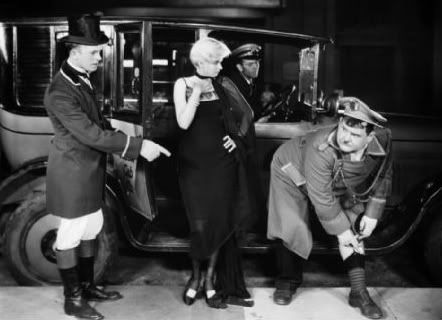
Tonight is the second night of silent Laurel and Hardy shorts in TCM's weekly Silent Sunday Nights feature. Probably the most interesting of tonight's shorts is Double Whoopee, airing at 1:00 AM. Stan and Ollie play a pair of men who get a temporary job working as doormen at a high-class hotel. Thanks to their uniforms, they're mistaken for a European prince and his retinue who are supposed to be chiecking in to the hotel on the same day Stan and Ollie arrive. Needless to say, chaos ensues. However, what really makes this one interesting is the presence in a brief scene of an 18-year-old Jean Harlow, pictured here with the two comedians. Her scene involves her getting out of a taxi, only for Stan to close the door on her dress and for the dress to get ripped off as she walks out of the taxi, making her walk into the hotel wearing just her slip. Oops! That's also some intereting hairdo that Harlow has.

Thursday, November 11, 2010

Mogambo vs. Red Dust

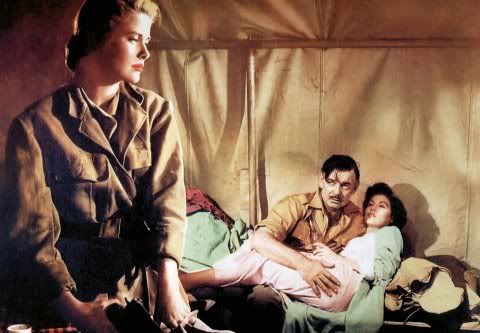
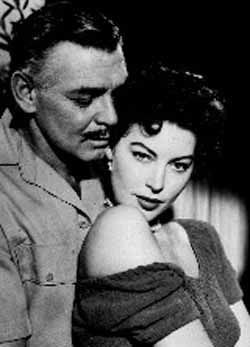
TCM is airing Mogambo tonight at 8:00 PM ET as part of the salute to Star of the Month Ava Gardner. It's a remake of the earlier Red Dust, with Clark Gable playing the male lead in both movies. To be honest, I prefer Red Dust.

In Mogambo, Ava Gardner plays a chorus girl stuck in Africa with big-game hunter Clark Gable, who falls in love with her. Then, Grace Kelly shows up with her husband, and Gable falls in love with Kelly, leading to predictable tension. In Red Dust, the Gardner part is taken by Jean Harlow, while the Kelly part is played by Mary Astor. (Red Dust is set on a rubber plantation in Indochina, but that's not important here.) I think the women are better cast in Red Dust: Jean Harlow exudes much more raw sexuality than Gardner, and the fact that Red Dust was made before the imposition of the Production Code makes it easier to show off the steaminess. As for Grace Kelly, she's lovely, but generally comes across as much too icy. Mary Astor has more ambiguity to her, and you can see why she would become disillusioned being stuck in the middle of nowhere and fall for Gable.

Also, Clark Gable was in his early fifties when he made Mogambo. I always knew he hadn't aged well, although part of that was colored by having seen Any Number Can Play, where his character is supposed to be somebody whom time has treated badly. Things don't get better by the time he made Mogambo. The one thing Mogambo does have going for it over Red Dust, though, is the fact that it was made on location, and in beautiful Technicolor. It's not a terrible movie by any stretch of the imagination, either; I just find it inferior to the original.

Mogambo has been released to DVD; Red Dust apparently hasn't. But you can watch Red Dust in a little under two weeks on TCM, at 5:00 AM ET on November 23. (That is, the very beginning of Tuesday morning; TCM lists it as being late late in the night on Monday.)

Monday, August 16, 2010

Mae Clarke, 1910-1992


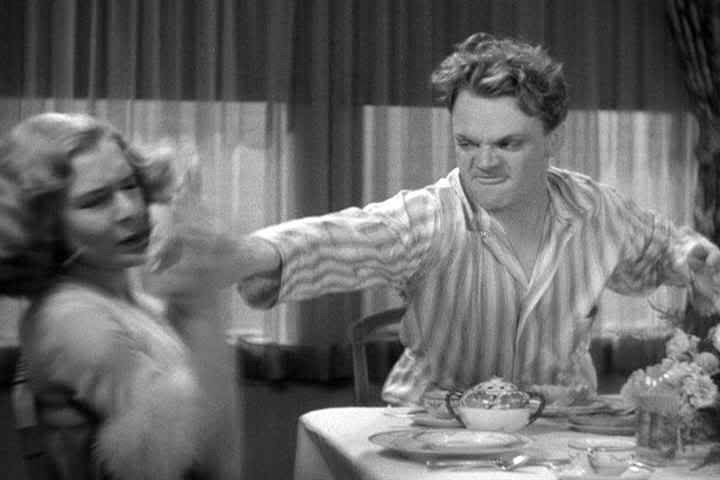
It was 100 years ago today that actress Mae Clarke was born. She had substantial roles through the 1930s, but never really became a big star. Ironically, her most iconic moment in film came in a picture where she didn't even get billing: The Public Enemy, where she plays the girlfriend who gets a grapefruit pushed in her face.

You probably know The Public Enemy is the movie about a man who shoots his way to the top, but there's actually quite a bit more interesting trivia about it. First, regarding the famous grapefruit scene, it was apparently not in the script; instead, it was either a practical joke by Cagney and Clarke, or ad-libbing. Director William Wellman liked the scene so much, however, that he decided to keep it in the final cut of the movie. To be fair, it does effectively show just how capricious Cagney's violent streak is.

As for Cagney, it's also thanks to Wellman that he's playing the lead. When Warner Bros. originally cast the movie, they had Cagney as the second man, with actor Edward Woods getting the lead. However, Wellman saw the early footage and realized that Cagney was by far the more charismatic actor, and knew that putting Cagney in the lead role would make it a much more forceful movie.

Jean Harlow gets second billing as one of Cagney's girlfriends, although the character of his wife is actually played by Joan Blondell. And in addition to Clarke being uncredited, the child star who plays the Woods character as a boy is also uncredited: Frankie Darro.

Tuesday, March 3, 2009

Jean Harlow, 1911-1937

Marie Dressler and Jean Harlow in 'Dinner at Eight' (1933)

Jean Harlow was born on this day in 1911. Sure, any day is a good day to post photos of the lovely Miss Harlow, but the anniversary of her birth is the most approriate day.

In the photo above, from the 1933 movie Dinner at Eight Harlow is seen with Marie Dressler, after just having told Dressler that she's read a crazy sort of book. If you haven't seen the movie, Dressler goes on to deliver one of the great one-liners.

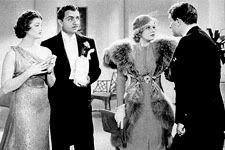
I've also recommended Harlow in Libeled Lady, from which this second photo is taken. Harlow, of course, is the blonde second from right, talking with Spencer Tracy who has his back to the camera. Harlow, of course, died tragically young, at the age of just 26. It's interesting to think about what might have come in her career later, but also a shame that she died young enough to allow this.