Today's post will be brief, because it's a holiday and I don't feel like spending too much time writing.
I had another geek moment the other morning when I turned on The Feminine Touch about 20 minutes in. The movie is set at a college and when the dean of the college appeared, I immediately recognized him as Grant Mitchell. I've mentioned Grant Mitchell twice before, although I've also blogged about The Great Lie without mentioning that he shows up at the beginning of it. My persoal favorite Grant Mitchell appearance is probably in Dinner at Eight, in which he plays Billie Burke's cousin, who'd rather be watching the latest Greta Garbo movie; Mitchell is the man who gets stuck holding Marie Dressler's dog.
Yesterday was the birthday of George Sanders, and TCM honored him with a bunch of movies. One they didn't show, ut I've blogged about, is Village of the Damned. Another excellent movie with George Sanders in it is Alfred Hitchcock's Foreign Correspondent. This ties in with the first half of my post: the original actor who showed up and made me realize just how many old movies I watch is Albert Bassermann, who appears in Foreign Correspondent as the diplomat whose kidnapping sparks the whole story. (And, I'm happy to say, Foreign Correspondent is available on DVD. However, I don't see myself blogging about it soon because I've blogged too much about Alfred Hitchcock.)
Friday, July 4, 2008
Brief connections on the Fourth of July
Posted by
Ted S. (Just a Cineast)
at
4:06 PM
0
comments
Thursday, July 3, 2008
Older actors are enjoyable, too
The 1954 movie Black Widow was on the Fox Movie Channel at lunchtime today, so although I'd already seen it before, I decided to watch it again. The fact that it was finally letterboxed was a big plus, but it's still a reasonably good mystery.
Set in the world of the New York theatre, Black Widow has a cast of stars who were slightly beyond their primes: Van Heflin is the lead, as a theatre producer who gets caught up in a dalliance with a young woman who has aspirations of making a name for herself in the theatre (played by Peggy Ann Garner) when his wife (Gene Tierney, unfortunately not looking nearly as hot as she was in Leave Her to Heaven -- the Cinemascope lenses must not have flattered her) is away. Eventually, she's found hanged in his apartment, and he's the natural prime suspect, being pursued by detective George Raft.
This being the New York theater, Van Heflin and his wife live in an impossibly nice apartment with huge rooms -- do they make rooms this size in New York apartments? An even more posh apartment, however, is that owned by actress Ginger Rogers and her husband, played by Reginald Gardiner, a floot above Heflin and Tierney. Rogers is a Margo Channing type in that she's dismissive of all around her, especially her husband, but also has a bit of Eve Harrington in her in that she seems to be a bit manipulative. Gardiner seems a bit mousy, although there's more to him than first meets the eye. (Of course, this being a mystery, there's more to everybody, including the victim, than first meets the eye.) I can't say that much more, however, without giving away the plot.
The actors, despite being a bit older than normal for an ensemble in a Hollywood movie (excepting those movies specifically dealing with old age), are fun to watch. Van Heflin is fine; he wasn't exactly endowed with matinee idol looks, but this role doesn't call for them. Instead, it works better as a slightly dumpy-looking man, the sort you'd expect to be going through a mid-life crisis. Gene Tierney would be fine if she had been given more to do; unfortunately, she's ignored for too much of the movie. George Raft's role is necessary but by definition not a starring role; he plays it quite appropriately, being understated and not overshadowing the various suspects, who are the real focus of the movie. Ginger Rogers is probably the best of the oldsters (although Garner as the victim is even better), although her role is a bit smaller than Heflin's. Seeing them all work together makes for eminently satisfying viewing.
Black Widow is available on DVD, which is a good thing. There was a completely different movie which also had the title Black Widow that was released in 1987; some TV listings mix up the two movies.
Posted by
Ted S. (Just a Cineast)
at
8:29 PM
0
comments
Labels: Gene Tierney, Ginger Rogers, Van Heflin
Wednesday, July 2, 2008
Young Lana Turner
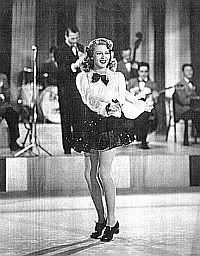
TCM is honoring big bands every Wednesday night in July; Artie Shaw and his band appear alongside Lana Turner in one of tongights more interesting selections: Dancing Co-Ed, airing overnight at 1:30 AM ET on July 3 (that's late in the evening of July 2 in the Mountain and Pacific time zones).
In Dancing Co-Ed, Ann Rutherford stars as a secretary to an agent for a dancer. Unfortunately, the dancer's wife, who is also his normal dancing partner, has just gotten pregnant, meaning that any new projects will be put on hold. Or maybe not: Rutherford and her boss come up with an idea for a dance contest. Co-eds at colleges across America will be able to enter a contest to determine who the dancer's new partner will be. The only thing is, it's going to be a rigged contest, with a dancer they want to promote (this is where Lana Turner shows up) being entered into the contest as a ringer. Of course, the girl has to get into college.... As a result, Turner and Rutherford enroll at the same college, with Rutherford taking the entrance exam for Turner.
Things go nicely until rich big man on campus Richard Carlson falls in love with Lana Turner. (Who wouldn't?) He's the editor of the campus newspaper, and has the distinct feeling that there's something not quite right about the contest. He's determined to expose the contest as the sham he (rightly) believes it is. The film bogs down a bit here, including our two lovebirds being temporarily expelled, since it's more about the music and the dancing than it is about any semblance of a plot. Eventually, we get to the final competition, in which Turner is supposed to win, but is otherwise indisposed; this being a Hollywood musical, you know there's eventually going to be a happy ending, although I won't give away exactly how it ends. The dancing is fun -- I don't think Lana Turner got to dance like this very often in the movies -- and if you enjoy swing music, then it's a great joy to be able to watch the music of Artie Shaw. As long as you don't expect this movie to be anything more than frivolous escapism, you'll find it a lot of fun. In addition to the stars, the cast also includes some well-known character actors, including Monty Woolley as a college professor; two names more familiar to serious movie buffs, Leon Errol and Lee Bowman; and Roscoe Karns, who appeared in the recently-aired His Girl Friday but might be best known as irritating bus passenger Oscar Shavely in It Happened One Night.
As for the plot, the TCM database has a very interesting synopsis: "A college girl fights to survive in academia and show business." Technically true, but in no way representative of what the movie is really about. (Ironically, my satellite box guide gets it right.) The other interesting piece of trivia is that for once, we actually have two people who would have been the correct age to play college freshmen; Lana Turner and Ann Rutherford were both 18 when the movie was released. (Richard Carlson, on the other hand, was 27. He would also go on to play another college kid the next year in Too Many Girls.) Sadly, Dancing Co-Ed is not available on DVD, so you'll have to look for one of its infrequent showings on TCM.
Posted by
Ted S. (Just a Cineast)
at
3:58 PM
0
comments
Labels: Lana Turner, musical
Tuesday, July 1, 2008
My Sister Eileen
Just a quick heads-up about a movie that's airing overnight tonight on TCM that's not available on DVD: My Sister Eileen, airing at 12:30 AM ET on July 2 (that's late in the evening of July 1 in the rest of the US). Rosalind Russell (TCM's Star of the Month for July) stars as a writer who, along with her sister Eileen (Janet Blair) moves from small-town Ohio to a basement apartment in Greenwich Village. Russell eventually becomes a successful writer by writing about the people in her apartment building, including those who stop by to visit the previous tenant, as well as the doings of her somewhat scatter-brained sister.
It's an episodic comedy that's quite a bit of fun, and based on a true story. Watch also for a cameo at the end; I won't give away who it is.
Posted by
Ted S. (Just a Cineast)
at
2:51 PM
0
comments
Canada Day
July 1 marks Canada Day, marking the 1867 anniversary of the UK's granting of dominion status to Canada. Canadians celebrate by being thankful they're not Americans, while we Americans celebrate by repeating our favorite Canadian stereotypes. That, and we celebrate all the famous Canadians who escaped to America to become successful in the movies, from Mary Pickford to Mike Myers, and then some. Perhaps the best known Hollywood movie set in Canada is Johnny Belinda, although it wasn't filmed in Canada: the coast of northern California substitutes for Nova Scotia. However, it's not just Americans who have stereotypes about Canadians; Brits do, too. The British look at Canada can been seen in one of the more remarkable movies from World War II, 49th Parallel.
The genesis of this movie is that World War II started in Europe two years before the Japanese bombed Pearl Harbor, meaning that for the first two years, the Americans were officially neutral. The British government wanted to encourage Americans to get behind the British, and so commissioned director Michael Powell, and his frequent collaborator Emeric Pressburger, to make a propaganda movie aimed at Americans. The result was 49th Parallel, but it's a very atypical propaganda movie. The basic story line is that a Nazi U-boat gets stuck in Canadian waters and, while a landing party goes ashore to get provisions, is bombed out of the water, leaving six of the Nazis stranded at a Hudsons Bay trading post. These six then try to make their way south to the still-neutral United States (the 49th parallel being the line of latitude that forms the US-Canada border from Washington to Minnesota), where they can be repatriated to Germany.
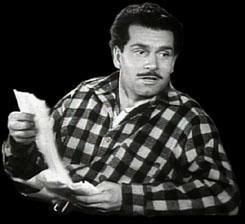
This being officially part of the war effort, quite a few stars appeared, taking on small roles for less pay than normal: Laurence Olivier (seen in the photo at left) is first among them, playing a hilariously miscast Québecois trapper (complete with horrendous accent and about a dozen siblings; thank you Catholic stereotypes); Leslie Howard plays one of his usually weak roles, as an anthropologist with a taste for modern art (what the Nazis call "degenerate") who only cares about the fight against the Nazis when they try to destroy his paintings; and Raymond Massey as a soldier who's gone AWOL but still loves his country.
The propaganda, such as it is, is sometimes blatant, notably in a sequence set at a commune of the pacifist Hutterite sect (the young Hutterite girl is played by a gorgeous Glynis Johns in one of her earliest performances). However, a lot of the time, it's much more below the surface, requiring viewers to think. The Nazis aren't portrayed as simply evil; they're also shown to be clever and manipulative, trying to play on what would have been natural divisions within Canada. Watch how the Nazis appeal to Olivier with a mention of the latent Québecois irredentism; that's something a Canadian filmmaker would probably never have done. One can only imagine what the America Firsters would have thought about this movie.
Ironically, 49th Parallel was ultimately not needed: Japan bombed Pearl Harbor before the movie was released, so by the time Americans could see it, the US was already in the war. Having said that, though, the movie was still wildly successful, in no small part due to the fact that it's much more than just propaganda. It's a darn good thriller. True, since it's supposed to be propaganda, you know the Nazis are ultimately going to fail in their attempt to make it to America. But seeing exactly how they fail is still a surprise. In addition to the excellent story, there's also a majestic score by Ralph Vaughan Williams, and wonderful location photography. 49th Parallel is available on DVD, and a movie I strongly recommend.
Posted by
Ted S. (Just a Cineast)
at
9:49 AM
0
comments
Labels: Michael Powell, World War II
Monday, June 30, 2008
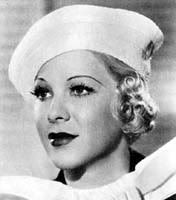
Glenda Farrell, 1904-1971

June 30 marks the anniversary of one of my favorite B actresses of the 1930s, Glenda Farrell. Farrell was quite popular for about a decade, usually getting billed well below the stars when she was in a "prestige" movie. But her characters always brightened the screen, being bold and brassy, and just plain fun.
One of the "benefits", if you will, of not getting starring roles, is that you show up with smaller roles in a lot of movies; Farrell made some 55 appearances in the 1930s. Many of the films are excellent A-list material, such as Lady For a Day, in which she plays the nightclub owner Missouri Martin; or I Am a Fugitive From a Chain Gang, in which she sends Paul Muni back down the river for a second stint on the chain gang; and even her first screen credit, as Douglas Fairbanks Jr.'s moll in Little Caesar. Even when she only had a tiny role, as in 1942's Johnny Eager, in which she plays the wife of a cop and only appears for a brief scene or two, she still shines.
Farrell did get to star in a series of B movies, too, as the wisecracking lady reporter Torchy Blaine. The movies are, as is usually the case in the B series of the 1930s, formulaic and short, but Farrell's boldness is fun to watch; often times it seems as though she has more cojones than any of the male characters! Farrell had earlier played a similar reporter in 1933's Mystery of the Wax Museum, which is the original version of the movie Vincent Price would later star in under the title House of Wax. The original might be better, in no small part thanks to Farrell, whose reporter drives quite a bit of the action.
Farrell's next movie to show up on TV is apparently Hollywood Hotel, as part of TCM's monthlong salute to big bands every Wednesday in July; Hollywood Hotel kicks off the proceedings at 8:00 PM ET on July 2. But a number of Farrell's movies, including most of those mentioned here (the exceptions are the Torchy Blaine movies and, surprisingly, Johnny Eager), are available on DVD.
Posted by
Ted S. (Just a Cineast)
at
3:14 PM
0
comments
Sunday, June 29, 2008
Glenn Ford's Maltese Falcon
TCM is airing Alfred Hitchcock's Spellbound tomorrow, but I've recommended enough Hitchcock for a while. Instead, I'd like to talk about a movie I briefly mentioned back in May: Plunder of the Sun.
Glenn Ford stars as an insurance adjuster who gets more than he bargained for when, stranded in Havana, he accepts an offer to transport a package to Mexico in exchange for the money he needs to get out of Havana. Unfortunately, he ends up on a ship full of mysterious people, each of whom is more than just what he or she originally presents himself to Ford as being. Much as in The Maltese Falcon, one of them dies along the way, and eventually, they all get to Mexico, looking for treasure. In this case, the treasure is Mesoamerican jewels, which are hidden somewhere in the ruins of an abandoned city of one of the civilizations that had inhabited central and southern Mexico a millennium or more ago.
The movie could stand on its own as a reasonably good B movie, but unfortunately, it has obvious comparisons to The Maltese Falcon, and there, it falls well short of the mark. The characters here are not as interesting as in The Maltese Falcon, and despite being an underrated actor, Glenn Ford isn't as good at playing a hard-boiled character as Humphrey Bogart was. Worse, there's a serious plot hole in Plunder of the Sun: the ruins where the treasure is to be found are not in the jungle, but a tourist attraction. You would think that the archaeologists who had discovered the ruins and maintaing the site as a historical site would have combed over the place to the extent that they would have found any buried treasure.
The other big flaw of Plunder of the Sun is that, despite the noir elements -- the attempts at hard-boiled characters, the story being told in flashback, and the like -- it really needs to be in Technicolor. The movie was filmed in Mexico, with the climactic scenes at the ruins being filmed at actual Mesoamerican sites in Mexico. These would have been much better were they on the screen in the brilliance of Technicolor. Noir may not work so well in Technicolor, but exotic locations certainly do.
All in all, Plunder of the Sun is a reasonable way to spend an hour and a half. It's not great, but it's better than a lot of the stuff that passes for entertainment on TV nowadays. It's available on DVD, too, if you want to give it a try. If, however, you want to introduce people who aren't movie buffs to the genre, it might be better to start with the Humphrey Bogart version of The Maltese Falcon.
Posted by
Ted S. (Just a Cineast)
at
7:13 PM
0
comments
Labels: Glenn Ford
Saturday, June 28, 2008
I know what you Nazis did last summer
On June 29 at 2:00 PM ET, TCM is airing what is, in my opinion, one of the most underrated movies of all time: Alfred Hitchcock's Notorious.
The story is part love story, part suspense. Ingrid Bergman plays Alicia Hubermann, the American daughter of a prominent Nazi sympathizer sentenced to a lengthy prison term for treason. She's pro-American at heart, and the intelligence officials know this, so they send their man Devlin (played by Cary Grant) to give Alicia an offer: she should go down to Rio de Janeiro with him to infiltrate a ring of Nazi expats living down there and doing something. Along the way, Devlin falls in love with Alicia -- who wouldn't?
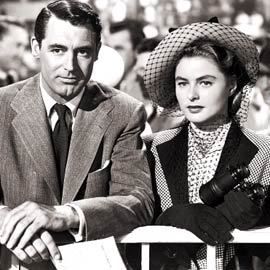
However, there's a catch for Devlin: the man Alicia is to meet, Alex Sebastian (played by Claude Rains), also falls in love with Alicia. Worse, Alex asks Alicia to marry him. As much as this pains Devlin, he realizes that it's actually a good thing in terms of their mission, as it will better enable Alicia to infiltrate the ring of Nazis. Clearly, though, Devlin is unnerved by it; watch how he treats Alicia in the pictured scene at the race track. Cary Grant is often given short shrift as an actor, on the grounds that he did a lot of light comedy, becoming almost typecast later in his career playing older romantic gentlemen. In Notorious, however, Grant gives one of his finest performances, showing just how good an actor he really was.
As for the suspense in Notorious, the "Macguffin" is that the Nazis are looking in Brazil for uranium sands, presumably with the intention of building an atomic bomb, although the movie never makes this clear, as it doesn't need to for the sake of the story. (As Hitchcock says in a segment that plays on TCM from time to time, the audience doesn't need to care about the Macguffin; it could just as easily have been industrial diamonds as uranium-238.) Alex Sebastian is the front man for the Nazis; it's in his palatial estate that the research is going on. Little does he know, of course, that his wife is spying on him for the Americans; he doesn't find out until after a party he and Alicia throw, planned by her with the express purpose of getting Devlin into the house to look for the Nazi secret. Here, watch for Hitchcock's execution of suspense: the uranium sands are being kept in certain wine bottles in the wine cellar. First, Alicia has to get into the cellar; the key to it is kept separately from the other keys in the house, and Hitchock expertly focuses on that key. Then, there's the problem that Alicia and Devlin might get caught in the wine cellar. Hitchcock builds the tension by showing an ice bucket filled with champagne bottles, and repeatedly returns to it, each time with fewer and fewer bottles left. Of course, Alicia and Devlin eventually do find the uranium sands, while Alex discovers that Alicia is an American agent. Claude Rains is outstanding in Notorious, perhaps even better that Cary Grant. Pay attention to the scene in which Alex tells his mother that he's married to a spy. Rains also gets some excellent facial expressions in the final scene -- and note that it is he, and not Grant or Bergman, who gets the finale.
Alex and his mother (a delightful study in evil played by an actress credited not with her given name, but as "Madame Konstantin") decide to poison Alicia by poisoning her coffee, leading, they hope, to a slow death that will creep up on Alicia before she can suspect anything -- just as she crept up on them. Eventually, Devlin realizes something is wrong when Alicia stops showing up for her contacts with him, and decides to force matters by seeing Alicia at her house to see just what is the matter with her. Will Devlin be able to save Alicia? Or will Alex be able to stop him? The climax is carried out on the grand staircase of the Sebastian house, and has just as much suspense as the party scene earlier in the movie. For a bit of trivia, though, pay attention to the staircase in the final scene. There's far too much action going on in that climax for it all to have taken place during the time it would take to walk down the staircase, so Hitchcock had to film the actors multiple times, with the background wall repeating for a couple of shots before they head further down the staircase. If you count the number of stairs any time one of the actors goes up the staircase during the course of the film, and then count how many steps they take on the way down, you'll notice a big difference.
Notorious is, as I have said, one of Hitchcock's most underrated movies, if not one of the more underrated movies of all time. For whatever reason, it doesn't show up on lists like the AFI's lists of the 100 greatest movies, despite the fact that it's much better than, say, Vertigo. It also didn't get the attention it deserved from the Academy come Oscar time. It only picked up two nominations; one for Rains, who richly deserved a Supporting Actor Oscar for his work but had the great bad luck to be up against Harold Russell in The Best Years Of Our Lives. Ben Hecht was nominated for his screenplay, but lost to The Seventh Veil. Even more sadly, Notorious is not readily available on DVD. It was released several years ago, but is out of print, and fetches a high price. Considering the director and the star power, Notorious would make an exceptionally good candidate for a new DVD release.
Posted by
Ted S. (Just a Cineast)
at
11:20 AM
0
comments
Labels: Alfred Hitchcock, Cary Grant, Claude Rains, Ingrid Bergman, please release me
Friday, June 27, 2008
I Love Lucy: The Movie
Our next movie is a comedy that's suitable for the whole family: The Long, Long Trailer.
Lucille Ball and Desi Arnaz had both made movies in the 1940s; Ball had more success than Arnaz, but even she never reached the true heights of movie stardom. It was only with the advent of their TV show I Love Lucy that the two became the couple, and once the TV show became a hit, it was natural that Hollywood's movie studios would once again come calling. The movie they made together was The Long, Long, Trailer, and it plays out much like an extended episode of I Love Lucy, only in Technicolor.
The two once again play a married couple, this time newlyweds. He's got a job that requires him to travel a lot, and she convinces him that a good way to keep expenses down, and enable the two of them to spend more time together, would be to buy a trailer, which they would drive around from place to place depending upon where he was working. Of course, this being the movie equivalent of Lucy Ricardo (the characters aren't named Lucy and Ricky, but Tacy and Nicky; some originality), you know that the result is going to be a disaster.
Indeed, Tacy and Nicky go through a series of mishaps that are painful for them, but hilarious for us: trying to back up the trailer, getting it stuck in the mud, trying to cook in a confined space, and on and on, with the climax being an attempt to navigate the trailer over a narrow mountain pass. The funniest, however, may be the sort of verbal comedy that Lucy Ricardo's mile-a-minute mouth gave us on TV. In one scene, Tacy tells Nicky, "Turn right here", which he promptly does, getting lost. It turns out that Nicky was too quick, not listening to all of what Tacy was going to tell him. It turns out that what she really intended was "Turn right here: left." You figure out what she meant. Ricky Ricardo never could.
The comedy is nothing groundbreaking, but it's more than pleasant enough. It's not exactly sophisticated, either, but that means you can watch it with the kids, especially because it's perfectly clean. In that regard, it's much like Yours, Mine, and Ours. Lucy and Desi made three movies together; the three have been released together as a DVD box set. However, The Long, Long Trailer is also available to be purchased individually, if you're either on a budget or have one of the other two movies already.
Posted by
Ted S. (Just a Cineast)
at
3:38 PM
0
comments
Labels: Lucille Ball
Thursday, June 26, 2008
The Lost Weekend is now a screwball comedy
The movie that made me think of combining a classic like The Lost Weekend with the best of screwball comedy is airing overnight tonight, at 12:30 AM ET on Encore Love Stories: Less Than Zero. I laughed my way through the movie, but it's unfortunately that the producers were actually trying to make a serious "message" movie.
Less Than Zero tells the story of a group of vapid, idle rich teens in Beverly Hills (zip code not mentioned here) who, after graduating from high school spend their days in lovely beach houses and their nights partying and snorting coke in the presence of copious quantities of neon. One of the clique, however, a young man named Clay (played by Andrew McCarthy), has sworn off all of this in order to go to college out east. He returns home for Christmas to find that his girlfriend Blair (Jami Gertz) is a casual snorter, while the third member of their little group, Julian, played by Robert Downey Jr., has a full-blown addiction. (One wonders how much acting Downey had to do, or whether this is just one of the dangers of "method" acting.)
Julian doesn't just have the physical addiction; cocain has screwed up his personal life, getting him thrown out of his house by his father, and caused him to run up a giant tab to his pusher (James Spader). Clay, in between sessions of making love to Blair, and driving around his high-priced sports car, decides that he cares too much about his friend to engage in "tough love", instead taking a more active part in helping him quit cold turkey -- ladies, have fun watching a naked Robert Downey going through withdrawal. Unfortunately for Julian, he's still got that pesky little debt, and his pusher wants that money, to the point of using Julian as a male prostitute. There's one particularly humorous scene where Clay walks in on poor Julian and has no clue of the humiliation poor Julian is going through.
It should go without saying that Less Than Zero does not measure up to the standard that Billy Wilder had set with the courageous The Lost Weekend 40 years earlier. While The Lost Weekend has a very ambiguous ending, Less Than Zero wraps everything up with a tidy little bow that allows it to make its anti-drug message. The styles make me wonder if the 80s were really as bad as is portrayed. I know that there's a lot of revision surrounding the 80s because it was the Reagan era and the cultural establishment (both high- and pop-culture) couldn't stand Reagan, but I don't remember the 80s being that bad. But the biggest flaw in the movie is that it's just so difficult to take seriously. I couldn't help but laugh at the Bette Davis style hamming from Jami Gertz, all the casual sex, and especially the homosexual prostitution. In that regard, Less Than Zero can be compared to Reefer Madness as movies that tried to be anti-drug but are so far of the mark that looking back on them, they're just funny. At least with Reefer Madness, though, you can give the filmmakers a pass for having a budget that would even have made Edgar G. Ulmer blanch. Less Than Zero was backed by a real studio, and was based on what is generally considered to be a much harder-hitting book. (I should point out that I haven't read the book.) However, if you want a good laugh, you could do worse than Less Than Zero.
One final point of trivia: two of the three leads -- Gertz and Downey -- were actually relatively young for Hollywood's portrayal of teens. They were only 22 at the time the movie was released; McCarthy was older, but still a relatively young 25.
Posted by
Ted S. (Just a Cineast)
at
12:51 PM
0
comments