Showing posts with label Van Heflin. Show all posts

Monday, November 10, 2025

Not as cool as rebel girls

In the second half of the 1930s, Katharine Hepburn famously got the label of "box office poison". Having seen some of the movies she made before heading back to the New York stage for a few years, I think it's not hard to see the self-centered characters she had a tendency to play combined with her mannered nature not working for audiences of the day. She's less self-centered in A Woman Rebels, but then there's the plot....

Hepburn plays Pamela Thistlewaite, a young woman living in Victorian England with her younger sister Flora (Elizabeth Allan) and widower father Byron (Donald Crisp), a judge who frequently travels to London. He's strict and has ideas about women that lead to them having a very narrow place in the world, something that Pamela strongly disagrees with. Dad thinks women should be wives and mothers, and it's past time for the two daughters to be married off.

So when Dad introduces the daughters to the world, it's a relief to him that Flora meets a nice young naval officer, Lt. Freeland (David Manners). Pamela meets a man too, Lord Gaythorne (Van Heflin), but the catch in his case is that he's already married, and there's no way he's going to be able to leave his wife. This is the Victorian era, after all, so the idea of getting a divorce would have been somewhat scandalous, even if the Anglican church had been founded precisely on the idea that the king should be allowed to get his divorce.

So when Lt. Freeland gets a post in Italy as a naval attaché, Pamela eventually follows to spend time with her sister, who is already with child. In fact, Pamela is with child as well, having been knocked up by Gaythorne, so her going off to Italy is convenient so that nobody in England will know of the baby. In Italy, Pamela meets diplomat Thomas Lane (Herbert Marshall), and kinda falls in love with him, despite her complicated personal life. And things suddenly turn as Flora's husband is killed in a shipwreck. The shock causes her to miscarry, and then ultimately die. But this gives Pamela an idea! She'll have her own baby, but pass it off as Flora's, with the idea that Flora died in childbirth and this poor orphan needs an aunt to raise it.

Pamela returns to England, and writes some fiction that she's able to get published in a ladies' magazine, before becoming an editor there when the regular (male) editor is out. This in an era when taking such a job, even if it is at a ladies' journal, is treated as kind of scandalous. Doesn't Pamela know she's supposed to get married?

Pamela's daughter, still thinking she's Pamela's niece and named after Flora, grows up with... Lord Gaythorne's son, things really start to get complicated. Technically, since they're half-siblings, they really shouldn't get married. But Pamela can't tell young Flora the truth for fairly obvious reasons. But Pamela is going to have to meet the elder Gaythorne about all this, and this time their tryst is discovered, so there's going to be scandal anyway....

I suppose the fact that the Production Code was in full effect partly drives what's going on in A Woman Rebels, but boy is the plot here nutty even compared to some of the other movies of the era that had to contort their plots to fit into Production Code strictures. And this I think is one of those places where the casting of Katharine Hepburn doesn't help. Bette Davis might have made the material seem fresh, but Hepburn is as cold and distant as ever here.

Still, there are people who like Katharine Hepburn, so watch this one for yourself.

Monday, September 9, 2024

Till the Clouds Roll By

I had some more movies that were about to expire from YouTube TV's cloud DVR, so I had to make a point of watching them to do a review now. The latest is the musical "biopic" Till the Clouds Roll By.

The movie opens with one of those old-style forewords informing us that the action begins on December 27, 1927, the opening night of the musical Show Boat. The music was written by Jerome Kern (played here by Robert Walker), a composer who had already had a string of Brodway hits in the 1920s, although getting to the top wasn't easy. On his way back home after the show, he asks the cab driver to detour and look for a particular brownstone. Since the movie opens up at the height of Kern's career, we know that we're about to get an exceedingly original plot device... the flashback to the beginning of the subject's career.

This time, we go back around 20 years (the real-life Kern got his start fairly young, around age 20 in 1905). Young Jerome is a budding composer, but he doesn't know so much yet about lyrics or good arrangements. To that end, he's been sent to the brownstone that older Jerome asks the driver to stop by. There (in 1905) lives an arranger, James Hessler (Van Heflin). Now, this leads to why I put the word "biopic" in sneer quotes above. James Hessler is the other main character of the movie along with Kern, but Hessler is a completely made-up person! Hessler is an arranger who would like to be a symphonic composer. He's also a widower with a young daughter Sally (grown-up Sally is played by Lucile Bremer). In any case, Hessler becomes Kern's mentor.

Kern writes good music, and would like to write for Broadway, but when they try to get a foot in the door, they learn that it's still the fad on Broadway to import revue-type shows from the UK and that the music of London is more popular to the Broadway crownd than the new American sounds bubbling up. So it's off to London.

Kern eventually meets British producer Charles Frohman (a real-life person, and his death along with Kern's tangential relationship to that being more or less accurately portrayed), and is able to sell one of his songs to Frohmann's London Gaieties. This also leads to Kern getting hired to write more songs for a show that's going to open in New York. Also while in the UK, Kern met Eva (Dorothy Patrick), the woman who would become Mrs. Kern.

Kern goes back to America with the Hesslers and Frohman, and I'd guess it was the US being out of the Great War for a couple of years while the European powers were fighting it that really boosted the careers of composers like Kern. Sally, now grown up, has always considered Jerome like an uncle, and wants to follow Jerome into musical theater. To that end, Jerome even writes a song for a musical that would give Sally her first solo even though she's not going to be the star of the show. The producer, however, thinks the song would be a better fit for the show's star, Marilyn Miller (another real-life person, played by Judy Garland). Sally has a hissy fit and... runs away!? Dad, by now ill with heart problems, wants Jerome to find Sally, but Dad dies before father and daughter can be reunited.

Jerome, like a lot of other composers and lyricists, went off to Hollywood once sound comes to movies, and wrote more memorable songs for movies in addition to adapting some of the old musicals for Hollywood. The last 10 minutes or so is a montage of various MGM stars doing numbers of a bunch of different songs, giving MGM a chance to put those stars into a big-budget musical if they hadn't already been used in a production number earlier in the movie.

If you like the Great American Songbook, you'll love Till the Clouds Roll By. The songs are unsurprisingly quite good. There's a reason why things like Show Boat or the song "Smoke Gets in Your Eyes" from Roberta endure. The production numbers MGM did, at least up until the finale which is a bit more bland, are also very well done. The dramatic story, however, is something best not discussed. To be fair to MGM, however, the real life Jerome Kern story was mostly something not cinematic or dramatic enough for a biopic. But that's part of why Till the Clouds Roll By is a bit of a mixed bag.

If you like the Freed Unit, then Till the Clouds Roll By is definitely for you.

Sunday, June 16, 2024

Four Daughters good, seven daughters better?

I've got a bunch of movies on my DVR that I haven't blogged about before but that are coming up soon on TCM. One of them is Raintree County, but that's currently on the schedule for July so I've decided I'm going to blog about it then. But there are two on June 18, which is why the first of them is getting a post already on June 16. That one is Seven Sweethearts, which comes on TCM at 11:30 AM on June 18.

A brief opening includes some doggerel about the Dutch contribution to America, reminding us of the town of Holland, MI, which was founded by Dutch immigrants although as I understand it the demographics have changed significantly since this movie was released in 1942. Then, driving into New Delft, which I guess is supposed to be the stand-in for Holland, is New York photojournalist Henry Taggart (Van Heflin, who had just become a star thanks to his performance in Johnny Eager, although this movie was released before he won the Oscar). He's got an assignment to do a piece on the town's tulip festival, and he's looking for a place to stay.

Unfortunately for him, he winds up talking to somebody who it seems would rather give him the runaround, that being Van Maaster (S.Z. Sakall). Henry first meets Van Maaster sitting in the town square playing his oboe, while other guys in the buildings around the square play the other parts of the piece. It just so happens that Van Maaster owns the local hotel, although he really only advertises it to the people he wants to have stay in the hotel, which seems like a good way to go bankrupt quickly. Fortunately for Henry, Mr. Van Maaster is willing to have him as a guest.

Henry gets shown to his room by one of Van Maaster's daughters, who just happens to have a boy's name, because Dad, wanting a boy, preemptively gave all his kids boys' names before they were born, only for his wife to push out one daughter after another, seven in all. Henry also discovers that this is a rather odd hotel, in that there are guests who haven't paid their bills in months, and all the guests seem as happy as they would be if they were Stepford Guests.

The daughters are all unmarried, because of a family tradition. Even though five of them have boyfriends who anywhere else would be a fiancé already, in the Van Maaster family, the daughters always have to marry in age order. And the oldest daughter, Regina (Marsha Hunt), instead of wanting to get married, wants to go off to New York and become an actress. So she's thrilled that Henry is here, because perhaps he can get her out of town.

It's youngest daughter Billie (Kathryn Grayson), however, who winds up weaving the web around Henry as this magical town grows on him. He and Billie fall in love, although there's a problem in that she doesn't really want to upset the family tradition and get married first. (I also couldn't quite tell how much of an age difference there was between the seven daughters.)

As I watched Seven Sweethearts, I couldn't help but think of the Four Daughters series that Warner Bros. had recently completed. That series worked in part because it was made before World War II came to America, during that latter stages of the Depression when that sort of small-town charm still worked. But also, Four Daughters had a hard edge of drama in no small part thanks to the presence of John Garfield and being done at Warner Bros.

MGM, on the other hand, put Van Heflin into Seven Sweethearts, and seemed to be of the belief that the thing to do with this material was to pour as much of the sentimental gloop as the studio could into the material. Another review I read used the word "cloying", and oh my is Seven Sweethearts nonstop cloy. You wonder why Henry didn't throttle everyone in town on his first day in New Delft.

But then, to make things worse, since they were grooming Kathryn Grayson for stardom, they had to give her a bunch of songs to sing. Her voice doesn't really work for me, and I've always considered her an acquired taste. But her vocal stylings work even less for this sort of movie.

There are going to be people who like Seven Sweethearts. But I'm not one of those people.

Tuesday, October 19, 2021

Don't go looking for Flipper

I don't remember whose day it was in TCM's Summer Under the Stars, but one of the old Studio Era prestige movies I hadn't seen before was airing, Green Dolphin Street. So I recorded it and recently got around to watching it.

In the early 1840s, the Patourels are a well-to-do family of French Catholic descent living on St. Pierre, one of the Channel Islands which are British. Dad (Edmund Gwenn) has been married to Mom (Gladys Cooper) long enough two adult daughters, elder Marianne (Lana Turner) and younger Marguerite (Doona Reed). Dad runs a shipping company, with one of the boats, the Green Dolphin, traveling far and wide.

Also living on the island is Dr. Ozanne (Frank Morgan). He's got an adult son William (Richard Hart) who has just returned after being away, with some vague suggestion that this might be a bad omen. There is, in fact, a not-so-good man around, one Timothy Haslam (Van Heflin). He needs the services of a doctor quick, having been in a knife fight that killed a man. And he needs to get off the island, so the captain of the Green Dolphin agrees to take him to the new colony of New Zealand, where he won't have to face the law back in Europe.

Meanwhile, William has met both of the Patourel sisters. Both like him, although William clearly loves young Marguerite. But because of his father's lower social standing, it's suggested that William make his own way in the world by becoming a Navy officer first, and then he'll be OK to marry Marguerite, not that anybody mentions marriage yet.

It's not until William sails off to China that he's finally ready to think about marriage, sending some jewelry to Marguerite. But the stereotype of the inscrutable Chinese woman decides to slip William a mickey to take all his money, and William wakes up the next morning a deserter as his navy ship left port. Fortunately, the Green Dolphin is there and can take him to New Zealand too.

William meets Timothy, who has become successful in the lumber business, although that also means moving inland, which presents a problem in that they're further away from civilization and have to deal with the Maori. But William becomes successful too, ready to write back to the Patourels and ask for Marguerite's hand in marriage. Except that he gets so drunk that he accidentally writes "Marianne" instead of "Marguerite".

Lots of melodrama follows on both sides of the world. We learn that Timothy has always carried a torch for Marianne. Also in New Zealand, there's both a Maori uprising and a massive earthquake that is the highlight of the movie. Back on the Channel Islands, we learn that Mrs. Patourel had loved Dr. Ozanne when she was younger, but didn't marry him because of his social status and her parents' pressure. She and Dad die within minutes of each other, and Marguerite, being a spinster, decides to become a nun!

Green Dolphin Street is the sort of movie that MGM excelled at making. The prestige nature of it is evident from the cast, as well as the pretty darn good special effects for 1947 of the earthquake and what it does to the river. (In fact, the effects won an Oscar.) The story, however, caused a few groans for me, specifically because there are some mean plot holes here. Marianne and William return to St. Pierre a long time after Dad died, and the house is being kept up like always, with all the old servants there. Who's paying them? And did William really think he could just gallivant in and take over the old family business which certainly would have been under new ownership once Mr. Patourel died?

But if you can overcome such plot holes, as well as the fact that the first half of the movie is very slow-moving (the movie clocks in at a leisurely 141 minutes), you'll find that Green Dolphin Street is a grand example of studio filmmaking near its best in the second half of the 1940s.

Wednesday, February 3, 2021

H.M. Pulham, Esq.

Another of the movies that I've had on my DVR for a while that I finally got around to watching because it's available on DVD courtesy of the Warner Archive (or at least was last I checked) is H.M. Pulham, Esq.

Robert Young plays Harry Moulson Pulham, who at the start of the movie is in his late 40s and, one can guess, a lawyer in private practice in Boston. He comes from the upper-crust of Boston society and lives the sort of "proper" life you expect from Bostonians of that era; think the Vales in Now, Voyager before Bette Davis insists on having that nervous breakdon. Mr. Pulham has a wife Kay (Ruth Hussey) and two children, and walks the dog every morning before walking to the office.

On this particular day, however, a couple of things shake up his routine. One is a call from Rodney Brown, nicknamed "Bo-Jo" (Leif Ericson). Brown was one of Pulham's friends from Harvard back in the day, and with their 25th class reunion coming up, wants to get together with all the friends and do some capsule bios of their lives in the quarter-century following graduation. The other is a message from a then young woman that Pulham knew from working with her in New York a few years after graduation, Marvin Myles (Hedy Lamarr). She's up in Boston, and invites Harry to see her at a partciular hotel. He goes, and looks at her, but can't brin himself to actually talk to her again....

Flash back to early in Harry's life, long before even meeting Marvin. He had a wealthy father in John Pulham (Charles Coburn) married to Mrs. Pulham (no first name given and played by Fay Holden from the Andy Hardy movies), and went to the right schools, even knowing Kay from a fairly early age but not caring for her because she, like a lot of the Boston families, are from stuffy stock. Then he goes off to Harvard and, after graduation, goes off to fight in World War I (the movie was actually released the week before Pearl Harbor; do the math).

World War I changed a lot of people, and Pulham seems to be one of them. He's not so certain he wants to go back to Boston, and one of his more liberal friends from Harvard, Bill King (Van Heflin), gets Pulham a job in advertising in New York, something that would scandalize the family, as this isn't exactly the most respectable job out there. Marvin is a copyrwiter at the agency, and Marvin and Harry seem to work a lot together.

Unsurprisingly, they fall in love too, although we know at the very beginning that they don't wind up together in the final reel since Harry and Kay are married in 1941. It turns out that Harry brings Bill and Marvin up to Boston to meet the family one weekend. Harry's kid sister Mary (Bonita Granville) likes Marvin, and Mom professes to, but Marvin understands that the whole familiy is so tradition-bound and stuffy that this could never be the place for her. But don't Marvin and Harry love each other?

H.M. Pulham, Esq. is one of those movies that MGM made well, much like Madame Bovary which I mentioned several weeks ago. Unfortunately, in the case of H.M. Pulham, Esq., the plot is a bit maddening. Harry and Marvin's reasons for breaking up just make me shrug my head and wonder why either of them thought they'd go on to live happily ever after snubbing each other.

So, while H.M. Pulham, Esq. is a stylish and well-acted movie, it's in service of a script that definitely has its problems. But, as always, judge for yourself.

Saturday, January 16, 2021

Madame Bovary (1949)

I hadn't intended to do posts on two late-1940s literary adaptations in such close proximity following the airing of the British Anna Karenina the other day. But I only realized last night, not having looked closely enough at the TCM schedule, that the 1949 version of Madame Bovary is on tomorrow morning at 8:00 AM. So I made it a point of watching it to do a post on here.

The movie starts off with an establishing story. Gustave Flaubert (James Mason) wrote the novel Madame Bovary in 1856, and the publication of the novel caused a scandal in France, at that time ruled by Napoleon III. Flaubert was put on trial for indecency, where he claimed that the Madame Bovary he was writing about was just the face for a real type of woman in French society. He proceeds to narrate that story....

Flash back to the early life of Emma (Jennifer Jones) before she met Bovary. She went to a convent school that she hated, and realized she wanted the better things in life. But when she grows up and leaves the school, she winds up in the provincial town of Yonville. One day, the town's new doctor, Charles Bovary (Van Heflin) shows up, and he immediately falls in love with Emma. She must think that a doctor will command a good salary, because she marries Charles.

As you can guess from everything that's happened up to this point, Emma and Charles don't live happily ever after. Charles is very much provincial, and thinks he's not particularly a good doctor, so the family isn't well to do. Emma meets the boy next door, Léon Dupuis (Alf Kjellin who was credited as Christopher Kent because MGM must have thought American audiences wouldn't be able to pronounce Kjellin), who is hoping to become a lawyer, a profession which will definitely be for financially rewarding than what Charles is bringing in. By now, Emma is already starting to rack up debts to keep a better lifestyle than Charles can provide her.

The doctor and Emma get invited to a society party in the nearest big city of Rouen, which is where they meet Boulanger (Louis Jourdan). Emma decides he's going to be her lover now that Dupuis has gone off to Paris and Boulange can dance with her the way that Charles definitely can't. Charles is understandably pissed when he sees what his wife's actions are doing to his reputation, but he's powerless to stop it. Emma goes into more debt in order that she may run off to Italy with Boulanger. But Boulanger plays a trick on Emma in that he leaves beforehand so on the appointed night they're supposed to go off together, he's already jilted her.

And now those debts are about to start catching up with her. L'hereux (Frank Allenby) had been lending Emma the money she needed, but he needs money himself, so he sells off the notes to another man who is going to sue if he can't collect. By this time, Emma and Charles have run into Dupuis again, now in Rouen, so Emma thinks she can go back to him to get him to pay off the debts. She doesn't realize that he's still not a lawyer at all, and there's no way he's going to be able to pay off those debts. What options does Emma have left?

Madame Bovary is an example of the sort of film that it was perfect for MGM to make, the period literary drama. MGM always had high production values and a sort of glitter that didn't work for certain genres of movies, as I've mentioned with Johnny Eager or East Side, West Side in the past. But, here, that sort of gloss is exactly what the movie needs in trying to show Emma's living above her means, especially, for example, with the ball where she meets Boulanger. She's wearing a fabulous gown/shawl combination, and there's something about Jourdan and Jones dancing together that looks surprisingly glamorous.

As for the acting, I'm not terribly enamored of the job that Jennifer Jones did, but I though Van Heflin was quite good as the country doctor who sinks into the bottle as the realization begins to dawn on him that he's got a wife he can't support in the way he wants. The supporting roles are handled well enough, although most of them are also relatively small.

I couldn't find a DVD release of Madame Bovary, which is a big surprise, since it was released by MGM, and as a prestige picture, should have been a prime candidate for either a standalone Warner Archive DVD or as part of a box set. It does, however, seem to be on a bunch of streaming services if you can do the streaming thing.

Friday, December 4, 2020

Once a Thief

Toward the end of Summer Under the Stars in August, TCM ran a day of the movies of Alain Delon. This gave me the opportunity to watch one I hadn't seen before, Once a Thief.

The movie starts off with a jazzy scene in a smoky club somewhere in San Francisco, intercut with a hold-up going on in a small store in Chinatown that results in the proprietress getting shot dead, all with the opening credits, implying that there's something edgy and new (well, at least for the mid-1960s) about the movie. We are then introduced to the main characters.

Delon stars as Eddie Pedak, a parolee who served time for robbery and shooting a cop. He's trying to put his life together by working at a shipper on the waterfront, hoping to buy a boat he can do fishing out in the Pacific with. He's also got a wife in Kristine (Ann-Margret) and daughter. And somehow, he was abot to scrape the money together despite having spent time in prison to buy a vintage Ford Model A that looks spiffy.

Van Heflin plays Mike Vido, a detective for the San Francisco police who is the man that was shot by Eddie in that previous holdup. So Vido has a thing against Eddie to begin with. And when it transpires that there was a Model A outside that store in Chinatown, and the bullet from her was fired from the same gun used to shoot Vido, he draws the natural conclusion that Eddie was involved in the shooting, even though the dead woman's husband can't identify him in a lineup. It's enough to get Vido to go to the waterfront and cost Eddie his job.

Eddie protests his innocence, and as we said, the Chinese guy in the store couldn't identify him. Eddie has trouble getting a job, but is also proud enough that he doesn't want Kristine to do the sort of work for which she'd be best suited. Recognizing all of this is Eddie's estranged brother Walter (Jack Palance).

Walter has a plan. Eddie's old employer on the waterfront is going to be handling a shipment of titanium, something that's going to be worth a large sum of money because the relatively rare metal is valuable. Walter has learned this somehow, and has assembled a team of people for the heist. The only thing is, he could use his brother's inside knowledge of the layout of the place, and Eddie doesn't really want to do it.

That's going to change somewhat, however, when keeps being unable to get a job, and it seems like this "one last heist" (sure) is the only way to get the money to pay off the boat. The fact that Walter and his minions are harassing Eddie's daughter doesn't make matters any easier for Eddie.

And then Vido finds an odd car in the garage of recovered stolen cars. It's a Model A that looks surprisingly like Eddie's, but it isn't Eddies. Vido is finally able to put two and two together and figure out that Eddie is framed, and we the viewer can guess that it's Walter who did it specifically to put more pressure on Eddie to go along with the heist. Unfortuntely, the Production Code was still in effect at the time the movie was made, so you can figure out how things are going to end.

Once a Thief isn't necessarily a bad movie, and certainly not a bad movie for its genre. But it suffers from the opening, which give the impression it's going to do a lot more than it ultimately delivers on. Sure, there are a lot of little touches to like, and having Van Heflin and Jack Palance in the movie is always a plus. But in the end it feels like a been there, done that movie that's not going to stand the test of time.

Once a Thief is available on DVD courtesy of the Warner Archive Collection.

Friday, March 27, 2020

B.F.'s Daughter


Another of the movies from 31 Days of Oscar that I recently watched was B.F.'s Daughter.

B.F. is played by Charles Coburn. This is B.F. Fulton, an industrialist living in a posh New York mansion during the height of the Depression. His daughter, Polly, is played by Barbara Stanwyck. She's got a boyfriend who's not quite a fiancé in Robert Tasmin (Richard Hart), who works as a stockbroker. He wants to be successful on his own before marrying Polly, instead of relying on her father's wealth.

One day, Polly and her friend Apples (Margaret Lindsay) go to a speakeasy, where they meet Thomas Brett (Van Heflin, being cast with Stanwyck again after The Strange Love of Martha Ivers). He's an assistant professor of economics who also writes essays and gives public lectures. He's to the left of Franklin Roosevelt (the movie starts about a month before Roosevelt's first election), so he certainly wouldn't like B.F. But Tom and Polly hit it off, and Polly devises a scheme to meet Tom as a theater showing of Hamlet.

The relationship continues to the point that they're going to get married, a sort of elopement so that Tom can go off to a little cabin to write his next book. He also wants to go on a lecture tour, but the bookers aren't about to give prominence to an unknown like him. What he doesn't consider is that Polly has money, and to make her husband happy by helping him to succeed, she convinces the agent to let her back the lecture tour's profitability (without telling Tom, of course).

The lecture tour winds up being a success, Tom becomes famous, and by the time World War II is about to roll around, Tom gets an important position in the Roosevelt administration, something he relishes because it gives him the opportunity to fuck over the sort of person he doesn't like, much like politicians have always done and do even today. The job also comes with a lot of duties that keep him away from Polly.

So she tries to make him happy again by getting him a nice place in Connecticut, but it's here that Tom learns about Polly's having backed the original lecture tour, which pisses him off because he, like Tasmin (who married Apples), wanted to succeed on his own. It threatens to destroy their marriage.

However, this being an MGM movie, you know it's likely to have a happy ending. If there's one thing wrong with the movie, it's that MGM shine, as I mentioned regarding another Stanwyck/Heflin pairing, East Side, West Side. Both leads are good with the material they're given, but the material is infuriating at times. (It doesn't involve either Stanwyck or Heflin, but there was a scene regarding a World War II mission where I found myself saying out loud to the TV that military secrecy is being horrendously violated.) I also found the love at first sight between these two a little hard to believe here.

Still, I think there are a lot of good performances, not just from the two leads, but from Coburn, and Keenan Wynn as a lefty radio commentator friend of Tom's. (It's his radio commentary that violates military secrecy.) That all makes the movie worth a watch, even if it probably could have been better. The movie is available on DVD courtesy of the Warner Archive Collection, so you can watch at your leisure.

Sunday, October 28, 2018

Patterns

A couple of weeks back TCM ran a night of films devoted to Ed Begley (Sr.) and, since I hadn't bloged about Patterns before, I decided to DVR it and watch it.

The Ramsey Corporation is one of those big conglomerates of the last century that's headquartered in New York and seems to have its fingers in everything, run by Ramsey (Everett Sloane), son of the founder of the business. Ramsey just brought up a new man who was managing a factory in the Cleveland area to be the newest executive, and that's what all of the secretaries are talking about. The new man, Fred Staples (Van Heflin), is going to be working alongside one of the most senior executives, Bill Briggs (Ed Begley).

Fred has a sort of wide-eyed view of New York, feeling it's the big time, and impressed with the way the corporation has handled his transfer. They've gotten him a big how out in the suburbs, already furnished, so on his first day his wife Nancy (Beatrice Straight) is able to drive him into work in a New York that has surprisingly little traffic. But Fred is soon to find out that everything isn't as idyllic as it seems.

Two things give Fred that indication. He's brought into a board meeting on his very first morning at the place, and one of the items up for discussion is the purchase of a factory currently in receivership. Ramsey wants to close it down for retooling for a good six months, since to keep it open would be unproductive and unprofitable. Briggs, however, feels it should be kept open, since it's the main employer in the town where it's located, and closing it down that long could mean by the time they're ready to reopen it, there's not going to be a workforce to work there. But really, this factory is just a McGuffin for the interaction between Ramsey and Briggs. Ramsey more or less winds up screaming at Briggs, belittling him and browbeating him into being a yes-man. Not what Fred expected at all. Worse is when Fred finds out this his secretary is going to be the thoroughly competent Marge (Elizabeth Wilson), who has been Briggs' secretary for years, and is being permanently reassigned to Fred. Marge knows what that means.

Although Fred has his misgivings, he's keeping a bit silent about them at work since he's made fast friends with Briggs, what with their working together on a big report. Nancy also realizes something's going on, and tries to get Fred to stand up for himself, even if that's going to cause some friction at work. If it's a dog-eat-dog world, you don't want to be the one being eaten. And it's not only causing friction at work, but at home, too.

Matters come to a head when the Staples hold a party for the various board members and their wives. Briggs can't make it, which should be another ominous sign. But Nancy engineers things so that Ramsey will get to read a copy of the report ahead of time, and Ramsey thinks that Fred should get all of the credit for it. Obviously, he's trying to push Briggs out, and since you can't really fire people this high up, you try to make their working life such a living hell that they'll give up and quit. Briggs, for his part, seems to have nothing in his life but his work, and isn't about to quit....

The plot of Patterns is a good one. The performances are uniformly excellent. The one problem I had, however, is with the script, which seemed a bit heavy-handed in places as it was trying to drive home its points. I was in many ways reminded of Executive Suite while watching Patterns, and I have to say that I'd give a slight edge to Executive Suite. That's not to say that Patterns isn't a darn good movie. Indeed, I can strongly recommend it.

Patterns is available on both DVD and Blu-ray.

Saturday, July 28, 2018

An MGM melodrama

I mentioned many years back when I blogged about Johnny Eager that there's something about the gloss that MGM pictures had that comes with a side effect of making certain pictures look not quite right. Another good example of this is East Side, West Side.

Barbara Stanwyck plays Jessie Bourne, who has lived in New York all her life and tells us in a prologue that the city isn't quite as glamorous as outsiders might think; after all, the people in New York have day-to-day lives, too. In Jessie's case, that means marriage to investment advisor Brandon (James Mason), and weekly trips to her parents' place every Thursday night for dinner. At one of those dinners, Brandon gets a call that his business colleague needs to see him before a board meeting the next day, so he's going to have to leave early while Jessie goes home to wait up for him.

Brandon doesn't get in until 4:00 AM. He's spent some time at a swanky nightclub after the meeting, which involved talking to a woman Rosa (Cyd Charisse). Rosa has other guys pursuing her, and one of them eventually took a slug at Brandon. Since Brandon is well-known in his field, and a playboy, and the fight happened outside, it made it into the paper, which ought to be much to Jessie's consternation. Except that she's seen this sort of thing before. She knows that Brandon has had difficulty staying faithful, especially in the case of a former flame Isabel (Ava Gardner).

Well, formerly former. Isabel has come back to town with the intention of taking Brandon away from Jessie! As for Jessie, she meets Rosa, whose boyfriend Mark (Van Heflin) is about to get back from Italy having done government business in the post-war transition. Except that for Mark, this is really only a relationship of friends; he likes Rosa as a friend but not as a girlfriend. But when he meets Jessie, he could fall in love with her if only she weren't already married to Brandon.

This love quadrangle results in Isabel getting murdered, Jessie and Brandon being considered suspects, and Mark (a policeman before going off to World War II and Italy) solving the crime, all in the space of one reel. Now that Isabel is out of the way, what will happen to Jessie and Brandon's relationship?

The problem I had with East Side, West Side is that it all seems too pat and sterile. There's a long lead-up to the murder which occurs less than a half hour before the end of the movie. And as I said, it's amazing that Mark is able to solve it so quickly. Brandon seems to be almost a cardboard cutout and not a real character, with James Mason practically sleepwalking his way through the role.

And yet, through all this the movie is very pretty to watch. It's photographed in nice black-and-white, with attention paid to the details of the Bournes' luxurious duplex apartment, as well as the nightclub and Brandon's office. Even the poor side of New York, where Mark and Jessie's characters grew up, looks too nice. Compare it to the place on the wrong side of the tracks when Dana Andrews' character returns home to his parents in The Best Years of Our Lives, which seems much more real. All of this sheen is hiding a by-the-numbers, pedestrian film.

East Side, West Side is available from the Warner Archive. But it's really one of those movies that would be better off in a box set.

Thursday, May 15, 2014

Count Three and Pray

I probably should have done a full-length post about Count Three and Pray yesterday, since it's coming on fairly early this afternoon at 2:00 PM on TCM, and it doesn't seem to be available on DVD. That, and TCM doesn't list it as coming up on the schedule after tomorrow at any time through August. But with any luck you can catch this afternoon's airing.

Ven Heflin stars as Luke Fargo, whom we see at the beginning of the film returning to his southern hometown fresh from having fought the Civil War. However, he fought on the Northern side, which is going to be a problem with any number of the townsfolk, especially shop owner Yancey Huggins (Raymond Burr). Before the War, Luke led a dissolute life, romancing the girls such as young Georgina Derais (Allison Hayes), and carousing. But something happened in the war: he was at the battle of Vicksburg, where he saw a chaplain die. He kept the man's bible and, disturbed by the horrors he saw at Vickburg, vowed that he was going to become a man of peace, spreading God's word. In fact, he's returned to his hometown to rebuild the church, which was burned down during the war.

However, there are several problems. First among these is that somebody else hs already take up residence in the parsonage, an orphan girl named Lissy (Joanne Woodward), who was obviously driven out of her own home -- wherever that was -- and took up residence here because nobody else was. It just wouldn't do for an unmarried preacher to be sharing the parsonage with an underage woman who isn't a maid or anything like that. Why, they're practically living in sin! And Lissy has absolutely no intentions of moving out.

There's also the problem of actually building the church. Luke just doesn't have the funds to do it, and doesn't have a flock who can help donate the funds or the labor. So in a scene you'd be able to see coming a mile away, Luke winds up betting on his horse against the owner of the local lumber mill -- something that Luke would have done back in his former high-living life, but just shouldn't be done by a preacher. It's the sort of trope we already saw in Friendly Persuasion when I blogged about it back in February 2012, but in fact Count Three and Pray came out a year before Friendly Persuasion.

The next complication is that although Luke believes he's gotten the calling, in fact he doesn't have much ability to be a preacher, being a lousy public speaker and not really knowing what to talk about even if he did have the gift of delivering a speech well. The other preacher thing he doesn't have is the ordination. Nowadays this theoretically wouldn't be a problem, what with all those independent megachurches out there. But back in the 19th century actually having been ordained would have been a pretty big deal for a lot of townsfolk.

And some of those townsfolk, especially the aforementioned Yancy, would like nothing better than to see Luke fail in his attempt to become a preacher and bring goodness and love to this town. Finding out that he hasn't been ordained could just get his growing flock to abandon him, but worse is that relationship with Lissy, who is still living with him.

You can probably guess where everything winds up going, just as you could see the horse racing scene coming. Count Three and Pray is nothing earth-shatteringly original, instead being an amiable little picture that meanders its way to a conclusion that satisfies the strictures of the Production Code, as well as being reasonable if unspectacular for the viewers. Instead, Count Three and Pray should be judged on the basis of the performances in it, which are all more than good enough, if not the best work that any of the principals put on screen. Van Heflin, who was never glamorous, is however always good as a conflicted man like he is here. Joanne Woodward is too old for her role, but does well enough with it. Raymond Burr was still about a year away from starting Perry Mason, and was still playing a lot of bad guys. This one isn't quite as bad as some of his others, but he's still entertainingly hissable.

All in all, Count Three and Pray is a nice, well-made little movie. It's unprepossessing and, while it will never wind up in any list of the greatest films made, it's solid enough and succeeds at what it sets out to do. It's more than worth a watch.

Thursday, December 12, 2013

Van Heflin's birthday tomorrow

December 13 marks the birthday of actor Van Heflin, and TCM will be spending much of Friday morning and afternoon with Heflin's movies. I was looking to do a post on Saturday's Heroes (7:45 AM), but I see that I've already mentioned it briefly. So I'll post those comments again, and then expand on them:

Here, he plays a college football player who sees the corruption going on surrounding the college football team -- and the administration supporting it -- at his school, and doesn't like it. When he protests, he gets kicked off the team. How does he respond? He gets the local sportswriter to help him get a coaching job at the school's main rival!

One of the things I didn't mention in that brief synopsis is that Heflin is also engaging in the corruption himself, to the tune of scalping tickets, and it's when that scalping is revealed that a lot of the plot conflict begins. This one I think doesn't have the trope of a college being in dire straits and needing the football team to be successful, but it does have some of the other tropes. One involves the character of Heflin's girlfriend (played by Marian Marsh). Now, there's nothing stereotypical about a college football player having a girlfriend, but once again, the girlfriend is the daughter of somebody important to the plot. In Gridiron Flash which I mentioned the other day, it was a campus security officer; here it's the coach of the football team. (Elsewhere in the movies there's Eleven Men and a Girl, in which the woman is the daughter of the college president!)

The professional versus amateur thing was actually an issue back in the 1930s, so that's not quite a trope. Andy Devine, as I understand it, played semipro football before playing in college. The movie, of course, climaxes with the big game between two rival schools, and heaven knows we've seen that in several thousand other college football movies. Still, Saturday's Hero is a reasonably entertaining way to spend an hour. As far as I know, it still hasn't received a DVD release of any sort.

TCM apparently honored Van Heflin on his birthday two years ago as well. That's when I blogged about Grand Central Murder, an eminently enjoyable little B movie that's on at 11:00 AM tomorrow. Heflin is at his wisecraking best, and MGM assembled a cast of oddball stock characters who ably perform around Heflin. When I blogged about this one I also mentioned Kid Glove Killer, which I enjoy even more, but which unfortunately isn't on tomorrow's TCM lineup. But Grand Central Murder is a more than fun enough movie to sit down with with a bowl of popcorn. This one does seem to have received a DVD release courtesy of the Warner Archive

.

Monday, August 6, 2012

Tonight's Van Heflin repeats

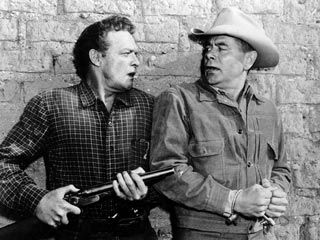
So it seems I've blogged about tonight's prime-time lineup on TCM before. Well, I haven't blogged about tonight, but it seems that in four and a half years of blogging, I've already done full-length posts on each of the first three movies that TCM is showing tonight in its Summer Under the Stars salute to Van Heflin. The picture at left is Heflin with Glenn Ford in tonight's first selection, 3:10 to Yuma, at 8:00 PM. I don't believe the recent remake is airing any time this week.

3:10 to Yuma will be followed at 9:45 PM by Johnny Eager. I blogged about this one back in April 2010 when Robert Taylor was Star of the Month. As I implied then, there are a lot of better gangster films out that, many of them made over at Warner Bros. instead of MGM. But Van Heflin richly deserved his Oscar for playing Taylor's alcohol-soaked best friend and quasi-conscience. He's by far the best thing in the movie.

Ooh, more pictures! I cribbed an image from somewhere for tonight's third film, The Prowler. It's nowhere near as prestigious a movie as either 3:10 to Yuma or Johnny Eager, but it's one that's just as deserving of a viewing if you haven't seen it before. It's coming on at 11:45 PM. All three films are out on DVD, in case you miss any of the showings.

There are also two interestingly titled Heflin military movies airing as part of Summer Under the Stars, neither of which I think I've seen before: Cry of Battle (not on DVD according to TCM) at 6:15 PM, and Battle Cry overnight at 3:00 AM.

Monday, December 12, 2011

Grand Central Murder

For some reason, I thought I recommended the movie Grand Central Murder, which is airing tomorrow morning at 6:00 AM on TCM, before. A Google search claims I haven't. It's one of those many, many B mysteries from the early 1940s, this one starring Van Heflin as a detective who investigates a murder that takes place in a private rail car that's currently in the bowels of Grand Central Station.

Heflin plays one of those wisecracking, slightly arrogant detectives, much like the Michael Shayne character I mentioned last month in Dressed to Kill. Not only is there that sort of detective; there's also a bumbling police investigator (played here by Sam Levene), and a story where anybody could have done it. That having been said, Grand Central Murder is interesting in part for Heflin's role, just before his career really took off with Johnny Eager. Another reason is that MGM's production values make this look better than just a B movie, especially the bowels of the station and the room where all the trains are routed.

Perhaps the reason I thought I might have blogged about it before is that Van Heflin made a related movie the same year, Kid Glove Killer, which I did blog about back when Ava Gardner was Star of the Month on TCM. In fact, I think I saw the two Heflin films back-to-back the first time I saw them before, which would be a good way to see them. (In fact, putting the two of them together in a DVD set wouldn't be such a bad idea.)

Thursday, February 24, 2011

It kills bugs, too!

Coming up at 7:00 AM ET tomorrow morning on the Fox Movie Channel is the interesting historical movie The Raid. What's interesting about it is that it's based on a real event.

The movie starts in September 1864 at a POW camp for Confederate soldiers located in northern New York. Confederate Major Benton (Van Heflin) leads his fellow POWs in a breakout which is successful and which enables them to get to neutral Canada where they can meet up with some of their Confederate sympathizers who have a plan hatched. That plan is to cross the border and raid the nearest moderately-sized town, St. Albans, VT. There, they'll rob all the banks to get the money necessary to buy arms for the Confederates still fighting in the South.

To that end, Benton goes to St. Albans with the view of finding a suitable farm where the Confederates can congregate in preparation for the raid. Posing as a Canadian, he puts up at the hotel run by the widow Mrs. Bishop (Anne Bancroft), who has good reason to hate Confederates, and no reason to suspect that her new boarder is one himself. Likewise her son (Tommy Rettig), who begins to look up to the new father figure in his life.

Benton eventually gets a place outside of town and begins to bring in some of the Confederates who will take part in the raid, but it's not so simple. Some of the soldiers, notably Lt. Keating (Lee Marvin), are rather more vocal in their defense of the Confederacy. That just won't do, since this is an operation where subtlety is called for, lest the townsfolk figure out what's going on. Eventually, the day of the raid comes....

The Raid is good enough, but not particularly great. The parts of the story embellished for Hollywood's purposes are fairly pedestrian and predictable, but don't do anything to take away from the real-life story that's quite interesting in its own right. The cast is competent, although you get the feeling at times that they've all been doing these character types for years, particularly Marvin and his mean bastard routine. Still, there are much worse ways to spend an hour and a half. Unfortunately, The Raid isn't available on DVD.

Friday, November 12, 2010

There's something about Van Heflin

To be honest, Van Heflin isn't the greatest actor out there. I shudder, for example, at the thought of him doing comedy. And yet, he's been enjoyable in almost everything I've seen him in. That's true even when he's miscast, as in The Prowler, airing tomorrow morning at 8:30 AM ET on TCM.

Van Heflin stars as Webb Garwood, a Los Angeles police officer partnered with Bud Crocker (John Maxwell). One night the two get called to investigate the presence of a possible prowler at the home of femme fatale Susan Gilvray (Evelyn Keyes). They don't find a prowler, but Webb finds Susan irresistible. She apparently finds him the same way too, as she strikes up a relationship with him, even though she's already married to a disk jockey who does the overnight shift. One night when Webb tries to see Susan, he's interrupted by her husband, who happens to be home. Webb mistakes(?) the man for the original prowler, and shoots him dead.

This turns out to be a blessing in disguise for Webb and Susan, as they can now live their relationship relatively unencumbered, as long as he quits his job and moves with her to another state where nobody will recognize the two of them. They just have to get through the coroner's inquest first, which requires the two to perjure themselves. The Production Code won't let them get away with perjury, of course, so when the inquest finds accidental death, we know that there's going to be a twist. Sure enough, it comes once the pair has gotten married and bought a motel in Las Vegas. Susan informs Webb that he's knocked her up, and Webb realizes their goose is cooked. The presence of this unborn baby will prove that the two were carrying on a relationship before her first husband died, and get them convicted on those perjury charges. So they have to figure out a way to solve their baby problems.

When I first watched the movie I thought they should just go to Mexico, but apparently the suits in Hollywood are brighter than I am, and decided that twisting the plot beyond any semblance of reality was a better idea. Suffice it to say that crime doesn't pay; how it doesn't pay is an exercise left to the viewer. Even though there are plot problems, The Prowler is still an entertaining movie. And even though Heflin looks so out of place in that uniform, he still does a good job and makes the movie worth watching.

Sadly, The Prowler isn't on DVD, so you'll have to catch the TCM showing.

Thursday, November 4, 2010

Ava Gardner in CSI: 1942

This being the first week of a new month, we get a new Star of the Month: Ava Gardner, whose movies will be seen every Thursday in prime time on TCM. Tonight's first Ava Gardner movie, at 8:00 PM ET is The Killers, and its presence in the salute to Gardner is why it wasn't used as part of the birthday salute to Burt Lancaster the other day. I'm not quite certain how far through the night the Gardner movies continue, although there are are least four of them, through the Arthurian legend Knights of the Round Table overnight at 2:15 AM. However, Gardner also shows up in a very tiny bit part later on Friday morning, in Kid Glove Killer, at 10:30 AM.

Van Heflin is the star of this movie, playing Gordon McKay, the head of a police investigative unit that's much like the CSI units of today, using his knowledge of such things as strands of fabric, paint chips, and things caught under fingernails to help track down killers. He's helped by his lovely assistant Jane Mitchell (Marsha Hunt), although he thinks she should just become a housewife and get married to boyfriend (and local rising political star) Gerald Ladimer (Lee Bowman). Unfortunately, McKay's investigations into the criminal underworld are about to hit Ladimer, as he's actually on the payroll of the mobsters. (We learn this fairly early on, and the movie is more of a suspense movie than a mystery as we know who the bad guy is.) Ladimer responds by making a car bomb, and our investigators have to figure out he's the one who did it, even though he, as a prosecutor, is in on the inner workings of the investigation.

Kid Glove Killer was designed as one of those B-movies to fill out a double bill, but it's really quite fun. This was Van Heflin just before he became a star, and he's good as the somewhat hard-boiled and cyincally sarcastic investigator. Marsha Hunt is nice, but nothing particularly special, as is Lee Bowman. What makes Kid Glove Killer interesting, though, is the 1940s look at crime investigation. I mentioned the fiber analysis and looking under fingernails already, but there's also spectrography to determine the chemical composition of an explosive; as I understand it the presentation of this isn't too inaccurate (although I don't know how much of a database of the composition of commercial explosives they had back in 1942). More humorous is a plot point involving incriminating particles caught in the guilty party's hair: Heflin looks for these by putting a Flowbee-like over the suspects' heads and vacuuming their scalps!

As for Star of the Month Ava Gardner, she appears briefly as a car hop at a drive-in restaurant scene. One other name to watch for is the director: that's Fred Zinnemann, making one of his earliest movies. Kid Glove Killer doesn't seem to be on DVD, though, so you're going to have to watch the TCM showings.

Thursday, September 9, 2010

Vengeance is mine; I will repay

By now you've probably seen the TCM promos for their September look at movies in which characters try to gain revenge for things that happened to them in the past. TCM is airing the movies every Thursday night in prime time. Even though I didn't have my modem up and running last week, to be honest, the highlighted movies were westerns that I didn't particularly care about. This week, though, sees some more interesting movies, even if they have their flaws. One of them is Act of Violence, airing at 9:30 PM ET.

Van Heflin stars as Frank Enley, whom we don't quite see at the beginning of the movie. The beginning deals with Joe (Robert Ryan), who we quickly find is stalking Frank and would like to kill him! In fact, Joe has come all the way west to California to find Frank. Frank, for his part, realizes that Joe is onto him, and tries to keep one step ahead of Joe, although this involves acting secretively and alarming his wife Edith (a young Janet Leigh), who knows Joe wants something with Frank, but doesn't know what.

Eventually, Frank tells Edith: he and Joe served in the war together, and with their unit wound up in a Nazi POW camp. Most of the soldiers wanted to escape, but Frank figured that if they did, the Nazis would discover the plot and kill all the attempted escapees. That, it turns out, is precisely what happened, although Joe knows it happened with a bit of help from Frank. Frank returned home from the war a "hero", but is nothing of the sort.

Of course, Joe is still on Frank's tail, and nearly catches Frank in the lobby of a hotel, forcing Frank to run for his life, where he quickly winds up with a prostitute with a heart of gold (Mary Astor). Our PHG has some friends with shady mob-like connections who could help Frank by eliminating Joe, but it's for a price....

Act of Violence is an interesting movie, but certainly not a perfect one. The beginning of the movie jumps around too much, but the ending is much too neat and tidy, as if the writers didn't know how to come up with a satisfying ending that the folks administering the Production Code would approve of. The characterizations are quite good. Robert Ryan was excellent at playing the bad guy, as he did in Crossfire a year earlier. Heflin's character is morally ambiguous, of a kind that Heflin would go on to play quite well in Shane or 3:10 to Yuma. Astor is a revelation as the thoroughly unglamorous woman. The atmosphere is surprisingly dark when you consider that the movie was made at MGM, the studio known for its glitz. However, MGM was nearing the end of the Louis B. Mayer era, and the man who would go on to succeed Mayer as head of production, Dore Schary, wanted movies to go in a more socially conscious direction. Indeed, it was also around this time that MGM made Border Incident. Most of these movies weren't MGM's A product, however, which remained the musicals and other prestige movies.

Act of Violence has gotten a DVD release, so you don't have to wait for TCM's showings.

Thursday, July 15, 2010

Martha Ivers

I briefly mentioned the movie The Strange Love of Martha Ivers almost two years ago. It doesn't show up too often on TCM, but one of the showings is coming up tomorrow morning at 8:15 AM.

The movie starts off with an expository sequence showing teenaged Martha Ivers, a girl with an unhappy childhood who is seriously thinking of running off with her friend Sam Masterson, in order to get away from her controlling aunt. However, her tutor and his son Walter O'Neil are called in to stop her. Eventually, a scuffle ensues, in which the aunt either falls or is pushed down the stairs, witnessed only by Martha and Walter, and possibly Sam, who was trying to get out of the house at the time. Martha can't run away, but Sam does.

Fast forward a good 15 years or more. World War II has just ended, and grown-up Sam (Van Heflin), having become a hero in the war, decides to stop by his old home town to see what's happened since he left. This presents quite a problem for Martha (Barbara Stanwyck). After her aunt died, she went on to marry Walter (Kirk Douglas), who is now the District Attorney, driven largely by the ambition of his wife. Martha and Walter, as the two confirmed witnesses to the old aunt's death, gave their version of events to the authorities, and they're convinced that Sam might have seen what happened, and testify that what's officially on the police record is not entirely true. Not that Sam suspects this at first, of course....

Unfortunately, it's a bit tough to give more of the plot without giving away too much of the important stuff that happens. The Strange Love of Martha Ivers is one of those noirish movies that is best seen without too much prior knowledge. I can, however, point out that it's an excellent movie worth watching. Barbara Stanwyck is as good as ever as the hard-boiled woman; she's more or less playing the same sort of character she did in Baby Face or Double Indemnity. Kirk Douglas, despite being pictured on the DVD cover in the picture above, only gets fourth billing; this was early in his career. However, it must have been a clear sign to viewers of the day of things to come as he's just as good as Stanwyck. Heflin is playing somebody almost as cynical as his character in Johnny Eager, but not quite as depraved (or, more accurately, sick of it all). Also in the cast is Lizabeth Scott, as a gorgeous young woman from the wrong side of the tracks with whom Sam Masterson falls in love. Finally, mention must be made of Judith Anderson, who plays the thoroughly nasty aunt. It's easy to see from the way she treats Martha why Martha grows up to be the woman she is.

Saturday, October 10, 2009

Glenn Ford, bad guy

TCM is airing the original version of the classic western 3:10 to Yuma at 6:15 PM ET this evening.

Van Heflin plays a rancher in the dry Arizona Territory who is trying ro fetch his herd along with his two sons. However, his attempt is interrupted when he comes along a stagecoach holdup in progress, committed by a gang of crooks led by Glenn Ford. It's a life-changing experience for all of them. Naturally, Ford is wanted by the law, and he's got a princely sum on his head. Nobody has the courage to turn him in to the authorities, though, because they know that his gang will come after them if they do so. Heflin, however, has rather more pragmatic concerns. It's those cattle in bone-dry Arizona. The place is going through a drought, and it questionable whether or not he'll be able to save the ranch. The reward money for turning in Ford would go a long way toward saving it. So, all Heflin has to do is apprehend Ford, and hold him until the authorities can come and take him away on the train -- the 3:10 to Yuma of the title -- where Ford has a date with the hangman's noose.

There's that pesky little word "all", though. It's really not that simple, or else we'd have a very different movie. Ford, despite being a remorseless killer, is also an exceedingly charming man, and quickly turns to trying to charm Heflin into letting him go, and trying to put doubts into Heflin's mind as to whether he'll even be able to succeed in turning Ford in. After all, Ford does have a gang to back him up, and they're bound to be waiting for the 3:10 to Yuma, too.

Glenn Ford has the looks of a leading man, and is definitely the lead here. He looks as though he's relishing his chance to play a bad guy, since many of the stars of that day didn't get the chance to play the bad guy all that often. Heflin, on the other hand, didn't have the looks of a leading man, and it certainly shows here, much to the film's benefit. Heflin looks uncomfortable, mostly because that's how his character should look: the man, it must be remembered, has never done anything like hold a criminal in custody awaiting transfer. (Who among us has?) He's not doing this because it's the right thing to do; he's doing it for the money. Both actors get great roles to play in a movie that has relatively little action: like the previously-mentioned No Name on the Bullet, it's more of a psychological suspense movie that just happens to be set in the Old West.

3:10 to Yuma was remade a few years back, and sadly, a lot of the search engine image searches yield more pictures from the remake than the original. The more important thing, though, is that the movie has been released to DVD.