Showing posts with label Shirley Temple. Show all posts

Monday, May 8, 2023

Fox remakes The Wizard of Oz

There's an apocryphal story about Shirley Temple being up for consideration to play the part of Dorothy in The Wizard of Oz, a role that ultimately went to Judy Garland. Of course, there was no way this was ever going to happen as producer Arthur Freed was at MGM and Temple was at Fox, and Freed had Garland under contract at MGM. It's possible that Temple wanted to play Dorothy -- what female child star wouldn't? -- and this got blown up into the story we have today. In any case, Fox responded by finding a similar property to utilize Temple. That movie has been in the FXM rotation recently: The Blue Bird. Not having done a post on it before, I recorded it and recently sat down to watch it.

The movie, like The Wizard of Oz, opens up with a scene in black and white (although not sepiatone). Temple plays Mytyl, a young girl living in a rural part of Central Europe during the early 1800s when Napoleon was on the march. Mytyl and her kid brother Tyltyl (Johnny Russell) are out in the forest when they capture a beautiful songbird. They pass by Angela (Sybil Jason), a sick girl, on their way home, and selfish Mytyl doesn't give Angela the bird.

Mytyl is increasingly unhappy, with her parents (Spring Byington and Russell Hicks) admonishing her. Things get worse for Mytyl when Dad learns that Napoleon is on the move again and all the able-bodied men are going to be called up to fight. Both kids go to bed in a very glum mood, but amazingly, both of them have the same exact dream.

Not only that, but as in The Wizard of Oz, they dream in Technicolor and get visited by a fairy, this one named Berylune (Jessie Ralph). She tells the two kids to look for the bluebird of happiness, and sends them off to a magical land to try to find the bird. Meanwhile, several characters from the kids' real life show up in this land, although where in The Wizard of Oz the characters were changed from humans to animals, in The Blue Bird the characters become human instead of the family dog and cat. Tylo the dog (Eddie Collins) is loyal and tries to help the two kids, while Tylette (Gale Sondergaard), the family cat, is mischievous and tries to thwart the children.

Mytyl and Tyltyl visit a series of places, starting with their dead grandparents, who come back to life because people are thinking about them, which is supposed to impart a message on both the two kids in the movie as well as any kid watching. Never forget your elders, and they'll always live on in your heart, if not biologically. The kids also suffer the danger of a forest fire, see a land of great wealth, and finally, the place that must have been the inspiration for Fox to make For Heaven's Sake a decade later: children waiting to be born.

If Fox had made The Blue Bird before The Wizard of Oz, it might be better remembered today. But watching The Blue Bird, it's impossible not to make comparisons to the more famous movie, and come away less than impressed in all of those comparisons. The Wizard of Oz is one of those movies where the MGM gloss really pays off. Here, in The Blue Bird, everything feels like it's being done on a tight budget, with the result that it feels like there's just something missing. Mytyl is also a heck of a lot less likeable than Dorothy, which doesn't help matters.

Still, The Blue Bird should be watched, at the very least to study what can go wrong when one studio tries to imitate the classic results of another studio's film.

Tuesday, November 8, 2022

Susannah of the Mounties

One of the movies that was recently added to the FXM rotation and which I had not seen before is Susannah of the Mounties. So I recorded one of last month's showings, planning to watch it and do a post on it the next time it shows up. Well, it's going to be on tomorrow (Nov. 9) at 6:00 AM and again on Thurdsay, Nov. 10.

As you can guess from an opening credits topped by Shirley Temple, it's Shirley playing Susannah. But first there's a little bit of scene-setting being done. It's the erly 1880s in what would now be Alberta or Saskatchewan, where the Canadians were building a railroad across their dominion, completing it in 1885. As with the more southerly locales in the US, the advance of white settlers meant conflict with various tribal peoples who were already on the land, in this case the Blackfeet (and indeed, Fox was able to get some real members of the Blackfeet for background roles, although of course the main Blackfeet adults were played by white guys). The Blackfeet have attacked one such group of pioneers, killing everybody but little Susannah, who hid under a barrell.

Susannah is rescued after the attack by Angus Montague (Randolph Scott), a member of the Mounties at a time when they were the law in this part of Canada and they didn't even have the army out there to keep order and pacify the Blackfeet. Indeed, it's the job of the Mounties to get the Blackfeet to sign a treaty. Needless to say, that's a controversial issue within the Blackfeet, with Chief Big Eagle (Maurice Moscovitch) more or less in favor and Wolf Pelt (Victor Jory) more or less opposed. But as a sign of good faith, Big Eagle sends Little Chief to stay at the Mounties' fort. One of the running subplots of the movie is that Little Chief and Susannah are going to become friends, but on his terms, which means Susannah is expected to act much the way a Blackfeet woman would. At the same time, Susannah becomes well-liked at the fort, because of course everybody loves little Shirley Temple.

The more grown-up plot involves the railroad being constructed in the area, with Harlan Chambers (Lester Matthews) managing the work crew. Some of their horses are stolen, which presents a problem, because it means there's a good possibility of renewed conflict between the whites and the Blackfeet. When Chambers discovers that the theft was done by Wolf Pelt, who was trying to sell Chambers back the horses he had stolen, Chambers threatens to call in the army to subjugate the Blackfeet. War is in the air.

The Blackfeet attack, kidnapping Montague in the process since they don't realize there's just as much infighting among the whites as there is among the Blackfeet over how to deal with the other side. Susannah is distraught, and actually sets out for the Blackfeet encampment to try to find Montague, leading to the film's climax.

Susannah of the Mounties has a lot of the formula that made Shirley so popular in the mid 1930s, although she was getting a little older and that formula isn't working quite so well. There's also a lot less singing and dancing than what you'd expect in most of Shirley's movies from her days at Fox. In fact, the scenes between Susannah and Little Chief are the best part of the movie, with Susannah learning about Blackfeet customs, even getting wasted after smoking a peace pipe. (I can't imagine little Shirley doing the "Dave's not here" bit, however.)

That's not to say that Susannah of the Mounties is bad by any means; it's more that it's not the first Shirley Temple movie I'd recommend to show people what she was really about. Note also that the print FXM is running is a colorized print. The color isn't bad, but the lack of Natalie Kalmus' name on the credits was a clear sign that this might not be real color.

Friday, October 16, 2020

Why does Stowaway seem so familiar to me?

Another of the movies that showed up in the FXM rotation recently is Stowaway. A search of the blog claims I haven't blogged about it before, so I decided to DVR it and watch to do a post on it the next time it shows up on FXM. That time is coming up, with an airing tomorrow (October 17) at 6:00 AM. However, having watched it, the movie seemed awfully familiar to me.

Temple plays Ching-Ching, real name Barbara Stewart, a girl whose parents died in China and who has been looked after by a missionary organization in a provincial town. This being the era when there was a civil war going on in China, the town is under threat from bandits of one stripe or another, so the missionaries decides this American girl should be sent to Shanghai, which is relatively safe.

So Ching-Ching and her dog are put on a boat headed for Shanghai, where her handler runs off with the money left for her. She wakes up all alone (well, except for the dog, and doesn't know anybody, so she gets up, gets off the boat, and goes wandering in town looking for a bone for her dog. It's there that she meets Tommy Randall (Robert Young), a playboy tourist trying to haggle with a store clerk who doesn't speak English. Ah, but little Ching-Ching speaks both English and Mandarin, so she's able to translate!

Tommy offers to get her a meal, and when he's at his club telling some of his expat friends about Ching-Ching, she gets out of the car because the dog runs off, only to hide in the trunk to get out of the rain. So Tommy doesn't know where she's gone, when he goes to have his car put aboard a boat bound for various Southeast Asian destinations.

Ching-Ching doesn't know what's going on, either, until she wakes up in the cargo hold of the ship and her dog starts barking, which makes the crew think there's a stowaway on board. (To be fair, little Ching-Ching is a stowaway, but not intentionally.) When she realizes the crew is chasing her, she runs off and hides in the cabin of one of the wealthier travelers.

You'd think that traveler is Tommy Randall, but no. Actually it's a pair of people, young Susan Parker (Alice Faye) and her future mother-in-law, Mrs. Hope (Helen Westley). They're travelling to meet Susan's fiancé Richard (Allan Lane). Mom is pissed, but Susan has sympathy. And when she runs into Tommy and tells her about the girl, Tommy finds that it's little Ching-Ching.

Now, if you've seen a Shirley Temple movie, you can probably guess where this one is going, which is part of the reason why I felt as though I might have seen this one. But there's more, such as a lullaby scene which seemed awfully familiar, along with much of the interaction between Young and Temple.

That having been said, there's really not a whole lot wrong with Stowaway. Alice Faye does well with her songs; Shirley Temple is as charming as always and gets a particularly fun song that has her imitating, among others, Al Jolson -- that particular impression is a hoot. The movie ends with a courtroom scene reminiscent of the one in Bright Eyes, except that this one is far more unrealistic, which is probably the movie's one big flaw. Eugene Pallette is underused as one of Randall's friends, while Arthur Treacher is hilarious as Randall's butler.

Anybody who wants a good family movie, however, will certainly enjoy Stowaway, which showcases Shirley Temple in the sort of role that made her immensely popular during the Depression. If I wanted to introduce people who didn't know what Temple was all about, there are some other of her movies that I'd recommend, like the aforementioned Bright Eyes, but you won't go wrong with Stowaway. It's available on DVD on one or another box set of Shirley Temple films.

Wednesday, April 29, 2020

For some values of "adventure"


Another of my recent movie viewings was Adventure in Baltimore, which ran on TCM as part of a night of movies featuring suffragette characters.

To be honest, the suffrage part of the movie is minor, although the main charcter, Dinah Sheldon (Shirley Temple), is certainly a strong young woman. She's at an all-girls school circa 1905 in an art class where she declares that she's going to be a great artist; as such, she needs to learn how to draw the naked human form. Such shocking language gets her thrown out of school and sent home to her family in Baltimore.

Dinah's father is Dr. Andrew Sheldon (Robert Young), the doctor here being a doctor of divinity as he's an Episcopal priest up for the vacant bishop's position in his diocese. Dr. Sheldon is somewhat socially liberal, as he wants to discipline Dinah a lot more lightly than her mom (Josephine Hutchinson) does. This lack of discipline might just jeopardize Dr. Sheldon's chance at being named bishop, although nobody talks much about the sin of pride.

Dinah, having returned home, continues to be brash and bold and make life a mess for everybody. She's got a friend in the boy next door, Tom Wade (John Agar, Shirley's real-life husband at the time), who works for the boss in the new-fangled job of auto mechanic. In most movies set in this era, you'd expect Tom to be Dinah's boyfriend, and you can probably guess that's going to happen by the end of the movie. But Tom meets the much richer Bernice who becomes his girlfriend, and has to deal with Dinah.

First up is Dinah going to the park to paint, doing a portrait of a drunk on a park bench, and inadvertently starting a brawl among some other bums who debate whether she's got the colors right (not that we can tell, of course, since this is a black-and-white movie). Dinah and the bums all wind up in bail, and Dinah asks Tom to bail her out, saying that she's going to jump bail!

Then, Tom has to deliver a speech for some civic function, and Dinah offers to make things up by helping. Of course, her "help" is to give Tom a barely-edited speech on women's liberation that she has to know is going to embarrass Tom. But no, she goes ahead and gives him that speech. Finally, she asks Tom to model for a painting in an art contest, and her painting is to put Tom's head on a shirtless body. Tom's justifiably angry, and the rest of the community is scandalized by the painting. Dad, to try to save his nomination for bishop, finally relents to Mom to send Dinah off to an aunt until things die down....

Adventure in Baltimore is a movie that has some potential, but that I think ultimately doesn't quite live up to it. That's mostly down to the writing of Shirley Temple's character. She was 20 she made this movie and trying to transition into adult roles, something that never quite worked out for her. The script here doesn't help because she's made out to be so obnoxious that I couldn't help but dislike her. She's not so much an independent woman in the style of Betty Grable's from The Shocking Miss Pilgrim but a jerk who doesn't seem to think of others.

I also had a problem with the ending, which seemed too artificial and tacked on in order to satisfy the studio's need for a happy ending. I can't help but think the rest of the parishes in Dad's diocese would have been nowhere near as liberal as he was and that this would have caused much more serious conflict. This isn't the post-Vatican II Catholic church, after all.

If you want to see why Shirley Temple didn't make it as an adult actress, Adventure in Baltimore isn't a bad place to start.

Saturday, December 14, 2019

Heidi


Another of the family-friendly movies TCM ran on Thanksgiving was Heidi. Not having blogged about it here before, I DVRed it so I could watch it and have it fresh in my mind as I did a review.

Shirley Temple plays Heidi, a little girl whose parents have died and is being sent to live with her grandfather Adolf (Jean Hersholt) in a village in the Alps that's so stereotypical it's even called Dörfli (which would be dialectical German for a little village). Adolf is a bitter old man who wants little more than to be a hermit, and certainly doesn't want to be taking care of a little girl. Except, of course, that the little girl is played by Shirley Temple, so as the two get to know each other, she slowly begins to melt his heart.

But just as Grandpa is finally warming up to Heidi, her nasty aunt Dete (Mady Christians), who had previous foisted Heidi off on Adolf, has found a way to exploit Heidi for money! Apparently there's a family in Frankfurt who have a wheelchair-bound daughter Klara (Marcia Mae Jones), and Klara needs a companion. So Dete takes Heidi from Grandpa and brings her to Frankfurt to be what is really an indentured servant, not that Heidi knows. And not that she's happy, either, since she's grown to love Grandpa.

Heidi's right to be unhappy, since life withe the family in Frankfurt, the Sesemanns, is no bed of roses. Klara, to be fair, is a nice girl in unfortunate circumstances. Her father (Sidney Blackmer) is away on business most of the time, so he has no idea what's going on in the house. Instead, it's the evil Fräulein Rottenmeier (Mary Nash) who runs the place, keeping Klara in her wheelchair and making life miserable for poor Heidi.

But Heidi throws herself into her new job with gusto, especially since none of this is Klara's fault. Heidi, being as perfect and sinless as any other Shirley Temple character, oozes so much charm that she decides Klara is just going to get up and walk through sheer force of will. (I suppose if Klara had been an amputee Heidi would be expecting her to grow her legs back through sheer force of will too.) And Klara does take some tentative steps, which really pisses Rottenmeier off.

Meinwhile, Grandpa has decided he's going to walk all the way from Dörfli to Frankfurt to take back Heidi, even though it's several hundred miles away. And he shows up in the big city on busy Christmas Eve, nearly in time to find Heidi before she's brought back home for a family Christmas. Rottenmeier, however, has other plans for Heidi....

I didn't dislike Heidi but oh boy is this a Shirley Temple movie. It's the sort of thing that would have made a lot of audience members happy during the Depression when simplistic, happy-ending stories could bring joy to moviegoers' difficult lives. Shirley ramps up the treacle, while Nash turns up the comic book villainy past 11. There's one big musical number that I didn't care for, but other than that it's pretty much a straight story, albeit one tailored for Temple and what her audiences wanted.

There are multiple DVD releases of this one, although only one of them seems to be available at the TCM Shop. I'm not certain how many of the out-of-print ones at Amazon are colorized. (And, of course, there are other movie versions of the story.)

Friday, July 19, 2019

Curly Top

FXM has a couple of Shirley Temple movies in their current rotation that, at the time they were put in, I hadn't seen. So I recorded some of them, including Curly Top, which I finally got around to watching.

Shirley plays Elizabeth Blair, who at the start of the movie is one of a whole bunch of girls at a private charity orphanage looked after by matrons Higgins (Rafaela Ottiano) and Denham (Jane Darwell). It's not mentioned where the money came from to get it, but Elizabeth has a pet pony that she brings in to the main building late one night! She is, it turns out, a rather mischievous little girl, although as is usually the case with Shirley Temple movies, she'll also melt your heart.

Elizabeth's hijinks get her in trouble when the trustees come for a visit. Wyckoff (Etienne Girardot) is the closest thing to a bad guy the movie has, the mean old trustee who doesn't want to spend money on anything since spartan living was fine for him in the old days. Fortunately for her, there's a much younger and nicer trustee in the form of Edward Morgan (John Boles), a Park Avenue lawyer worth millions. He offers to adopt Elizabeth, although because of some bizarre notion that Elizabeth can't accept kindness without being beholden to people, he plans to do it in the name of a nonexistent friend, and just look after Elizabeth until the friend gets back from Europe.

Complicating things is the fact that Elizabeth has an older sister Mary (Rochelle Hudson). She, like Edward, is an amateur musician, writing songs for Elizabeth to sing. And when their parents died, Mary was still young enough to be in the orphanage, and made a promise to the parents that Mary would never let herself and Elizabeth be split up. So if Elizabeth gets adopted, Mary has to go, too.

Of course, Edward finds himself falling in love with Mary even though in real life John Boles was 20 years older than Rochelle Hudson. A pilot Jimmie (Maurice Murphy) also falls in love with Mary at Morgan's Long Island summer house, and that makes for the one other conflict in the movie. Jimmie isn't a bad guy by any means; it's just that Mary doesn't really love him.

Curly Top is a movie that has a fairly threadbare plot, filled out by a whole bunch of songs. Shirley is charming here, but because of the lack of real dramatic tension the movie winds up being little more than a pleasant diversion. It's not bad, and to be fair there are some good points, perhaps most notably in a scene where Temple's Elizabeth parodies Mr. Wyckoff. Seeing Shirley do "old man" is a hoot. Darwell is good although she, like everybody else from the orphanage disappears from the movie once Shirley is adopted. Also providing good flavor is Arthur Treacher as yet another butler.

Curly Top is available on DVD both as a standalone, and as part of at least one box set.

Sunday, June 23, 2019

Sit down, don't cheer

Another of the movies that got pulled out of the Fox vaults recently for showing on FXM is Stand Up and Cheer!. It's going to be on again over the coming weekend and again on July 5. It's also on DVD, so since I don't have that big a backlog of recently-watched movies to blog about, I'm going to do a post on it now.

The movie was released in 1934, and the first thing you notice is that this is likely a re-release print: the 20th Century Fox fanfare starts before we see that this is from the "Fox Film Corporation", the merger between Fox and 20th Century not having come until 1935. (IMDb suggests that the original ran about a dozen minutes longer than the 68-minute version FXM ran.) On to the threadbare plot, we see Broadway producer Lawrence Cromwell (Warner Baxter) going to meet president Roosevelt (only seen from the back). With a depression on, the president thinks America's spirits need to be raised, and the best way to do that is with a Department of Amusement. Cromwell, being an important Broadway producer, is just the man to do it.

Now, my immediate thought is that a department like this would be a money pit for propaganda of the sort that the Federal Theater Project was, churning out stuff like ... One Third of a Nation...; people of political interests would try to capture the bureaucracy if only to see that the people they oppose didn't capture it first. But Stand Up and Cheer is pretty obviously pro-New Deal propaganda, so it would never suggest anything was wrong with a program like this.

There are two senators opposed to it, and a shadowy cabal behind them, but the two senators are played by guys who had a slapstick vaudeville routine, "Mitchell and Durant". Their brand of humor is unfunny. We also get treated to Stepin Fetchit, and the humor that the screenwriters forced him to do is even more unfunny, especially in the later scene with a penguin doing a Jimmy Durante impression.

In between all this, we get several musical numbers that are unrelated to the plot of the movie, and a love interest in the form of Children's Section head Miss Adams (Madge Evans). One of the numbers involves a young Shirley Temple before Bright Eyes made her a real star; she dances with James Dunn playing characters named Shirley and James probably (I'm guessing) because Shirley was still young enough that this would make it easier to remember her lines. She shows up again in the retch-inducing finale, a song with large groups of people marching in formation looking like the old Soviet military parades going through Red Square as the Great Leaders watched from Lenin's mausoleum.

Stand Up and Cheer! is terrible, although at least Shirley Temple shows she already had talent at a young age. The two DVD listings at the TCM Shop both focus on Temple, although at least in one case it's fair because it's a box set with six Temple films. I might think about getting the box set for the other five films; I certainly wouldn't bother with the standalone.

Monday, April 22, 2019

Fort Apache

TCM is running a morning and afternoon of Shirley Temple movies tomorrow in honor of her birth anniversary. Among them is Fort Apache, at 2:15 PM.

Temple plays Philadelphia "Phil" Thursday, who is traveling out west to Fort Apache, Arizona Territory, with her father, Lt. Col. Owen Thursday (Henry Fonda), who is going to be the new commander of the fort. The stagecoach gets lost and drops them off at a way station where Phil runs into Lt. Michael O'Rourke (John Agar) who is in the middle of washing up. The lieutenant colonel sees him this way and is none too pleased, even though it's not really O'Rourke's fault. As for Phil, she's already taken a shining to O'Rourke, although Dad is eventually going to forbid her to see young O'Rourke.

Young O'Rourke is fresh out of West Point and also going to Fort Apache, where his father, a sergeant major (Ward Bond) is stationed. So Thursday requisitions O'Rourke's trael and they get to the fort together, where Thursday finds Capt. Youk (John Wayne) in temporary command and an atmosphere that's certainly more casule than what you'd find back east. Thursday is none too pleased at this, too.

In fact, Thursday seems none too pleased by anything. He's a by-the-book martinet who has seemingly never been west, and certainly not in territory where there have recently been Indian uprisings, with the Apache under Cochise (Miguel Inclan) being the most dangerous. In fact, there are rumblings that Cochise might be leading his Apaches back into Arizona since the Mexicans don't really want them in Mexico, either.

Lt. Col. Thursday sends York to meek Cochise along with Sgt. Beaufort (Pedro Armendariz), since Beaufort and Cochise both speak Spanish. Not that Thursday wants it this way, but York has been out west longer and knows how things work with Cochise as the two have had dealings before. Still, Thursday eventually decides that he's going to do things his way, regardless of what reality dictates, and decides he's going to launch a ridiculously ill-fated attack on the Apache who badly outnumber the Cavalry.

Fort Apache is well-made, although not particularly my favorite film, in part because this is the sort of western that's not my favorite genre, and in part because of the direction of John Ford. It doesn't help that Fonda's character is such an asshole that you want somebody to bring up Nuremberg and not having to follow illegal orders, even though the action takes plays 70 years before World War II. Fonda does a good job; it's just that his character is so hateable.

I'm certain, however, that people who like westerns will love Fort Apache. In addition to being on tomorrow, you can also find it easily on DVD.

Sunday, March 31, 2019

Poor Little Rich Girl (1936)

FXM took the Shirley Temple movie Poor Little Rich Girl out of the vaults recently. It was on this morning, and is going to be on again tomorrow morning at 7:55 AM, so I watched it to do a full-length post here.

Temple plays the title character, a young girl named Barbara Barry who is the daughter of widowed soap magnate Richard (Michael Whalen). She lives in the lap of luxury, except that she finds it extremely constraining -- she just wants to be a little girl and play and do other little girl things. Instead, she's got a bunch of servants who play a game of operator the minute she sneezes that results in people thinking she's seriously ill. Dad eventually decides that it wouldn't be so bad to send her off to boarding school, where she can be with other people her age.

As for Dad, he's in a business rivalry with another soap manufacturer, Simon Peck (Claude Gillingwater), with each of them thinking the other should be bought out. Complicating things is that Richard meets Peck's ad executive Margaret (Gloria Stuart) and falls in love with her until she realizes who he is. Another complicating factor is that the Barry soap company sponsors a popular radio show while Peck refuses, thinking the idea is old fashioned.

Back to poor little Barbara. At the train station, her nurse loses her purse and when she goes out to fetch it, she gets hit by a car, leaving poor Barbara alone. She walks out the station and follows an organ grinder, since one of her favorite children's stories involved an organ grinder. That man lives in the same apartment building as the Dolans (Alice Faye and Jack Haley), a pair of struggling vaudevillean dancers. Mr. Dolan practices his tap dancing steps, and little Barbara downstairs is just so damn good that's she's able to repeat the steps she heard from the floor above her. Mr. Dolan realizes he's got a hit on his hands, but Mrs. Dolan is worried about the legal problems of bringing this girl on as the third Dolan.

This being a Shirley Temple movie, it's not too hard to figure out where this is all going to go. The act of "Dolan, Dolan, and Dolan" is going to wow the producers enough that they try to pitch it to Peck. Little Barbara is so darn charming that she's going to melt Peck's heart, and he'll put the Dolans on his new radio show, making them a huge success. And then Dad is going to realize that his daughter is not at school, but a star on a radio show. (You'd think the school would have called the day Barbara didn't show up, and that the date would have been fixed before Barbara and her nurse got to the train station.) Oh, and the Dolans are going to have to worry about their potential legal problems, but those will all go away.

I think I've said with pretty much every 1930s Shirley Temple movie I've blogged about that it's so easy to see why she was such a big hit with Depression-era audiences. Poor Little Rich Girl is, on the face of it, nothing more than a formulaic movie of a seeming orphan charming everybody. But Shirley Temple is so charming that she makes the material work. It doesn't hurt when Fox paired her with good dancers like she has here. Michael Whalen is the weak part of the movie, but he's not around much so it doesn't matter.

All in all, Poor Little Rich Girl is another solid Shirley Temple entry that will probably please anybody in need of a good pick-me-up. It doesn't seem to be on DVD, so you're going to have to catch the FXM showings. (Well, it is on Amazon streaming if you can go that route.) And in that regard there was a problem either with my DVR (which is nearly full and getting old), or with the FXM print, in that a few spots near the end were turning green and purple. (I had problems with Bachelor Flat as well; it could just be a certain portion of the disk that's the problem.)

Wednesday, July 26, 2017

Take an arrow too while you're at it

Another movie that I watched off my DVR because it's available on DVD is Baby, Take a Bow, which can be found on one or another Shirley Temple box set.

Shirley doesn't show up for a while due to the structure of the story. Kay (a very young Claire Trevor) in on her way to Niagara Falls with a stopover at Ossining. The later is the town that gave its name to the notorious Sing Sing prison, which is where Eddie (James Dunn), Kay's fiancé, is finishing up his sentence. Unfortunately, on the train up to Sing Sing Kay meets the obnoxious Welch (Alan Dinehart), an insurance investigator who is responsible for putting a lot of people behind bars. About to start a stretch in Sing Sing is Eddie's friend Larry.

Years pass. Eddie and Kay have a five-year-old daughter Shirley (that, obviously, is Shirley Temple), and Eddie has a good job as a chauffeur to a wealthy industrialist. And Larry is about to get out of Sing Sing and join his wife Jane. Eddie is planning to teach Larry the chauffeur gig so that Eddie can take an apparently better job in the industrialist's factory. I'd think the chauffeur job is better, but what do I know. At any rate, both men have kept their noses clean, despite the predictions of Welch.

There's a third convict who's about to make a mess for everybody. Trigger (Ralf Harolde) steals a necklace from the home of Eddie's boss, and when it's discovered that Eddie had a criminal past, well, there goes his job. This even though we know he's innocent. And Trigger is going to make things an even bigger mess by trying to get Eddie and Larry to fence the necklace, something they have no desire to do. When that doesn't work, Trigger finds little Shirley and gives the necklace to her.

Welch comes along looking for the necklace, absolutely certain that he's going to find it in Eddie's apartment and send Eddie and Larry back to prison, something he seems overly anxious to do. Can they keep Welch from finding the jewelry, and would anybody believe Shirley's story? Thankfully for Shirley, events overtake her and it becomes obvious that Trigger is the man behind the heist.

Baby, Take a Bow came out before Bright Eyes (indeed, it was before the merger with 20th Century, so the print FXM showed had no Fox fanfare), so Shirley doesn't get to do any singing, and only has one short dance scene as a dance student of Jane. Temple is fine and charming enough, except for a few points where the script lets her down. And to be fair, at that point the script lets everybody down. When Welch shows up looking for the necklace, everything screeches to a halt, as Eddie and Larry keep making up ridiculous lies to throw Welch off the scent. It's supposed to be funny but winds up wildly unfunny and obnoxious.

Overall, Baby, Take a Bow is something that would play well as a quality B movie of the era, but which, if it's remembered at all, is remembered for being an early Shirley Temple vehicle. That's a bit unfair because the movie is better than that. And for the price of the Temple box sets I saw, you can't really go wrong if you do pick it up.

Monday, July 6, 2015

TCM Star of the Month July 2015: Shirley Temple


Shirley Temple (r.) with Jane Withers in a still from Bright Eyes

We didn't have a Star of the Month on TCM last week because the last several months have had Stars of the Month on Wednesdays, and this Wednesday was July 1. TCM apparently didn't have enough films to run five nights of programming for July's Star of the Month, Shirley Temple, so her tribute is showing up on Mondays instead.

To be fair, having Shirley Temple as your Star of the Month means having to get the rights to a bunch of films from Fox. Bright Eyes, from which the photo above is taken, is one example. That movie is airing tonight at 11:00 PM. There have been three of Temple's movies getting regular airings recently on FXM Retro, and one of them shows up in this month's tribute: Wee Willie Winkie is on next Monday at 9:45 PM.

As it is, TCM couldn't get enough to have four full nights of prime time, as the last movie in the night, that is the one that leads into 6:00 AM, is just a film with another child star. As for tonight's schedule:

Shirley winds up with gambler Adolphe Menjouy in Little Miss Marker at 8:00 PM;
Temple gets to meet long-lost father Gary Cooper in Now and Forever at 9:30 PM;
The aforementioned Bright Eyes is on at 11:00 PM;
Orphan Temple gets adopted by a wealthy man in Curly Top at 12:30 AM; and
Temple runs off in New York and helps two struggling dancers hit it big in Poor Little Rich Girl at 2:00 AM.

Tuesday, February 10, 2015

The Bachelor and the Bobby-Soxer


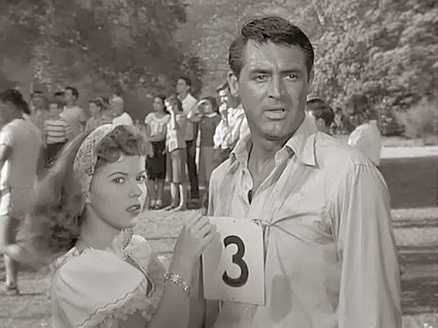
Shirley Temple and Cary Grant in a scene from The Bachelor and the Bobby-Soxer (1947)

Apparently I haven't done a full-length post on The Bachelor and the Bobby-Soxer before. It's coming up on TCM overnight tonight (or early tomorrow morning) at 2:45 AM, so now is a good time to do that post.

The titular bachelor is Richard Nugent, a playboy artist played by Cary Grant. He's consistently winding up in court prosecuted by assistant district attorney Tommy Chamberlain (Rudy Vallee) for the sorts of crimes that would be TMZ fodder nowadays: nothing for which he should end up with a substantial jail sentence, but annoying for everybody all around. He's brought up before Judge Margaret Turner (Myrna Loy). She's got problems of her own. She's got a much younger sister Susan (Shirley Temple) at home that she's taking care of because the parents are presumably dead. (With a kid sister 22 years younger, you can understand why the parents would be dead by now.) Susan mat Mr. Nugent when he came to her school do give a lecture on art, and she unsurprisingly developed a crush on this man who is so much more worldly and better looking than the gawky, pucescent classmates she sees around her every day. Still, Margaret understands that there's no way thi crush could successfully become a real relationship, especially consideirng that Nugent wouldn't want these young girls pursuing him.

So it gives the good judge an idea: sentence Nugent to be Susan's escort for a while! It'll disabuse Susan of any notions she has about Nugent once she has to spend a lot of time with him, and it will teach him a few things about responsibility. Why any defense lawyer would permit this is beyond me, but perhaps Nugent thought all the other alternatives were worse. Besides, he's got a plan of his own. He escorts Susan, but starts acting as though he enjoys doing this, and tries to do what he can to make the "responsible" adults regret their decision to come up with this "punishment". Now, he does it all in a classy way, of course, and nothing at all illegal, which I'd think would drive the judge and the people around her up a wall. Especially when you consider that Nugent's actions don't seem to be doing anything to make Susan fall out of love with him.

Along the way, one other thing happens that you can probably guess from a movie like this: Judge Margaret finds herself beginning to fall in love with Nugent. It doesn't help that the ADA has had his eye on the judge. Can anybody say conflict of interest? Of coure, The Bachelor and the Bobby-Soxer is light comedy, and never meant to be anything with any sort of message, so we can overlook how the film has no grounding in any sort of reality.

The ultimate result is a movie that's frothy, but a hell of a lot of fun. We all knew that Cary Grant was one of the great comic actors, as he'd been doing roles like this for a decade or so. Myrna Loy also does extremely well as the more grounded character, but still adept at comedy nonetheless. The Thin Man, after all, was a full 13 years before The Bachelor and the Bobby-Soxer. The surprise is Shirley Temple, who shows little of the qualities that made her endearing in all those movies she did at Fox, but here would be terribly inappropriate. Her character isn't an adult, but is not childish by any stretch of the imagination. And Temple does well playing off of Grant in their scenes together.

And then there's the screenplay. It was written by Sidney Sheldon, who won an Oscar for it. My first memory of Sheldon was in the late 1970s or early 80s with the ads for the novel Rage of Angels, which sounded so grown-up and trashy. (I've never read the book.) And then when I watched TV reruns I saw I Dream of Jeannie and noticed that it was created by... Sidney Sheldon. And then many years later I saw this. An interesting career, to say the least.

The TCM Shop lists The Bachelor and the Bobby-Soxer as being available on one of those four film box sets, focusing on Cary Grant.

Saturday, May 3, 2014

Rebecca of Sunnybrook Farm

Back when Shirley Temple died and TCM had their day-long tribute to her, I mentioned that Bright Eyes was one of the first movies to follow what would become a successful formula. Another good example of this would be Rebecca of Sunnybrook Farm, airing tomorrow morning at 6:00 AM on FXM/FMC.

Shirley Temple is once again an orphan; Rebecca (naturally, she gets the title role) is a little girl whose biological parents have died and who is going around the country with her actor stepfather Henry (William Demarest). Henry and Rebecca show up at a radio station just in time for the auditions for a cereal magnate's auditions to find the next "Little Miss America". Obvoiusly, Rebecca has the same charm and talent that Shirley Temple does, so she'd be a natural for the part. But a mix-up happens, and Henry thinks that the programming director's (Randolph Scott) decision to stop the audition is because they've failed. With no job prospects, Henry decides to send Rebecca to her aunt's farm.

Aunt Miranda (Helen Westley) is a bit of a tough character. She doesn't like those acting people, and she certainly doesn't want Rebecca hanging out with them. She also doesn't like the farmer who lives on the other side of the fence, and orders Rebecca to stay away, even though they're OK with her. Also with Rebecca and Aunt Miranda is Gwen (Gloria Stuart), another of Miranda's nieces and one of Rebecca's cousins.

But back to that other farm. It's owned by Tony Kent, who just happens to be... a programming director. And he's the same one who was looking for "Little Miss America", and had intended to sign Rebecca to a contract for it, before she and her stepfather left thinking he audition had failed. He's come up for a visit; being a city folk, he doesn't actually run the place. It's the manager Homer (Slim Summerville) who is the subjected of Miranda's aforementioned dislike of everybody on that side of the boundary fence. Anyhow, Tony hears Rebecca singing, and realizes -- here's the girl I've been looking for!

Complications, of course, ensue. Miranda only took in Rebecca on the agreement that it would be for good, and none of those acting people. (Never mind what Rebecca wants.) Henry learns that Rebecca is going to be successful, and wants her back. And there are also the romantic complications. There's no reason for Gwen to be in the story, other than to serve as the eventual romantic interest for Tony, and that it's going to be Rebecca who brings them together. And you can probably guess that Rebecca's presence will ultimately convince Miranda that perhaps she was wrong about Homer.

It's all a tried-and-true formula, having worked for a good three years already. Once again, Shirley Temple is the stick that stirs the drink, making everything work. She's paired up with all the comic character actors and other supporting talent Fox could find, including getting a dance with Bill "Bojangles" Robinson. Nobody really outshines Shirley Temple, of course; instead, many of these actors make good pairings with her to entertain the viewer. Rebecca of Sunnybrook Farm is, after all, entertainment first and foremost, with an unchallenging plot and a predictably happy ending. This should, however, not be construed as a negative. Rebecca of Sunnybrook Farm succeeds in spades at what it's trying to do.

There are several DVD releases of Rebecca of Sunnybrook Farm, but some of the cheaper ones seem to have been colorized.

Saturday, March 22, 2014

Bright Eyes


Jane Withers (l.) and Shirley Temple in Bright Eyes (1934)

A couple of weeks back, TCM showed Bright Eyes to honor its star, Shirley Temple, after she had recently died. It was already on the TCM schedule for March, though, and that original scheduled airing is coming up tomorrow morning at 10:00 AM. If you didn't get a chance to see it two weeks ago, don't miss it this time.

Five-year-old Shirley Temple plays Shirley Blake, whom we see at the beginning of the movie hitch-hiking her way to the airport, at a time when there was little enough air traffic that the idea of armed goons at an airport claiming to protect "homeland security" would have been considered bizarre nonsense. Never mind the idea of a five-year-old hitch-hiking and not having helicopter parents. Of course, part of the reason little Shirley doesn't have helicopter parents is that her dad's already died, having "cracked up" in a plane crash as Shirley's godfather Loop (James Dunn) tells her. Indeed, it's Loop whom Shirley is going to see at the beginning of the movie; the two love each other like a real father and daughter would, and the other pilots also like little Shirley, considering her a sort of good luck charm.

Of course, life isn't as swell and idyllic as it might seem from that opening description. Shirley's mom Mary (Lois Wilson) is working as a maid for the Smythe family, considing of parents (Theodore von Eltz and Dorothy Christy), a daughter Joy (Jane Withers), and their wheelchair-bound uncle Ned Smith (Charles Sellon). They don't really care for Mary or the fact that she's got a flyboy coming to see her, and they don't particularly care for Shirley, either. In fact, the only thing the Smythes seem to care for is uncle Ned's money that they expect to inherit when he finally dies. They've also got a cousin Adele (Judith Martin) who is coming to visit; complicating matters is that she had a relationship with Loop that broke off. She might be willing to patch it up, but Loop isn't.

Christmas is coming, and Shirley is going to be given a party at the airport by all the pilots. All they're waiting for is for Mary to bring the cake. Unfortunately, as she's trying to cross the street with the cake, she gets run down in a traffic accident and killed. Poor Shirley is now an orphan! Who will ever take care of her? Loop wants to take care of her, but he's a single man constantly away from home on businees, what with being a pilot. He even lives at the airport! That's no place for a little girl. Uncle Ned likes Shirley even though they're not related, so eventually the Smythes try to get custody, if only to humor Uncle Ned until he dies off and leaves them his money, at which point they can just drop Shirley in an orphanage. Adele wants to help Loop, and there's a really obvious solution to all this involving the two of them patching up their relationship. But can Loop put his feelings of pride aside and suck it up for Shirley's sake?

Bright Eyes was one of the first Shirley Temple movies to follow the formula that would become more or less standard for her movies, that of the poor girl with an unstable family situation who finds somebody who could take care of her, but has their own problems that only Little Miss Fix-it Shirley can resolve. Oh, and she can do it with some songs and dances along the way. Temple is pretty good here, although it's tough to judge exactly how good of an actress a five-year-old can be. She's engaging enough, though, and has a real chemistry with Dunn, which is most notable in the scene in which he has to tell her that her Mom has "cracked up" too. Most of the other adult actors are serviceable, with Jane Darwell particularly noticeable as the grandmotherly cook in the Smythe household. The one person who really stands out is Jane Withers as Joy. She's Veda Pierce from Mildred Pierce and little Rhoda from The Bad Seed rolled into one, a spoiled brat who makes life difficult for Shirley. There's a scene in which Shirley finds a doll that Joy threw in the garbage and is willing to take care of the doll, but Joy responds by literally tearing the doll limb from limb! Later on, Joy wants to play "Train Wreck" with Shirley; adults should be able to figure out where that joke is going. She also gets a final line that's both delightful and kind of shocking at the same time.

Bright Eyes has a little of everything. There's a melodrama, a love story, comedy, and music, with Shirley famously singing "On the Good Ship Lollipop". Little girls will probably enjoy it more than little boys, but it's the sort of movie that adults of all ages can enjoy. It's easy to see why Shirley Temple was such a hit with audiences of all ages in the 1930s.

Sunday, March 9, 2014

TCM's Shirley Temple Tribute


Shirley Temple in The Little Princess, which is on tonight at 9:30 PM

Shirley Temple died back in February, and with 31 Days of Oscar there was no way for TCM to program a tribute until sometime this month, and that tribute comes starting later this afternoon and overnight in the form of eight movies:

Heidi at 4:30 PM;
Stowaway at 6:15 PM;
Bright Eyes, in which Temple sings "On the Good Ship Lollipop", at 8:00 PM;
The Little Princess, mentioned above, at 9:30 PM;
I'll Be Seeing You, in which Temple plays a supporting role behind Ginger Rogers and Joseph Cotten, at 11:15 PM;
The Bachelor and the Bobby-Soxer, in which Temple develops a crush on Cary Grant, at 12:45 PM;
A Kiss for Corliss at 2:30 AM; and
The Hagen Girl at 4:15 AM.

Friday, April 12, 2013

Since You Went Away

I've briefly mentioned Since You Went Away several times in comparison to other moviews about World War II. It's airing again tonight at 10:15 PM on TCM as part of Cher's look at studio-era movies with strong portrayals of women; this week's theme being women during wartime.

Claudette Colbert stars as Anne Hilton, a wife and mother of two. There's a war on, of course, and Mr. Hilton has gone off to fight, leaving Anne alone to raise two young adult daughters. Jane, the elder of the two, is played by Jennifer Jones, while Bridget, the younger, is played by Shirley Temple. The family was at least middle-class before the war, and probably higher on the economic ladder than that considering how big their house is and the fact they used to have a maid they had to let go because they could no longer afford to keep her on, what with the husband's salary being replaced by allotment checks. What's a mother to do? Well, she decides to advertise for roomers for the last bedroom, with a preference for military personnel. What they get is Col. William Smollett (Monty Woolley). He's military, all right -- a colonel from the first World War! But he's no dummy, either, and points out that he is military, which is what they wanted, so they really have to take him.

Col. Smollett proceeds to turn everybody's life upside down. He's a difficult, exacting person who expects everything to be run his way, and that forces the three women to change the way the house is run. However, it turns out he's also got a grandson, William II (Robert Walker). The young William is an enlisted man, and one who seemingly can do nothing right by his grandfather, which understandably frustrates him. Jane feels sympathy for him and eventually he begins to pursue her romantically. This is also an issue for Jane as she's had her eyes on a much older man, Lt. Tony Willett (Joseph Cotten). He's an old friend of Anne's who's in the military on business that I don't think is ever quite made specific. The movie is sprawling and there's a lot of detail that's easy to miss.

Eventually, the war starts to turn personal for all the women, at least in the sense that it begins to hit home and makes them make real sacrifices and suffer far more than just having to share a bedroom. Young William is called off to war; young men on the periphery of the Hiltons' lives get killed in action; and a telegram arrives containing the sad news that Mr. Hilton is missing in action. Where the first half of the movie is a bit slow, the second half picks up and becomes rather more forceful.

The bad news is that forceful doesn't always mean powerful in a good sense. Since You Went Away was released in 1944, and as such had to provide a sense of morale on the home front. So there are some scenes that are almost obvious in the way they're trying to deliver their message. There's one with an immigrant, and one where Anne tells off a gossipy woman (Agnes Moorehead) about "doing one's part" for the war effort. And some of the action is telegraphed. But there are also some quite excellent sequences, such as when young William gets on the train to go off to war, leaving Jane behind. The performances are also quite good, with Colbert being strong in the lead and Monty Woolley providing very good light relief.

I don't know that Since You Went Away is the best of the movies about the home front. It was compared in its time to Mrs. Miniver, a movie that audiences back in the day loved but which I find interminable at times. It could also be thought of as a bookend to The Best Years of Our Lives, seeing as how both of them run about 170 minutes and deal with the way war affected people: the former with the women and how they handled things during the war, and the latter with the men having to adjust to the end of the war. The Best Years of Our Lives never feels too long despite its 170 minutes; Since You Went Away does feel too long at times. And I've also mentioned a few foreign films that look at the homefront, in places where the war came much closer; In Which We Serve and The Cranes Are Flying come to mind. Still, Since You Went Away is a worthy movie, both on its own and as a contemporary look at how America was handling the homefront back in 1944.

Since You Went Away got a DVD release years ago, but I don't know if it's in print. The movie is available for purchase on Amazon, but not at the TCM shop.