Showing posts with label Stanley Donen. Show all posts

Monday, March 2, 2026

Sadly not a drama

Another of the movies that I recorded and was getting close to expiring from the DVR was the later Gene Kelly musical It's Always Fair Weather. It's on TCM tomorrow, Mar. 3, at 10:00 AM, so I've watched it in order to be able to put up this review.

The movie starts off with an introductory sequence set at the end of World War II. Soldiers are being demobbed, and three of them are spending their first day back on American soil at a bar in New York: Ted Riley (Gene Kelly), would-be artist Doug Hallerton (Dan Dailey), and Angelo Valentine (Michael Kidd). They have way too much to drink and go on a drunken dance sequence, this being a Gene Kelly musical after all. At the end of the day, the three "best friends" who made their way through Europe together vow that they'll meet at the same bar ten years from now, or October 11, 1955.

To remember this vow, each of them takes a third of a one-dollar bill and writes the date one it, so sure enough, when the main action of the film opens up on October 11, 1955 (oddly enough about a month after the film was released), they all see that they have a reminder of the day. Doug wanted to go back to Europe to become the great American artist, but wound up using his art skills to go into the more lucrative field of advertising. He's based out of Chicago, where he's in an unhappy marriage, but created the ad campaign for a New York-based slice-of-life show hosted by Madline Bradville (Dolores Gray), so he was going to be in New York anyway and shows up at the bar.

Angie had been hoping to become a quality chef, but life didn't work out that way for him either. Instead, he got married (and as far as we can tell is happily married) running the sort of hamburger joint up in Schenectady that Thelma Ritter ran in The Mating Season. And as for Ted, he's a native New York who had been hoping to become a lawyer and marry his sweetheart. However, in the opening scene on October 11, 1945, he's learned that that sweetheart couldn't wait for Ted to come home and married another man, leaving Ted embittered. Instead of becoming a lawyer, he got into the fight game, training a second-class boxer who probably had pretentions of greatness at one point but is now being asked to take a dive.

Doug has an expense account, so he offers to take his two old friends to a swanky restaurant where the three find out that they really have nothing in common other than their service in the war. Ted and Doug think Angie is a hick; Ted and Angie find Doug snobbis; and Doug and Angie see Ted's act as kind of scammy, which in many ways it is. Especially when they run into some of the staff from the show who are having a business meeting in the same restaurant. This includes segment producer Jackie Leighton (Cyd Charisse), on whom Ted immediately starts putting the moves, only to discover she's much too smart for that stuff.

Except that there's a bit of a problem, which is that the show goes live, and the subject for the show's "surprise" segment won't be able to do it. So Jackie figures a surprise segment of having the three soldiers appear together on live TV for their 10th anniversary reunion would be a great thing. Except that she doesn't quite realize that the three men, having met each other, don't really want to see each other any more. So they're going to have to engage in some minor deception to make the reunion work. Meanwhile, Jacke and Ted learn about the fixed fight, which gives some extra motivation to what goes on later that evening.

It's Always Fair Weather is another of those movies with a really good premise, that unfortunately doesn't quite work in the execution. For me, I think that's for a different reason than a lot of the other reviewers I've read. Everybody else loves the Gene Kelly dance numbers, but I found myself thinking that this is the sort of plot that shouldn't have been set to the genre constraints of a musical. It's the sort of thing that could be a drama, either serious or somewhat lighter considering the finale is clearly being played for its comic effect.

Wednesday, January 15, 2025

Seven Brides for Seven Brothers

I've mentioned before that musicals aren't my favorite genre of movies, in part because they're even more artificial than other movies in that nobody just breaks out into song like that in real life. Never mind that I don't always care for the voices of the singers. So I have to admit that as a result I've put off watching Seven Brides for Seven Brothers for a while. It was on TCM last month, and is on again tomorrow, January 16, at 6:00 PM, so I've finally gotten around to watching it to do a full-length review.

A title card just after the opening credits informs us that the action is set in the Oregon Territory, 1850. Adam Pontipee (Howard Keel) is a farmer out in the backwoods who has come into town in part because he's in want of a wife. Outside one of those hotel/restaurants you see in old westerns, he meets Milly (Jane Powell). Seeing the way she can handle the rough men who pass through town, he realizes she can handle life on a farm, and so almost immediately proposes to her. This is a rather shocking idea, but back in those days it wasn't as if there was much way for men and women to meet, so she takes him up on the marriage proposal.

It's only when the two of them get back to the farm that Adam informs Milly that he's got six brothers, all of whom work the farm with him. Amazingly, none of the brothers gets jealous and tries to do anything inappropriate with Milly, at least not in the way you'd think of men doing in a place where there's only one woman around. But they are uncouth, not having had the civilizing presence of a woman around, and poor Milly has to try to civilize them.

The brothers go to a barn raising, which is an excuse for the big dance number in the film and the number that everybody remembers with good reason. More importantly, however, its a chance for the brothers to be around women, and for them to cotton on to the idea that they need wives as well. However, they come up with a rather dumb way of trying to find themselves wives. As winter is setting in, they go into town and look for the women they met at the dance... and basically kidnap the women to bring them back to the farm for a marriage ceremony. And they set off an avalanche on the way back so that the women's angry fathers and brothers won't be able to follow them until spring, which will give the women time to accept the situation and fall in love with the brothers the way Milly has fallen in love with Adam. The only thing is, they don't have anyone to perform the wedding, and there's no way the brides are going to consummate a non-marriage relationship. Never mind what the Production Code says. Adam is disgusted with this behavior and goes to a trapping cabin to spend the winter, even though Milly is now pregnant with his child.

Of course, there is that pesky Production Code, so we know that in the end everything is going to be made right. The fact that Seven Brides for Seven Brothers is also supposed to be a light musical also requires the sort of happy ending that we're going to get once spring comes and the brides' families come for the brothers.

Fans of musicals will love Seven Brides for Seven Brothers, although most of those will probably already have seen the movie. I didn't dislike it, although I have to say that I'm still generally more of a fan of backstage musicals about putting on a show like 42nd Street or Gold Diggers of 1933 or biographical musicals since songs and dance numbers tend to make more sense there. It's easy to see why Seven Brides for Seven Brothers has such high critical praise.

Tuesday, October 1, 2024

The Grass is Greener

Back at the beginning of January when I posted about Robert Mitchum being TCM's Star of the Month for January, I mentioned that one of his movies I hadn't heard of before was The Grass Is Greener. Recently, I finally got around to watching it before it expired from the DVR, and now I can do a post on it.

The opening credits, designed by Maurice Binder, oddly show a bunch of infants, with four names getting roughly equal credit and only one name being listed among co-stars. After the credits, we get a song from Noël Coward about British stately houses and how the aristocrats who lived there can now no longer necessarily afford to do so. Cut to one such manor, where Victor (Cary Grant) and Hilary (Deborah Kerr), the Earl and Countess of Rhyall respectively, live, together with their two children. The couple live in a couple of rooms in one wing of the house that are marked "Private", which is because the rest of the house with all its artwork and other museum-quality furniture is subject to guided tours to help pay for the upkeep of the house. They even have to get rid of the governess, giving those duites to the butler, Sellers (Moray Watson, the one non-star in the credits).

During one of those tours, a man walks into what is essentially Victor and Hilary's living room, claiming that he did not see any "Private" sign because it fell off the door. That man, Charles Delacro (Robert Mitchum) is an American oilman who is in the UK on an extended holiday. Hilary is obviously none too pleased at first about seeing this strange man walk right into her living quarters, but the two strike up a conversation and Charles reveals himself to be extremely charming, as they head out onto the grounds. Eventually, however, Victor comes back into the living room from his office, discovering the two, and figuring out (correctly) that there's some sort of budding romance taking place.

Charles heads back to London where he's staying, and Hilary finds a reason to go to London, namely to get her hair done. But the only appointment is first thing in the morning, before the train would get her there, so she's going to have to stay overnight. She calls her and Victor's frend Hattie (Jean Simmons), a recent divorcée living off the alimony, to ask to stay there. What Hilary apparently doesn't know is that Hattie and Victor were romantically involved. Hilary spends several days in London consistently meeting up with Charles, while Hattie goes to see Victor, with the latter two planning a way to get back at poor Hilary.

That "revenge" is to try to get Charles to agree to a duel, and to use that duel to get Hilary to make up her mind about what to really do. Along the way, however, there's a lot of verbal jousting over who knows what about whom. The duel does eventually take place, albeit with somewhat surprising results.

It's mentioned in the opening credits that The Grass Is Greener is based on a stage play, and despite the attempts by the playwrights (who also wrote the screenplay for the movie adaptation) to open up the play, it's always very obviously based upon a stage play. Now, all five of the players give very good performances, and the movie isn't bad by any means. However, I must admit that it's once again the sort of material that probably would have worked better on the stage with a live audience than in this screen version. Watching it by myself, and with the stars not having any audience energy to play off of, it just feels like something is missing.

Of course, it's also not as if The Grass Is Greener is going to be widely revived on the stage for people to be able to see, so this movie version is going to have to suffice. It's a thoroughly professional outing from everyone involved.

Sunday, December 12, 2021

Two for the Road

Apparently I've never done a post on Two for the Road, since a search of the blog can't find one. It's been in the FXM rotation for a little while now, with another airing tomorrow (Dec. 13) at 1:05 PM, followed by on at 11:00 AM on Dec. 14. So I made a point of watching it recently so that I can finally do a post on it here.

Mark Wallace (Albert Finney) is an architect based in London who is about to travel to the south of France with his wife Joanna (Audrey Hepburn) to attend the "opening", as it were, of a new house he designed for the Dalbrets (Claude Dauphin and Nadia Gray), a wealthy couple the Wallaces met on one of their previous visits to France. Mark and Joanna have been married for about a decade now, with a child who is staying behind in London to be looked after by Grandma. The two are going to make the same drive through France they have on those past vacations, with the caveat that they take an air ferry across the channel.

On the plane, we learn that the couple's relationship has gotten somewhat old and stale, as happens often enough over the course of a long-term relationship. When they get off the plan in the north of France, we flash back to a time earlier in the relationship, although the movie doesn't exactly tell us that we've flashed back. Indeed, that's the main conceit of the movie, that it flashes backward and forward to various periods of the relationship as it fills in the pieces of how the couple ended up the way they are now, on the verge of divorce even though they're going to Saint-Tropez together.

While the story is not linear in terms of time, it is, however, linear in terms of space. The couple takes pretty much the same route through France each time they go, which allows the movie to stop at one particular point (spatial) in the journey, and then move either forward or backward in time to what was happening at that particular location on another of their journeys. There are, more or less four distinct journeys:

The first one comes before the couple got married. Mark was traveling alone, but met a girls' choir of which Joanna was a member. However, much of the choir gets sick, with the exception of Joanna, which is how the two meet and fall in love, hitchhiking through France.

Some years later, after they've gotten married, they're driving an MG roadster through France. There's a stereotype of British cars being notoriously unreliable at this time (I'm not a car buff so I don't know how much less reliable they were than other cars), and the MG develops problems when a pipe falls off from the exhaust or something. Mark re-attaches it, but the mechanical problems cause the car to catch fire and be destroyed. It's when trying to dispose of the car that they first meet the Dalbrets, who are so amused by what happened that they take on Mark and Joanna as passengers in their luxury car and give Mark various architectural jobs.

A third vacation has the Wallaces vacationing together with the Manchesters (William Daniels and Eleanor Bron), friends from a ways back. Mr. Manchester is a bit officious in trying to organize the vacation down to the last detail, while they have a daughter who hasn't had enough discipline in her life and is a hellion as a result.

Finally, there's the present day, the one ten years into the marriage when the couple are on the verge of divorce and constantly bickering.

Two for the Road is a movie that some people are probably going to have problems with, thanks to the fact that it jumps backwards and forwards in time without really telling the audience. Watch the cars. But the performances are quite good despite what can't be easy roles to play. Since the story moves through both time and space, there's no good way to film the story in a straight linear in terms of time manner and then edit it into the final product; you'd have to move from one physical location back to another and that would be prohibitively expensive. In a lot of movies, there aren't such big changes in characters, but since the couple's relationship changes pretty drastically over the decade-plus of time covered, it's easy to see what makes this such a complex movie. Unsurprisingly, Finney and Hepburn are up to it.

It's also an interesting time capsule thanks to the various cars, as well as Hepburn being given typically stylish for the 1960s fashions that look firmly rooted to the 60s today. Wait for those wraparound sunglasses; I can't believe anybody considered them stylish at any time. The opening titles reminded me of Bedazzled with a similar typeface; both films had titles by Maurice Binder and direction by Stanley Donen.

If you haven't seen Two For the Road before, it's definitely worth a watch.

Tuesday, March 16, 2021

Boxing Finds Andy Hardy

TCM did a programming tribute to Mickey Rooney on the centenary of his birth last September. One of the movies that I hadn't blogged about before which they ran is Killer McCoy. So I DVRed it and watched it to do a post on here.

Rooney plays Tommy McCoy, a young man who makes money for his family selling newspapers, because it's not as if his parents are bringing in any money. Mom (Gloria Holden) is a housewife, while father Brian (James Dunn) is a former vaudeville star waiting for a comeback that's never going to come. Dad deals with this by drinking and wasting whatever money the family does get. But the local church hosts a boxing night with entertainment, that entertainment being Brian and Tommy doing a dance number.

Not long before, Tommy had gotten in a scrap with another newspaper seller who he thought was honing in on his territory, Tommy ignoring licensing laws. That other guy shows up at the fights, and Tommy challenges him to a fight, which he wins. That gets the notice of lightweight prizefighter Johnny Martin (Mickey Knox), who barnstorms the country and invites Tommy and Brian to be part of the performance.

Eventually Mom dies, with Dad missing out because he's too busy getting drunk at all the bars on the road. Johnny also loses a fight, and announces his retirement to start up a ranch with his wife, leaving Tommy to try to start a career in boxing. Tommy has some success in the ring, but Dad is taking all the purses and gambling on the horses with numbers runner Jim Caighn (Brian Donlevy), even eventually selling Tommy's contract to Jim.

Tommy has a big fight lined up, but the opponent has to back out injured, so who gets brought in to replace the guy by Johnny Martin, who's gone broke and needs the money despite being badly out of shape. Tommy wins the fight, but it comes at the cost of killing Johnny with a punch, giving Tommy the nickname "Killer McCoy".

Tommy tries to quit the ring, but needs the money and so goes back to Caighn, who still has Tommy's contract. Caighn offers Tommy a secluded training sight at the house of a Mr. Carrson, and while training there, who should show up but Carrson's daughter Sheila (Ann Blyth)? She's being educated at a private school and didn't know anything about Tommy's presence, so she's miffed, but once things get ironed out, the two fall quickly in love. Very much complicating matters is the fact that Sheila shows Tommy a picture of her father, who is... Jim Caighn, not that you couldn't have figured that one out.

Meanwhile, back in the ring, Tommy has a killer right hand, but Caighn has come up with the idea that he should avoid using it to get rich bettors to think that Tommy is just a palooka, with Caighn making a killing off of them. Caighn also finds out his daughter is seeing Tommy, and is none too pleased with it because he doesn't want his daughter to know the truth about him. (It turns out she already does, but has never let on to Dad that she does.) One of the bettors finds out about Caighn's deception, and kidnaps Brian and Sheila to force Tommy to throw the fight.

The story in Killer McCoy is not particularly special; in fact the movie is a remake of The Crowd Roars which I have not yet seen. Despite the silly ending, Killer McCoy is worth a watch thanks to the fine performances of Mickey Rooney and Brian Donlevy. As for Dunn, people will probably come to diametrically opposed views on him. He's such a jerk that some people are probably going to hate him, while other people will probably have some sympathy for the fact that his life has been empty for years and has nothing to live for other than his son's success.

The boxing scenes are also well-photographed, although as someone who's not a fan of boxing I don't know just how inaccurate they are. The dance number at the beginning, to "Suwanee River", was directed by a very young Stanley Donen, and a young Shelley Winters has a bit part.

Killer McCoy received a DVD release courtesy of the Warner Archive.

Wednesday, February 10, 2021

Indiscreet (1958)

A couple of months back, TCM featured Scott Eyman, who had recently written a book on Cary Grant. One of the movies they featured that night was Indiscreet, which I hadn't blogged about before, so I DVRed it and finally got around to watching it to do a blog post on here.

Cary Grant is one of the stars, but the other one appears first. That's Ingrid Bergman, playing Anna Kalman. She's an actress based out of London who, needing a change in life, went down to Spain for the winter, but quickly got bored of it and returned to London. So when her sister Margaret (Phyllis Calvert) and Margaret's husband Alfred Munson (Cecil Parker) show up to borrow the apartment to change for a function in central London, they're surprised to find that the apartment is not unoccupied.

Anna was planning to spend a nice quiet night in her apartment, but the Munsons are going to some NATO banquet on international currency, and they've got the keynote speaker, Philip Adams (Cary Grant) with them. He's an American who is apparently an expert on currency stability, and Alfred and his bosses are trying to get Philip a job in Europe working for them. Philip, being played by Cary Grant, is obviously good looking, at least in the way that a 40-something woman (Bergman was in her early 40s when she made Indiscreet and Grant was 54) would like, so when Philip makes the excuse that they could use Anna to make the numbers even, she decides to go, not that she needs much convincing.

As you can guess, Philip and Anna eventually start a relationship. But there's a catch. Philip informs Anna that he has a wife in his home town of San Francisco, and that she's never going to grant him a divorce, so Philip will never be able to marry Anna. So Anna knows what she's getting herself into with her eyes wide open, and still goes for it. Philip eventually gets a position working in Paris, and gets an apartment one floor below Anna's so that when he returns every weekend, he can be right in the same building as Anna.

There's one other catch. It turns out that Philip isn't really married. In fact, he's never been married, and has no intention of getting married. The false claim of a wife is what Philip thinks is the honorable way of telling women that he has no interest in a truly serious relationship with them right from the start, rather than leading them on into thinking he might marry them only to drop them later. And in the case of Philip and Anna, it has gotten pretty serious, to the point that Anna plans to follow him to New York when work is going to send him on a temporary transfer there. By this time, Alfred and Margaret have learned the truth about Philip, and Margaret is mean enough to tell Anna.

To be honest, Indiscreet isn't really about the story that goes on, but about the acting performances of the two leads. Those are unsurprisingly quite good, and make the movie work even if the actual story feels like material that's been done before. It's an intelligent take on two older people looking for (and finding love) and the pitfalls they face. If there's one flaw, it's that the ending felt a bit rushed to me, but that's a minor flaw. Other than that, Indiscreet is eminently watchable.

Sunday, February 24, 2019

Arabesque

With the recent news of the death of Stanley Donen, I decided that I would sit down and watch my DVD of Arabesque from the four-film Gregory Peck at Universal collection and do a fuller review than the one-paragraph mention I gave it some years back.

An opening scene involving an elderly professor getting killed at an eye doctor's office sets the scene that we're in for some sort of espionage. Cut to Prof. Pollock (Gregory Peck), a professor of Egyptology at a British university. The same eye doctor who killed the first professor approaches Pollock, offering him a job decoding some hieroglyphics, but Pollock wants more specifics.

One day after class he goes for his daily jog, which is where Pollock gets waylaid by a Rolls-Royce. That Rolls-Royce has as one of its passengers Prime Minister Jena (Carl Duering). He knows about the paper with the hieroglyphics on it, and that those must be some sort of code for what an opposition businessman, Beshraavi (Alan Badel), is doing. So the Prime Minister would like those hieroglyphics translated. (You'd think that Beshraavi already knows what he's going to do and thus wouldn't need the hieroglyphics translated, but I'm guessing that Beshraavi would have thought that hieroglyphics reveal what somebody else knows about him.)

Beshraavi is a ruthless businessman, keeping a peregrine falcon to go after anybody who is disloyal to him, so Pollock knows he's a sort of prisoner in Beshraavi's house. Also there is Yazmin (Sophia Loren), Beshraavi's lover and a mysterious woman. She realizes that Pollock is in over his head and in danger, suggesting that he try to get away with the piece of paper with the hieroglyphics. When he does, Beshraavi sends one of his men to try to kill Pollock and Yazmin.

They are able to flee to seeming safety, but it turns out there's another faction, led by Yussef Kasim (Kieron Moore) who also wants that paper. It all goes on like this until Pollock is able to determine the importance of this paper with the hieroglyphics, with a lot of twists and turns along the way.

The plot of Arabesque is in many ways a bit of a mess. The paper with the hieroglyphics, it turns out, is not a Macguffin, but otherwise figuring out how Beshraavi, Yazmin, and Yussef all fit into things will probably leave you confused. The fact that everybody's lying because of the espionage games doesn't help. Instead, watch for the various set pieces which come one after another, and are reasonably entertaining.

As for Stanley Donen, he has some rather stylish direction. The sets and cinematography are generally lovely, although there are any number of shots that some may not like, having been photographed through framing objects like chandeliers and various other odd perspectives. Arabesque is firmly dated in the 1960s, but it's a fun 1960s.

Saturday, May 20, 2017

Bedazzled (1967)

Bedazzled is going to be on FXM Retro tomorrow at 4:00 AM and 11:20 AM. It doesn't seem to be available on DVD, so you're going to have to catch the rare FXM showing.

Dudley Moore plays Stanley Moon, who works as a cook at the Wimpy Bar, which isn't a bar but the sort of urban diner people went into in vintage movies to get cheap meals. Stanley flips burgers for waitress Margaret (Eleanor Bron) to serve to the patrons. Secretly, Stanley is in love with Margaret, but she has no idea of any of this, as Stanley is too timid to approach Margaret and tell her how he really feels about her. As a result, Stanley feels trapped in a dead-end life.

Feeling that his life is at that dead end, Stanley decides that the only thing for him to do is commit suicide. So he sets up a noose, ties the other end around a water pipe, and prepares to jump off a stool to his death. Except that this succeeds only in breaking the water pipe, spilling water into his flat and making his life even more of a mess, no pun intended.

Into all of this walks George Spiggott (Peter Cook). George seems to know a surprising amount about Stanley and his ancestry, more than Stanley knows about himself. The reason for that is George is in fact the Devil, and it's his job to know about people and use that information in an attempt to win people's souls. To that end, George offers Stanley seven wishes, after which George will be in eternal possession of Stanley's soul.

Stanley eventually decides to take George up on that offer. But of course, there's a catch, and here I don't mean the catch about George getting possession of Stanley's soul at the end of all this. Instead, every time Stanley makes a wish, George makes it come true. At least, only as far as Stanley specified things. Those parts of the wish Stanley failed to specify, well, George is going to interpret those in a way that makes Stanley dissatisfied. And when Stanley wants out of his wishes, he finds that George is constantly engaging in all sorts of mischief on the poor people of Earth.

Along the way, Stanley talks a lot with George on why anybody would want to become the devil if it's not as glamorous a life as you'd think, and why he acts the way he does, and George has some interesting -- and at times sensible answers. There are points that could actually be thought-provoking, although the movie is meant as a fairly light comedy in spite of the subject matter.


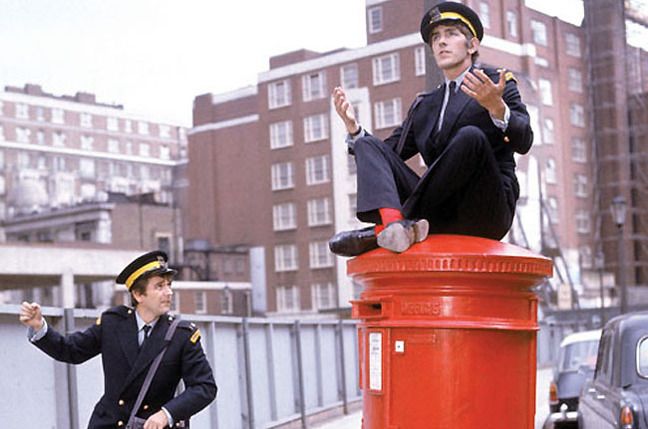
Peter Cook (r.) having a bit of fun with Dudley Moore explaining why he grew tired with God

In thinking about it more, I think I'd consider Bedazzled to be almost an alternate-universe version of Oh, God!. Where you have a charming George Burns wanting John Denver to let people know that, yes, God is still here; in Bedazzled you have a charming Peter Cook wanting to let at least one person know that yes, the Devil is still here. (The wishes seem detached from reality, and there's no indication that the other characters know what's going on in those wishes.) And indeed, both Cook and Moore are charming in their roles, to the point that you feel sympathetic for both of them even though Moore is on the verge of losing his soul. There are, however, a few points at which the movie feels it's running on a bit much. That criticism aside, Bedazzled is well worth a watch.

Note that Bedazzled was remade in 2000 and updated to have the Devil be played by a woman (Elizabeth Hurley), which I think not having seen the movie that it would add some unwanted sexual tension to the movie. Both versions did get a DVD release somewhere, which is something to watch out for if you're looking for an expensive used copy of the Cook/Moore version. The older one is, I think, out of print everywhere; the remake is not listed at the TCM Shop but seems available on streaming video for Amazon Prime members who can do the streaming thing.

Sunday, April 12, 2015

Charade

I neglected to do a post on the 1963 film Charade the last time it aired. It's coming up again this afternoon at 4:00 PM on TCM, so now's your chance to get it.

Audrey Hepburn plays Regina Lampert, a French woman married to an American who's in the business of business, or something. She doesn't really know what her husband does, except that it provides her with a living that keeps her in all that Givenchy and going to fashionable places in the alps to spend her holidays with her friend Sylvie and Sylvie's son Jean-Louis. That's where Regina meets Peter Joshua (Cary Grant). He's walking along the breakfast terrace of one of those places, when Jean-Louis comes up and... shoots him with a water pistol! Peter and Regina strike up a converstaion, playing it a bit coy and Regina thinking nothing of it.

She'll have more time to think when she gets back to Paris. She returns to find that her apartment has been emptied, and her husband murdered, thrown off a moving train! It's some small consolation that Peter has somehow made it to Paris too, and is there to comfort the grieving widow. But if Regina thinks the shock is big, she ain't seen nothing yet. When she goes to the funeral, three strange men show up to pay their respects: Tex (James Coburn), Herman (George Kennedy), and Leopold (Ned Glass); all three of them show up briefly, do something strange, and then leave. And not long after the funeral, Regina gets a letter stating that she is to appear at the American embassy and meet officer Hamilton Bartholomew.

He's got an even bigger shock. Those three men were three of her late husband's four accomplices in the theft of $250,000 in gold that the five of them stole during World War II. One of the other men was believed already dead, and none of the remaining four had been able to get their hands on the hidden gold, apparetnly until now, with Mr. Lampert presumably having done so which would explain why the other three were trying to track down Lampert and get to him. They wanted their share. Regina, for her part, is completely innocent, having no idea that her husband was involved in anything like this and no idea where the quarter million could possibly be. A search of her husband's traveling back yields no clues.

And what does Peter Joshua have to do with this? He's passing himself off as a man who could be Regina's friend, and the one person she can trust in Paris while these other three guys are coming after her for the money, thinking that she's holding out on them. But as the movie goes on it's clear that Peter is keeping secrets from Regina, even as the two of them and the three obvious crooks wind up at the same run-down hotel in their search for the money and their attempts to keep their eyes on each other. Who among the various characters are the real criminals, and where is the money?

Charade is a movie with an excellent story, and one that's told exceedingly well. But, it's a movie that's got one small problem, and that's in the casting. Specifically, the casting of Cary Grant and Audrey Hepburn. Both of them are fine actors, Grant doing well playing the suave older gentleman and Hepburn being an elegant damsel in distress. But it's Grant and Hepburn. Both of them had reputations, and already 20 years earlier when Grant made Suspicion it was clear that producers hated the idea of him being an unalloyed villain and how audiences would respond to that. In the intervening 20 years, especially the decade or so leading up to Charade, Grant had become a man playing characters you knew where going to be the good guy regardless of what the story was trying to tell you. You can't help but expect that to happen in Charade too, and that's the one thing that works to the movie's ddetriment. Other than that, though, the movie is a winner in every way. It's lovely to look at, and there's a good mix of dramatic thriller elements and comic relief to break up the dark proceedings.

Charade is listed as being available from the TCM shop, but courtesy of the Criterion Collection, which means more pricey.