Showing posts with label Sterling Hayden. Show all posts

Friday, June 5, 2026

Out west with Anita Ekberg

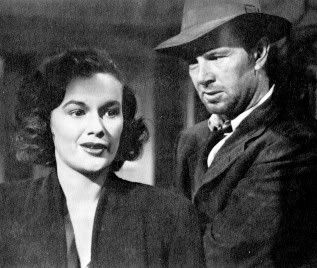
Another of the movies that TCM ran during their Summer Under the Stars day with Sterling Hayden was Valerie. Once again, not havng heard of it before, I decided to record it to be able to watch it later and write up what is not this post on the movie.

The movie opens up with the Sterling Hayden character, John Garth, and his ranch hand Jim Mingo (Jerry Barclay) riding up to a ranch house which they enter. We don't follow them inside the house, but hear several gun shots and the men exit the house. The next morning, the sheriff comes to Garth's house to arrest Garth on a charge of murder. It turns out that two people in the house were killed, although Garth thought that there were three dead. Indeed, Garth has just finished up writing what is a sort of confession -- or defense, depending on your view -- of what he did, which was to shoot his wife Valerie, née Horvat (Anita Ekberg), and her parents who had immigrated here from Europe. The parents died but Valerie is currently only severely injured although not expected to live.

Cut to a shot of the doctor's house where he and a nurse are treating Valerie, which is where we learn that there are a lot of people in town who might well take Garth's side of the dispute. In any case, with a couple of dead bodies, we've got a murder trial coming up. And here's where things get interesting: we get various witnesses giving accounts reminscent of the movie Rashomon, describing their view of what happened, and all trying to make themselves look good.

First is Rev. Blake (Anthony Steel, Ekberg's real-life husband at the time), who is new to this town and gets a message from Valerie to come and visit. Since this is one of those towns with only one church preaching some generic form of Protestantism where everybody goes to the same church, it's unsurprising that the Garths might want to see the reverend too, or at least Valerie. She's deeply unhappy about something, and she as well as her parents and possibly John's brother Herb (Peter Walker) seem to be taking Valerie's side. Rev. Blake starts ministering to Valerie enough that pretty much any man would be filled with jealousy.

Then John himself testifies, which seems a bit odd considering it wouldn't be the prosecution calling him. John was a major in the US Army during the recently-concluded Civil War, having dealt with getting information from Confederate prisoners, which probably gave him some dark cynicism and a propensity toward psychological manipulation and some outright torture-like violence. He only returned home when his father fell ill. The reason for the marriage isn't so happy, as Dad was an inveterate gambler who's left quite a bit of debt behind, and a marriage for John, the older brother, would be financially convenient.

Having heard those two views, we then get the fairly ridiculous premise of Valerie herself testifying, which is surprising since it was thought she was on her deathbed. But testify she does, and by the end of the movie we learn the truth.

Valerie is another of those movies where there's a good idea behind the movie, although in the telling it falls a bit flat. To be honest, it's always going to be tough to compare to a classic like Rashomon. And Valerie is like the old programmers of a previous generation, not necessarily a prestige movie. But still, Valerie is just there. There's no real excitement or tension to it. My guess would be that it's down to the director, Gerd Oswald, who had the great good luck of a debut film like A Kiss Before Dying but was mostly only good enough for B-level work and TV episodes.

Still, Valerie is one of those films you're going to want to watch and judge for yourself.

Saturday, September 20, 2025

Not the right kind of nakedness

I'm always up for Eddie Muller's Noir Alley on TCM because he always makes the movies he selects interesting, even if they're not always quite in the noir genre. So when I see one show up with in an interesting synopsis that I haven't heard of before, I'm going to record it to do a post on later. Such is the case with the Universal release (which might explain why I didn't really know about it before) Naked Alibi.

Sterling Hayden is the star here, as police detective Joe Conroy. But he's not the person we see first, instead meeting local baker Al Willis (Gene Barry). Willis is getting picked up on a drunk and disorderly and doesn't have his ID on him. Conroy and fellow detective Fred Parks (Max Showalter when he was being credited as Casey Adams) are sure Willis is guilty of more and part of the crime ring that's been going around the city, so they try to rough him up before being forced to release him. For their troubles, Lt. Parks gets shot in a phone booth later that night. Worse, later on another two policemen involved in the case also get killed when their car is bombed. And Willis is able to avoid the tails on him by going into a church open 24/7 and slipping out the back.

Det. Conroy is getting angry at this and roughs up Willis some more, to the point that the higher-ups can't avoid it any longer, especially with those good government types investigating everything that's going on in the city. Conroy is put on leave, but uses a PI to keep following Willis and make Willis know that he's still being tailed. So to get away from the tail, Willis leaves his wife behind to go to the Mexican border town not named Tijuana or Mexicali but the imaginatively named Border City. Part of the reason he goes there is to lay low until the heat is off, but the other reason is that he's got a mistress there in nightclub singer Marianna (Gloria Grahame) who doesn't know anything about Willis' family back in the US.

Conroy heads for Border City and when he gets there immediately starts being incredibly unsubtle about trying to find Willis. He's also a bit naïve in that he goes with a guy claiming to know where Willis is, which is clearly a set-up for Conroy to get mugged, or worse. Wouldn't you know it, however, but Conroy is found by a young boy who just happens to live downstairs from where Marianna lives. Marianna, taken with the handsome detective, starts nursing him back to health but also rifles through his things, which is where she finds a newspaper clipping of Willis that reveals to her that he's married back in California, which obviously changes her opinion of him.

There are still a lot of twists and turns to go, however, as Conroy tries to prove that Willis is behind the murder of the cops. To do that, however, Conroy is going to have to get back into the States and find the murder weapon without getting arrested by his fellow cops since there's technically a police brutailty charge awaiting him. Willis, for his part, really is guilty if you couldn't already figure that out. He gets taken by Conroy during a fight at the nightclub, and Conroy heads for home, Marianna in tow.

Naked Alibi is entertaining enough if rather pedestrian. A lot of it belies filming on Universal's backlot, and the movie has the feel of something that, like The Internecine Project that I recently posted about, would have been a made-for-TV movie had it been made well after the 1950s. Hayden is as gruff and emotionless as ever here, while Grahame isn't exactly the most talented nightclub singer beyond having the requisite sex appeal. Anybody who's watched reruns of The Rifleman will have no difficulty spotting Chuck Connors in his small role.

So, while no great shakes, Naked Alibi is OK for a rainy day.

Sunday, February 2, 2025

For some values of love

Eva Marie Saint's turn as TCM's Star of the Month for her centenary last July gave me another opportunity to record some movies I'd never heard of. One such film was the 1970 film Loving, one I didn't know much about because the 1970s are one of the eras of fim I don't know so much about.

The real star here is George Segal. He plays Brooks Wilson, an advertising artist working out of an office in New York and commuting back to Connecticut, where he lives with his wife Selma (Eva Marie Saint) and two daughters. As the movie opens, Brooks is out of the office for a tryst with his mistress Grace, eventually rushing home because one of his kids is in a school recital. There, he runs into Nelly Parks, wife of his neighbor Will. Brooks really doesn't want to be at that recital however, as he has a lot on his mind.

Much of what's on his mind is a contract for the Lepridon truck company. The owner Mr. Lepridon (Sterling Hayden) is coming to New York from the company's midwestern headquarters, and wants to meet with Brooks. If Brooks can get the contract, it would mean a lot of money, and the Wilsons would be able to move to a bigger house in town, which would make the family look better. It's the sort of town where appearances matter, at least to everyone else in town, if not so much to Brooks, who's been worried about the Lepridon contract for months. And then when Brooks gets to Grace's apartment in New York, he finds that there's another man in the apartment. Talk about awkward.

Brooks turns to alcohol and drinks enough that he nearly misses the important meeting with Lepridon, who seems unhappy with Brooks' drawings on the grounds that he wants photographs that are honest since the trucks are used by unemotional engineering types. It seems enough to doom Brook's chances, and he's still going to have to wait for a while to find out whether he gets the contract. In the meantime, Brooks and Selma go to a home viewing for a home that's being sold because the couple that lived there are getting a divorce.

Eventually, Brooks finds out the good news that he does indeed get the contract. However, it's on the same day as a big party in their neighborhood given by Grace's relatives and inviting a bunch of young smart-set types. In an obvious bit of foreshadowing, it's revealed that the owner has a bunch of closed-circuit cameras installed around the property, and can watch them on one monitor in the study with a remote control switching from camera to camera. Brooks drinks some more and eventually takes Nelly, not Grace or Selma, to an unoccupied playhouse outbuilding, where you can guess what happens.

Loving comes across as emblematic of the sort of "daring" film Hollywood tried to make in the years following the end of the Production Code. It deals with grown-up themes in a way that films from just a decade earlier couldn't possibly do, and does so with location shooting and cinematography that are again totally different from what Hollywood gave us through the early 1960s. However, as a story, for me Loving doesn't quite work. It's not that it's a particularly bad movie or anything; it's more that I find it hard to feel an attachment to any of these characters. It's as if the characters are all supposed to feel a sense of disillusionment or something, but that the end result is the viewer feeling disillusioned with the characters.

I think, however, that people who are fans of the American cinematic style of the early 1970s will probably enjoy Loving. It's more that it's not a film for everyone.

Thursday, September 21, 2023

Boomerporn

A couple weeks back, I mentioned a movie that TCM ran during Anthony Perkins' day in Summer Under the Stars. Another movie they ran is one in which he had a rather smaller part, Winter Kills.

The star here is Jeff Bridges, who plays Nick Kegan. Nick is doing some sort of work on a ship someplace not too far from Southeast Asia, in oil exploration or some other sort of research. He came from powerful stock, however; his half-brother was president of the United States, at least until he was killed by a sniper close to 20 years ago. Dad (John Huston) is the patriarch of the family, having created the family business.

One of Dad's business associates, Keifetz (Richard Boone), helicopters on board the ship to tell Nick that he's got a guest, a seriously injured man claiming to know something about the brother's assassination. Unfortunately, this man can only get part of what he knows out before he dies. But it's enough to send Nick on a possible wild goose chase back to the States to try to prove that there's more going on. Specifically, that involves a second gun which has allegedly been hidden in the same location for the 20 years since the shooting, in a building, which seems to me like utter bullshit. If it had been buried on somebody's land, especially in a rural area, that might be one thing. But between floors of a highly-trafficked commercial building? And wouldn't they dismantle the murder weapon for parts?

I suppose you could say that the conspirators wanted Nick to find this weapon that wasn't really involved in the shooting, leading him to go on a wild goose chase. But Nick and friends do find the weapon, only to have it stolen right from under their noses and Nick's two friends killed. Nick wants to go to his father for help, not suspecting that perhaps Dad might be involved in everything that's going on.

If any of this sounds familiar to you, it's because it doesn't take much of a leap to compare this to all the conspiracy theory nonsense surrounding the shooting of John F. Kennedy. But while the movie starts off as though it's going to be a political thriller (it's based on a book by Richard Condon, who also gave us The Manchurian Candidate), it eventually morphs into an extremely dark comedy with a plethora of stars. Anothony Perkins plays the executive behind the Kagan family empire. Dorothy Malone is Nick's mom, while Sterling Hayden is one of Pa Kagen's political and business rivals. Eli Wallach gets the Jack Ruby role, and so on.

My first thought was that whether you like Winter Kills or not is likely to depend on your view of the Kennedy era. If you're one of those boomer types who was around for the Kennedy assassination, as the critics who wrote the original reviews on first release were, you're probably going to love this movie.

I, on the other hand, have never bought into the Camelot bullshit, and instead see the Kennedys as little more than the Kardashians of the 1960s who gained political power. So I found the material here too obvious by half, and turgidly unfunny. Maybe when the last of the boomers die off we can finally stop comparing stuff to the 60s.

Monday, June 19, 2023

Kansas Pacific

For those who like those old B westerns that have fallen into the public domain, I recently came across one that is definitely worth a wath. That film is Kansas Pacific.

The movie is set in the beginning of 1861, after the election of Abraham Lincoln as president but before the actual fighting began in the US Civil War. It is, as you can guess, set in Kansas, which had a reputation at the time as "Bloody Kansas" because as it was still a territory, it was unclear whether it would become a state as one that allowed slavery or one that didn't. With the territory bordering the slave state of Missouri, it was not a surprise that people on both sides of the slavery issue flooded into the territory and that violence ensued on both sides.

Meanwhile, as the US included a contiguous landmass from the Atlantic to the Pacific, the race was also on to build railroads and telegraph lines that spanned the continent, along with serving the forts that the federal government had been putting up on territorial land to deal with the Native American tribes that were understandably unhappy about the encroachment by the white man. Confederate sympathizers especially were unhappy with the building of railroads that in theory would enable a non-slave state like California to transport men to the east much more efficiently, so they tried to sabotage the building of railroads like the Kansas Pacific.

As for the actual plot of the movie behind the history, this one involves Cal Bruce (Barton MacLane), a construction foreman for the railroad who is out in Kansas with his adult daughter Barbara (Eve Miller) and an engineer with whom he has worked since the early days of railroads, a man nicknamed "Smokestack". They're trying to get the railroad built, but southern sympathizers, led by William Quantrill (Reed Hadley), are trying to sabotage it. (Recall from any number of movies about Jesse James or the Civil War in the Missouri-Kansas border area that William Quantrill was a real figure leading guerilla groups including the James and Younger brothers.)

The federal government back in Washington is concerned about the sabotage, since they want the rail line built to connect to their forts in the Colorado territory. But because the war is not officially on, they can't sent active duty military to build the rail line. So Gen. Winfield Scott sends a man undercover, Capt. John Nelson (Sterling Hayden) to help oversee the project and stop all the sabotage going on.

It's a fairly basic plot, and as you can guess, the presence of Barbara is so that the hero will have a love interest (and, I suppose, some female beauty for the male demographic to enjoy). It's all fairly predictable, but all well enough done, especially for those who like the less complex westerns or movies with old trains. The landsacpe doesn't look anything like Kansas as far as I'm aware, but that sort of geographic accuracy isn't the point of a movie like this. It's more a film you're just supposed to sit back and enjoy.

Wednesday, December 18, 2019

Where's the Kenny Loggins song or the shirtless volleyball?


Over the Thanksgiving weekend, DirecTV had a free preview weekend of all the movie channels, so I got the chance to record a bunch of stuff I otherwise wouldn't have. (Having a brand new empty DVR helped, too.) One of the movies I recorded was the 1955 western Top Gun.

Sterling Martin plays Rick Martin, who doesn't seem to be into superstion, black cats, or voodoo dolls. Instead, he's a gunfighter who's returning to his hometown in the Wyoming territory where his mom is buried. The townsfolk don't like him because they know his reputation and consider him responsible for a couple of the bodies in the cemetery. Indeed, people like Lem Sutter (a young Rod Taylor) would like to take Martin down in a gunfight.

But Martin has other ideas. He'd been spending some time with outlaw gang leader Tom Quentin (John Dehner), and has learned that Quentin and his gang plan to raid the town tomorrow to make it an open town safe for all sorts of vice. He tells the marshal, Bat Davis (James Millican), and the marshal is sympathetic. But is the town council, led by big landowner Canby Judd (William Bishop) going to listen to Martin?

It turns out that there's a lot more going on between between Martin and Judd. First is the matter of Martin's dead mother. The offical story is that she mortgaged the family ranch for $5,000, and the night she did so the money was taken from her and she was shot, enabling Judd to get his hands on the land. But a look at the records office shows that somebody had glued a mortgage declaration on top of what was really a bill of sale, do Judd used dirty tricks to get the Martin ranch.

The other big thing is Laura (Karin Booth). She was Martin's girl before he had to leave town the last time some years back, and in the meantime she decided that she didn't want to be married to a gunfighter, even though Martin's plan was to pick her up to head west for California and start a new life there. Instead, Laura has gotten engaged to... Canby Judd, a wedding that's supposed to take place in a few days' time.

That is if the Quentin raid doesn't do terrible things to the town. Two strangers walk into the town bar, and Bat quickly figures out they're from Quentin's gang, trying to get information. And Judd is still trying to figure out ways to get ride of Martin, the sort of keeping your eye off the ball that could make the Quentin raid more likely to succeed.

Top Gun, as you can probably figure out, has absolutely nothing to do with the Tom Cruise movie of the same title or the coming remake, but is just a standard-issue 1950s programmer western. There's nothing notably bad about it, but also nothing that will make it stand out. It's available on DVD as well as Amazon streaming if you get the Starz package. Note that when StarzEncore Westerns ran it, the put it in a 16:9 format when IMDb claims it's still in the Academy ratio (not surprising for a B western even though it's after the introduction of Cinemascope). Indeed, the StarzEncore presentation looked badly stretched until I was able to adjust the aspect ratio.

Wednesday, September 6, 2017

Crime of Passion

I mentioned a while back that I had DVRed Crime of Passion when it showed up on Noir Alley back in the spring, but didn't do a full-length blog post because it was out of print on DVD. Except that it was scheduled for a DVD release on September 5, which is of course yesterday. For some reason, both the TCM Shop and Amazon are listing the DVD as scheduled for a release yesterday, but either on backorder (TCM Shop) or temporarily out of stock (Amazon). Having said that, Amazon is currently offering it via streaming video.

Stanwyck plays Kathy Ferguson, who at the start of the movie is a women's advice columnist at a San Francisco newspaper, single and proud of her career. This even though she writes sappy crap. San Francisco is in the news because a female murder suspect from Los Angeles has fled there, and the LA police send a pair of cops up to find the suspect and bring her back to justice in Los Angeles. It's because of this that Kathy meets Bill (Sterling Hayden) and his partner Charlie (Royal Dano).

Both of the cops are dismissive of Kathy, Charlie more so, but Kathy apparently begins to feel some sort of lust for Bill. She was going to take a better job in New York, but she suddenly decides to drop everything and go down to Los Angeles to marry Bill! Not only this, but she's going to become a housewife and give up the columnist gig! It's never really made clear why Kathy does something so out of character. Maybe her biological clock was ticking, although Stanwyck in real life was pushing 50 by the time she made the movie.

Back to Kathy's idiot motivation, she soon realizes she's done something incredibly stupid, since she doesn't care for the gossipy wives, and the men don't respect her intellect. Eventually Kathy gets so fed up with it that she decides she's going to help her husband's career by getting to know the Popes. Tony (Raymond Burr) is Bill's boss, married to Alice (Fay Wray). If she can do this, she can possibly put a good word in for Bill and get him a promotion. So she starts stalking Mrs. Pope and eventually causes an accident.

Mr. Pope sees right through this, asking Kathy what she was doing over there since it was way out of the way for her. But in a movie where several of the main characters have screwed up motivations, he's willing to succumb to her attempts to seduce him! To be fair, Mrs. Pope has been on the verge of a nervous breakdown, hoping that hubby would retire so she doesn't have to worry about him. And if he does retire, well there's a great career opportunity for Bill. And if Mr. Pope passes Bill by? Well hell hath no fury like a woman scorned!

Crime of Passion is a movie that I have decidedly mixed feelings about. The movie is really only partly a noir, being at the end of the noir cycle; the other part is more of a soap opera as you could easily see a Joan Crawford character doing many of the things Barbara Stanwyck's character does. The characters act in ways that are almost ludicrous at times, leading me to laugh at times when that most likely wasn't the intent of the movie.

Stanwyck does the best she can with the material. Burr does fairly well; he was still a heavy at the time as it was still another few months before Perry Mason would premiere on TV. But his character suddenly finds his conscience again, making for a rapid volte-face in yet another plot veer. Sterling Hayden doesn't have to do much other than be sturdy, something which was easy for him to do.

All in all, Crime of Passion is not without interest, but is another of those movies that would probably be better in a box set.

Wednesday, May 6, 2015

TCM Star of the Month May 2015: Sterling Hayden


Sterling Hayden (r.) and Jean Hagen in The Asphalt Jungle (1950; 9:45 PM)

We're getting close to finishing the first week of a new month, and so we finally get to the new Star of the Month: Sterling Hayden. (In an interesting coincidence, it's the third straight month in which the Star of the Month is showing up on Wednesday nights.) Hayden is an interesting choice, as he wasn't quite your typical star, at least, not in the way the studio system produced stars in the era just before Hayden got to Hollywood. He certainly didn't become as big as some of the other people who came around in the early 1950s, like Ernest Borgnine or Jack Lemmon. Still, Hayden's films are worth a watch and I'm glad that TCM has selected him.

Probably Hayden's most famous movie is The Asphalt Jungle, and that one is airing at 9:45 PM this evening. In fact, most of the movies this evening have a substantial crime element to them:

The night starts at 8:00 PM with The Killing, in which Hayden masterminds a daring robbery of a racetrack's takings, only for the robbery to go wrong because of the foibles of some of the conspirators. In this case, that means Elisha Cook Jr. and Marie Windsor who play an unhappily married couple; both of them are quite good.

Third up is Crime Wave at 11:45, with Hayden as a more or less good guy, a cop trying to investigate a gang of criminals. The only thing is, he has to deal with an ex-convict (Gene Nelson) who would really prefer to stay straight.

Suddenly comes on at 1:15 AM. This one also has Hayden as the good guy, a sheriff who gets held hostage by a man (Frank Sinatra) who wants to take out the President in a sniper attack. It's suspenseful, but whenever TCM have shown this one, they've had a lousy print since I think this is one of those movies that wound up in the public domain.

Concluding the night, at 4:15 AM, is Five Steps to Danger, which has Hayden getting mixed up with Ruth Roman, East bloc spies, and a scientist at a US army base. It's entertaining enough, but one of those decidedly low-budget movies.

The only one of the night's films I haven't seen before (at least, I think I haven't seen it) is Crime of Passion at 2:45 AM. Hayden stars along with Barbara Stanwyck and Raymond Burr. Sounds interesting.