Thursday, March 20, 2008

Paul Scofield, 1922-2008

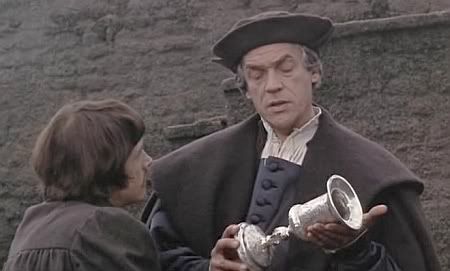
Paul Scofield handing a chalice to John Hurt in A Man For All Seasons
Paul Scofield hands a silver chalice to John Hurt in A Man For All Seasons

Paul Scofield, the actor who won a Best Actor Oscar for portraying Sir Thomas More in the 1966 movie A Man For All Seasons, has died at the age of 86.

The plot of A Man For All Seasons is fairly simple: Scofield plays Sir Thomas More, a devout Roman Catholic serving as Lord Chancellor to English King Henry VIII (played by Robert Shaw). Henry's marriage to Catherine of Aragon has failed to yield any surviving sons, and Henry has fallen in love with young Anne Boleyn (played in a brief cameo by Vanessa Redgrave). Of course, the Catholic Church has a thing against divorce, and His Majesty is trying to find some way to get around this problem.

This is set against a backdrop of a corrupt political establishment (there's nothing new under the sun), in which many people are perfectly willing to abandon their faith and bow to the King's wishes, if only because it will allow them to get ahead. More, however, being devout, will have nothing of this; considering the King's marriage to Catherine licit under Catholic Canon Law, he will not under any circumstances sanction the divorce and remarriage to Anne Boleyn, instead being willing to resign his post as Lord Chancellor when Henry creates his own (Anglican) Church.

Unfortunately, More is not allowed to live out the rest of his days quietly, as the King is forcing everybody to take a loyalty oath; the oath would require More to reverse publicly his stance on the King's marriage to Anne Boleyn, or else be in violation of the oath by continuing to be a Catholic. More, consequently, refuses to take the oath, and is arrested and put on trial for high treason. More, in his defense, delivers a blistering indictment of the King's actions and the political and religious establishments' willingness to abandon their moral values for political expediency, but the defense is obviously all for naught: the whole oath and trial was little more than a sham to get everybody to come to the King's position, or else get rid of those who did not agree with the King. More is sentenced to be executed, and dies for his beliefs.

The cast is excellent; in addition to Scofield, Wendy Hiller plays his wife, Alice; a young and lovely Susannah York plays his daughter, Margaret; Vanessa Redgrave's brother Corin plays Margaret's betrothed, William Roper; John Hurt appears in his first major movie as Richard Rich, a man looking to get ahead at the royal court; Leo McKern plays Thomas Cromwell; and Orson Welles has a small role as Cardinal Wolsey. Directing duties were more than capably handled by the great Fred Zinnemann, in a job that must have felt like a reprise of High Noon.

A Man For All Seasons is available on DVD and is well worth watching.
Wednesday, March 19, 2008

The master of suspense

TCM aired Alfred Hitchcock's Rope yesterday afternoon. Despite not normally receiving the acclaim of movies like Rear Window, Psycho, or Vertigo, Rope is on of the movies that best shows just how good Hitchcock was at creating suspense.

We know right away at the beginning of the movie that there's been a murder: Hitchcock shows us how the roommates Brandon (John Dall) and Philip (Farley Granger) strangle their friend David (Dick Hogan), and hide his body in a chest. They then proceed to throw a dinner party ostensibly in his honor, and serve the buffet off of the chest in which David's body is stored! Into all this walks their housemaster from prep school, Rupert Cadell (played by James Stewart in the first of four movies he made with Hitchcock). We know there's been a murder, but he, and the other guests, don't. And so, the question becomes, are Brandon and Philip going to get away with murder? And if not, how are they going to be caught? That was Hitchcock's thesis about the difference between suspense, murder, and horror: that we in the audience know something the characters don't.

Hitchcock gives us some excellent characterizations here, as Brandon is confident to the point of hubris, as well as being domineering toward Philip and manipulative. Philip, on the other hand, is much less comfortable with the idea of murder, to the point of becoming unhinged and pitiable. Brandon and Philip are clearly supposed to be a gay couple, although thanks to constraints of the Production Code, this couldn't be mentioned -- but it actually works to film's benefit that the homosexual relationship is only (obviously) implied. A modern-day remake would probably try to make the relationship much more explicit (and graphic), if not campy. (It must also be pointed out that the movie, and the play on which it was based, were drawn from the real-life case of Chicago thrill-killers Leopold and Loeb, who were in fact gay.) And James Stewart is excellent as Rupert Cadell, the philosopher whose ideas inspired Brandon and Philip to commit murder; Rupert becomes rightly horrified when he not only realizes that his two former charges have committed murder, but learns why they've committed murder. Stewart displays an emotional register that's deeper than anything he had before World War II (even though Stewart was great in movies such as Mr. Smith Goes to Washington and The Philadelphia Story), suggesting that he was drawing on whatever dark experiences he had during the war to play Rupert.

Much has been made of the technical aspects of Rope: Hitchcock wanted to make Rope evocative of a stage play, and made the movie a series of very long takes. The film canisters could only hold about nine or ten minutes of film at any one time, so there are a number of shots in which Hitchcock hides the camera behind a dark item such as a jacket or the chest, and has a discreet dissolve there to where the new canister of film begins. However, the commonly stated claim that these are the only cuts is untrue: Hitchcock eventually realized that he would be limited by the amount of film that could be shown on one projection reel, which was about 20 minutes; so every 18 minutes or so there is a "hard" cut as opposed to the dissolves.

Rope is available on DVD, so if you missed TCM's showing, you're not out of luck.

Tuesday, March 18, 2008

A Treat Williams treat

Over on the TCM boards, somebody recommended the movie version of Hair, starring Treat Williams. His name reminded me of a little-known movie of his that, happily, is available on DVD: Where the Rivers Flow North.

Williams only has a small part, as a promoter of a carnival wrestler. The starring role goes to Rip Torn, who plays Noel Lord, a man eking out a meager existence in the Northeast Kingdom of Vermont in the 1920s as a logger. However, he's about to face the loss of his land, as an electric company wants to bring electricity to the region by damming the local river, which would flood his land. Of course, they're offering money to all the people whose land will be lost, but Noel is one of the only ones who doesn't want to take the money. The power company sweetens their offer, but there's always the threat of their using eminent domain laws to force a sale. Meanwhile, Noel's love interest, the Native American woman Bangor, played by Tantoo Cardinal, is of the opinion that they should accept the power company's offer, so that they can move west and buy a new plot of forest.

It's a little movie, but ever since I've started watching classic movies, and especially the B-movies, I've come to the belief that a good story is just as important, if not more so, than anything else in a movie. Some of my favorite sci-fi movies, for example, are those that have an intriguing story and rely little on special effects. Where the Rivers Flow North fits into this in that it's a very well-told story, dealing with the very common theme of tradition versus modernity. The characters are interesting, and the movie has a beautiful look to it thanks in part to the cinematographer and in part to the location shooting in the Upper Valley of the Connecticut River (ie. northern New Hampshire and Vermont).

The cast also includes Michael J. Fox (second from right in the above photo) in a small but effective role as an executive of the power company.

Monday, March 17, 2008

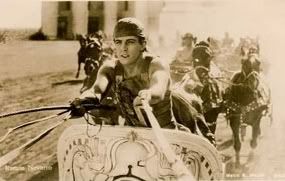
Ramon Novarro

Ramon Novarro in Ben-Hur,
Ramon Novarro in Ben-Hur (1927)

So I got up early this morning to watch TCM's showing of Across to Singapore. Unfortunately, it's not available on DVD and, since it's a silent, it's not so likely to show up soon on TCM. Ramon Novarro stars as Joel, the youngest of the four Shore brothers, the oldest three of whom are seamen. Joel's in love with Priscilla Crowninshield (Joan Crawford), but so is his older brother Mark, played by Ernest Torrence, who in real life was 21 years older than Novarro -- but more on that later. Older brother Mark is betrothed to Priscilla, much to the chagrin of both her and Joel.

Things change, though, when Joel too becomes a seaman and goes off on Mark's next voyage. Mark sees him as immature, and when they get to Singapore, Mark orders Joel out of a bar and back to the ship, just before Mark gets stabbed by a gang led by a sailor overlooked by Mark for first mate in favor Joel. The new captain has Joel put in irons for the voyage home, and here's where we have to congratulate the make-up department: despite having spent several months at sea in harsh weather, followed by several months in irons below decks in the brig, when the ship returns home, Novarro is impossibly photogenic, as though he's just come from the set of the 1920s equivalent of Dawson's Creek. Novarro was 28 at the time, and since his age isn't actually given in the movie, we can be generous and suggest that MGM weren't too egregious in their casting. Torrence, on the other hand, was 49 when Across to Singapore was made, and looks every day of his 49 years, and then some, with a winswept, craggy, and totally unappealing face. It's easy to see why Crawford's Priscilla wouldn't want this man.

Eventually, Joel proves that his ending up in irons was an injustice, and he and Priscilla end up together courtesy of an unbelievably melodramatic ending. Joel has the good fortune to retain his boyish good looks, despite having spent several more months at sea, and getting punched around in a fight.

As I mentioned, Across to Singapore isn't available on DVD, probably in part because the print isn't all that good, really showing wear from its 80 years. If you'd like to watch Novarro on DVD, your best bet would be Novarro's best-known movie, the 1927 silent version of Ben Hur.

One final note about Across to Singapore: it's based on the novel "All the Brothers Were Valiant", and under that title, the movie was made earlier as a silent, and then in the 1950s. The novel was written by Ben Ames Williams, the same man who wrote Leave Her to Heaven

Sunday, March 16, 2008

Eine Nacht zu erinnern

Everybody knows the story of the Titanic: hubristic shipbuilders build the hitherto biggest ship in history, and claim that it's "unsinkable", only to have the ship hit an iceberg on its maiden voyage and sink, killing some 1400 people. The story has been told on film many times, and thankfully to the best of my knowledge, Hollywood has never tried to make a version in which the Titanic does not in fact sink. (They did make The Unsinkable Molly Brown, but that's based on a true story of one of the survivors.)

Perhaps one of the most curious versions is one made in 1943 in Nazi Germany, which is airing overnight at 2:30 AM on March 17, as part of TCM's Imports series. The story itself is about as accurate as any other version of the movie, although having been made in Nazi Germany, there certainly is some propaganda. This version paints the executives of the White Star Line as greedy capitalists to a much greater extent than Hollywood would have done in the studio era, or in what is probably the best cinematic look at the disaster, A Night to Remember. (To be fair, though, the Hollywood of 2008 would probably revel in propagandizing against large companies. Remember Denzel Washington's idiotic line in the remake of The Manchurian Candidate that "this is what happens when you have rich people doing bad science"?) Also, there's a ludicrous casting change as one of the ship's officers is not English, but German -- and this is the only officer who shows any virtue in the run-up to the disaster, recognizing the dangers of going too fast through iceberg-infested waters where his English superiors steam blithely on.

What is more interesting about this version, though, is the back story. The original director, Herbert Selpin, faced a critic far tougher than Siskel and Ebert, with their two thumbs down: watching over the production was Joseph Goebbels, the man responsible for Nazi propaganda. Goebbels eventually concluded that showing a movie about a sinking ship probably wouldn't be a good idea for the Germans of 1943, who faced air-raids and, with the defeat at Stalingrad, a proverbial sinking ship of their own. So Goebbels had the director arrested; soon thereafter Selpin was found dead in his jail cell under mysterious circumstances. This version of the Titanic story was banned in Nazi Germany, although interestingly enough it was allowed to be shown in occupied France, where audiences loved it, making it a big hit.

It's not the greatest version of the Titanic disaster, although it's more than passable, and not dreadfully overlong or filled with crappy Céline Dion music the way James Cameron's version is. It's worth watching, and not just for the historical curiosity of seeing the Nazi take on a very British disaster. It's also available on DVD, although as an import, it can be a bit pricey.

Saturday, March 15, 2008

Powell and Loy return!

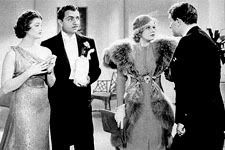
Poster for Libeled Lady

A few days ago, I mentioned William Powell and Myrna Loy appearing together in Manhattan Melodrama. One of their great comedies, Libeled Lady, will be airing on TCM at 8:00 AM ET on March 16.

Loy plays the title role, socialite Connie Allenbury, who is libeled about a romantic tryst by the newspaper publisher Mr. Haggerty (played by Spencer Tracy). She sues him, and he, trying to get out of the suit, hires noted detective Bill Chandler (that's Williams Powell) to seduce Connie so that there will no longer be any libel. What actually happens, however, is that Chandler falls in love with Allenbury, with hilarious consequences. Also appearing, as Haggerty's long-suffering fiancée Gladys, is Jean Harlow. Note her and Tracy on the right of the photo, with Loy and Powell on the left. Finally, Mr. Allenbury, Connie's father, is played by Walter Connolly, who also appeared as the father in the classic screwball comedy It Happened One Night.

Libeled Lady is in itself a hugely enjoyable movie, but there's a bit of a backstory that's interesting. At the time, Tracy hadn't really done any comedies; most of his movies had been at Fox, with a number of less savory types included. Libeled Lady showed that Tracy could really do comedy, and this movie, combined with another 1936 release, San Francisco, helped make Tracy a big star.

It's fairly well-known, but despite appearing together in a slew of movies, William Powell and Myrna Loy were not romantically involved. At the time Libeled Lady was released, Powell had gone through a divorce from Carole Lombard, and was quite smitten with Jean Harlow. (Well, who wouldn't be?)

Watch for the opening credits. With so much star power, it's only logical to conclude that there was going to be a dispute over who should get top billing. So MGM came up with an interesting solution that obviated this problem: the four stars are walking together arm in arm, with their names being superimposed over them. All four stars ger more or less simultaneous top billing. (I do wonder, however, whether anybody complained about being further to the right of anybody else.)

Libeled Lady was remade by MGM as the Technicolor movie Easy to Wed, starring Lucille Ball, Van Johnson, and Esther Williams. Both versions are available on DVD.

Friday, March 14, 2008

Writer's Block

I was having a difficult time thinking of a subject for today's post, until I thought about writer's block: "Hmm," I thought to myself, "movies about writers would be a quick way of dashing off a blog post for today." And so that's what you're going to get.

I could mention biopics about writers, such as The Life of Émile Zola. Paul Muni plays the title role, the French writer who defended the railroaded Jewish military officer with his famous essay "J'accuse!".

There have been several movies about advertising writers, and perhaps this would be a good topic for a post all its own. For today, however, I'll just point out adman Cary Grant in the title role as Mr. Blandings Builds His Dream House.

Newspaper writers are a very common source of inspiration for Hollywood. One of the best movies about the newspaper biz is His Girl Friday, starring Rosalind Russell as the writer and the aforementioned Grant as her editor; this one is airing on TCM at noon ET on March 16.

Then there are the screen writers. The most famous of these would be William Holden playing Joe Gillis in Sunset Blvd., working for the insane Norma Desmond (Gloria Swanson) on her screenplay.

But there is at least one movie dealing more directly with the idea of writer's block: The Lost Weekend. (Technically, Cary Grant is suffering from writer's block too in Mr. Blandings; he can't come up with a good slogan for Wham hams.) Ray Milland won a Best Actor Oscar for his portrayal of Don Birnam, a writer suffereing from writer's block who can only face the day by drinking. I'm not much of a drinker, but supposedly this is relatively realistic, or at least realistic enough that the studios were skittish about releasing such a depressing movie when it was made back in 1945.

Fortunately, all of the films I've mentioned above are available on DVD.

Thursday, March 13, 2008

Dame May Whitty

Dame May Whitty in The Lady Vanishes,
Dame May Whitty, 1965-1948

TCM aired Alfred Hitchcock's The Lady Vanishes this evening in prime time. Dame May Whitty plays the title role; governess Miss Froy, who's returning from a made-up country in Central Europe back to England. She meets young woman Iris Henderson (played by Margaret Lockwood) just before boarding the train, but Iris wakes up during the train ride to discover that Froy has gone missing! And she can't get anybody to believe that Froy even existed -- until Gilbert Redman (Michael Redgrave) comes to believe it. I won't give away any more of the story line, except to say that it's filled with Hitchcock's twists, turns, and a MacGuffin. If you missed The Lady Vanishes on TCM, you'll be pleased to know that it's out on DVD.

If you want to see more of Dame May Whitty, though, you can just tune in to TCM on March 14 at 8:00 PM ET: TCM will be showing Gaslight. Ingrid Bergman stars as Paula Alquist, a young woman whose aunt, a famous opera singer, was murdered. She's in Italy recovering, where she meets Gregory Anton (played by the suave Charles Boyer). They fall in love right away, get married, and return to Paula's old home in London. But all is not right with their marriage, as Gregory is browbeating Paula, and she seems to be going mad as a result. Why is he doing it? Well, that would give away the whole story!

Dame May Whitty plays Bessie Thwaites, an elderly woman who meets Paula in Italy at the start of the movie, and then is surprised to find that they're neighbors in London. Her role isn't as big here as it is in The Lady Vanishes, but she's still fun to watch. The other supporting roles, however, may be more interesting: Joseph Cotten plays a Scotland Yard detective who suspects something's going wrong with Paula, and is determined to figure out what. He'd be fine if he were playing an American detective, but as a Scotland Yard man, he seems miscast. The best of the supporting roles, however, is that of Gregory and Paula's young maid: that's a teenaged Angela Lansbury in her first movie role.

Gaslight is also available on DVD.

Wednesday, March 12, 2008

Governor Gantry

One of the reasons to spend time watching classic movies is to get away from our dreadful current political culture. However, I cannot help but think of some of the movies that would fit the resignation of our vile Willie Stark of a Governor here in New York. Sure, the above reference to All the King's Men would fit, and on a political blog I read, somebody smartly mentioned Rain. But I've recommended Joan Crawford in my last two posts; besides, I'd like to recommend something with a little more class: Manhattan Melodrama.

William Powell stars as Jim Wade, an honest man who goes from lawyer to prosecutor to governor, who has an interesting relationship with gangster Blackie Gallagher (Clark Gable). The two grew up together -- watch for yet another appearance by an adolescent Mickey Rooney as the young Blackie, who is already at this young age a small-time chiseler. Wade and Gallagher both fall for the same woman (more on her later), and Gallagher eventually helps Wade become governor, albeit without Wade's knowledge. However, that surreptitious help is eventually discovered, leading to a crisis for the Wade administration. There is a deft resolution to the problem, however, which would satisfy the folks involved in policing the Production Code.

Playing love interest Eleanor Packer is Myrna Loy. Loy's isn't the most important character in the movie; Powell and Gable get much more of the screen time. But it's really interesting to see this particular pairing of Powell and Loy. Most of the movies starring William Powell and Myrna Loy are comedies -- the six "Thin Man" movies are technically mysteries, but there's a lot of comedy in them. Their other movies, like Libeled Lady and Love Crazy, are straight-up screwball comedies. But both Powell and Loy were good at drama, and show it here. Gable is also quite good as a gangster, and indeed spent quite a bit of time early on in his career playing suave guys with dubious morality: A Free Soul and San Francisco both come to mind.

Interestingly, Manhattan Melodrama is the movie gangster John Dillinger was watching when he was shot to death after exiting a movie theater. It is available on DVD and, although a big change of pace from the other Powell/Loy movies, is still well worth watching.

Tuesday, March 11, 2008

More Joan Crawford

This time, we get an older Crawford in The Caretakers, airing at 2:30 AM ET on March 12 on TCM. (Note that this means 11:30 PM on March 11 for those out on the west coast.) In this 1963 movie, Crawford plays the head nurse at a mental institution. Robert Stack plays the head doctor, and he's a "progressive" who wants to try new ways of treating the patients. Unfortunately, this raises havoc for Crawford's nursing staff, and so she fights him at every turn.

That's not the only thing about this movie that's unfortunate. Although the above sounds like an interesting enough idea for drama, it's also the sort of situation that's easily made exploitative, with the patients suffering by being treated as caricatures. And that's what happens in this movie.

Still, it's fun to watch Stack and Crawford, as well as the supporting cast. An aging Herbert Marshall appears as one of the doctors, and Polly Bergen (Gregory Peck's wife in the original Cape Fear) probably gets the highlight as a woman who suffers a nervous breakdown in a movie theater in this film's opening sequence.

Like Ice Follies of 1939, this one is liable to be released on DVD only as part of a completist edition of the movies of Joan Crawford. God knows she made enough B-grade stuff in the 1960s after What Ever Happened to Baby Jane?