Monday, June 2, 2008

TCM's Sydney Pollack tribute

I've been remiss in posting the details of TCM's tribute to the late Oscar-winning director Sydney Pollack. That tribute is airing tonight, and features four of Pollack's movies:
The Slender Thread at 8:00 PM ET;
Three Days of the Condor at 10:00 PM;
Tootsie at midnight; and
Jeremiah Johnson at 2:00 AM.

I commented on Tootsie when Pollack died, so today I'll recommend The Slender Thread instead. Sidney Poitier stars as a psychology student who, as part of his coursework, is manning a crisis hotline. One day, he gets a call from Anne Bancroft, who tells him that not only is she suicidal, she's actually taken the pills necessary to kill herself. It's now a race against time: Poitier has to keep her on the line in order that the phone company can trace the call, but there's another good reason for keeping her on the line, namely, that keeping her talking makes it slightly less likely that the sleeping pill overdose will knock her out and hasten her death. I can imagine this would be a difficult enough situation for an experienced psychologist, and for a student like Poitier's character, it must be extremely nerve-wracking. Of course, Hollywood has a relative amateur put into the situation, as it's a natural part of the formula for creating more tension and suspense. Indeed, the formula had been used before by Hollywood, in movies such as Fourteen Hours, where Paul Douglas plays the part of the inexperienced man trying to prevent a suicide to Richard Basehart's man threatening to jump off a building ledge.

Despite the fact that it may seem formulaic, The Slender Thread delivers an effective dose of tension and suspense. Pollack got excellent performances from the two leading stars, and the rest of the cast is filled with names that should be familiar from watching TV: Telly Savalas plays the professional psychologist who set up the hotline; Ed Asner is a police detective; Steven Hill, who spent many years on one of the "Law and Order" shows, plays Bancroft's husband; and Dabney Coleman has a small role, too. For those living in Seattle, watch for the vintage location shots.

Unfortunately, The Slender Thread does not seem to be available on DVD, so you'll have to catch it tonight.

Sunday, June 1, 2008

Save Universal films!

By now, you've probably heard about the massive fire at Universal Studios. In looking at a list of the movies Universal put out in the 1930s, it surprised me to discover just how few I had heard of. That's partly because Universal have been bad about licensing their movies to be shown on TV, and partly because so few of them have ended up on DVD. You'd think that with all the cable channels Universal owns (USA, Bravo, SciFi, Chiller, and Sleuth, amongst others) showing informercials in the overnight hours, there would at least be a place for Universal to show some of its old movies, even broken up with commercials. But no.

So I'd like to mention one of the few that has shown up on TCM, and suggest it be released to DVD: Remember Last Night? It was released a year after The Thin Man, and is a clear knock-off of the genre, in that you've got a heavy-drinking couple who solve a murder mystery, in a light comedic atmosphere. But where Nick and Nora Charles were urbane, our heroes (played by Robert Young and Constance Cummings) are much wilder. They start off at a society party where everybody's drinking cocktails -- drinking so many, in fact, that everybody gets far more drunk than Nick and Nora ever did. (These opening scenes may be somewhat uncomfortable to modern audiences as drunk driving is presented as a funny thing, and the characters do a bit in blackface.) However, when they wake up hung over, they discover that a member of their party has been murdered! And nobody can remember much of anything about what happened the previous night! Thankfully, though, there's police detective Edward Arnold, who is a friend of Robert Young's; if anybody can solve this case, he can. Of course, Young and Cummings aren't going to make it easy for him; they're determined to solve the case their own way. Eventually, the case gets solved in part with the help of hypnotist Gustave von Seyffertitz.

People newer to old movies would probably be better served starting with the original The Thin Man or screwball comedies like My Man Godfrey (both of which are available on DVD) before lobbying for a lesser-known movie like Remember Last Night? to be released to DVD. Those who, like me, are movie mavens, however, will probably get a kick out of this movie, especially out of some of the cast and crew. In addition to the few stars mentioned above, character actors like Gregory Ratoff (Max Fabian from All About Eve) and Edward Brophy (the murderer in the original Mad Love) appear; the butler is played by eternal butler Arthur Treacher (later of fish-and-chips fame). The director of this comedy? James Whale. That's right -- the same guy who directed the classic 1931 version of Frankenstein and whose last days would be chronicled in Gods and Monsters.

Teenagers on Trial, Japanese style

Late in April, TCM aired a day of 1950s movies about disillusioned teens and the resulting deliquencies. The decade and a half following World War II was one of upheaval in a lot of places, not just the US. Thanks in part to changing cultural norms, and the New Wave of filmmaking, other countries had their own "troubled teen" movies, too. TCM is airing one such movie overnight tonight as part of its TCM Imports slot: 1960's Cruel Story of Youth, June 2 at 2:00 AM ET.

This movie, looking at Japanese teens in trouble, starts with a young woman who gets in trouble when she accepts a ride home from an older man one night. He has more ideas than just taking her home. When he tries to go past first base, she is saved by a young college man on his motorbike, who threatens the older man; hes give the young woman some money if only she'll keep quiet about what happened. She's been having trouble at home, so she fals in love with this young man and eventually moves in with him. (Later, we see why there's trouble at home for her: her father was part of the World War II generation but is now nebbish; her allegedly good older sister is in fact working for a doctor who performs back-alley abortions.) Anyhow, our college student antihero doesn't treat his girlfriend all that well, but together, they have an idea: since they got money out of the first older man who propositioned her, why not use that as a way to make money in general?

In a terribly nihilistic move, the two proceed to pimp her out, but are in reality running an extortion racket. That racket runs well, until an older man with nothing to lose reports them to the police. But that's not the only problem for them; the young man's college friends want her as well, and are willing to fight over this and the extortion racket.

Cruel Story of Youth has one big benefit, which is that unlike most of the "troubled teen" movies from the US, which were low budget black-and-white affairs, it was filmed in color. Part of the social upheaval of Japan in the 1950s and 1960s is that it was becoming an economic powerhouse, with Tokyo becoming a glitzy city with perhaps more neon signs than Las Vegas. This glitziness is one of the things for which color is actually a big advantage, and it's an excellent artifact to have a movie like Cruel Story of Youth displaying Tokyo as it was in 1960.

Cruel Story of Youth is available on DVD, but DVDs of foreign films are generally pricier than those of Hollywood movies simply because there's generally less interest in them. Although some may find the story a bit tedious, especially having to pay attention to the subtitles, it is quite interesting, and visually well worth the effort, too.

Saturday, May 31, 2008

20th Century Pictures

I've mentioned before that 20th Century-Fox wasn't formed until 1935, when Fox Films merged with 20th Century Pictures. The Fox Movie Channel have aired some of the movies from Fox Films, but movies from 20th Century Pictures show up very rarely (largely because the studio existed in that incarnation for only about three years), but one of those rarities will be airing on June 1 at 10:00 AM ET: Blood Money. You'll note from the very beginning of the movie that there's a historical curiousity: it was 20th Century Pictures that had what we now think of as the iconic Fox logo, and the "Fox Fanfare". However, there's much more interesting in this movie than just some studio history.

Blood Money is a pre-Code movie not only in time, but in spirit. When we think of pre-Codes today, we think of movies with sexual innuendo, or other adult topics that couldn't be discussed after 1934 when the enforcement of the Production Code became rigorous -- and Blood Money packs quite a bit of pre-Codeness into its brief 66 minute runtime. George Bancroft stars as Bill Bailey, a bail bondsman, a man who's clearly playing both sides against the middle, having one foot in the underworld, and the other in the offices at City Hall. His girlfriend Ruby, played by Judith Anderson, is the sister of a two-time loser. However, the relationship begins to go sour when shoplifter "Jane Smith" (played by Frances Dee who was clearly playing against type here, and seemingly loving it) walks in to his office. Bill, having bugged the phones in his office, listens to her phone call and finds out that "Jane Smith" is actually Elaine Talbart, daughter of a wealthy businessman. Not only is she a rich girl who likes shoplifting, she intimates that she's got a thing for some S&M, too. (Just try imagining Mickey Rooney and Judy Garland in S&M Finds Andy Hardy.) Needless to say, Bill falls head over heels for Elaine. Hell hath no fury like a woman scorned, as the saying goes, and Ruby immediately tries to bankrput Bill by having all his clients jump bail. Meanwhile, her brother has robbed another bank and faces life imprisonment, and Ruby tries to get Elaine to run off with him.

The end of the movie is a bit silly, involving a loaded eight-ball, so I'd rather mention more of the pre-Code goodies to watch out for. I mentioned above how Frances Dee's Elaine is not above some S&M; she gets another opportunity at the end of the movie to let us know this: a woman comes running out of an office building telling Elaine she had gone in do some modelling photos, but that the man really just wanted to grope her. Elaine's response is to want to know where the man is -- and it's made fairly clear she's not going to see the guy to give him a piece of her mind. Ruby has a scene where she's on the phone to Bill, and angrily tells him to "go to [hangs up phone as she's about to finish the sentence]". We know fully well where she's telling him to go, of course. And Bill gets in on the action too; when he first goes to visit Ruby at the speakeasy she runs, he meets at the bar a tuxedo-wearing woman who has a thing for cigars. There's a nice bit of gender-bending and sexual imagery. Also, watch for a sequence at a greyhound track. Allegedly, the blond who says she's been offered five bucks to be an escort for one of Bill's friends is a young Lucille Ball. Ball isn't in the actual movie credits, and I didn't think the voice sounded like her. But judge for yourself.

Blood Money, being a 75-year-old movie with a cast of actors who aren't so well-known today, isn't available on DVD. With any luck, Fox can figure out a way to package Blood Money with some of their early-1930s material. After all, they've got a bunch of Spencer Tracy movies.

Friday, May 30, 2008

Frankly, my dear...

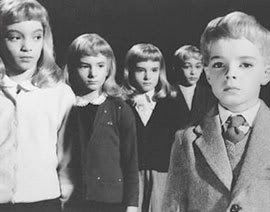
I was thinking about "movies for the damned" this past Tuesday when TCM aired Voyage of the Damned. My first thought was to recommend the campy 1977 post-apocolyptic movie Damnation Alley, but despite the icon on IMDb listing DVD availability, it's not on DVD. Instead, I'll have to recommend another sci-fi classic that is available on DVD, the original 1960 version of Village of the Damned.

The movie starts out with a calm, idyllic village somewhere in rural England. One afternoon, something happens and everybody is knocked unconscious. The military is brought in to investigate, but before they can figure out what happened, everybody wakes up again. All returns to normal, until it's discovered that all the women of child-bearing age were knocked up -- a good term here since husbands like Prof. Gordon Zellaby (George Sanders) were impotent, while other boyfriends were away with the merchant marine, leading to the natural questions about how some of the women got pregnant.

Once the kids are born, they start developing faster than normal, and eventually develop into perfect little Aryan-looking hellraisers with superhuman intelligence, as well as the power to read -- and manipulate -- minds. The obvious question than becomes what to do with the kids -- especially since it's been determined that there were other similar groups of kids, and they all had to be destroyed. The British military wants to kill them; Prof. Zellaby wants to study them in the name of science. Matters eventually come to a head when it's discovered that the kids are becoming able to read thoughts up in the air, and ask for a ticket out of town, where they'll begin to take over the world. Even Zellaby realizes the kids have to be killed. But how? After all, if he thinks about it, they'll be able to read his thoughts.

Village of the Damned is the sort of movie that shows just how important a good script is. Despite it being a science fiction movie, there are almost no special effects, with the notable exception of the children's eyes "glowing" when they start to manipulate somebody else's mind, and even that isn't a very expensive effect. Because of the story, however, Village of the Damned is an outstanding movie, one that is intelligent, and, like the films of Val Lewton, expects the viewer to provide a good portion of the fear himself, by imagining what might be rather than being graphic and showing the horror. It's also in black-and-white, giving it a timeless quality that a lot of the color movies from the 60s don't have. Village of the Damned is better, and more chilling, than a lot of the stuff released today. One word of warning, though, it you want to see it on DVD: the movie was remade in 1995 with the same title; make certain you're getting the 1960 version.

Thursday, May 29, 2008

Ian Fleming centenary

Wednesday, May 28 marked the 100th anniversary of the birth of Ian Fleming, who is of course best-known for writing a series of books about James Bond, the British secret agent with the code name 007. A slew of Bond movies have been made, and the spy has become an icon unto himself, so it would certainly be fitting to discuss Bond on a blog about classic cinema. Since Frank Sinatra was The Man With the Golden Arm last night on TCM, I'll discuss a bit less gold (or more gold, as the case may be): Goldfinger

The story, of course, is fairly simple: Bond (played in this installment of the series by Sean Connery is asked to investigate a case of international gold smuggling. His investigation leads him to Auric Goldfinger (Gert Frobe), as well as a dastardly plan. Goldfinger doesn't plan to steal all the gold in Fort Knox; that would be too difficult. Instead, he plans to irradiate the gold, rendering it unusable and thereby driving up the price of the rest of the world's gold, a substantial portion of which he owns.

This third Bond movie really begins to show the hallmarks of the franchise. Whereas the previous movie, From Russia With Love was a taut suspense movie with a believable plot, Goldfinger clearly goes for action and a storyline that is clearly over-the-top with its unrealisticness. There's the blue humor with the names of the Bond girls (in this case, Pussy Galore played by Honor Blackman), and the dark humor. In the famous scene pictured, Goldfinger is about to kill Bond with a laser slowly moving up towards Bond's private parts. Bond asks Goldfinger, "You expect me to talk?" Goldfinger responds, with a sinister laugh, "No, Mister Bond. I expect you to die!"

It's a departure from the Bond books, and from the other spy movies of the 1960s. Where movies like The Spy Who Came in From the Cold and The Quiller Memorandum show the legacy of film noir by being dark, gritty, and brooding, the Bond movies, starting with Goldfinger, veer towards the generation gap territory by becoming campy and eminently parodiable. The bad guys would become bigger -- compare bowler-throwing Oddjob in Goldfinger to Richard Kiel's Jaws in Moonraker, and the plots would too: the movies ended up in increasingly exotic locales (and outer space), with outrageous ideas like mass hypnoisis, diamond-based space rays, and multiple trips to outer space. (And I haven't even gotten into crossing the Iron Curtain in a cello case.) The series is still going, but the early movies are the best. The movies, being as popular as they are, get sold to commercial TV channels because they can spend more money on the rights. But if you want to watch them commercial-free, they've naturally been released to DVD: they're a big money-spinner, after all.

Wednesday, May 28, 2008

Frank Sinatra vs. Cliff Richard

If you've been reading this blog for any length of time, you'd realize that I grew up in the 70s and 80s, and enjoy making references to some really lousy music. Those of you who remember the train-wreck-of-a-movie Xanadu may remember that, stuck in amongst the symphonic rock of the Electric Light Orchestra, was a duet between star Olivia Newton-John and the quintessentially British singer Cliff Richard: "Suddenly". Someday I might blog about Xanadu, but I make the bad music pun because overnight tonight, ie. at 3:00 AM ET on May 28, TCM are airing the Frank Sinatra movie Suddenly.

Sinatra comes late to the movie; we first see 50s B-movie stalwart Sterling Hayden as Todd Shaw, the sheriff in Suddenly, California. He's approached by the Secret Service: the President is taking a fishing trip, and his train is going to make an unexpected stop in Suddenly so that he can disembark and get into a car that will take him to his final destination. It's up to Sheriff Shaw to get everybody away from the President and the train station, without letting anybody in on the fact that the President is coming to town.

Of course, the bad guys already know the President is coming to town. They're led by John Baron (played by Frank Sinatra), and they're casing the town for the best place to shoot at the president. That, of course, is obvious: it's a house on a hill owned by "Pop" Benson (there's wonderful character actor James Gleason in yet another role), who just happened to be a Secret Service agent before being shot in the line of duty. He lives there with his widowed daughter-in-law (played by Nancy Gates), who just happens to be in love with the sheriff. Naturally, Baron and his gang force their way in, taking the Bensons hostage, and eventually taking the sheriff hostage as well when he shows up -- he too realizes that the Benson house is the obvious place for any bad guy snipers to shoot at the president.

Suddenly is a pretty good "B" thriller (despite having a star like Sinatra, it's got all the trappings of a "B" movie), and it's available on DVD. Apparently, Sinatra had it pulled from any sort of distribution after John F. Kennedy was assassinated, and it must have fallen into the public domain, allowing those with prints of it to sell copies themselves. (The only print I've ever seen is pretty lousy; let's hope TCM have access to something better.) The one upside to this is that you should be able to find a DVD of a good movie for a very small price.

edited to correct the time Suddenly is airing

Tuesday, May 27, 2008

Sydney Pollack, 1934-2008

Sydney Pollack, 1934-2008

Pollack directed a whole host of movies, from The Slender Thread, in which Sidney Poitier plays a volunteer for a suicide hotline who gets a call from Anne Bancroft, and has to keep her on the line; to
Out of Africa, the movie which won him his only Oscar for Best Director; and even the treacly
The Way We Were, in which Barbra Streisand and Robert Redford love each other from the 1930s to the 1950s.

The movie I'd like to mention, however, is Tootsie, since it has a connection to those of us here in the Catskills. You know the story of Dustin Hoffmann's character dressing up as a woman to get an acting job, but having to keep this from everybody, including the fellow actress (played by Jessica Lange). with whom he (while acting as a woman) develops a friendship. Lange takes Hoffmann upstate to see her father (Charles Durning), who's fallen for the actress. Many of the upstate scenes were filmed at the Hurley Mountain Inn, a downscale restaurant that well captures the blue-collar nature of Durning, who would be horrified to find out that the woman he's fallen in love with is, in fact, a man. Other than the curiosity factor of seeing the location where the Tootsie scenes were filmed, however, I don't know that the Hurley Mountain Inn would have that much interest to movie buffs; the patrons are more likely to be down-to-earth types like the Thelma Ritter character in The Mating Season than they are to discuss which of Sydney Pollack's films is their favorite.

There's also a secondhand personal note for me on Tootsie; my uncle (since deceased) managed a theater and got to spend some time on the set when it came to the Catskills, even getting to meet Jessica Lange. My grandmother probably had the most interesting reaction, asking, "Who's Jessica Lange?"

As of this writing, I haven't seen any announcement from TCM of a tribute to Pollack.

Monday, May 26, 2008

Manhattan Transfer

A remarkable movie that I had never even heard of, until it aired about a month ago on the Fox Movie Channel, is being repeated, as is Fox's wont, at 6:00 AM ET on May 27: Tales of Manhattan. Directed in 1942 by French exile Julien Duvivier, Tales of Manhattan is an anthology movie, telling several stories framed by a formal topcoat, and the several people into whose hands it falls, both figuratively and literally.

As is the case with anthologies, the stories are uneven, with some only good, and others outstanding. The happy side of this, however, is that if you don't like the current story, wait ten minutes, and you'll get another story. A brief synopsis of the seven stories:

1. Charles Boyer is having an affair with Rita Hayworth behind the back of her husband Thomas Mitchell;
2. Henry Fonda helps his friend Cesar Romero by claiming a love letter to Romero is actually for him; Ginger Rogers falls for the ruse and falls for Fonda;
3. Charles Laughton gets the chance to conduct the concerto he wrote;
4. Edward G. Robinson, a disbarred lawyer living at James Gleason's mission, goes to his 25th reunion, where he's discovered by George Sanders;
5. W.C. Fields plays a teetotaler pushing the benefits of coconut milk -- not knowing that Margaret Dumont's husband has spiked it;
6. J. Carroll Naish plays a casino robber;
7. Paul Robeson and Ethel Waters are sharecroppers who share the $41,000 Naish robs with their preacher, Eddie "Rochester" Anderson.

As you can see, Tales of Manhattan has an all-star cast (and I haven't mentioned a few character actors who show up in the framing stories). Perhaps the best of the stories are two in the middle. Charles Laughton's composer is a struggling one; at the opening of his story he's working as a pianist in a jive joint, playing popular music instead of the serious music he'd like to compose. Indeed, every time the boss turns his back, Laughton tries to play the songs with a more classical-styled arrangement. Watching this, along with the extremely expressive faces that Laughton makes in the bar and later, as his big chance seems to go sour, is a joy.

Edward G. Robinson's story is also excellent; he's a disbarred lawyer who needs the topcoat to be able to go to his reunion, and when he gets there, you can see it's clear that he doesn't want to disappoint his classmates by their finding out the truth about him -- despite the machinations of Sanders, who is wonderfully slimy, eight years before Sanders played the similar schemer Addison DeWitt in All About Eve.

The Naish segment might be the weakest of the bunch, in part because it's too short to have much of a story line, and in part due to the lack of star power. Other reviewers suggest that the Henry Fonda/Ginger Rogers love story is a bit weak, too. It's a straight up comedy, something which Fonda didn't do much of during his career. Usually, when he was in a comedy, he tended to play the foil and let others around him be funny, as in Yours, Mine, and Ours. (Yes, I know he was in Preston Sturges' The Lady Eve, but that's an exception.) Fonda isn't that bad, but the humor is often forced, and it's a "comedy of lies" (in that a little white lie leads to bigger and bigger cover-ups that are supposed to be the basis of the humor) that generally rubs me the wrong way.

Some may find the final segment uncomfortable, since it does come close to verging on racial stereotyping, much more so than when Anderson and Waters were together in Cabin in the Sky.

One final note: if you look carefully, you'll see that W.C. Fields isn't in the credits. That's because his sequence had been cut from the movie at one point, only to be added back in in the restored version.

Sunday, May 25, 2008

Silly love songs

Some people want to fill the world with silly love songs
And what's wrong with that?


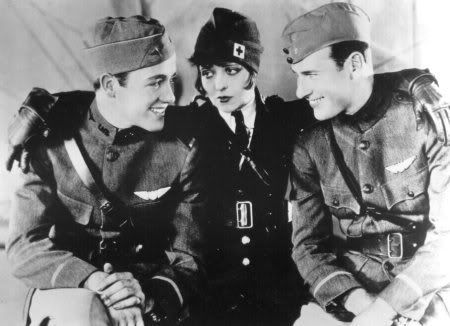
That would be a good way to introduce Wings, if we were talking about the musical group led by Paul McCartney, and not the first movie to win the Academy Award for Best Picture. Actually, though, there is a silly love story in the movie, which is airing on TCM at 6:00 AM ET on Memorial Day, May 26.

Buddy Rogers and Richard Arlen star as a pair of young men in a small American town in the days leading up to America's entry into World War I. The only thing is, both of them are in love with the same woman, played by Jobyna Ralston (whom you might remember as Harold Lloyd's girl in The Freshman). It's too bad that they both want Ralson, since either of them could have had the lovely Clara Bow as well. Indeed, after the two of them head off to France to fight in the air corps, Bow follows them as a member of an ambulance crew.

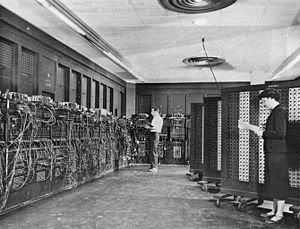
So much for the love story; Wings is really about the flying that the men do in the war. Director William Wellman had himself fought in World War I as part of the Lafayette Escadrille, and knew what dogfight scenes should look like. The only problem for him is that this was 1927. There was no way the fight scenes could have been done using CGI, as Eniac was still almost 20 years from being invented. I suppose he could have done it with punchcards, but that would have taken computing power several times the size of the Empire State Building. (Wait a minute -- the Empire State Building hadn't been built in 1927 either.) Not being able to resort to modern techniques, Wellman had to do things the old fashioned way -- real people flying real planes with camera bolted to them, all the way up in the air. And the two male leads, Rogers and Arlen, flew their own stunt flights. When you see them on screen, they're really several thousand feet up in the air. Indeed, Wellman got a lot of help from the Army Air Corps, but even then, Wings was still a difficult picture to make, as some of the pilots crashed and died during the filming.

That dying during flight training is something to watch for: there's a bit part for a man who is more of a flight veteran than the two leads but who gets killed during a training exercise. That bit part is played by none other than a young Gary Cooper, who steals the scene he's in. Other stalwarts appearing in the cast are vaudvillean El Brendel as a German-American who wants to fight for his adopted country, but, unable to make the grade, has to find other ways to support the cause; Roscoe Karns, whom you might best recall as the annoying Mr. Shapely who bothers Clark Gable and Claudette Colbert on the bus in It Happened One Night, and a bit part for Hedda Hopper as Buddy Rogers' mother.

Wings isn't readily available on DVD, and is one of those movies that really should be given a good DVD release here in the US. It's an important piece of cinematic history, and even without the Oscar trivia, is a fine movie.