Friday, October 31, 2008

Tod Browning


Tod Browning on the set of Freaks

I forgot to mention Tod Browning yesterday as one of the great horror directors, and a couple of his movies aired this morning. First, there was Freaks, the movie looking at the world of circus sideshow members, and how they're thinking, feeling human beings just like the rest of us.

Freaks was followed by The Devil-Doll, in which Lionel Barrymore plays a wrongly-convicted prisoner who esacapes and, having learned from a mad doctor the secret of shrinking people and taking away their free will, devises a plan to shrink people, make them his slaves, and use them to get back at the people who framed him! The movie also stars Maureen O'Sullivan

Browning isn't known so well today, for a couple of reasons. First, he did a lot of his work during the silent era. Movies like The Unkown (with a young Joan Crawford) show up on TCM's "Silent Sunday Nights" from time to time, but silent movies don't get the attention nowadays that talkies do. The bigger reason, though, is that once Browning started making talking pictures, he made some films that were highly controversial, including both Freaks and The Devil-Doll. The humanization of the various sideshow characters in Freaks, combined with the fact that they're portrayed as having the same traits as regular people, must have been shocking for audiences even in the pre-code era. I can't imagine Browning having gotten away with some of this stuff after they started enforcing the Production Code, and that may be part of the reason Freaks was officially out of circulation for years. As for The Devil-Doll, Tod Browning doesn't receive on-screen credit for having directed this.

Happily, both movies are available on DVD for you to watch any time you wish.

Thursday, October 30, 2008

Cat People

With tomorrow being Halloween, TCM are airing an entire day of horror movies -- actually, two days, since they started off this morning. One of the great producers of horror movies was Val Lewton, who is responsible for RKO's great B-movies of the 1940s. Perhaps his best horror movie is airing tomorrow on TCM at 7:30 AM ET: Cat People.

Kent Smith stars as an engineer who meets an artist from Serbia played by the lovely Simone Simon. Unfortunately for her, she comes from a village that is believed by its inhabitants to be subject to a curse: some of the people in the village turn into cats. And, needless to say, she's one of them! Still, boy marries girl, although we know fully well it's going to have tragic consequences.

What Val Lewton was so good at, partly by necessity, was in making the horror based on what is unseen; what we imagine based on the fears in our own minds. Sure, we see some big cats, but they're in cages at the zoo; we don't see any trick photography turning Simone Simon into a cat. We do, however, hear the cat, in one particularly frightening scene involving the "other woman" -- one of Smith's co-workers whom Simon fears is having a relationship with him -- trying to escape from the cat. The other woman escapes into a swimming pool, but we get to see her fright when she sees a shadow of the cat on the wall and hears a cat's roar. It's tame stuff for 2008, but it shows that we don't need to see the blood and gore in order to be frightened.

As I said, it was in part out of necessity that Lewton used the techniques he did. RKO gave him very small budgets, so he couldn't use the effects that the better studios would have been able to use on their prestige movies. This leads to some imperfect production values on the one hand, but also an inventiveness that makes the movie sparkle. It wouldn't be quite the same if we could see everything perfectly polished.

Cat People, and Val Lewton, aren't so well remembered today, and that's a shame. Thanks to TCM, though, we get to see his excellent work at Halloween. And thanks to modern technology, you can watch it any time you want on DVD.

Wednesday, October 29, 2008

The joy of sex

You might not have seen the reports on the death of director Gerard Damiano, who died recently at the age of 80. You might not even have heard of him before now. Yet, he directed a movie with one of the most well-known titles: even if the vast majority of us have never seen Deep Throat, we've all heard of it. Yes, if you didn't know by now, the name of the informant in the Watergate scandal got his name from a porno movie. Hollywood doesn't want to talk about it, but adult movies have been one of the enduring staples of the film industry, if not the one that actually makes the most pictures. Even though Hollywood has itself always been using sex to sell its movies -- after all, look at some of the pre-code movies, and the fact that it was the sexuality of these movies that went a long way toward the strict enforcement of the Production Code -- they seem to want to consider themselves "above" adult movies.

Consider the movie Zack and Miri Make a Porno. I've only seen the promos, and don't intend to see the movie, largely because I hate going to the local sixtyplex. It sounds like a fairly dumb comedy about two people in financial difficulty who decide to try to make the money they need by making a porno movie. Such a plot could be good, but I don't expect Hollywood to do anything but go for the lowest common denominator. But what I find fascinating is that while the original commercials gave the title in full, as Zack and Miri Make a Porno, the ads I've seen in the past few days are simply calling it Zack and Miri. Go figure.

Zack and Miri Make a Porno originally received a rating of NC-17 from the MPAA. This rating only came about in the early 1990s, thanks in no small part to the adult movie industry. Of course, before there was an NC-17 rating, the movies with too much sex got an X rating. Purveyors of porn took this as a badge of honor, in many cases advertising their movies as being "XXX-rated". Hollywood felt that there were apparently movies out there that were completely unsuitable for kids, but had nothing to do with porn, and so, to try to distinguish that tiny group of films, they came up with the NC-17 rating. Again, go figure.

Tuesday, October 28, 2008

Billy Wilder night

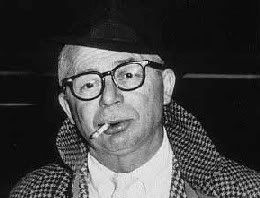
Head shot of Billy Wilder,

TCM are showing a bunch of movies directed by Billy Wilder in prime time tonight, but what might be most interesting is the documentary that precedes the movies: Billy Wilder Speaks, at 6:45 PM ET. This programs revolves around a series of interviews that the filmmakers did with Wilder in the 1980s, both in English and Wilder's native German, interspersing the interviews with clips from a bunch of his famous movies. It's always nice to hear the moviemakers in their own words, and I usually enjoy programs like this as much as I enjoy the Private Screenings interviews, or the old The Men Who Made the Movies programs originally made back in the 1970s that show up on TCM from time to time.

For the record, the Wilder movies TCM is showing tonight are all from the 1950s:

Sunset Blvd., in which Gloria Swanson declares that she is big -- it's the pictures that got small -- at 8:00 PM;
Ace in the Hole, at 10:00 PM;
Sabrina, at midnight on Wednesday (that's still late Tuesday evening for people not in the Eastern Time Zone);
Witness For the Prosecution, at 2:00 AM Wednesday; and
Some Like It Hot, at 4:00 AM Wednesday.

(Please note that Some Like It Hot is listed as having a 121-minute running time, while TCM claim the first movie Wednesday morning begins at 6:00 AM ET. If you set your recording device to catch Some Like It Hot, add a few minutes to the end.)

Monday, October 27, 2008

Alas, poor Carole

Tonight is the last night of TCM's October Star of the Month salute to Carole Lombard, and it's only fitting that the night should start off with her final film, To Be or Not To Be, at 8:00 PM ET.

Lombard stars as Maria Tura, the wife in a husband-wife pair of actors in the Poland of 1939. Her husband, Joseph, is played by Jack Benny. Together, they plan a great new triumph satirizing the Nazis in neighboring Germany -- until those darn Nazis invade and conquer Poland. The poor Turas are relegated to doing their stock Shakespeare. Meanwhile, a young pilot in the Polish air force, Lt. Sobinski (played by a young and virile-looking Robert Stack), goes to the Turas' theater every night to watch Hamlet. He does this because he's in love with the lovely Maria, and every night when Joseph starts Hamlet's famous "To be or not to be" soliloquy, Sobinski gets up from his seat to go see the object of his affection.

The Nazis' invasion, of course, scuppers all these plans, and Lt. Sobinski flees the country in order to go to England and fly with the Polish military-in-exile. One day, he's asked to smuggle into Poland a scientist who's part of the Polish Resistance, but he believes that the scientist is actually a double agent working for the Nazis, as this man has no idea who a famous actress like Maria Tura is. As a result, Sobieski ends up parachuting into Poland himself to meet the Turas, and get them to apprehend this man.

What happens next is sheer comedy. Naturally, the Turas have no idea how the brutality of dictatorships works, which should lead to their slipping up and letting the whole big secret out. Instead, their actions turn the exercise into such a big farce that the Nazi authorities, paranoid as they are, don't have any idea whom or what to believe.

Ernst Lubitsch directed, and was outstanding at comedy. It helped, however, that he had a cast that was equal to the task of making Lubitsch's vision work on screen. Lombard, of course, was a master of the screwball comedy, and goes through the movie effortlessly, but in no way implying that she doesn't care about the material. Jack Benny did more of his work in radio, and later television, but he was good at movies too, probably getting the best line: during a rehearsal of the Turas' Nazi satire, Benny is playing Hitler, and when he walks into the room, the rest of the cast gives the Nazi salute and says "Heil Hitler!" Benny's response? "Heil myself!" Even Robert Stack does OK here, even though he's not somebody you'd think of when you think comedy. There's also a great supporting cast, with often seen names such as Lionel Atwill, Felix Bressart, and Sig Ruman.

To Be Or Not To Be is one of the underrated comedy classics, and is not to be missed.

Sunday, October 26, 2008

Laughing at the past again

One of the fun things about watching classic movies is seeing people say or do certain things in the past that not only no longer hold true; but are very far off base. A classic example of this would be a lot of the movies that are set in the future, but were made long enough ago that what was then the future is now the past. The 1930 movie Just Imagine, for example, is set in the distant future... of 1980! Needless to say, most of the predictions were nowhere near accurate.

But there are also some funny things in documentary pieces. Today, for example, TCM showed one of the Traveltalks shorts, Around the World in California. In one of the scenes, they showed a bunch of cyclists taking a guided tour of Beverly Hills, and the dulcet tones of James A. FitzPatrick intoned, "There is never too much traffic...." Yeah, right. Just imagine these cyclists on the streets of Los Angeles County now. (By the same token, last week showed Mighty Manhattan, New York's Wonder City, with a sequence of where the UN building was then going up. The East Side parkway had shockingly little traffic.)

Later, we learned about some of the ethnic communities of Los Angeles. First, FitzPatrick used a hard 'g' here, something I don't think I've ever heard in contemporary English. (Bob Cummings also uses it in Saboteur.) More humorous, however, is the comment that Los Angeles has a population of "several thousand Mexicans". That had to have been wrong even 60 years ago, considering that Spain owned the place for a few centuries, and Mexicans have always been emigrating north of the border.

Thank goodness TCM shows some of these warped time capsules.

Kiss of Death

A few days back, I mentioned that the Fox Movie Channel's web site had a glitch that prevented me from noticing Richard Widmark's Kiss of Death was airing that day. According to my box guide, it's coming up twice this week, at 2:00 PM ET today, and at 2:00 PM ET on Wednesday, October 29.

Saturday, October 25, 2008

Who wants to be a pervert?

Karlheinz Böhm
Karlheinz Böhm in Peeping Tom

One of tonight's featured movies on TCM is the very interesting, and somewhat controversial, Peeping Tom, airing at 10:00 PM ET. Directed by Michael Powell, Peeping Tom tells the story of cinematographer Mark Lewis (played by Karlheinz Böhm) who has some secrets in his life. In addition to working for one of the London film studios, he's got a second job as a porn photographer, and a hidden interest on top of that: he rapes women and kills them, filming it all. It is this hidden interest that we first see at the beginning of the movie, and I can only imagine how shocking it must have been for movie audiences back in 1960 when the movie was made.

Unfortunately for Mark, his life is closing in on him in more ways than one: first, the police are naturally investigating the work of a serial killer, and slowly but surely, they're going to catch Mark. Perhaps worse for him, however, is that a young woman who is one of Mark's housemates (named Helen, and played by Anna Massey) has fallen in love with him. It's here that we begin to learn why Mark has turned out the way he did. His father was a scientist, performing experiments on him, and filming the results. Actually, he wasn't just filming the results; he was filming every aspect of poor Mark's life. It's easy to see how this could warp poor Mark's mind. Helen seems horrified but thinks she still loves Mark, while her mother has other ideas. The mother is blind, but she's one of the smart blind, able to see what other people can't see; although she can't see what's on those reels of film Mark is keeping in a spare room, she's figured out he's up to no good.

As I mentioned briefly above, Peeping Tom, in its presentation of a whole host of uncomforable topics -- rape, murder, and voyeurism just to name three -- was shocking for its time. Despite Michael Powell's fame, the movie shocked critics so much that the reviews were poor, and the British Board of Film Censors ordered quite a few cuts to the movie. It also made it impossible for Powell to get anybody to finance movies for him.

Friday, October 24, 2008

TCM's new intro


TCM have been running a promo between movies claiming that we bloggers and other social networking types can embed our favorite movie clips on our sites thanks to the TCM Media Room. With TCM finally having introduced a new primetime introduction, I figure that now would be a good time to try it out. If it works, you should see a link to the new intro.

As for the intro itself, I'm a bit ambivalent about it. The onld one with the fanfare was almost iconic, and elegant, harkening back to the days of the movie palaces in a way the new one doesn't really do. But the new one looks fresh and in keeping with the rest of the new graphics package, which isn't too bad. The new look for the trailers, in which the "screen" showing the trailer is a head-on view, is much better than the previous one, which used billboards that were at an angle.

I could go either way on the afternoon opening. TCM's previous intro during the afternoons was of a band box, which frankly didn't have all that much to do with the movies. The new one doesn't have much to do with the movies either, with people on an el train not necessarily going home to watch movies.

And as for the morning promo, TCM used to have "The Sunny Side of Life" as the theme. It was memorable, although in some ways not entirely appropriate: do you really want to play Look for the silver lining.... before a movie like The Lost Weekend? The new intro in the mornings has a big advantage in that it's acrually evocative of mornings, in its montage of daybreak and heading into work. On the other hand, the bluesy music does not, at least in my opinion, fit in as well with the early morning.

I wonder how long it will be until TCM change the montage of clips that open Silent Sunday Nights.

Thursday, October 23, 2008

The art professor vanishes

Tonight at 8:00 PM ET, the Fox Movie Channel is showing the 1976 comedy Silver Streak. It's a wonderful homage to the railway movies of the past, as well as the Alfred Hitchcock suspense movies.

Gene Wilder stars as George Caldwell, an editor taking the train from Los Angeles to Chicago just to get a few days' peace. In the compartment next to his, he meets Hilly Burns (played by Jill Clayburgh), secretary to a noted but reclusive art historian. The historian has just written a biography of Rembrandt that will have some revelations about which of Rembrandt's works are authentic and which aren't, and there are apparently other people on the train who know this as well, and are out to get the man. Caldwell discovers this when, during foreplay with his new lady-friend, he sees her boss falling off the roof of the train.

Or does he really see it? Naturally, nobody believes him, except of course for the bad guys, who know what the truth is -- and they have no interest in telling him he's onto something. Still, they (in the form of Richard Kiel, the man who played Jaws in two of the Bond movies) literally throw Caldwell from the train, and this is where the fun really begins, as Caldwell finds himself teamed with an old lady rancher trying to help him get back on the train.

He gets on again -- and off, thanks to another dead body, and not getting any help from the local police, Caldwell gets help from a petty thief played by Richard Pryor. After all, he's got nothing to lose, already being a criminal. One of the best scenes in the movie involves Pryor trying to help Wilder evade the police, who are at the train station looking for him. Pryor helps by having Wilder disguise himself in blackface! Wilder, of course, has no rhythm, which is what makes the scene so funny.

The story itself is more than adequate, but it is the relationship between Pryor and Wilder that is the highlight of the movie. They have excellent chemistry, and impeccable comedic timing together, in the rich tradition of Hitchcock's black comedy. The movie, however, is a more modern movie, as evidenced by the sex and bad language, which really make it unsuitable for the kids. Adults will enjoy it, though, and not only for the pairing of Wilder and Pryor. The supporting cast includes several names we've all seen before, including Patrick McGoohan as the bad guy; Scatman Crothers as a train porter; and people like Ned Beatty, Fred Willard, and Ray Walston. The score, by Henry Mancini, is not so much memorable as it is thoroughly evocative of the 1970s, and fits the movie like a glove.