Showing posts with label Fredric March. Show all posts

Tuesday, October 8, 2024

Before the foxes were even little

I did a post on the movie The Little Foxes some time back. Some years late, Lillian Hellman wrote a play that was a prequel to The Little Foxes, called Another Part of the Forest. It's unsurprising that the play would get turned into a movie, and it's one I'd been curious to see for some time. Several months back, TCM finally ran it, and I recently got around to watching it to do a post on here.

The Little Foxes tells the story of the Hubbard family in a small town in Alabama circa 1900. As Another Part of the Forest opens, it's Confederate Memorial Day in the year 1880, so 15 years after the war ended. Col. Isham leads the entire town -- well, almost the entire town -- in remembering their defeat, specifically a massacre of local boys that Isham just knows someone local had to clue the Union Army into, at the local war memorial, and watching from the nearby woods is Lavinia Hubbard (Florence Eldridge), the matriarch of the Hubbard family. I metioned that almost the entire town is there. Conspicuously not there are most of the Hubbards. Oscar (Dan Duryea, who in the earlier movie played Oscar's son) shows up, but Isham tells him he's decidedly not wanted. This especially because he cavorts with a dance-hall girl.

Oscar's brother Ben (Edmond O'Brien) comes to town having been in the big city, where he was hoping to invest some money. But he was called back home by his father, Marcus (Fredric March), who runs the local dry goods store with an iron fist. Dad was ruthless in making his fortune, and he thinks that all of his kids are varying sorts of weak, and doesn't necessarily care for any of them. As for Lavinia, she seems to think the family has some sin to atone for, as she shows up at the Confederate memorial statue talking about taking some of the family fortune and using it to start a local hospital.

Rounding out the family is daughter Regina (Ann Blyth). She's been carrying on with a rather older man, John Bagtry (John Dall), who was injured in the war and who still hasn't gotten over it. Regina is hoping he'll marry her and take her away to Chicago to get the heck away from the rest of her family. Ben thinks she should marry one of the richer guys in town, but Regina is having nothing to do with that. Indeed, she's perfectly willing to use her brothers' secrets to try to get Dad to do her billing. It's clear that nobody in the family loves one another, with the exception of Lavinia. But then Lavinia is the sort of woman who, in that era, might have been a candidate for a sanitarium, if only for the rest of the family to keep her silent.

Lavinia reveals what she knows of the family secrets, which is that Marcus made the family fortune by smuggling salt during the war and then selling it at inflated prices. That too explains why the rest of the county seems to hate the Hubbards. But there's a lot more in the way of secrets, and as the family bicker with one another, those secrets are about to come out.

I mentioned at the beginning that Another Part of the Forest was based on a stage play, and once again those origins seem fairly clear. Another Part of the Forest, however, is helped by a bunch of fine performances, as well as a script that while not great, is so overripe that it makes the movie fun. The movie winds up being good, although probably not for the reasons Lillian Hellman would have wanted.

Saturday, December 30, 2023

Bedtime Story

We're getting to the end of the year, so I'm doing a couple of posts on movies that are about endings in one way or another. First up is Bedtime Story, which isn't really about bedtime at all.

The movie opens up with the end of a stage play, like quite a few movies dealing with theater actors (The Guardsman comes to mind here). The stage star here is Jane Drake (Loretta Young), getting rapturous applause for her latest role. As she gets her curtain call, she informs the audience that it's the last time for her to play that role, and indeed it's going to be the last time the audience will see her in any role, as she's going to be retiring to a farm in Connecticut with her husband, Lucius "Luke" (Fredric March), a playwright who wrote the play.

Sadly, Luke was not able to make it to the final performance, and we quickly learn it's because he had different ideas about the direction his, and by extension Jane's, career was going to take. Luke has been working on a new play, and it goes without saying that he wrote it with the intention of giving Jane another big role to star in. Not only that, but he's hoping to build a new theater on Broadway just for Jane. Jane, however, is horrified when she learns that the money for the new theater is coming from Luke's having sold the farm in Connectict. Her response is to take a train to Reno to do the several weeks of separation necessary to be able to file for divorce.

Luke still wants to do the new play and wants Jane to star in it. With that in mind, he fakes a story about having lost it to one of those newspaper gossip columnists, knowing it will be printed in Reno. Sure enough, Jane returns, but she learns that it was all a ruse to get Jane to come back and do the play when the couple's best friend Eddie (Robert Benchley) comes to their apartment with a new young actress, Virginia Cole (Eve Arden), who would be just perfect for that starring role if it weren't for Jane. So Jane heads back to Reno.

Meanwhile, Jane had an old flame in the form of a banker, William Dudley (Allyn Joslyn), who was always in love with her and still is. So he shows up in Reno to try to start a relationship with Jane again. Eventually, Luke also shows up in Reno to try to get Jane to come back to him and do the play. There's still the question of whether all the conditions necessary to obtain the divorce have gone through, leading to the mildly madcap ending....

Bedtime Story had the great bad luck of being made in 1941 and not being released until Christmas 1941, three weeks after the attack on Pearl Harbor that brought the US into World War II. The movie fits very well into the genre of the more upscale romantic comedy, but audience tastes were changing with the US now being at war. That, and the story here had been done enough that in Bedtime Story it's beginning to feel formulaic.

That's not to say that Bedtime Story is a bad movie by any stretch of the imagination. It's well made, and March and Young show that both of them can do comedy. Of course, having support from people like Benchley and Arden is a great help. It just feels like the movie could have been better and more original.

Monday, October 17, 2022

So Ends Our Night

TCM's daytime lineup for tomorrow is a bunch of movies starring Margaret Sullavan. One of them is a movie that was new to me when I first saw it on the TCM schedule a few weeks back: So Ends Our Night. I recorded it then because it sounded interesting, and since it's on the schedule for tomorrow at 5:45 PM, I decided to sit down and watch it to be able to do a review on it here.

Sullavan isn't the star here; that honor goes to Fredric March although the movie is somewhat more of an ensemble cast. March plays Josef Steiner, a dissident in Nazi Germany who's been forced to flee the country, leaving behind a wife Marie (Frances Dee in a tiny role), and leaving behind his passport. This means that Steiner is a refugee, and like many of the other refugees from Nazi Germany, unable to obtain work or legal permission to stay in whatever country he's fled to.

Steiner isn't the only one in this predicament; there are lots of Jews like Ludwig Kern (Glenn Ford in an early role) who at the start of the movie are in detention for having been picked up as illegal aliens. Sometimes they can get temporary work permits; sometimes they work under the table; but eventually they're found out and picked up by the police, being placed in detention until they can be deported into another country for the process to be repeated all over again. Nobody wanted them as refugees, in part because they were all recovering from the depression and had trouble creating enough work for the people who were born citizens of their countries.

It's around the end of 1937, a few months before the Anschluss in which Nazi Germany absorbed Austria, and Kern and Steiner have both been thrown out of Czechoslovakia into Austria. Steiner, only being a dissident, has a slightly easier time getting a false passport. Kern meets chemistry student Ruth Holland (that's Margaret Sullavan), who like Kern is Jewish and has fled Germany, studying chemistry where and when she can under a professor who himself is a fellow refugee.

Ludwig and Ruth are eventually found out and forced to leave Austria, this time heading for Switzerland, where they're able to hide for some time, although they're trying to make it to France since rumor has it that it's easier to get work permits there than in other European countries. (Obviously they wouldn't have known that the Nazis were going to overrun France in two years' time.) They do get to France, only to find out that it's not that much easier in France than anywhere else they've been. Steiner also makes it to France, which is where he gets a letter informing him that his wife is terminally ill back in Germany.

So Ends Our Night is another of those movies with an interesting premise. I mentioned quite a few years ago how Hollywood was for a long time unwilling to take on the issue of Nazi Germany's human rights problems, since Germany was still a big market for them. There was also the issue that a lot of Americans were still weary of the Great War and didn't want to get involved in another European war. Indeed, in the second half of 1941, Congress started hearings on the subject of those Hollywood movies that did dare to call out the Nazis, although of course those hearings would go by the wayside once the Japanese bombed Pearl Harbor. Most of the other movies that did deal with Nazi Germany either had westerners getting caught up in the country, or Nazi spies in America. Even The Mortal Storm didn't mention Jews.

So Ends Our Night is more unflinching, although it's in some ways unrelentingly grim, in that we get it after the second or third time the characters are forced back into hiding. The ending also seems unrealistically upbeat. But the main characters all give good performances, and as a look at how Hollywood tried to be daring before actually going to war with Germany, it's a movie that's absolutely worth a watch.

One note, however, and that's that the print TCM showed a few weeks back wasn't in the best of shape, being slightly wavy, almost as though whatever source material had been used for the transfer wasn't quite flat. It's not jumpy, but the scenes do have a sort of uncomfortable sway to them.

Tuesday, April 5, 2022

Melodramatic 1930s love triangle #58347205723806

Merle Oberon was one of the stars honored in Summer Under the Stars last year, which gave me the chance to DVR a movie I hadn't blogged about before, The Dark Angel. I probably should have watched it in March since it was shown again for 31 Days of Oscar thanks in part to Oberon's nomination, but I only got to it recently.

Oberon plays Kitty Vane, who lives in one of those English manor houses in the early part of the 20th century. She's got two best friends who have all known each other since childhood, Alan Trent (Fredric March) and Gerald Shannon (Herbert Marshall). With these three knowing each other more or less all their lives, it's unsurprising that they would wind up having romantic feelings for one another, or at least heterosexual romantic feelings, since there's no way they could have depicted Alan and Gerald being in love with each other. But while both guys like Kitty, Kitty loves Alan and only considers Gerald a close platonic friend.

And then the Great War comes, sending both of the guys off to fight. Both of them get leave at the same time, and when they get home, Alan decides he's going to propose to Kitty. Gerald accepts this, and Alan and Kitty think about having the marriage be as soon as possible. This would be doable with the ten days' leave he and Gerald have. But unfortunately, all leave gets cancelled just as Alan is going to get the marriage license. No vicar is going to be able to perform the ceremony before Alan has to go back to the front.

So at the other end of the railway line where the soldiers are going to depart for France, Alan and Kitty decide that they're going to spend the night together anyway, despite not being married. Lawrence, another soldier who knows Alan, Kitty, and Gerald, happens to see Alan in a compromising situation, and is a bit of a dick to Alan about it. You'd think Alan could just tell Lawrence that he's having dinner with Kitty, but the idea of an unmarried couple sharing a hotel room together is something their class of society would consider scandalous back in those days (see the later Merle Oberon movie The Divorce of Lady X).

Lawrence is enough of a dick that he lets Gerald in on the fact that Alan had somebody in his room with him, which leads to problems out on the front. Alan tries to put in for leave, but Gerald won't approve it because he thinks Alan has been dishonorable to Kitty. Instead, Alan winds up on one of those dangerous missions that could lead to his death, one that he in fact doesn't return from.

Gerald eventually returns to England and Kitty feeling responsible for Alan's death, more so when Kitty reveals it was she who was in the hotel with Alan that night. Worse, it turns out that Alan didn't die at all. He was only blinded by an explosion in the field and taken to a German hospital under a different name. After some time and with the war over, Alan is as well as he's ever going to be but still blind, and free to go back to England.

He takes the train to Kitty's home town, but decides not to get off because he doesn't want to be a burden. Instead, he goes to another town where he stays at an inn where the kids have never seen a blind person before. Alan treats the kids to some children's stories, which get written down and published under that different name. But you just know that eventually Alan's path is going to cross with the path that Gerald and Kitty are on. They've decided to marry, since Gerald always loved Kitty and they just know that Alan is dead.

If you like sappy 1930s melodramas, you're going to love The Dark Angel. It's well acted and the story certainly pours on the melodrama. If melodramas aren't your thing, then you probably won't care so much for it, since the characters make some pretty dumb (and dated) choices in their lives. Indeed, I don't think The Dark Angel is the sort of movie I'd pick if I were trying to get people not so interested in old movies into 1930s films. Better to pick a comedy or a drama with more of a payoff at the end like San Francisco with its depiction of the earthquake. But it's easy to see why audiences of the day would have flocked to The Dark Angel.

Tuesday, May 11, 2021

Merrily We Go to Hell

During last autumn's Women Make Film series on TCM, they unsurprisingly included Dorothy Arzner, one of the few women directing movies in the golden age of the Hollywood studio system. The film TCM selected, Merrily We Go to Hell, was recently released on DVD courtesy of Criterion, so I sat down to watch it and do a review.

Sylvia Sydney plays Joan Prentice, daughter of a canned-foods magnate (George Irving) who, at the start of the movie, is a guest at a penthouse party in Chicago. Also at the party is newspaperman Jerry Corbett (Fredric March) who, like a lot of newspapermen in the movies, is cynical and a heavy drinker. Jerry hits Joan with an elastic band, which leads the two of them to talk, and Joan to invite Jerry to her house the next day for a party.

Jerry shows up, eventually, being late in no small part because of that drinking. But still, for some reason, Joan falls in love with Jerry, while Dad tries to disabuse Joan of any notions of romance. He also tries to disabuse Jerry, to the point that when he's proposed to Joan her dad offers Jerry a large sum to break off the engagement. But Jerry says he's going to marry Joan and live on his money, not her father's. Of course, he can barely bother to show up to the engagement party, having passed out drunk on the way when his friend and drinking buddy Buck (Skeets Gallagher) tries to bring him. And at the wedding, Jerry has lost the wedding ring. Talk about an auspicious marriage.

Jerry decides that he's going to right the Great American Play, although it's not clear if he'd ever tried to write any stage work before getting married. He's a journalist, you see, so he should be able to write anything. Unsurprisingly, success doesn't come at first, until just as he's about to give up and a telegram comes from New York saying the play can be produced if Jerry comes to New York to make changes.

Those changes are because the lead actress, Claire Hempstead (Adrianne Allen), demands them, and it seems she's had a past with Jerry. Jerry, for his part, has gotten on the wagon to try to get this play produced. But having Claire around is enough to drive any man to drink, especially considering she seems determined to drive a wedge between Jerry and Joan. Joan decides she too might think about stepping out. Only after she finally leaves Jerry to return home to Dad do we learn that she's gotten pregnant, too.

Merrily We Go to Hell is interesting if predictable, helped out by being a pre-Code movie and two good performances from Sidney and March. Cary Grant shows up ninth-billed in a small performance, but that voice is still instantly recognizable.

There are other pre-Codes that I'd recommend first, but Merrily We Go to Hell is definitely worth a watch.

Wednesday, January 29, 2020

Smilin' Through (1932)


One of the TCM Spotlights in December was remakes, and one of the movies I hadn't mentioned here before is Smilin' Through, which has been done multiple times, although the one I DVRed was the 1932 talkie. (The sub-theme that day was movies with musical remakes, allowing TCM to show the 1941 version with Jeanette MacDonald and Nelson Eddy.)

Leslie Howard plays Sir John Carteret, who at the start of the movie is mourning the love of his life, a young woman named Moonyeen (Norma Shearer) who died tragically young many years earlier, back in 1868. We then see that she's a ghost, so there's some unresolved issue in her life/afterlife/death, however you wish to put it.

Cut to about 1897. Relatives Sir John hasn't seen in ages have died, and they left behind a young orphaned girl Kathleen. John takes her in, although he's continuing to mourn for Moonyeen. Fast forward many more years, to 1915, and Kathleen has grown up to be played as an adult by Norma Shearer, so of course John notices the similarity in Kathleen's and Moonyeen's appearance.

One day Kathleen is riding around and ends up at an abandoned estate where two friends show up: Kenneth Wayne (Fredric March), and his friend Willie. There's a war on over on the continent, and both of these young men are going to be fighting in it. But Kathleen falls in love with Kenneth anyway.

Unfortunately, there's a problem with her choice of romantic partners. When Sir John meets Kenneth, he realizes Kenneth looks exactly like his father Jeremy (also played by Fredric March). Jeremy was Sir John's romantic rival for Moonyeen, and when Moonyeen decided to marry John, Jeremy responded by killing Moonyeen on her wedding day. (It's more ironic than rain.)

This explains why Sir John has been so bitter all his life, and why he decides to be such a jerk to Kenneth and Kathleen. If Kenneth's father was a jerk, then Kenneth needs to be made to suffer for it, just so Sir John can be happy that he's utterly screwed somebody's life over. And if he has to screw his foster daughter too, oh well. Thankfully for everybody Kenneth goes off to France and suffers a serious injury that makes him not want to see Kathleen ever again because he stupidly thinks Kathleen is going to suffer by seeing him injured.

Smilin' Through might be a good movie, but it's not the sort of movie geared to somebody like me. It probably belongs on the Hallmark Channel or Lifetime Channel instead. The male characters had motivations that made me want to pull my hair out, while Shearer overacts shamelessly, going into ridiculous histrionics. People who want a romantic tear-jerker are going to love this one, as it does what it does quite well. It just wasn't my cup of tea.

So even more than some movies I don't like, Smilin' Through is definitely one that you need to watch for yourself and draw your own conclusions about.

Saturday, January 4, 2020

Anna Karenina (1935)


During the TCM Spotlight on remakes back in December, they included a day of literary adaptations, which seems like a slight cheat since it's so easy to do adaptations and, since all of them are remaking a book or play, they're not necesarily remaking a movie. But it gave TCM a chance to run two versions of Tolstoy's Anna Karenina. Recently, I sat down to watch the 1935 version.

Happy families are all alike; every unhappy family is unhappy in its own way. So begins the book, and the first of the unhappy families to be presented is the Oblonskys, with husband Stepan (Reginald Owen) having an affair with the children's governess, much to the consternation of Stepan's wife Dolly (Phoebe Foster). Dolly has a sister Kitty (Maureen O'Sullivan), who is going to be part of the general unhappiness, while Stepan has a sister Anna Karenina (Greta Garbo), who will be part of the major unhappiness of the movie.

Anna has visited Moscow to smooth things over between Stepan and Kitty, and while there she meets the dashing cavalry officer Count Vronsky (Fredric March). Vronsky has been toying with Kitty, who in her turn thinks Vronsky really loves her. The one who really does love Kitty is Levin, who lives out in the country which Kitty really doesn't want but winds up marrying him because there's nobody else for her.

Vronsky and Anna meet at a ball although they kind of know each other since Anna and his mother met on the train down to Moscow. Anna, you see, has a husband (Basil Rathbone) and son (Freddie Bartholomew) back in St. Petersburg. Still, Anna and Vronsky fall in love, even though it's bound to be a doomed relationship.

Thanks to Tolstoy's radical Orthodox Christianity, he's going to present a morality tale about how evil it is for a woman to step out on her husband; this is a perfect coupling for Hollywood's moralistic Production Code. There isn't any way Anna's husband Alexei is going to grant a divorce, even if Tsarist Russia had been as open about it as 1930s Hollywood (in real life) was. So Alexei says no, you can't have a divorce, and if you're not going to stop seeing Vronsky, you're out of the house and don't even get to see our son Sergei.

So Anna leaves to think it over and spend more time with Vronsky, who's got problems of his own. There's a war going on between Serbia (part of the fractious area between Austria-Hungary and the Ottoman Empire at the time) and the Ottomans. Russia ought to remain neutral, and the Tsar hasn't joined the war. But there are a lot of folks in the military who see the Serbs as their Slavic brethren against those heathen Mohammedans, so they want to form a volunteer regiment and fight in Serbia because reasons. Vronsky at first wants to spend time with Anna (although I don't understand how he was able to get enough of a leave of absence to go off to Italy with her), but pressure mounts on him to join that volunteer regiment.

You probably know how the story ends although I'm not going to reveal it here. This isn't a bad retelling of Tolstoy's sprawling novel. Tolstoy's novel, depending on the translation, clocks in somewhere between 800 and 1,000 pages, meaning that for any movie, there's a lot that's going to have to be left out. Thankfully, when MGM made this version a big portion of what was left out was Levin, who serves even more than all the other characters as a vehicle for Tolstoy to expound upon his views not just on Christianity, but on treatment of the peasant classes. It makes the novel a slog at times, and not having much of it in the movie makes the movie move at a much brisker pace.

This is also the sort of material that was right up MGM's alley in an era when they still had Irving Thalberg. The lush MGM style works here instead of causing the problems it would in other genres, although I did at times find the movie trying a bit too hard to dollop on Russianness and not always succeeding. Still, it's an entertaining primer to Tolstoy's source material, if you don't want to deal with all of Tolstoy's philosophy.

Several of the versions of Anna Karenina are on DVD, including this one which got a release courtesy of the Warner Archive.

Sunday, May 5, 2019

The miserables of 1935

One of my recent movie watches was the 1935 movie version of Victor Hugo's classic sprawling novel Les Misérables. It's available to watch on Amazon's streaming service but apparently out of print on DVD. But, since I need to free up more space on my DVR, I'm doing a post on it now.

Thanks to the 1980s musical and the movie adaptation of the musical, you probably know the basic story. Jean Valjean (Fredric March) is arrested during the French Revolution of stealing a loaf of bread to feed his starving family, for which he's punished with a long sentence as a galley slave. When he gets out, the only person who will give him lodging is the Bishop of Digne (Cedric Hardwicke), who is the first person to treat him well by not turning him in to the authorities for committing a crime.

Valjean goes to a town in the north of France where he comes up with a good way to make colored glass, making money for himself but more importantly making the whole town prosperous. They make him mayor, but this brings him to the attention of Émile Javert (Charles Laughton), a dogged police inspector who had seen Valjean once before during Valjean's incarceration. He suspects the mayor, and this ultimately causes Valjean to flee.

By this time, Valjean has come into the possession of a foster daughter Cosette (played as an adult by Rochelle Hudson), daughter of Fantine (Florence Eldridge) who had been fired from Valjean's factory because of rumors about her past. Valjean and Cosette go to Paris and when Cosette grows up it's time for the revolutions of 1830. This is how she meets Marius (John Beal). Javert is still on Valjean's trail, however.

This version of Les Misérables is not bad for what is essentially a Cliffs Notes version of the book, although to be fair with the original novel clocking in at well over a thousand pages, it's going to be tough to come up with any movie that doesn't cut a lot out, or else come up with something close to four hours as was done for Gone With the Wind. March is good as Valjean; Laughton is excellent as Javert. Beal is the weak link, wooden as Marius but then it would probably explain why Beal never made it to the top in Hollywood. This version also looks like it came straight out of 1930s Hollywood; nowadays the production values would at least look much more better.. On the plus side, this movie doesn't have the obnoxious shithead Gavroche.

I can certainly recommend the 1935 Les Misérables, although I wish it were on DVD too.

Tuesday, March 5, 2019

TCM Star of the Month March 2019: Fredric March

Posting is going to be a little lighter than expected this week, but I note that now that 31 Days of Oscar has finished for another year, we get back to the regular themes on TCM, starting with a new Star of the Month. This time around, it's Fredric March, whose films will be showing every Tuesday in prime time, continuing into the early hours of Wednesday morning.

The salute unsurprisingly kicks off with a lot of March's earlier works, such as his first Oscar for the 1932 version of Dr. Jekyll and Mr. Hyde, which is going to be on tonight at 9:45 PM. Also on tonight is the 1934 version of The Barretts of Wimpole Street, overnight at 1:30 AM. I've still got the 1950s version on my DVR, which I think ran for Ronald Colman's turn as Star of the Month or something. It's sitting unwatched because that version has, as far as I know, not received a DVD release.


Kicking off the March 12 prime time schedule is the 1937 version of A Star Is Born, at 8:00 PM


March won his second Oscar for The Best Years of Our Lives, which will be on at 8:00 PM March 19


Seven Days in May will run at 2:30 AM, March 27, part of the Tuesday, March 26 prime time schedule since TCM's day goes from 6:00 AM to 6:00 AM; it'll still be March 26 out in the Pacific time zone when this one starts.

Sunday, January 13, 2019

Hombre

A movie that FXM pulled out of its vault to show for the first time in years is Hombre. It's going to be on FXM tomorrow at 11:15 AM, again on Tuesday, and a couple more times next week.

The movie starts off in the mountains of Arizona, where some Apache who aren't living on the reservation are making a living rounding up horses for the stage company to use. Except that the stage line, run by Mendez (Martin Balsam), is going to be shutting down since the railroad is coming to town. Mendez wanted to see one of the Apache, too, except that this is actually a white man who was raised by the Apache. John Russell (Paul Newman) had a foster father in town, and Mendez informs him that Dad died and left him an inheritance. Perhaps this would be a good time to rejoin white society.

Russell learns that he's inherited a boarding house managed by Jessie (Diane Cilento) who lives there with her lover, the town sheriff Braden (Cameron Mitchell). It's not anything you'll get rich off of, but it'll provide a living. Except that Russell doesn't want to be burdened by it, so he plans to sell, and since the will made no provisions for Jessie, she's out of luck too.

Meanwhile, the Favors (Fredric March and Barbara Rush) show up at the stage line, looking for the next stage to Bisbee. Mendez informs them that the stage is closed, and nothing is available, but Mrs. Favor keeps insisting that she'll go to great lengths to make certain they get a stage and they're on it, even buying it and the horses if necessary. Eventually, Mendez relents. He and his assistant Billy are on the stage, along with Billy's wife, Russell, Jessie, the Favors, and Cicero Grimes (Richard Boone), who has wangled his way onto the coach by being a complete jerk.

Of course, Grimes has good reason for wanting to be on that stage, which is that he plans to rob it with the help of some men on the outside. He knows that Favor has a bunch of money on him. Favor, it turns out, is the Interior Department Indian agent who administered the Apache reservation, and has a whole bunch of money that he embezzled from underdelivering on the Apache's meat rations. He's planning to abscond to Mexico with that money. Russell, having been raised by the Apache and having seen what federal mismanagement did to the Apache, really doesn't like Favor.

But once the stage has been held up and the passengers are left there stranded, Russell is pretty much the only one who has any competence in getting everybody out of the situation alive. He's willing to set off alone, but the others at least have the sense to realize they need his help and thus follow him.

There's really nothing wrong with Hombre, although because of my predisposition against westerns, I'm sure that other people will rate it even higher than I would. I find it good, if not great, with a relatively slow build up: it runs 110 minutes and probably could have been done in 90. Newman is quite good, even if he in now way could pass as anything but white. Cilento also does well as a woman whose life experiences have inured her to the hardship of life in the old west: it's just the way things are that you're going to have to scratch and claw to make your way in life. Balsam is even more miscast as a Mexican but does the best he can, and Boone is thoroughly slimy and nasty.

Hombre is out of print on DVD as far as I can tell, so you're going to have to catch the cable showings. I recorded it off of StarzEncore Westerns, and their print had an oddity. The credits were in something close to the Cinemascope aspect ratio, although this one was filmed in Panavision. After the credits, however, the print is slightly less rectangular, but with an aspect ratio greater than the 16:9 (about 1.78:1) of today's TVs, since the print is still letterboxed. It just that the top and bottom bars are narrower than during the credits. The picture looked slightly less crisp on my TV, but I've also got a 10-year-old TV. I have no idea what the print FXM is using will look like.

Wednesday, July 11, 2018

The Hawk and/or the Eagle

Some time back I DVRed a double feature of World War I airplane movies off of TCM. I already blogged about Hell's Angels; the other movie was The Eagle and the Hawk.

Jerry (Fredric March) and Henry (Cary Grant) are a pair of trainees in the British air corps, or whatever it was called before the RAF. On one of their training flights together, Henry crash-lands their plane, much to Jerry's consternation. The result is that when the rota is prepared for the next round of reconnaissance flights, Jerry is one of the pilots, but Henry's name is nowhere to be found. Henry blames Jerry for this. Anyhow, Jerry flies his first mission, and it's successful, except that as part of the dogfighting with a German airplane, Jerry's observer (the man with his eyes to the ground doing the actual reconnaissance work) gets hit and during a loop-de-loop, falls out of the plane to his death. Jerry is none too pleased about it.

Jerry keeps flying missions, and he keeps having the terrible luck of losing observers, to the point that he loses five in two months. Attrition among the air corps is so high that pretty much any available hand is brought it, and that eventually means that Henry is back with the reconnaissance team. And he gets paired with Jerry, something which makes neither of them happy.

To be honest, I found The Eagle and the Hawk to be less of an action movie and a bit closer to a character study of two men who are turned cynical by the violence of war. Fredric March, unsurprisingly, is excellent in his role, as he had had more than enough opportunities over the course of his career to play men with hardened hearts. Grant, on the other hand, is usually remembered for much lighter fare, so it's easy to forget that he had a couple of hard-boiled men like his Henry. This is one of the movies that shows just how good of an actor Cary Grant was.

Adding to the cast is Jack Oakie as another pilot whose role in the movie is to provide the lighter moments. Carole Lombard gets fourth billing although she only has a few scenes when Jerry has leave in London. Even thouse scenes are well-handled, as Jerry has to face a kid who wants to see one of those pilots that people back home are putting on a pedestal. Jerry knows he's no hero.

The Eagle and the Hawk is available at the TCM shop both as a standalone, and in a couple of box sets.

Saturday, June 30, 2018

Anthony Adverse

One of those movies I had known about for a long time only because it's in those lists of Oscar winners is Anthony Adverse. I finally DVRed it the last time it showed up on TCM. It's going to be on again tomorrow at 11:30 AM, which was the impetus for me finally to get around to watching it.

Fredric March gets top billing, although he doesn't show up for quite some time. Instead, we get a long introductory sequence introducing us to Anthony and his backstory. In France circa 1770, Don Luis (Claude Rains) is the Spanish ligate to France, having just gotten married to Maria (Anita Louise). However, he's also busted his foot and has to go to the spa for a spa cure. Maria is perfectly happy for that, since this is an arranged marriage and she doesn't like her creep of a husband. She's been having a torrid love affair with Denis (Louis Hayward), one that results in her getting knocked up. Eventually, Don Luis finds out and kills Denis in a duel. Maria dies in childbirth, and Don Luis leaves the baby at a girls' convent school, and Maria's maid Faith (Gale Sondergaard) with Maria's father John Bonnyfeather (Edmund Gwenn), a British merchant in Livorno (called by the old-fashioned English name Leghorn), Italy.

Long backstory, isn't it. And it's still not over. Ten years pass and the nuns have to do something with the kid, since you can't well have a boy at a girls' school. So they look for a foster parent among the British merchants to whom they can apprentice the boy, whom they named Anthony since the boy was dropped off at the convent on the feast day of St. Anthony. Bonnyfeather immediately recognizes the resemblance between the young boy and his dead daughter, although how the kid grows up to look like Fredric March is a mystery to me. Faith, on the other hand, is pissed. She knows the kid is a danger. She was slated to receive the bulk of the Bonnyfeather estate if John died without a biological descendant, but now there's this damn kid. And don't you know that John wants to make Anthony his chief heir.

Anthony grows up and falls in love with the chef's daughter Angela (Olivia de Havilland, turning 102 tomorrow unless she drops dead in the next 24 hours), who wants to be an opera singer. But Napoleon invades, and that threatens everybody's business, especially Bonnyfeather who's got debtors all over the place. Bonnyfeather sends Anthony to go to Havana to deal with one of the debts. But before heading off, Anthony marries Angela and the two go off to their separate jobs.

Years pass, and Anthony goes first to Havana, and then to Africa to be a slave trader to pay off Bonnyfeather's debts. And when he finally does that he heads for home in Livorno, where he finds out that John died and that Faith hid the news from him because of that whole inheritance thing. So it's off to Paris to straighten out the inheritance, with Faith and her now husband Don Luis in hot pursuit to stop Anthony. To make matters even more complicated, Angela has made her way to Paris where she's known as Mlle. Georges, a successful singer and mistress of Napoleon. She's also born Anthony a son, who was obviously conceived in the quickie Anthony and Angela had in the 20 minutes between when they were married and when the two had to go off to Havana and the opera tour respectively.

Anthony Adverse is one of those wannabe epics that's not particularly epic, instead being more of a story that goes on and on and on and never really goes anywhere. To me it felt more like a series of scenes than a connected whole. The acting is also uneven. March is surprisingly bland here, while Rains overacts, chewing the scenery every chance he gets. De Havilland is second-billed, but doesn't have much to do. Gale Sondergaard won the first Best Supporting Actress for hissing her way through the role and basically looking nasty all the time.

Anthony Adverse is available on DVD from the Warner Archive. But it's a movie I'd suggest watching on TCM first before deciding whether you want to spend the money on the DVD.

Wednesday, March 4, 2015

TCM Star of the Month March 2015: Ann Sothern

With 31 Days of Oscar over, we get back to normal things like a Star of the Month on TCM. The films of Ann Sothern will be running on TCM every Wednesday night in prime time. This month sees a bunch of her supporting roles from the 1930s, such as in Trade Winds, airing at 10:30 PM.

Sothern only being the second womna, she understandably doesn't get the opening scene. That belongs to Joan Bennett, who plays Kay Kerrigan, a San Francisco socialite. Her kid sister just committed suicide, and she thinks she knows who's to blame for it. So she goes to the man she considers responsible, who says to her, go ahead and shoot me. She shoots at the lower part of his body, and he drops dead! She's a murderess, she thinks! So she dyes her hair and goes on the run, making it look like she too has committed suicide. Detective Blodgett (Ralph Bellamy) is on the case, and the police figure that Kay is actually on the run when the Hawaiian police report a piece of jewelry he owned has been pawned there; obviously, Kay is in need of money to get somewhere else. The San Francisco police chief doesn't think Blodgett can handle the case alone, so he sends in private investigator Sam Wye (Fredric March).

So Wye and Blodgett both head off for the Far East, ultimately working in a sort of friendly rivalry to find Kay. What Sam doesn't know is that his trusty secretary Jean (Ann Sothern) has also come along. There's a big $100,000 reward (and this is 1938 dollars) available for Kay's return, and that would solve Sam's financial problems and allow Jean to get a regular paycheck, which is a nice little benefit of being a secretary. Blodgett finds Kay, except that it's not Kay, it's Jean. But she can help them find Kay. Kay may be in Japan. Or maybe China or Saigaon or Singapore or anywhere in the Far East, as she's constantly on the run and they're constantly chasing her.

Eventually they do find Kay, and in that most surprising of plot twists, Sam falls in love with her. Ooh, that's going to present a mighty big problem. And to make things more interesting, Blodgett is falling in love with Jean. Jean, meanwhile, is also becoming friendly with Kay to make certain she gets that reward, thinking that if Sam or Blodgett gets it, she won't see a penny of it. How are we going to get the requisite happy ending out of all of this?

That's one of the problems with Trade Winds. The Production Code kind of limits what a movie like this can do, and we know that if the Fredric March and Joan Bennett characters are going to end up together, as the script is leading us to believe, there's going to have to be some twist. The other problem is all those locations. Hollywood couldn't have done location shooting for a movie like this, as it would have been prohibitively expensive and inconvenient to boot. So they used rear-projection scenery, which wouldn't be that big a deal since all the movies did it back then. Except that this time the cast is going all over East and Southeast Asia, so we get a lot of rear projection that's extremely obvious.

Those criticisms having been said, Trade Winds is still pleasant enough, if a bit forgettable after you've watched it, since it seems so much like a bunch of other 1930s movies you've probably watched before. It is worth one watch, however, since the cast is so good. I don't think Trade Winds is available on DVD, so you're going to have to catch tonight's TCM airing.

Monday, October 27, 2014

One Foot in Heaven

Some months back, I recommended the sentimental film Spencer's Mountain. An earlier film that evokes many of the same feelings is One Foot in Heaven, which is coming up tonight at midnight on TCM.

Martha Scott plays Hope Morris, a young Canadian woman living with her parents in one of those fashionable upper-middle class houses that you had at the turn of the last century. She's still living with her parents because she's waiting for her boyfriend, William Spence (Fredric March) to finish his medical education so the two o them can get married and go off to start a practice somewhere. Well, they're about to start a new life together, but not the one they expected. William stops by the Morris house telling her and her parents that he walked into a church and got "the calling". That of course means a life in religious ministry and not medicine. William is going to become a Methodist minister, at a time when the Methodists were still apparetnly fairly conservative -- at least, it seems more conservative than William Lundigan's minister in I'd Climb the Highest Mountain. Still, Hope loves William, and marries him, not knowing what the future is going to hold.

That immediate future holds a post in a small town. Money is a constant issue, as Methodist ministers aren't paid much, and the parsimonious parishioners seem generally unwilling to help out the minister's family more than they're obligated to. On top of all that, a minister's family is expected to be the leaders in practicing a life of virtue. This isn't always easy for the minister himself or his wife, but they chose the life. Imagine what it must be like for their two children, who didn't get a choice as to what sort of life they were born into.

Rev. Spence rises up the ladder, eventually getting a post in a bigger city where the parishioners want to build a fabulous cathedral. But they want to do it their way, and not the way the minister wants. To be fair, though, Rev. Spence has shown himself to be a bit more forward-thinking than many of his parishioners. And if the minister doesn't conform to their tastes, then they're not above doing some rather un-Christian things to try to get the Spences to change, even going so far as to exploit his children. But this being a happy Hollywood movie, we know the Rev. Spence is going to come out right in the end.

As I said at the beginning of the post, One Foot in Heaven is one of those sentimental and nostalgic movies, looking at a way of life that really doesn't exist any longer. I mean, there's a scene in which the Methodists learn that motion pictures aren't so bad after all! And the controversy in the final segment is one that could be solved nowadays with a couple of phone calls. Never mind the severely declining enrollment of mainline Protestant churches. (I've always found humorous the scene at the end of The Bishop's Wife in which David Niven's bishop wants it made certain that a copy of his Christmas sermon makes it to the local paoper for publication.) I have to admit that going into it, One Foot in Heaven wasn't quite the sort of movie I thought I'd really enjoy. But the movie is well made, with March delivering a very professional performance as always. The rest of the cast is good enough too. There are a few blunt parts that are basically in the movie to show us how much more kind and tolerant Rev. Spence is compared to the his parishioners, but those don't really bring the movie down.

One Foot in Heaven does not seem to be available on DVD, which is a shame.

Saturday, March 8, 2014

Middle of the Night

The Essentials returns tonight, with Drew Barrymore sitting down with Robert Osborne for a third season of discussing movies that are apparently considered "essential" for a well-rounded film fan to have seen. Tonight's first essential is Marty at 8:00 PM, which leads off half a night of movies written by Paddy Chayefsky and directed by Delbert Mann. The second of them is Middle of the Night, at 9:$5 PM.

Fredric March stars as Jerry Kingsley, a widower who works in New York's garment industry by day, and goes home to a lovely apartment with his spinster sister Evelyn (Edith Meiser) by night. He's also got an adult daughter Marilyn (Lee Grant), but she's got a life of her own, married to Jack (Martin Balsom) with a kid on the way. Jerry had a good life, with the emphasis on had; now, he's a bit of a lonely old man.

Of course, you know that's going to change. Enter Betty Preisser (Kim Novak). She's a secretary working in the receiving office in the dingy ground level of the clothier that Kingsley and his business partner run. She's also a divorcée, having left the instability of her musician husband George (Lee Philips) and living with her mother, Torchy Blane. Well, actually, it's not Torchy Blane; it's Glenda Farrel playing a decidedly olded-up and less energetic woman than Torchy ever was. Now, you'd think that this nice woman would be just right for Jerry, but that's not what's going to happen. Betty gets sick and has to leave early, and when Jerry stops by her place to see how she's doing, the two feel a spark between them.

Or at least, they think they feel a spark between them. They're both lonely souls in need of a companion, so perhaps they might just be loving the one they're with rather than being with the one they'd truly love. They also recognize that other people are going to have uncomfortable questions about this new relationship. This was the 1950s, though, so the questions have nothing to do with a boss dating the secretary and any "sexual harassment" issues that might bring up. Instead, once everybody finds out about the relationship, the objections are that Jerry is too old for Betty, and besides, they're really of mismatched backgrounds. They need to find partners more compatible for themselves.

And so, everybody talks at each other about the relationship, or more like talking past each other, which is one of the places that for me the movie really starts to lose steam. The whole time I was watching the movie I felt like the two protagonists would be better off with companionship than love, so I didn't care too much about their relationship. I also couldn't bring myself to care that much about everybody around Jerry and Betty, who to me generally wound up seeming rather nondescript. It's a bit of a shame, since the acting by everybody is quite competent, and the production design is a very nice look at New York City as it was in the late 1950s. Ultimately, if I were going to recommend one of Chayefsky's movies from this period, I'd suggest Marty or The Catered Affair.

But, I'm blogging about Middle of the Night in part because I'm sure that there are other people who are going to like it despite my mixed review. That, and the fact that it seems to be out of print on DVD.

Wednesday, February 5, 2014

The women of "The Best Years of Our Lives"

There's a big snowstorm heading for the Catskills which will probably disrupt my Internet access all day today, so I've had to come up with a post early. With yet another airing of The Best Years of Our Lives on tonight at 8:00 PM as TCM honors all of the Best Supporting Actor nominees from 1946, I figured I'd look at the movie again from another angle, this being a movie that stands up to so many repeated viewings. When I blogged about the movie for it airing exactly six years ago, I did a piece contrasting Fredric March's character, Al Stephenson, and the struggles his character faces, with the much greater struggles faced by Dana Andrews' character, Fred Derry. This time I'll spend some time looking at the women in the movie.


Virginia Mayo as Marie Derry I think the easiest of the major female characters. Marie Derry, played by Virigina Mayo, is ultimately a good-time girl who married Fred because he was just so handsome in his uniform, a theme which shows up quite a bit in World War II era movies without really exploring the consequences of what's going to happen to these people after the war. (Judy Garland and Robert Walker in The Clock, I'm talking to you.) Marie Derry probably would have been living it up more or less on the combined payment from her work at the nightclub, and the allotment check she would have received from the military department. After all, it's made quite clear at the beginning of the film that she's earning more than enough to move from the wrong side of the tracks where Fred grew up and where his parents still live, to what looks like a reasonably nice apartment in the center of town. Her character wants to keep living the high life, and when Fred can't or won't provide it, she's perfectly willing to divorce him in favor of somebody who can. And to be fair, since theirs was a quick marriage, it's really for the best for both of them that the two divorce. No offense to Virginia Mayo, but her character is written a bit too one-dimensionally. We're supposed to have sympathy for all Fred went through, and one of the ways to engender that sympathy is to make the wife he comes home to seem like even more of a jerk.
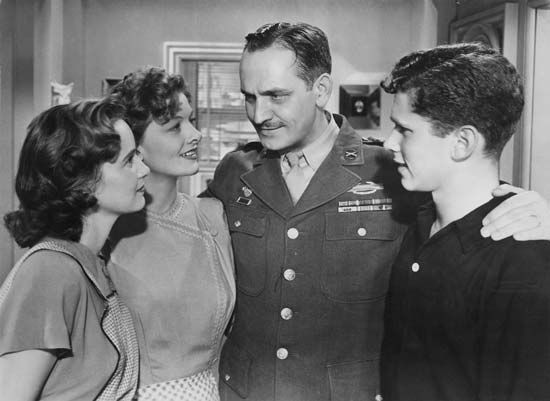


Myrna Loy (second from left) at Milly Stephenson Milly Stephenson was married for years to banker husband Al before World War II came and he went off to fight -- married long enough that by the time he comes home, he's got an elder daughter who's at least in her early 20s even if her exact age isn't given. I stated when I blogged six years ago that I thought Fredric March had the easier character to play than Dana Andrews, something by which I'll still stand. Milly might be tougher to play than Marie Derry, but only because the character isn't as one-dimensional. If the screenplay of The Best Years of Our Lives had wanted to focus on Fred and Marie wanting to make their marriage work, the Marie character would probably be much more complex, on the level of Judy Holliday's character in The Marrying Kind. Still, Milly is a character that has two roles. First and foremost is as the wife to Al. They've been through most of it all, falling in love, having times where they would have thought the marriage was on the rocks, and coming out on the other side with a deep abiding friendship and love. Even though the war changed Al Stephenson, it looks as though he's going to have less of an adjustment than Fred Derry, and a long-term wife to make it all the easier. Milly, though, has a second role, as housewife (which we see at the beginning when she points out that it's been the maid's night out since 1943), and mother, especially to a daughter Peggy (more on her later) with her own problems. This gives Milly a lot more to do, and it's unsurprising that her character is more of a glue to the movie than Marie Derry.

Teresa Wright as Peggy Stephenson Peggy, as I mentioned in the previous paragraph, is the adult daughter of the fairly well-to-do Al and Milly, and did her part for the war effort by becoming a nurse and ministering to sick soldiers. This again is something we see fairly early on. After the Stephensons have to take a drunken Fred Derry home with them, Fred has a nightmare obviously brought on by post-traumatic stress disorder, although back then they didn't know what it was called. Peggy, however, knows the basics of how to deal with it, as she's obviously seen it before, as she tells Fred the next morning. She begins to fall in love with Fred, even though this is a serious problem since he's already married. Peggy is a bit naïve, as she thinks she's just going to be able to go in and save Fred from Marie, a notion of which her parents disabuse her. This even though Peggy is quite right about the state of Fred's marriage, and we viewers can quite clearly see that it would be in Fred's best interests to be with Peggy and not Marie. I can't really imagine the emotional difficulty this must mean for Peggy. After she and Fred see each other again in the movie's finale, viewers are left with a hopeful note, which is helped by the fact that having helped soldiers in the past as a nurse, Peggy might be able to deal with the setbacks that are going to come when they get married.


Cathy O'Donnell as Wilma Cameron Cathy O'Donnell isn't given the biggest role in The Best Years of Our Lives, and the challenges her character Wilma is going to face are presented in the movie as possibly not as big as those faced by any of the men, or even Peggy Stephenson when Dad forces Fred Derry to break off all contact with her. Wilma Cameron is the quintessential girl next door, who grew up with boy next door Homer Parrish (Harold Russell), who is realistic because he was a real World War II veteran with no acting experience who lost both his hands in the war. Wilma's role is to serve as a rock for Homer; that is, somebody who will stand by him and constantly tell him that she loved him for something more than his hands, and so even though he no longer has any hands, she can still love him just as much. She doesn't get all that many scenes, although she gets one of the most important, when Homer invites her up to his bedroom at night to show her what his nightly routine is, how it leaves him completely dependent upon others, and asks whether she'd be willing to spend her whole life like this. Wilma of course says yes, and the movie implies that Wilma and Homer are going to live as a happy couple just like Al and Milly and even Fred and Peggy. But I can't help but think that in real life, Wilma would have had it the most difficult. Homer Parrish probably would have had some difficulty getting a truly good job. Fred's problems were mental, and you could see him advancing rapidly if he got into a field he liked. The disabled, however, have always had it tough, and being married to a man with no hands would have likely brought with it a whole range of practical problems. The movie shows to an extent what it's like for Homer; it doesn't really show what it's going to be like for the woman he marries.

One other woman who deserves mention is Gladys George, playing Fred Derry's mother Hortense. She's only in a couple of scenes, but one of them is a vitally important scene in which her husband Pat (Roman Bohnen) finds one of the letters of citation for all those ribbons Fred has on his chest. Hortense doesn't have much to say, but reacting is acting just as much as delivering lines.

Thursday, February 21, 2013

Seven Days in May


Burt Lancaster and Kirk Douglas in Seven Days in May (1964)

Another movie that I have surprisingly never blogged about before is Seven Days in May. It's showing up overnight tonight at 2:15 AM on TCM, so now would be a good time to blog about it.

The movie starts off with scenes of people picketing outside the White House for and against President Jordan Lyman (Fredric March). It seems as though he's negotiated a controversial nuclear disarmament treaty with the Soviet Union, and gotten it through the Senate, with the result that it's had a disastrous effect on his popularity. Apparently, the people who opposed the treaty believe that the Soviets won't honor it. To be honest, the premise may be a plot hole, in that there would have been a very low chance of ever getting a treaty like this through the Senate, since a lot of the Senators would rightly understand that it would get them voted out of office. They, after all, can see how unpopular this is making the President. But ignore that gaping plot hole, and you're in for a pretty entertaining movie.

Anyhow, after the establishing scene, we meet our two other main characters. Col. Casey (Kirk Douglas) is the adjutant to General Scott (Burt Lancaster), who is presumably on the Joint Chiefs of Staff. Casey, in his job, sees some odd things cross his desk. First is a betting ring on the Preakness Stakes; there's talk of odd troop transfers and a base in Texas; and something called "Ecomcon", which is obviously an acronym for something, and whatever that something is, it's got to be nefarious. Col. Casey decides to do some discreet investigating, and he discovers enough to realize that there is indeed something serious, and that General Scott is trying to keep him in the dark. Eventually, Col. Casey suspects that the generals are planning a coup for the coming Sunday, and that the President is obviously in grave danger!

What's a colonel to do? Good loyal American that he is, he goes to a commanding officer. No, not his own commanding officer in the form of the General, since that would give the game away, but the Ultimate Commanding Officer, the Commander-in-Chief himself. The President and his advisers himself are obviously reluctant to believe that there could be a coup being plotted, since this means there are some serious consequences. But, they're not imprudent, and they decide to do some subtle investigation of their own, as well as taking steps to ensure that President Lyman won't be where the generals can keep him hostage. One presidential aide gets a confession from an admiral who is now stationed off Gibraltar, but unfortunately he's killed in a plane crash trying to return from Spain. Another Lyman supporter, Senator Clark (Edmond O'Brien) goes to Texas to investigate the new base, and gets held on a trespassing charge. It's becoming more and more clear that there is a coup being planned, but can the President and his advisors prevent it?

There's one other thing that could stop it, which is indiscretions on the part of General Scott. It turns out that he had had an affair with socialite Eleanor (Ava Gardner), and that she's got a bunch of love letters that, if they were ever made public, would doom the General. Col. Casey knows Eleanor, and tries to get the letters for her, even though it's going to mean possibly ruining the friendly relationship he has with her.

Seven Days in May is a movie that is immensely engrossing and entertaining, set against the unsettling unasked background question of whether any plot like this is possible in the real America. Just consider how many people believe in nonsense conspiracy theories about the assassination of President Kennedy, or the birth certificate stuff about Barack Obama, or the phony documents about George W. Bush's National Guard service. With the exception of hanging all the events on the hook of a treaty that I think would never have gotten passed by the Senate, the story is well-done, and the cast is uniformly excellent. Career supporting actor names I haven't mentioned are Martin Balsam as the aide who dies in Spain; John Houseman as the admiral from whom Balsoam extracts a confession; and Whit Bissell as a senator who seems in on the machinations of the generals.

Seven Days in May is part of a Burt Lancaster box set that the Warner Archive put out.

Wednesday, November 16, 2011

Nothing Sacred

It looks as though I have never blogged about the screwball comedy Nothing Sacred before. It's airing tonight at 8:00 PM, and is one of the funnier movies you'll see.

Carole Lombard stars alongside Fredric March, but more on her in a bit. March plays Wally, a bombastic newspaper reporter somewhat reminiscent of Clark Gable's character in It Happened One Night. He gets taken in by a story about some foreign potentate who is in fact a hoaxster, and gets in trouble with his editor (Walter Connolly, who happened to play Claudette Colbert's father in It Happened One Night) for it. To get out of the doghouse, Wally figures he needs the next big story, which he finds when he hears about Hazel (Lombard). Hazel is a small-town girl from Vermont who gets diagnosed with a rare case of radium poisoning and doesn't have long to live. She's never been to the big city, so she'd like to see it before she dies. This is perfect for Wally, who can get the story.

So Wally brings Hazel and her doctor (Charles Winninger) to New York, at which point a media frenzy erupts. Just like the circus surrounding somebody sympathetic (at least in the eyes of the media) like Amanda Knox, everybody begins to fall over themselves to show how much sympathey they have for her. You've got the high society of New York all the way down to the Girl Scouts, all impressed with Hazel's bravery in the face of death. And then Wally and Hazel learn the stunning news: she's really not sick with radium poisoning, and is not going to die. This presents a rather big problem, since everybody in the country has been following her story waiting for her to die. What to do? The other problem is that along the way, Wally and Hazel have begun to fall in love.

Nothing Sacred is a tremendously funny comedy which lives up to its title: the movie holds nothing in reverence. The small-town Vermonters are lampooned. But so are the allegedly sophisticated big-city people, who are shown to be just as gullible as they would argue the small-town folk are. The media's role in fomenting all of this frenzy -- something which clearly still goes on to this day -- is also lambasted. Viewers of today watching Nothing Sacred might find that some of the material veers into politically incorrect stereotyping. After all, back in the 1930s they didn't have quite the sensitivity towards black people that Hollywood would show today. But the movie is still amazingly funny.

Nothing Sacred is also in very good Technicolor, as you might have guessed from the photo above. (Indeed, it's nice to have the establishing shot of Rockefeller Center as it was back in 1937 in such nice color.) Tonight's TCM showing may or may not be that brilliant. In the past, all the prints have been fairly low-quality, as the movie fell into the public domain somewhere along the way. However, the movie has apparently been restored, and we may be getting the restoration print tonight.

Saturday, January 22, 2011

I Married a Witch

I briefly mentioned the movie I Married a Witch last October when Fredric March was TCM Star of the Month. It's airing again tomorrow morning at 10:00 AM ET on TCM.

Veronica Lake and Cecil Kellaway play a pair of witches in colonial Salem who get prosecuted by Fredric March and are executed for it. Fast forward 250 years. The witches' souls have been spending all these years inhabiting a tree, which gets hit be a bolt of lightning. This kills the tree and frees the souls, which need something a little more corporeal. Lake finds that one of prosecutor March's descendants is still around (conveniently, also played by Fredric March), and decides to take the form of somebody who needs rescuing from a fire -- and only March can pull her out of that fire.

March does, but there are all sorts of problems for him. The latter-day March is running for political office, as well as preparing for his upcoming nuptials (to Susan Hayward). (You'd think a smart politician would schedule his wedding around election season, but no). The presence of this witch could not only derail his campaign, but also the marriage. This being a comedy, all will eventually work out, although as is often the case with Hollywood movies, the journey is more rewarding than the destination.

On the face of it, you'd think I Married a Witch is little more than B-movie material that happens to have an A-list cast, and in some ways, that's true. And yet, the movie is a hell of a lot of fun. March is one of those actors who isn't exactly gifted at comedy, but is more than capable enough to be the foil for everybody else around him to be funny. Cecil Kellaway is good at striking the jovial note and being the more conscientious warlock, while Veronica Lake is the real star of the proceedings as the witch.

Sadly, I Married a Witch doesn't seem to be available on DVD.

Monday, November 15, 2010

Man on a Tightrope

I mentioned a week ago in conjunction with the new Elia Kazan box set that one of the new-to-DVD movies, Man on a Tightrope, was coming up soon on the Fox Movie Channel. That "soon" is tomorrow morning at 8:00 AM ET.

The scene is Czechoslovakia of the early 1950s, not long after the Communist takeover. Fredric March plays Karel Černik, the head of a circus troupe who also used to be its owner until the circus was nationalized by the Communist authorities. He doesn't like the Communists not only because they've taken his circus, but because the Communists were constantly engaging in arbitrary impositions on everybody that made life difficult: you didn't know how the Communists were going to make like difficult next, or whether they were going to come after you. His personal life is also a mess, with a second wife (Gloria Grahame) with whom he's having relationship problems as she likes some of the better-looking members of the troupe; and a daughter (Terry More) who, having grown up, is showing interest in men (Cameron Mitchell) her father doesn't particularly approve of.

So, it's only natural that Mr. Černik has a desire to escape. Escape alone isn't really an option as it would leave his family and the circus troupe he really does like behind. So, he comes up with a daring plot that would have his troupe go to the border to "perform" for the border guards, and "perform" their way right across the border. One of the many impositions put upon the circus troupe, however, was the implanting of spies, so Černik has to be careful about whom he lets in on his plan for escape. The one person who does know, and has the power to stop Černik, is the local Party boss, played by Adolphe Menjou. And he certainly plans to stop them....

Man on a Tightrope is a well-acted little movie with a tight storyline. After the end of the Hollywood blacklist, the anti-anti-Communists have held sway, with the result that anything anti-Communist from the early 1950s gets unfairly maligned. Sure, some of the movies are lousy, but some such as this one are quite good. What's interesting about its portrayal of Communism is that it's doesn't do anything lurid to portray the Communist violence against the individual, the way that movies like The Big Heat or The Phenix City Story are very up front about the badness of their antagonists. Instead, the inherent evil of Communism is shown in people being forced to lie to themselves and the people closest to them, as well as in a thoroughly arbitrary state. Indeed, as with the Stalinist purges in the Soviet Union, the heavy hand of the state can even hit local bosses like the one portrayed by Menjou.

I'm glad that Man on a Tightrope has gotten a DVD release, becuase it's an underrated movie that really deserves more attention.