Showing posts with label fred macmurray. Show all posts

Wednesday, September 17, 2025

Swing High, Swing Low

Fred MacMurray was honored in the 2024 edition of TCM's Summer Under the Stars, and that gave me the opportunity to record another movie that I had seen the title show up a number of times, but had never actually seen the movie: Swing High, Swing Low. Now, having actually seen it, I can finally do a post on it.

Fred MacMurray is the male lead, although since the movie was made in the late 1930s, the real star is the female lead, played by Carole Lombard. Her character, Maggie King, is working her passage as a beautician on board a cruise ship that goes from the US Atlantic coast to the Pacific and back through the Panama Canal in the days when the US still controlled the Panama Canal and had a strip of land on either side. On this passage through the Zone, she sees a soldier patrolling the shore, and he sees her. His name is Skid Johnson (that's MacMurray as if you couldn't tell), and although he's in the army, he says it's his last day as he's being demobbed tomorrow.

Maggie isn't really interested in SKid, but the next day he's driving a taxi showing Maggie and her friend through Balboa, the city that served as the Pacific terminus of the Canal Zone although today it's part of Panama City. Maggie misses her boat as a result of Skid and his friend/roommate Harry's (Charles Butterworth) showing her around town. Worse, they go to a club where Skid reveals that he's a trumpet player and Maggie reveals she hates trumpet music. But at the bar a man hits on Maggie and Skid, obviously already in love with Maggie, gets in a fight with the man, to the point that Skid gets arrested and Maggie has to bail him out. So now she also doesn't have the money to get a ticket back to America.

So Maggie gets herself and Skid jobs at Murphy's (Cecil Cunningham, a woman even though she has the name Cecil) club in Balboa, Maggie claiming that she's married to Skid. Also workin at the club is Anita Alvarez (Dorothy Lamour), who at some point in Skid's past was his girlfriend, which introduces that romantic tension that's going to drive the rest of the plot. Skid gets famous enough that he's able to get enough money to go back to New York, although it's apparently only enough money for him, not both him and Maggie. This even though by this time Maggie and Skid have gotten married for real.

Back in New York, Skid works at a club where Anita just happens also to be on the payroll. And Anita has no qualms about trying to win Skid back for herslef. Doing this, however, leads to Skid's screwing up his marriage to Maggie, and when she files for divorce, he responds by turning to drink, which threatens to ruin his career, at least until she shows up again.

My being a fan of older movies is part of why I'd always been interested in seeing this one, but I have to say that it doesn't quite work for some reason. I think it's that at times it's too serious a drama for its own good, while at the times it tries to be lighter, it's not really a comedy either. It also doesn't help that despite being about musicians, and not fully developing the characters, it doesn't have particularly memorable music either.

Swing High, Swing Low isn't a terrible movie, but if I were going to introduce people to Fred MacMurray or Carole Lombard, there are other movies I'd pick for that job.

Sunday, June 8, 2025

Kisses for My President

Fred MacMurray was honored in last August's Summer Under the Stars on TCM, which means that as I write this in early May I still have a couple of his movies to get through watching on my DVR before they expire, although by the time this gets posted they will have expired. First up is the 1964 comedy Kisses for My President.

The new President of the United States is being inaugurated, and that president is... a woman! Her name is Leslie McCloud (Polly Bergen), and while no real mention seems to be made of her political career before the presidency, she also has a husband Thaddeus (Fred MacMurray) and two children, teenaged Gloria and elementary school-aged Peter.

Thaddeus was a successful businessman before Leslie was elected president, and for ethics reasons since the business apparently contracts with the federal government, Thaddeus has had to sell the company. That would naturally leave anybody a bit disgruntled, I would think. But then Thaddeus gets to the White House and really gets irritated. Apparently nobody had thought of the term "First Gentleman" at the time. Not only that, but everything designed for the First Lady is, well, designed for a woman, right down to the décor in the separate bedroom that the First Lady has from the President. (At least in the context of the movie there's an explanation that since the President has to be ready for a 3AM emergency, there's an office adjoining the presidential bedroom so the President can't really use the other bedroom.)

So what's a First Gentleman with no direction in his professional life supposed to do? Madame President has him entertain a visiting foreign dignitary, President Valdez (Eli Wallach) of some Latin American tinpot dictatorship. Valdez likes any number of stereotypical masculine things like fast cars and bar-hopping that need a male companion. But the visit goes wrong, and since Valdez's country is important during the Cold War conflict with the Soviets, this is a problem.

Also going wrong is when an old friend of the McClouds, Doris Weaver (Arlene Dahl), decides to hire Thaddeus for the McCloud name. She tells him that he's going to develop a line of male cologne and hygiene products, but this is a ruse, in part because as mentioned she wants the McCloud name to help sell product and in part because she seems to want Thaddeus romantically. All of this gets Thaddeus brought before the Senate committee headed by Leslie's political enemy Sen. Walsh (Edward Andrews).

Further complicating matters for the president is that the two kids both let the influence of having a parent be president, with the concomitant Secret Service protection, go to their heads. It's not as bad as anything Hunter Biden did, since these are just kids, but using the Secret Service to get into fights with your classmates or to deal with your boyfriend's hot-rodding are definitely things that would redound negatively on the president herself.

Kisses for My President is a bit of a mess, in part because there's really only the one joke here, and because the movie doesn't know how to resolve the conflict. Interestingly, at the time the movie was made Polly Bergen was only 34 years old, which would have rendered her ineligible to be US President thanks to the requirement in the Constitution that the president be 35 years old. Of course, Leslie McCloud couldn't be 34 and have a high school-aged daughter, at least not in that generation. The movie is also slow, running its joke out for 110 minutes. Maybe the material might have worked in the days of the B movie (with a similarly short running time) before World War II. But not really in 1964.

Wednesday, March 26, 2025

The Moonlighter

With Barbara Stanwyck being TCM's Star of the Month and my having multiple of her films on my DVR that I hadn't gotten around to watching yet, it should come as no surprise that I'm highlighting a couple of them over the course of the month as they show up on TCM. This time, it will be The Moonlighter, which TCM has tomorrow (March 27) at 8:30 AM.

The Moonlighter in the title of the movie refers to a man who works at night, specifically rustling cattle so that nobody can get a good enough look at his face while he's doing it. That man is Wes Anderson (Fred MacMurray), a man who's stealing cattle around the turn of the century, just at the time when the horseless carriage started to show up (which as you can guess is a plot point later in the movie). But as the movie opens, he's been caught by a sheriff in some town and is being brought in to jail. This is done under cover of anonymity, as the sheriff knows that the locals will try to break in to the jail and lynch Wes for his crimes.

In another bit of foreshadowing, the sheriff and #1 deputy make a big deal about putting Wes in cell #3, the first time in a western I've seen the cells numbered like this. Then another prisoner is brought in and makes comments about the dirty state of the cells. So the sheriff lets this new prisoner use a broom to sweep out the cells, putting Wes in a different cell until that job is done. Having done all that, the sheriff and deputy go out for a quick bite to eat, leaving behind an older deputy who's clearly not up to the task of stopping the braying mob from breaking in.

Sure enough, said mob does so, and then goes to the restaurant when the deputy takes the keys there. The sheriff only tells the mob after they beat him that Wes is in cell #3, which we of course know is no longer the truth. But the guy in #3 looks vaguely like Wes, down to the beard that MacMurray is surprisingly sporting for plot reasons (he can disguise himself by shaving it off). The mob leaves the keys close enough to where Wes can get them from his cell, so he takes the opportunity to escape. Seeing the lynching, he decides to gain revenge on the people who did this to him, even if it wasn't him.

A week or so later, an emissary from Wes' family shows up to claim the body. That woman is Rela (Barbara Stanwyck), who had been Wes' girlfriend until he left five years back to try to make enough money to be able to support her so she'd marry him, only to find he had to resort to illicit means that for Rela are a deal-breaker. The undertaker tells Rela that another family member already paid for the burial and, in a flashback, we learn that it was Wes using just his initials as if that would fool the townsfolk.

Wes, during his revenge tour, eventually gets himself shot in the shoulder and, having nowhere else to go, decides to go home to his mother and kid brother Tom (William Ching). Tom is working at a bank but, more importantly, decided to start putting the moves on Rela himself since Wes is no longer in Rela's plans. And if Tom can earn enough money.... But he panics one day when a man comes in to the bank looking like a sheriff's deputy and asking about Tom and Wes. For the mistakes he makes handling money, Tom gets himself furloughed. Worse, it turns out the man was only an old friend of Wes' named Cole Gardner (Ward Bond). Cole has plans for "one last heist" that will leave everybody financially set. Tom overhears it, and thinks this is how he can get enough money to marry Rela.

But the plan goes wrong, Tom gets shot, and a posse is sent out to look for Wes and Cole. Meanwhile, as with lots of heist movies, the survivors start arguing with one another about the split. Rela is the only one who knows where Wes' old hideout might be, so she approaches the sheriff in asks to be deputized, going solo to find Wes.

The Moonlighter is a modest little western, and one that doesn't really do much special, with one exception. That exception is that somebody came up with the idea to film this in 3-D, this being early 1953 when 3-D was one of the gimmicks to get people to leave the small screens at home and come back in to the movie theaters. There's not much the 3-D is used for, apart from the opening credits and then some waterfall shots near the end. MacMurray and Stanwyck are professional here, although you get the feeling that they're just taking a paycheck since they're not doing anything that stretches their talents.

I don't think anybody involved with The Moonlighter had anything to be embarrassed about in having this be part of their filmography. But I also don't think anybody will think of it near the top of the lists of great movies they made.

Thursday, December 29, 2022

No Time for Love

Many years back, TCM ran the movie No Time for Love. I watched it, but a search of the blog claims I never did a post on it. Anyhow, a few years back I bought a box set of Claudette Colbert movies, and No Time for Love was on it. I remembered the plot, although not the title; now that I've watched it again recently, it's a good time to do a post on it.

Colbert plays Katherine Grant, a photographer who works for one of those Life-type magazines: human interest photojournalism and the like. She's a very good photographer, if unorthodox in her shot and framing selections, and that quality is why her publisher Fulton (Paul McGrath) has kept her around and fallen in love with her to the point that they're thinking of getting married.

Katherine's next assignment is to go underground, where a tunnel is being built and photograph the blue-collar men making that tunnel. It's difficult work, as the tunnelers have to go through a compression chamber on the way in and out to help keep mud from seeping in to the works while they're underway. (Washington Roebling, who designed the Brooklyn Bridge, got a serious case of the bends when an emergency forced him to leave one of these chambers early.) Anyhow, these men, led by Jim Ryan (Fred MacMurray), are the sort of rough-and-tumble men you'd expect at a worksite like this.

Indeed, their manners seem quite coarse to Katherine, who eventually tells Jim she's got a bedroom chair with more character than him. But when their work hard, play hard attitude results in letting off some steam with fisticuffs. Katherine takes a picture of it, thinking it would be a visually arresting addition to the magazine story. Jim objects, since getting in a fight like this will likely get him suspended from his job.

Katherine agrees not to publish it, but she doesn't destroy the negatives, and somehow a copy of the photo makes its way to the editors, who understandably like it and publish it not realizing the consequences. Poor Jim gets suspended, and Katherine feels bad about it, even though the two supposedly don't like each other.

I say supposedly, because Katherine is clearly taken by Jim's masculinity, as we see in what is probably the movie's highlight, a ridiculous dream sequence in which Katherine imagines Jim as some sort of superhero. She's falling in love with Jim but doesn't want to admit it. To try to disabuse herself of the notion, she decides to hire Jim as an assistant, telling herself that she's doing him a favor by giving him a job during his suspension.

It's fairly predictable where No Time for Love is going to end up, but it's certainly a well-enough made movie from all involved. It's only programmer length at about 83 minutes, so it doesn't overstay its welcome. But Colbert and MacMurray are appealin together, while the supporting cast does OK, including Ilka Chase as Colbert's sister and June Havoc as a chorus girl who seems more like the social class of person the MacMurray character would be interested in.

I'm glad that a movie like No Time for Love wound up on a box set. It's definitely a nice little romantic comedy.

Wednesday, January 26, 2022

The Egg and I

I mentioned some time back that I picked up a Claudette Colbert box set, and have reviewed three (I think) of the six movies on it. Another of the films in the set is The Egg and I, which is going to be on TCM tonight at 8:00 PM. So once again, I put it in the DVD player and watched it so I could do a post on it.

Claudette Colbert plays Betty McDonald, who at the start of the movie is on a train some time after the main action of the movie. A Pullman porter accidentally drops a breakfast egg, and Betty talks about the importance of the lowly egg, leading us into the main action of the film.... Betty is a city slicker recently married to Bob McDonald (Fred MacMurray), who fought in the recently won World War II and returned to do some sort of big-city office job. However, like the GI in The Best Years of Our Lives who was asking Fredric March for a loan to become a farmer, Bob decided in the trenches that he wanted to do something different with his life, so he bought a farm sight unseen.

The plan is to raise chickens on the farm and then sell the eggs, which seems like it would be a tough proposition for anybody who's never done any farming before. And, unsurprisingly, it's going to be even more difficult because this is a dilapidated little farmhouse: the roof leaks, the wood on the porch is rotting, the furniture in the farm-house seems generally run down, and the like. It's all the sort of thing that's an obvious target for humor as other movies like George Washington Slept Here and Mr. Blandings Builds His Dream Housedid. (There's also the Zachary Scott movie The Southerner which did it in a more dramatic sense.)

In any case, the McDonalds start putting sweat equity into the property, and start meeting the neighbors. Chief among them are the Kettles. Pa (Percy Kilbride) is a bit of a lovable con artist, Ma (Marjorie Main) is a woman with wisdom born of experience on the farm, and Tom (Richard Long) is the oldest of the Kettles' brood of 15 or so kids. Tom has just graduated high school and clearly has the talent to go on college, and he has the desire to become an engineer. But there's a question of whether he could support himself while going to college full-time. One other neighbor is Harriet Pullman (Louise Albritton), who owns another farm, and seems to have people run it for her as she's always impossibly well-dressed for a farmer and doesn't look like she's done a day's worth of farm work. If she had, she'd look more like Ma Kettle.

Along the way, the McDonalds learn a thing or two about farming, and actually start to get a bunch of hens laying eggs, but there's also a lot of difficulty. One problem comes when there's a forest fire that also burns down their farm, killing most of the chickens. But there's also Harriet; Betty gets the distinct impression that she's got a thing for Bob, and Bob seems to be spending entirely too much time with Harriet.

The Egg and I is a fairly gentle comedy that's probably best remembered as being the movie that spawned the whole Ma and Pa Kettle series. The Kettles were popular enough in this film that Universal decided to build a series around them, and their rural way of life untouched by modernity. But the rest of the movie works fairly well, even if none of the plot lines are particularly original. MacMurray and Colbert had starred in a handful of movies together over at Paramount before World War II, and they're an appealing couple here. And the movie isn't being gratuitously mean to those dumb hillbillies. Pretty much everybody is a decent person here, and even Harriet turns out not to be bad.

If you haven't seen The Egg and I before, it's a movie that's definitely worth watching.

Friday, July 2, 2021

Maid of Salem

A couple of months back, I mentioned the Claudette Colbert box set that I picked up. One of the odder entries in the set is Maid of Salem, which I recently watched.

Colbert plays Barbara Clarke, who lives in Salem, Massachusetts in 1692. Now if you know your history you'll know that's the year of the infamous Salem witch trials. Barbara lives with her aunt Ellen (Louise Dresser) and the two work as candlers, making candles for the rest of the village in exchange for the goods and services they need. Ellen is being pursued romantically by Miles Corbin (Sterling Holloway), a cow herder who has ambitions of getting some good land with a sizable amount of livestock.

Among the people to whom the Clarkes sell their candles is the Elder Goode (Edward Ellis), who seems to have the only slave in town, Tituba (Madame Sul-Te-Wan). We see Tituba doing a bit of palmistry to tell the fortunes of a bunch of the town's women, which ticks the Elder off to no end when he finds out. What terrible idle, gossipy women! Indeed, even his own wife (Beulah Bondi) is in on it.

Another of the Clarkes' clients is Jeremiah (Halliwell Hobbes), who lives a bit outside the village on a hilltop that looks entirely too high for Massachusetts. He lives alone, but things lead Barbara to believe he's not along right now, and wouldn't you know, she's right. Jeremiah's nephew Roger Coverman (Fred MacMurray) is there, having fled Virginia where he's considered a rebel. Because he's a wanted man and there's a reward on his head, he's more or less hiding out. But he falls in love with Barbara, and the feeling is mutual.

This causes Roger to stray from the confines of his uncle's property, and people start seeing him, thinking they've seen the devil. This, combined with Tituba's fortune telling and practicing of some elements of the traditional African culture that have still been handed down since she's probably only a second-generation slave, and reports of witchcraft in other parts of the Massachusetts colony, lead to the eventual accusations of witchcraft that tear the village asunder.

Ironically, it's the Elder Goode's own daughter Ann (Bonita Granville) who sets the ball rolling. She's stolen one of Dad's books on how to deal with witches, and thinks it would be interesting to find out what it's really like to be bewitched. Of course, when she strts acting bewitched, she can't tell everyone it's just a lark since she'd get in big trouble with her strict father. So she starts rumors as to who's bewitched her. The town's citizens quickly realize that it's better for them to make false accusations before other people can accuse them.

Among the people accusing Barbara is her own cousin Timothy. He thought he saw Roger although he didn't know Roger's real identity of course. He also sees Barbara practicing a dance Roger had taught her that definitely wouldn't be allowed in Salem. He puts two and two together and immediately suspects something's wrong. The fact that Barbara is a bit of a free spirit doesn't help her cause. Barbara, for her part, could produce an alibi in the form of Roger, but since he's a fugitive she doesn't want to get him caught and extradited back to Virginia where he'd probably hang anyway. (Or at least that's what we think; there's one scene in which we discover that the new governor will be pardoning the rebels.)

Maid of Salem is odd in that when I think of Colbert and MacMurray being paired together, I think of romantic comedy, and something fairly light. Not the Salem witch trials. Now, the material is somewhat lighter than The Crucible or any more modern retelling of the trials would be, but still, there's some fairly dramatic stuff here. There's a lot of obvious Hollywood here, most notably Colbert, who looks more like a star than 1690s.

But although Maid of Salem is always a Hollywood product, it's still quite an interesting movie, and not a bad one. It's also always timely, whether you have Arthur Miller reworking the Salem witch trials to be an allegory about the Red Scare of the 1950s, or whether you can compare it to the deplatforming movement coming from the opposite political direction that's going on today. Definitely worth a watch.

Sunday, October 18, 2020

Not that there's much moonlight....

I watch a lot of movies that are available on DVD courtesy of the Warner Archive in part because most of what I record is off of TCM, and in part because I make it a point to look up the movies I haven't blogged about that have been released by the Warner Archive in order that I can blog about them. With that in mind, the latest Warner Archive selection is The Moonlighter.

Bruce Willis and Cybill Shepherd are nowhere to be found, as this is an early 1950s western. Fred MacMurray plays Wes Anderson, a man who has just been put in jail for "moonlighting", or rustling cattle under cover of darkness. Of course, this is a serious offense in those old westerns, and he's probably going to get a substantial punishment. But the townsfolk, led by Alex Prince (Morris Ankrum), don't want to wait for legal justice to take its course, so they plan to bust Wes out of jail in order to lynch him.

There's one problem however, which is that they don't know what Wes looks like, since there's no photograph on a wanted poster for them to consult. All they know is which jail cell he's in. And this is where the big problem comes. When the jail cells were being cleaned, Wes got moved into a different cell, and another man was put in the one he had been in. So when they lynch mob comes, they get the wrong guy! But everybody just natuarlly assumes Wes was killed.

Some time after the lynching, a woman named Rela (Barbara Stanwyck) shows up in town asking about Wes. Upon learning that he was killed, she pays for his funeral and breathes a sigh of relief. She had been in love with Wes in the past, but things grew problematic what with Wes' life of crime. She fell in love with another man, and is now free to marry him.

Of course, we know that Wes is still alive. He, having seen the lynch mob kill an innocent man, decides that he's going to exact his own form of vengeance on the mob, trying to kill them one by one. This isn't easy, and in one of the attempts to kill people in the mob he gets shot himself. So he beats a hasty escape and decides that he'll go back to his old home.

There, Wes will meet his kid brother Tom (William Ching), and Tom's girlfriend... who just happens to be Rela. Oh dear. As with Love Me Tender, the reappearance of a man who was thought dead but isn't causes all sorts of problems.

Tom has been working at the bank in town, but gets fired. Around the same time, one of Wes' old friends, Cole Gardner (Ward Bond) shows up. Cole wasn't part of the lynch mob, and has a new job in mind for himself and Wes: rob the bank in this town. Wes understandably doesn't want Tom in on this at all, but Tom, having been fired, wants his own revenge, so he's anxious to be let in on the bank robbery.

The Moonlighter, like Love Me Tender, has an interesting premise. And with two headliners like Barbara Stanwyck and Fred MacMurray, you'd think you'd get a really good little movie out of it. Yet somewhere, The Moonlighter loses its way. Nothing really works as well as it should, and at just under 80 minutes it all feels quite rushed, with an ending that doesn't make a whole lot of sense but seems to satisfy the Production Code.

I certainly wouldn't use The Moonlighter to introduce people to either Fred MacMurray or Barbara Stanwyck. But for people who are already movie buffs and looking for something new to them, why not give The Moonlighter a try and judge for yourself.

Wednesday, July 1, 2020

Smoky (1946)


During one of the recent free preview weekends that DirecTV gave us while everybody was under lockdown is the 1946 version of Smoky. It's going to be on StarzEncore Westerns again overnight tonight at 1:44 AM, and again on July 11.

Smoky is a wile horse somewhere in the mountains of Utah that has a reputation, enough that everybody thinks Smoky is some sort of special horse and wants to catch the poor thing. But somehow, Smoky is always able to stay one step ahead of all the humans.

That's until Clint Barkley (Fred MacMurray) shows up. He's a man with a past, one one day he winds up at Julie Richards' (Anne Baxter) latter-day ranch looking for a job. He's vague about his past, leading to the presumption by some that he was a criminal, something that Frank (Bruce Cabot) seems to know more about but isn't letting on.

Anyhow, Clint does get a job, and eventually catches Smoky. And Clint must be some sort of horse whisperer even though they didn't have that phrase back in the day, as Clint is the only one who is able to have any sort of positive effect on Smoky. In fact, the effect is so positive that when Clint falls of Smoky and gets injured, Smoky drags him all the way back to the ranch.

But Frank is a dick and abuses Smoky to the pont that Smoky escapes, getting captured by other people who put Smoky in the rodeo. When Clint recovers he decides to go looking for Smoky....

Smoky is the sort of movie I think you have to be a kid to enjoy, because if you're an adult, you'll probably find it endlessly eye-rolling. It only runs 87 minutes, but it still feels long, mostly because of how little action there really is. There's a whole lot of narration that rather seriously anthopomorphizes Smoky, which I found cringe-inducing.

Worse might be the presence of Burl Ives as ranch hand Willie, who brings the film to a screeching halt every time he breaks out into one of his songs. Once would be once too many, but it happens multiple times.

If you liked the old nature movies that Disney made and TCM would show in the old Treasures from the Disney Vault series, then you might well like Smoky. And if you're a kid, the material is so juvenile and unobjectionable that you probably won't notice how poor the whole thing really is. As for the parents, well I offer my condolences.

Smoky doesn't seem to be on DVD either, so when it's in the StarzEncore Westerns rotation is about the only way you're going to catch it.

Wednesday, March 6, 2019

True Confession

I wanted to watch a relatively short movie the other night so that I could get to bed at a reasonable time, and decided to finish up the movies on the Carole Lombard box set I have by watching True Confession.

Lombard plays Helen Bartlett, a struggling writer married to equally struggling lawyer Kenneth (Fred MacMurray, with an odd mustache here). In the opening scene, we see that Helen is less than fully truthful, as she recommend her husband take up the defense of someone who is guilty as sin. Then she calls up her friend Daisy (Una Merkel) and gives her every lie in the book to blow off work and come visit her.

Helen decides to help make ends meet by taking a job as a secretary for the wealthy Krayler, even though she doesn't know how to take dictation and only hunts and pecks to type. It's obvious Krayler has other things in mind for her, but she takes the job anyway.

When she realizes what's up, she leaves and gets Daisy to go back to the apartment with her to get her purse and coat, but when they get back, they find that Krayler has been murdered! Even though we know Helen didn't do it, and she'd have an alibi in Daisy once the police and coroner determined Krayler's time of death, Helen decides she's going to confess to the crime so that her husband can defend her and get her off on a self-defense argument. (If the real truth came out, Helen could face perjury charges.) Once her husband wins the case, he'll be a successful lawyer and the money will come flowing in.

Sure enough, Helen is found not guilty, Kenneth becomes a successful lawyer, and Helen actually becomes a successful writer by writing about the case. But there's one small catch. A drunk turned self-styled "criminologist", Charley (John Barrymore), has a piece of evidence that would prove conclusively that Helen didn't kill Krayler. He's willing to blackmail the Bartletts to get a bunch of money so he can live high off the hog.

I found True Confession to be the weakest of the movies on the box set. The problem is in Lombard's character, who as one of those chronic liars who just keeps piling one lie on top of another, she's obnoxious and someone I wanted to see get her comeuppance. This is supposed to be a comedy, and that sort of obnoxiousness didn't really work here. Barrymore is also overacting shamelessly, and relatively irritating too. The deus ex machina that solves Helen and Kenneth's problems doesn't really work for me, either.

Still, I always like to suggest people just for themselves, and since this was on a very low-price box set, getting one dud in the set isn't that big a deal.

Saturday, October 13, 2018

The Princess Comes Across

I didn't have time for a long movie last night, so I popped in one of the DVDs from the Carole Lombard collection I bought some time back and watched The Princess Runs Across with its brief running time of just under 77 minutes.

The princess, such as she is, as Princess Olga of Sweden (Carole Lombard, doing a Garbo impersonation), traveling with her lady-in-waiting Gertrude (Alison Skipworth). They're boarding a ship to America, as Olga has signed a contract to become an actress in Hollywood films. Also boarding is King Martell (Fred MacMurray), a concertina player traveling with his manager Benton (William Frawley). He was accidentally given Olga's stateroom, but he gives it up because he's obviously smitten with her and wants to keep her happy so that she'll fall in love with him.

Another person who is on the ship is Darcy (Porter Hall). He's a blackmail artist, and he has information on both Martell and Olga. What he knows about Olga is that she's really not Olga, but a Brooklyn-born chorus girl named Wanda, who has obviously come up with a fake identity to become the latest European discovery. (You'd think the Swedish government would hve noticed that somebody was claiming to be a fake Swedish princess, but that never happens.) Darcy also knows about one of Martell's indiscretions, and tells Martell that he also has information on a third passenger. Perhaps it's the alleged murderer who was on the passenger manifest but may or may not have boarded.

If people aren't willing to pay Darcy, he's in luck in that there are a bunch of detectives from various countries on board going to an international conference in America. Darcy goes to one of those to reveal his information, but soon after that, we find Darcy's body in Olga's stateroom. Martell takes the body back to Darcy's own cabin, and when the body is eventually found, the detectives set about trying to solve the murder mystery. Martell does too, if only to save his own hide.

I went into The Princess Comes Across expecting a light comedy, and that's not what you get here. It's a lot lighter than a standard mystery, but the comedy isn't quite as glaring as in something like The Thin Man and all the imitators that followed it. In that regard it's an odd mish-mash at times, but it all comes together reasonably well in the end. There's nothing wrong with the movie, but at the same time Lombard and MacMurray will both be remembered more for other things they did. It you want entertainment that's not particularly challenging, The Princess Comes Across is certainly not a bad place to look.

Friday, September 15, 2017

Hands Across the Table

TCM is running a night of Carole Lombard movies tonight, so I made a special point of watching Hands Across the Table off my cheap Lombard box set since that movie kicks off the night at 8:00 PM.

Lombard plyas Reggie Allen, a working girl working a humdrum life as a manicurist. (To be honest, I wonder how humdrum it could really be considering the size of her apartment.) The shop she works in is on the ground floor of a hotel, so all sorts of rich men come to the place and get a manicure as part of their routine. Among them is Allen Macklyn (Ralph Bellamy), a pilot. Well, ex-pilot, since he had a crash and is aralyzed from the waist down, confined to a wheelchair. Reggie goes up to his suite and does his nails, and finds him to be a nice guy. Marriage material? Well, it is Ralph Bellamy. This even though Reggie is open about the fact that she only plans to marry for money. Allen likes this honesty to the fact that he falls in love with Reggie.

On the way out Allen's suite one day, she runs into Ted Drew III (Fred MacMurray). He's acting like a spoiled rich playboy, and Reggie doesn't like him one bit because he says nothing in that first meeting to indicate that he's rich. And then he calls for an appointment, specifically looking for Reggie since he's obviously fallen in love with her. Reggie doesn't like him -- until she finds out that he's from a rich family. Obviously she can learn to like him in that case.

So Reggie and Ted go out for a night on the town, in which Ted gets drunk to the point of passing out and misses his boat to Bermuda. You see, he was supposed to go away for a couple of weeks because his fiancée's family is redoing the house. Oh yeah, and he has a fiancée. But he doesn't even have cab fare to get back to a hotel, so he spends the night at Reggie's place.

It turns out that Ted isn't rich at all. His family was at one time, but the lost it in the crash of 1929. Ted isn't even suited to holding any sort of job, which makes you wonder how he got along for the previous five years since the movie was released in 1935. But Ted is clearly in love with Reggie to the point that he'd think about getting an honest job, while Reggie has conflicted feelings about Ted. And of course there's poor Allen back at the hotel; you know he's not getting the girl at the end. Predictable consequences ensue.

Hands Across the Table is formulaic and certainly not bad, but it's also a movie that I had some problems with. The big one is that Ted's character is written to be such a jerk that it's difficult to figure out why Reggie would fall in love with him. There are also various minor plot holes that it should be easy enough to suspend disbelief over (such as the previously mentioned size of her apartment), although there were enough of them that I kept noticing them. Still, Lombard gives a profeesional role, while a young MacMurray does just fine. Poor Ralph Bellamy is given yet another thankless role but pulls it off.

The supporting cast has Marie Prevost as Reggie's annoying coworker who believes in numerology, and Ruth Donnelly as Reggie's boss who seems more interested in finding Reggie a husband than in whether Reggie does her job well. Astrid Allwyn plays the fiancée. All of them do well, even though Prevost, like Bellamy, is given some really thankless material.

Hands Across the Table was cheap for the price of the ultra-cheap box set I got, what with no extras and movies on both sides of the disks. But if you just want to see the movies, that's not a bad way to go.

Wednesday, August 30, 2017

Fred MacMurray, 1908-1991


Fred MacMurray protecting Barbara Stanwyck in Double Indemnity (1944)

Today marks the birth anniversary of actor Fred MacMurray, who was born on this day in 1908. I have a feeling that people my age and younger are probably going to remember MacMurray first from reruns of My Three Sons, and any of the Disney movies that showed up on Wonderful World of Disney or whatever the then-current incarnation was. I think for anybody who does have that as their first memory of MacMurray, seeing something like Double Indemnity is a revelation, since MacMurray is so dark in it. He's just as much the bad guy in The Aparment, which was about the last thing he did before My Three Sons. (Both came out in 1960, but I don't know the exact filming dates.)

Of course, MacMurray's pre-TV career wasn't all dark. There are quite a few comedies, with one of the earliest being Hands Across the Table which I think I is on that Carole Lombard box set I got a few months back. I've been meaning to get back to that set, but don't want to do a whole bunch of movies from the same set all at one time. Then with Claudette Colbert there are things like No Time For Love and The Egg and I. MacMurray and Stanwyck also did a comedy, the glittering Christmas movie Remember the Night

And for something completely different you could watch the wartime "historical" comedy Where Do We Go From Here

Wednesday, April 20, 2016

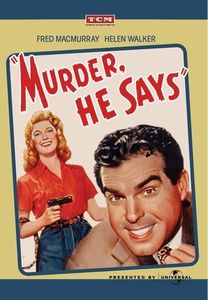
Murder, He Says

One of the movies that I watched over the weekend while my home Internet connection was out is Murder, He Says. It's available on DVD, so I'm more than comfortable doing a full-length post on the movie.

The movie starts off at a general store in what passes for Hollywood's stereotype of a small town in Appalachia or maybe the south. The sheriff is making a speech about the dangers of the Fleagles who live several miles outside of town, because the adult daughter in the family, Bonnie, has just broken out of prison where she had been doing a spell for bank robbery. Into all of this walks Pete Marshall (Fred MacMurray). He's a pollster for an organization doing research on the attitudes of rural Americans, and he's specifically come to this town to look for his colleague, since this was the colleague's last known location and the guy hasn't been seen or heard from for some time. There's reason to believe that the colleague wound up at the Fleagle place, so Pete heads there.

We fairly quickly learn why the Fleagles are people to avoid. When Pete arrives on the property, he gets chased by dogs, before eventually falling into a booby trap. One of the Fleagles takes him to the house, where he quickly learns that he wants to get away from the place. The Fleagles living in the house now, however, are not Bonnie's parents and siblings, but her cousins. There's Mamie (Marjorie Main), on her third husband, Mr. Johnson (Porter Hall); her twin sons Mert and Bert (both played by Peter Whitney); and her mentally slow daughter Elany (Jean Heather). They are there because they're convinced that the money that Bonnie stole is somewhere on the property, and they perceive outsiders as a threat to them. Also in the house is Grandma (Mabel Paige), who knows that this branch of the Fleagle family tree is up to no good, and knows that they've poisoned her: she literally glows in the dark. But the Fleagles use Pete to try to get information from Grandma, and she gives him a tough-to-decipher clue of a sampler and a song with wacky lyrics.

Things get more complicated when Bonnie shows up. Only, it's not actually Bonnie, something you'd think the Fleagles would recognize. Instead, it's the daughter of a man who was fired for the bank robbery, and this woman (Helen Walker) wants to find the money to redeem her father. She convinces Pete to stay at the place and try to help her find the money, despite the danger that awaits both of them.

Murder, He Says is a comedy, however, so all of the seemingly dark plot is in fact handled quite lightly. MacMurray would of course become well-known for the TV show My Three Sons as well as those Disney comedies in the 1960s, but this movie was released in 1945, at a time when MacMurray was doing all sorts of movies. He's more than capable of handling this material. He presents a good contrast to the ruralites, who are well played by Marjorie Main and Porter Hall. This was a year or two before The Egg and I introduced movie viewers to Ma Kettle, the role with which Main is probably best known. She's clearly the villainess here, but she's still portrayed lightly. The sight gags involving the twins are good, but there's an even better one involving a meal that's meant to poison Pete. He realized the food is poisond, and Johnson invented a lazy-Susan dinner table, so that gets put to good use.

All in all, Murder, He Says is enjoyable light entertainment and more than worth a watch if it shows up on TV. You may find the DVD a bit pricey, however.

Wednesday, January 20, 2016

A Millionaire For Christy

TCM's Star of the Month Fred MacMurray was adept at comedy. Somebody who is not particularly remembered for doing comedy, however, is Eleanor Parker. The two were teamed in A Millionaire for Christy, which is airing early tomorrow morning at 4:45 AM.

MacMurray plays Peter Lockwood, a radio host out on Los Angeles who is about to get married to June (Kay Buckley). This to the chagrin of his best man Roland (Richard Carlson), who had a thing for June. What none of these people knows is that things are about to change for them, in a big way. Apparently, Peter had a distant relativedie and leave him a $2 million inheritance, which would be quite nice today, but a whole lot nicer back in the early 1950s. The law firm sends one of their secretaries, Christy Sloane (Eleanor Parker), to inform Peter of his inheritance.

Except that Christy gets some other ideas. Well, she's given those ideas by fellow secretary Patsy (Una Merkel). If you're going to meet a man who is about to become a millionaire, Patsy tells Christy, why not try to get him to fall in love with you? Sounds like an utter violation of ethics to me, but then this is the legal profession. Sure enough, Christy thinks this is a great idea. So when she gets to Peter's place as he's getting ready for the wedding, she no longer has the professionalism to inform him of the inheritance, instead screwing up her job and getting Peter to think that perhaps this woman is a lunatic. And what is this lunatic doing at his apartment on the day he's supposed to get married, anyhow? That's not going to go over well with June.

Roland, a psychiatrist who is more than happy to delay Peter's wedding, gives Peter the idea to take Christy to a mental hospital, which for some reason Christy doesn't have a problem with! I guess she wants the wedding broken up too. And all this even though it's Roland who should have been doing that. But the wedding gets put off as Peter takes Christy to the hospital. Only, they never get there. Bad weather forces his car off the road in the apparent middle of nowhere in southern California, and the two wind up at a beachfront shack owned by Mexican immigrants who don't speak a word of English. They get the idea that Peter and Christy are on their honeymoon, and treat the couple appropriately. This, unsurprisingly, gives Peter and Christy a chance to fall in love....

To be honest, I found A Millionaire for Christy to be an utter mess. Christy is a dishonest, scheming blankety-blank and I can't think of any rational reason for Jef to fall in love with him. The bigger problem is that the movie is full of plot holes. I can't imagine anybody being able to pull off unprofessionality the way Christy tries to; in real life it would have been the doctor taking the alleged nutcase to the hospital, if he hadn't already figured out she's faking it; the conveniently-placed shack in the middle of one of the fastest-growing regions of the country; and on and on. Parker tries too hard and may have been better suited to drama; MacMurray tries but is weighed down by the awful script.

Thanks to the Warner Archive, however, you can watch this dreck whenever you want and judge for yourself.

Wednesday, January 13, 2016

If I had the time....

I'd think about doing a full-length blog post on Double Indemnity, which is airing tonight at 8:00 PM on TCM as part of the salute to Star of the Month Fred MacMurray. That having been said, I'm always a bit loath to do a full-length post on such a famous movie since it's somethign people already know pretty darn well and there's not much that I can add.

All three leads are excellent in their parts. Fred MacMurray plays the insurance man who meets Barbara Stanwyck when he has to meet her husband to discuss the husband's policy; Fred immediately falls hard for Barbara and comes up with a daft plan to bump off the husband and take the money from a new insurance policy. Edward G. Robinson plays the insurance fraud investigator and friend of Fred's who investigates the case because he realizes there's something not right about it. The movie was nominated for several Oscars, but unfortunately in 1944 the Academy had the nonsensical idea that Going My Way might actually be a good movie. There were so many better movies that year, not just Double Indemnity. Ingrid Bergman won the Best Actress Oscar for Gaslight, but then it's not like there was a strong female character in Going My Way. Alfred Hitchcock probably did his best directing work on Lifeboat. And as much as I hate the hagiolatry, Alexander Knox as Wilson is a standout performance.

At any rate, I can strongly recommend Double Indemnity. That will be followed at 10:00 PM by a lesser known movie that definitely deserves a full-length post: There's Always Tomorrow. Oh, look at that: I have already done a full-length post on it.

Wednesday, January 6, 2016

TCM Star of the Month January 2016: Fred MacMurray


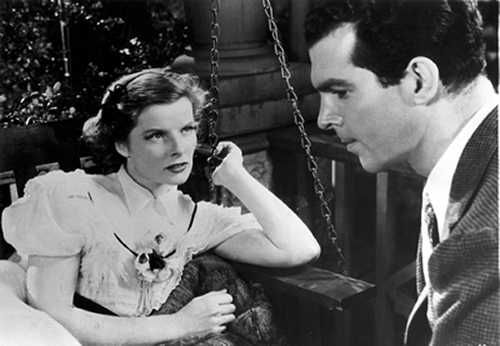
Fred MacMurray and Katharine Hepburn in Alice Adams (overnight tonight at 1:00 AM)

Now that we're in the first full week of a new month, it's time for a new Star of the Month on TCM, and this month that honor goes to Fred MacMurray. Nowadays, MacMurray is probably best remembered for playing the patriarch on My Three Sons for a dozen years on TV, but he had a darn good film career before that. I'm not certain what his single best film performance is, but my first impression is that I'd probably rate it a toss-up between playing the guy who falls for the blonde in Double Indemnity (January 13 at 8:00 PM) or perhaps the boss who is having an affair with elevator operator Shirley MacLaine in Jack Lemmon's apartment in The Apartment (January 20 at 10:15 PM).

Looking through the movies TCM is showing this month in MacMurray's honor, however, there are quite a few more good performances in there. MacMurray is definitely a supporting character to Katharine Hepburn in Alice Adams, airing overnight tonight at 1:00 AM; then again, everybody in that movie is playing second fiddle to Hepburn. I note that when it comes to MacMurray's movies, i've only mentioned the dramas so far. My Three Sons was a successful TV sitcom, but MacMurray made comic movies that were quite a bit better.

Airing tonight at 9:30 PM, for example, is Murder, He Says, which I have to admit I only saw the first half of the last time it aired on TCM. MacMurray plays a big city pollster doing a survey out in the sticks which is where he runs into a family containing Marjorie Main, Barbara Pepper, and a cast of even wackier characters. It turns out that there may be a tidy sum of money hidden on the property, and everybody is trying to get that money for themselves, to the point that they're willing to kill their own family members. (Grandma has already been poisoned and is glowing in the dark for the brief remainder of her life.) MacMurray gets in on the antics.

Thursday, June 18, 2015

The Swarm

TCM is giving us a night of insect-based horror/disaster movies this evening. A movie that's highly entertaining, if not particularly good, is The Swarm, airing overnight at 2:45 AM (or still late this evening out on the west coast).

The movie begins with Brad Crane (Michael Caine) driving up to an isolated military base somewhere in Texas. Not only is it isolated, it seems as if there's very little activity going on, and much of what does go on takes place underground. Brad investigates, and indeed, there's next to no sign of life. Eventually, it turns out that there's still a sign of life in the escape areas. Meanwhile, General Slater (Richard Widmark) has also arrived at the facility, wondering what this Brad guy is doing there. Everything is explained pretty quickly. Brad is an entomologist, and what happened at this military installation has the hallmarks of an attack by killer bees. Except that the killer bees are supposed to be a tropical phenomenon, and shouldn't be appearing this far nother. They are, of course, and that presents a huge problem not just for Brad, but for everybody in America!

Brad and the general are obviously going to be battling each other throughout the movie; that much is foreshadowed fairly early in the film. But Brad wins, at least in the sense that Washington authorizes him to investigate the phenomenon and set up a research station at the military base and assemble anybody he wants. Among the assembled are wheelchair-bound Dr. Krim (Henry Fonda), and reluctant researcher Dr. Hubbard (Richard Chamberlain).

I said earlier that those bees could become a problem for all of America, and we wouldn't have much of a film if they didn't start attacking good old average Americans. Marysville is a town not far from the military base, and they're about to have a civic pride festival. Little do they know the whole apple cart is about to be upset. A family goes out for a picnic at a state park not too far out of town, which just happens to be not too far from where the bees are massing to go swarm. So they swarm this family, killing Mom and Dad and making the kid drive away in fear of his life, not that he can drive very well either. He winds up in Marysville, which is how the town is made aware of the impending doom. To make matters worse, these bees aren't just swarming; they're even more venomous than previous killer bee strains. People can get killed by being stung only once.

There's a lot of formula in The Swarm is the civilian scientists fight the military over how to solve the problem. It's a theme that gets visited in a lot of horror movies, but here it's set against the backdrop of an all-star disaster movie. Katharine Ross plays Helena, the woman who ends up assisting Brad; there's a love triangle in Marysville involving schoolteacher Maureen (Olivia de Havilland) being pursued by two lovers (Fred MacMurray and Ben Johnson). That, and there are all sorts of over-the-top set pieces involving Marysville, a train, a nuclear power plant, and Houston. The result is a movie that should be terrible on so many levels. You have to feel bad for this cast of stars (I believe seven of them won an Oscar at some point in their careers) having to utter such horrendous dialog. The scenes of people dying during the bee swarms are some of the more hilariously bad death scenes you'll ever see. And some of those set pieces will make you laugh, even though that wasn't the intention.

That's all down to Irwin Allen, who produced and directed this movie. He had been successful at the beginning of the 1970s with The Poseiden Adventure, and seemingly tried to replicate such an all-star disaster film on an ever grander scale. The Swarm is near the end of that cycle, and it's clear that Allen had run out of steam. But while the movie is nearly bereft of ideas, it redeems itself by so unrelentingly missing the mark at every turn. Allen never intended movies like The Swarm to be comedies, but you'll probably be laughing a lot at the ludicrousness of all this. Ultimately, it's one of those movies that bombed but wound up being fun by so doing.

The Swarm is one of those movies that did get a DVD release at some point in the past, but is out of print. The TCM Shop doesn't list it as available for purchase, while Amazon has the sort of entries that strongly imply an out of print DVD.

Wednesday, November 19, 2014

Where Do We Go From Here?

A few weeks ago, FXM Retro showed a movie that was completely new to me, to the point that I had never even heard of it: Where Do We Go From Here? It's on FXM Retro again tomorrow morning at 7:40 AM, and is certainly worth at least one viewing.

Fred MacMurray plays Bill, a man who wants to fight for his country in World War II, but can't because the government has declared him 4F. It's an unhappy situation for him, especially considering that the woman he's got his eye on, Sally (Joan Leslie) sings fot the troops at the local USO place and really prefers a man in uniform. Meanwhile, Lucilla (June Haver) has her eye on Bill. Not being able to fight, Bill does his service in the best way he can, which is dealing in scrap metal that will be recycled to go to military uses. After spending a fruitless night with Sally, Bill goes back to the scrap yard, which is where his life is about to change.

A woman comes and gives him a bunch of stuff that's been sitting in her attic, including an item that looks a lot like an Aladdin's lamp prop. Not only does it look like an Aladdin's lamp, it sounds like there's something inside, just begging to be let out! So Bill rubs the lamp, and sure enough, there's a genie inside (Gene Sheldon). As genies are wont to do, this one offers Bill a wish. Bill, as you can probably guess, wants to serve, so he wishes he can be in the army. The genie grants that wish, but....

Unfortunately for Bill, the genie is a bit out of practice. Like that Geico commercial where the guy wishes for a thousand bucks and gets a thousand male deer in his yard, Bill's wish to be in the army does get fulfilled, but not in the way he had hoped. Instead, the genie has put Bill in George Washington's army at Valley Forge, with the Hessians about to cross the Delaware River at Trenton. Bill knows his American history, so he knows that he can be of service to General Washington as a spy. This gets Bill sent to Trenton, where sadly he gets caught and put before a firing squad. Ah, but there's that genie! Bill wishes he could be in the navy, and once again, the genie grants that wish....

This time, it's by puting Bill in the service of Christopher Columbus (Fortunio Bonanova). It once again goes without saying that this is not what Bill had in mind, and certainly, it's not going to work out either. Bill winds up adrift on the ocean, going to Manhattan Island and the early 1600s, where he gets involved in a fraudulent land scheme with Indian chief Anthony Quinn to buy the island amd then has to prove that he really does own the island in order to get the girl.

Where Do We Go From Here? is a musical fantasy with a large dollop of comic elements. At times, it doesn't quite mesh together, which I think has mostly to do with the fact that Fred MacMurray was not an actor suited for musicals. The story itself isn't bad, although how much you'll like it will probably depend upon your views of the type of humor used in the historical vignettes, which is reminiscent of the parodies that Mel Brooks or the Zucker brothers would do decades later. At times it comes across as dumb; but then there are scenes which are surprisingly funny. It's all done with good intentions, so even when the humor doesn't hit it's still inoffensive.

I don't believe Where Do We Go From Here? is available on DVD, so you'll have to catch the rare FXM showing.

Tuesday, August 5, 2014

There's Always Tomorrow

Another of the Barbara Stanwyck movies in today's lineup that I haven't recommended before is There's Always Tomorrow. It's on tonight at 11:30 PM.

Barbara Stanwyck doesn't show up right at the beginning of the movie; that honor goes to the male lead, Fred MacMurray. He plays Clifford Groves, who runs a toy company out in the Los Angeles area and has done a good job for himself. At the end of the day, he goes home to a lovely wife Marion (Joan Bennett) and three wonderful kids. But of course, all of that is about to change, or else we wouldn't have a movie. That change, in fact, starts on the Mrs. Groves' birthday. Clifford comes home all ready to surprise Marion, taking her out to dinner and a show. It is quite the surprise, as Marion had all sorts of other plans doing things with the children since she's been busy raising them while Clifford has been out earning the money to keep them in that lovely house. Dad offers to take each of the kids, but they've got things to do, too, especially eldest son Vinnie, who's got a date with his girlfriend Ann.

Into all of this walks Barbara Stanwyck. She plays Norma Miller Vale, a woman who used to work for the Groves business before Clifford became a husband and father, and who went off to New York in the intervening years and became successful in fashion design. She's in town on business, and on a lark decided to see what happened to the man she worked with and had a good friendship with. Clifford, having theater tickets and reservations to dinner, decides to ask her to spend the evening with him. Purely innocently, of course.

Fast forward a few days, when Dad has planned to make up for Mom not being able to do anything on her birthday, by taking Mom out to one of the desert resorts for the weekend. However, youngest daughter Frankie sprains her ankle, and Mom thinks it would be better to stay at home with Frankie. But why not go off to the resort yourself, Cliff, Marion suggests. Schedule one of your business meetings there. So he does, and Norma just happens to be there, again purely coincidentally. Except that this time, Vinnie and some of his high school friends show up at the same resort where Dad has met Norma. Vinnie, of course, suspects the worst.

At this point, Vinnie has a complete change, much like Ann Blyth's character in Our Very Own, and the film descends into unintentional hilarity. Vinnie, being the oldest of the kids, gets his two younger sisters to take his side and they're utter jerks, too, especially when Dad invites Norma over to dinner with the whole family. Dad, beginning to feel unloved, decides that perhaps he should go off with Norma.

Douglas Sirk directed There's Always Tomorrow, and while it's not as over the top as some of his lush Technicolor movies, his fingers are all over the movie, partly in the sene that there's not really a happily ever after, but more in the laying it on thick once the kids see what Dad's up to. A lot of reviewers will give you some mumob-jumbo about this being a blistering indictment of the staid 1950s view of family happiness and the suburbs and all that, but I've always tended to think that's a bit more revisionist history than Sirk thinking how he can put agitprop into all of his movies. To be fair, much of the material he got was already on the border of overcooked.

As for There's Always Tomorrow, it's not terrible, but the way the kids turn on a dime makes the movie never rise to anythying close to greatness. And it's doesn't go as far around the bend as Imitation of Life or Written on the Wind, so it's not quite as fun to sit and laugh at. MacMurray and Stanwyck both do about as well as can be expected with their roles, making the movie ultimately worth one watch, although you may want to reach through the screen and smack those kids.

Friday, May 9, 2014

No, not the Madonna song

Some months back, or maybe it was a year or two or more, I had the chance to watch a TCM airing of Borderline. The fact that I don't even have a vague idea of how far ago it was probably says something not so good about the quality of the movie (and it will certainly say something bout the quality of this post). But, the movie is on again tomorrow morning at 7:00 AM, so you've got a chance to see it and judge for yourself.

Claire Trevor plays Madeleine, a lady police officer in the LAPD. She's been tapped for special duty, which is to go undercover to help bring down a drug smuggler. However, that smuggler's operations go into Mexico, which is why this is special duty. Madeleine is being asked to play a nightclub girl in one of those little Mexican joints to try to get better acquainted with Richie (Raymond Burr), who runs the whole shebang. So she heads to Mexico and, while she can't quite get close to Richie at first, she gets to one of his underlings, which is a good place to start. At least until Richie breaks in on her snooping around the underling's room. That might look bad for her, but suddenly, there's a complication: in barges Johnny (Fred MacMurray). He's working for another drug smuggling operation, and gets Madeleine away from Richie.

This is where the story really begins to get complicated. Johnny is actually not working for that other smuggler. He, too, has gone undercover, but he's a federal narcotics officer. And the wonderfully competent government has totally failed to co-ordinate operations among various police departments, to the point that when Johnny takes Madeleine away from Richie's place, he has no idea that she's really working with the police. Madeleine, for her part, understandably has no idea that Johnny is working for the feds, not having been told by her superior officers. And it's also completely understandable that neither of them should tell each other of their true identities, since each of them has perfectly good reason to believe the other one is part of the criminal organization.

It's a good premise, but one that never lives up to its promise. I'm not quite certain why. There are some dark elements to the movie as well as some opportunity for humor, and Fred MacMurray was good at playing in both genres. Claire Trevor could also certainly play hard-boiled dames, which is something she's good at doing, too. Raymond Burr was also in his element here, as he played a whole bunch of heavies before taking on the role of Perry Mason on TV. And yet, the whole movie comes across as not quite sure what it's trying to do, being a bit of a slog at times, rather than a simply entertaining ride. Borderline isn't terrible, mind you; it's just not nearly as good as it could be. See it once, and then probably forget it.

Borderline has apparently received several releases to DVD, at least according to Amazon. I'm not certain whether any of them are still in print, though.