Showing posts with label Lana Turner. Show all posts

Monday, September 14, 2026

Latin Lovers

Tonight's second night of Ricardo Montalbán's turn as TCM's Star of the Month kicks off with a movie of his that I had never gotten around to watching before, but was on my DVR: Latin Lovers, tonight at 8:00 PM.

Although Montalbán is Star of the Month and the male lead here, we don't actually see him for a good half hour or so. Instead, the movie kicks off with female lead Lana Turner. She plays Nora Taylor, a woman who went from rags to riches when he struck oil during Nora's childhood, before dying fairly young. Nora manages the money -- all $37 million of it -- by figuring the best way to keep your money from drying up is work and investment. Deep down inside, however, she's worried that men are only going to be interested in her for her money, and is seeing a psychologist about it (Eduard Franz, whose scenes with the character's wife are the comic relief in the film). This, even though he current boyfriend Paul Chevron (John Lund) is also worth eight figures.

Paul is planning to tell Nora he's going to marry her, but his hangup is being too forward, so after going to an analyst of his own (Beulah Bondi in a cameo), he decides instead that he's going to give Nora time to consider the proposal while he goes down to Brazil to look at polo ponies, since that's what rich people do. Now, all of this happens before we meet the Montalbán character, so we know that Paul isn't going to return from Brazil to a Nora who says yes and they live happily ever after.

Instead, Nora hears that it's apparently a thing for rich guys to go to Latin America and fall in love with the beautiful Latin ladies, a fate that Nora doesn't want to have happen. So she decides she's going to take her secretary Anne (Jean Hagen) and go down to Rio and get a suite of rooms on the same floor as Paul, who has no idea about any of this. The other question of who's running their respective businesses also never gets adequately answered.

Here is where Ricardo Montalbán comes in. He plays a rancher named Roberto Santos, living on the old family ranch with his impossibly young grandfather (Louis Calhern). Paul goes out to the ranch for business; Nora goes with him; she meets Roberto and immediately falls head over heels for his Latin good looks. Since Montalbán is billed above John Lund and he's not a wooden drip like John Lund, we know who's going to end up with whom at the end of the movie. The question, of course, is how we get there.

And there are a lot of complications considering that Nora is this close to being engaged to Paul. She's also worried about what's going to happen when Roberto finds out about her wealth. Then there's his stereotypical Latin attitude toward gender roles. At least in this case, part of his defense is that Nora was stupid enough to show up way late to a meeting at the Santos ranch and then expect him to drop everything for her. She deserved some of the treatment she got.

Latin Lovers is a competently made film that's not exactly bad so much as it is predictable and modest in its aims. It's the sort of thing that would have entertained audiences in the days before television, although by 1953 when this one was made I can't help but think audiences might have been interested in authentic location shooting. Think Three Coins in the Fountain from a year later. Latin Lovers is OK, but ultimately unmemorable.

Thursday, June 25, 2026

Mr. Imperium

Another of the movies that I reecorded when Lana Turner got a day in the 2025 edition of Summer Under the Stars was Mr. Imperium. It's a movie that I don't think gets all that much mention when it comes to Turner's filmography. Having seen it, I can understand why.

Turner plays Frederica Brown, an actress who is doing some sort of American-themed stage show at a club in Italy in 1939, which is of course just before World War II kicked off in Europe, and a fact that ought to set off all sorts of alarm bells in terms of anachronisms and the question of how the movie will handle the history of the intervening 12 years. Anyhow, one of the male patrons sees Frederica and falls for her, creating a ruse in which he calls himself Mr. Imperium to get the chance to meet her.

Imperium takes Frederica to the sort of lovely Mediterranean villa that, by the end of the decade, would have been filmed on location in lovely wide-screen in addition to the pretty good color we have here. (IMDb says the California coast around Monterey and Pebble Beach are standing in for Italy, which isn't a bad stand-in.) Imperium played by the much older Ezio Pinza, reveals that his true identity is Alexis, the crown prince of Italy. Alexis is a widower with an unseen 5-year-old son. Alexis knows his duty is to become king, and he's resigned himself to that, although he's not thrilled that this is going to be his son's fate too. And not that Alexis can really marry an actress like Frederica: it would cause a royal scandal.

In any case, Alexis suddenly hears from the prime minister Bernand (Cedric Hardwicke) that the King has taken a sudden turn for the worse and that Alexis is going to have to go to Rome to see the King. Alexis writes a note to Frederica to explain, but Bernand burns the note so that Frederica won't understand why Alexis just up and left her, at least not until she sees the news of the king's death. Frederica has to be smart enough to know what all that means.

Anyhow, a dozen years pass. Frederica, now using the stage name Fredda Barlo, is a successful Hollywood actress with a boyfriend in producer Paul Hunter (Barry Sullivan) who is trying to get her to sign a long-term contract. In Paris, Alexis sees a marquee and lobby card for Fredda's latest movie. He realizes he has to get to America incognito to have another chance to see her again. So he schemes to get in contact with Fredda, who is going to be going to Palm Springs to contemplate her next movie. Fredda is staying at a private resort run by Mrs. Cabot (Marjorie Main) and her shockingly indiscreet niece Gwen (Debbie Reynolds).

Alexis, again registered under the alias Mr. Imperium, tells Fredda about the history of what's been going on in his country since the war. He abdicated following a post-war revolution, and his kid is at a boarding school in England, soon to turn 18. However, the country has been going through revolution for quite some time, with one section of the population tired of the revolution and thinking that the monarchy would be a good way to return stability and a unifying force to the country. There's going to be a plebiscite next week on whether to restore the monarchy, and Alexis plans to lose it so he can stay with Fredda. And then Bernand shows up to reveal a twist....

Mr. Imperium is another of those movies that's decidedly of its time, and is supposed to be inoffensive. If you're not the biggest fan of MGM's musical romances of the era, especially considering that Pinza's music stylings are more operatic, you're probably going to have a problem with this one. For me, the bigger problem was with Debbie Reynolds' scenes. She's just so obnoxious in trying to snoop on her guests. If she hadn't been the proprietress' niece, she would have been fired for cause.

Mr. Imperium is a minor movie, but I can see why some people might like it.

Sunday, April 19, 2026

Portrait in Black

A genre that's often fun even if the movies aren't necessarily very good is the potboiler of the 1950s and 1960s. Recently, I had the opportunity to see another of those movies: Portrait in Black.

Lana Turner is the star here, and she plays Sheila Cabot, the second wife of shipping magnate Matthew Cabot (Lloyd Nolan). Matthew is an extremely tough businessman, and that toughness is driving him to an early grave as he seems to need a series of injections from his doctor, Dr. David Rivera (Anthony Quinn). However, Matthew is tough in his personal life as well as his business life; as one example he seems quite ticked that Sheila has decided to get a learner's permit to be able to drive for herself. This, after, would mean she'd no longer be forced to use the chauffeur Cobb (Ray Walston) to go anywhere.

And goodness knows she's got places to go. She's secretly carrying on an affair with Dr. Rivera! Both of them have had the thought that they could hasten Matthew's death through an air-bubble induced embolism, although that would of course be unethical malpractice, and there's a reasonable chance somebody might figure things out since there are signs that Sheila is less than fully honest about where she's taking the car. Cathy (Sandra Dee), Matthew's adult daughter from his first marriage, notices that Sheila often goes "shopping" but comes home having bought nothing.

Of course, Cathy's relationship with her dad isn't much better. Cathy's boyfriend is Blake Richards (John Saxon), who runs one of the tugboat concessions in the San Francisco harbor. But, thanks in part to Dad, as well as Dad's second-in-commmand Howard Mason (Richard Basehart), Blake's dad was driven out of business, giving Blake good reason to hate Mr. Cabot. Worse, Mr. Cabot and Mason screw Blake over in awarding the new contract to deal with the Cabot Line.

And then Matthew dies suddenly, although it's not because of any untoward doings on anybody's part. However, a few days letter Sheila receives an hand-printed letter with no return address but a postmark from Carmel congratulating her on doing away with her husband! Sheila and David are convinced that somebody knows about their affair and is going to try to blackmail them. Suspicion eventually falls on Howard Mason's shoulders, and Dr. Rivera comes up with a ridiculous plan to bump off Howard in a shooting that could easily be blamed on a disgruntled longshoreman since there a labor dispute brewing. Except that the killing doesn't quite go to plan. Oh, Howard gets killed all right, but it takes two attempts and then Cathy starts trying to put two and two together....

Portrait in Black got scathing reviews at the time of its release in 1960, and it's not hard to see why. However, 65-plus years on, it's easier to sit back and have fun at how delightfully overwrought and bad this one is. It goes from one ridiculously over-the-top scene to the next, leading up the a climax where you know Anthony Quinn's character is going to get it if only because the Production Code was still in effect and demanded it. But the movie generally swims in a sea of hatred that's brewing just under the surface, with all the characters delivering bad dialogue.

Portrait in Black is definitely recommended, but not for the reasons the filmmakers at the time would have wanted you to see it.

Tuesday, February 24, 2026

The Merry Widow (1952)

The TCM lineup for tonight in prime time going through to the start of tomorrow's prime time lineup is Oscar-nominated movies that are remakes of earlier films. One that's on my DVR that I hadn't seen before is the 1952 version of The Merry Widow, which you can see tomorrow (Feb. 25) at 7:00 AM. So once again, I made the point of sitting down to watch the movie in order to be able to write up this review.

Now, the first thing I have to say is that I have not seen the Franz Lehár operetta on which this movie is based, nor have I seen the 1934 movie, so I'm judging this one on its own merits. I of course knew the famous "Merry Widow Waltz" both from piano lessons when I was a kid as well as its use in the Alfred Hitchcock movie Shadow of a Doubt where the widows didn't exactly stay merry for long. This version opens literally at the turn of the 20th century in Washington DC where everybody is celebrating at the various countries' embassies. Well, every embassy but one, the embassy of the fictional central European monarchy of Marshovia. Marshovia is a nearly bankrupt country, and the ambassador can't even pay the embassy's rent.

But the ambassador gets a coded cable from the king (Thomas Gomez) that there are three Marshovians living in the US, and one of them died, having emigrated to America and become an exceedingly wealthy man, leaving his widow with $80 million, a hugh fortune by the standards of 1900. Perhaps she can be convinced to come to Marshovia to dedicate a statue to her husband, although this would really just be a ruse to get her to use her fortune to help pay off the national debt.

The ambassador and his aide, Popoff (Richard Haydn), visit the widow, Crystal Radek (Lana Turner), who has a very capable secretary in the form of Kitty Riley (Una Merkel). Eventually Crystal does agree, and the two women head off for Marshovia, where the King has planned a big reception at the train station, except for the fact that the train is late getting there so everybody has gone a block or two away to party when the train arrives, leaving Crystal and Kitty to hear the joyous singing and see the dancing only from a distance and make their way to the palace by themselves.

The king has a military officer, Count Danilo (Fernando Lamas), whom he knows to be quite the ladies' man, and Danilo's singing has already impressed the two women. So the king comes up with a detailed schedule of how Danilo should seduce Crystal so that she'll marry him, at which point Danilo can use the estate to pay off the national debt. Mind you, this is supposed to be a light comic operetta. And the king can order Danilo to do this. Some of the king's ladies-in-waiting aren't thrilled, so they put the copy of Danilo's agenda in the envelope that accompanies the flowers Danilo is going to give Crystal. The point is that Crystal will find this and understand that the wooing is a sham.

Things get complicated when Danilo goes to see Crystal but Kitty answers, and Danilo gets the mistaken impression that Kitty is in fact Crystal. But when the two women see the agenda, they get fed up with Marshovia and leave for Paris, where Crystal gets a bunch of suitors. Danilo eventually follows, and Crystal is willing to let Kitty pretend to be her. Meanwhile, the real Crystal meets Danilo but hides her real identity and kinda-sorta falls in love with Danilo except for the fact that Danilo is on a mercenary mission. Crystal, calling herself Fifi, completely bowls over Danilo, who falls in love with her but can't go further because the King requires him to marry Crystal. And, of course, he can't find Fifi either, until the film's climax....

This version of The Merry Widow was made in Technicolor and is lovely to look at. It's not a surprise that the film's Oscar nominations were in the color technical categories, from the era when set and costume design had separate awards for color and black-and-white movies. Fernando Lamas does most of the singing here, and there's quite a bit of singing and dancing. This may slow the movie down for the sort of people who, like me, aren't the biggest fans of musicals or opera. I also have to admit that I find the plot of a mercenary marriage a bit mean, although the way the screenplay here gets around the Production Code more or less works.

Tuesday, June 24, 2025

Another ensemble hotel picture

Some months back I did a post on the movie Hotel Berlin, which is based on a story by Vicki Baum but is not the remake of Grand Hotel. As I mentioned at the time, the remake is Week-End at the Waldorf, and with that having been on my DVR, I eventually watched it in order to be able to do a review of it here.

It's mildly unfair to refer to Week-End at the Waldorf as a remake of Grand Hotel, since it's not so much a remake as a reworking, with the story lines all getting substantial reworkings. The setting is moved from Weimar Berlin to New York's Waldorf-Astoria in the latter days of World War II as well. Walter Pidgeon is the nominal male lead here, and his character doesn't really exist in Grand Hotel. Pidgeon plays Chip Collyer, a war correspondent who's returned stateside for some rest and wants exactly that. His editor, however, wants Chip to get the goods on shady businessman Edley (Edward Arnold), who is trying to secure the oil rights from the Bey of Stock Arab Country (George Zucco), possibly by trying to involve non-shady businessman Jessup (Samuel S. Hinds) who has an apartment at the Waldorf. Except that Jessup doesn't use the apartment on a full-time basis, so he's decided to let a war hero and his newlywed wife use it since with the war on hotels are fully booked up with people moving in and out of the city.

Another connection to World War II is wounded soldier Capt. James Hollis (Van Johnson) who wants to go back to his old home town and start a business there. He's also written a song which, though a mix-up, winds up in the hands of Xavier Cugat. James meets the hotel stenographer Bunny (Lana Turner, since Joan Crawford was now much too old for the role and besides had already decamped to Warner Bros.) and the two fall in love, although Bunny wants financial security and thinks she sees that in Edley who keeps calling her up to his suite on actual work matters. He's also got the financial security -- or so she thinks -- to get her to do his bidding.

One of the main story lines from Grand Hotel is that of the world-weary actress, played in the original by Greta Garbo which is why the role is so big. Here, that actress is played by Ginger Rogers, a woman named Irene Malvern who is in town for the opening of her new film before heading back to Hollywood. Chip shows up in her suite thanks to a botched attempt to get the story on Edley. Instead, Irene thinks Chip might be the jewel-thief who is rumored to be in the hotel and rumored to want Irene's jewels. Chip uses this as an excuse to get involved romantically with Irene, as she has to use him to help out somebody else as well as explain how he wound up in her room.

There's more to the cast of characters, notably a young Keenan Wynn as the reporter Chip's editor sends in Chip's place to get the story on Edley when Chip claims to need that rest, along with story lines coming together and drifting apart until the final reel when the good guys get the requisite happy ending and the bad guys get their comeuppance.

Week-End at the Waldorf runs 15-20 minutes longer than Grand Hotel, and frankly, it shows in the final product. It consistenly feels long, in the sense that nobody was able to find the spark that made Grand Hotel one of the classic all-star movies of the early 1930s. Walter Pidgeon is, I think, not quite right as that war correspondent, while Ginger Rogers doesn't really give off the sense of wanting to be left alone.

Having finally watched Week-End at the Waldorf, I think it's with good reason that it's not as well-remembered as Grand Hotel.

Friday, May 9, 2025

Bachelor in Paradise

Next up in the series of movies that I've got sitting on my DVR and are coming up on TCM is the Bob Hope comedy Bachelor in Paradise. It comes on early tomorrow morning (or overnight tonight, if you prefer to look at it that way) at 4:00 AM.

Hope plays A.J. Niles, and as the movie opens he's on the French Riviera. Niles is an author who has written a series of books purporting to be on the lives of various European countries, but are really an excuse to scandalize people with the steamy look at Europeans; think Peyton Place levels of scandal. Niles hasn't lived in America for a decade or so, which would imply not lot after the end of World War II since the movie was released in 1961. That being an expatriate turns out to be a big problem.

Even in those days Americans had to pay income tax on their worldwide earnings even if they didn't actually live in America (technically, you only have to file a tax return; there's a good chance an expat will fall below the tax threshold or else have paid enough tax abroad to avoid a US tax liability). Niles earns enough that he definitely would have to pay tax to the US, especially since the earnings are royalties from book sales in the US. But the plot point of the story is that Niles' accountant failed to pay those taxes for years. Even so, Niles is still liable, and owes some $600,000 in taxes. And this also means the IRS won't let the State Department renew Niles' passport. So Niles is going to have to return to America and pay off his tax debt somehow.

Fortunately, Niles' editor Austin Palfrey (John McGiver) has a brilliant idea: write a book called How the Americans Live similar to the books he's written about various European countries. Since Niles' photo hasn't been printed on the dust jackets of his books, people don't know what Niles looks like; also, he can work under an assumed name. To that end, Palfrey is going to rent Niles a house in one of those new-build suburban developments that sprung up like mushrooms in the years Niles was in Europe, this one in a Los Angeles suburb called Paradise.

The only thing is, this particular development caters to families, and Niles is a bachelor. Indeed, he's going to have to rent the house of one Rosemary Howard (Lana Turner), the assistant to the builder. Niles, taking the name Jack Adams, immediately tries putting the moves on Rosemary, who isn't having any of it. There's also humor in the idea that Niles has no idea how to keep house, especially in a suburb like this, as we see when he makes a mess of things with next-door neighbor Linda Delavane (Paula Prentiss).

To do his research, Niles starts offering lectures to the assembled housewives, although this winds up having the effect of changing the dynamic between various husbands and wives in the development, not always for the better. Additionally, Niles the writer has a bad reputation because of how "scandalous" those books are. It all winds up in a big court case where everything is revealed and we get to the requisite happy ending.

Bachelor in Paradise isn't the world's greatest movie, but it's better than some of the films Hope made later in the 1960s, some of which were terrible. A lot of people say, and I think I'd agree, that another really nice thing about the movie is how it looks at then-contemporary suburbia closer to how it actually was (there was location shooting in Woodland Hills, CA), and not that revisionist view of the 1960s that media wants to push today. People who like mid-century modern design will probably love the production values of Bachelor in Paradise.

Tuesday, August 27, 2024

The Prodigal

There are movies that I'd see show up on TCM every so often but never got around to watching. Another such movie was the 1950s MGM biblical film The Prodigal, so the last time it showed up on TCM I recorded it in order to be able to watch it and do a review here.

The movie starts off with a voiceover about the ancient era being a time when very few people believed in only one God, as though that were the most natural and correct thing to do, with the only people doing that being the believers in Jehovah. We are then told that the action takes place in 70 BC in the seaport of Joppa (modern-day Jaffa, part of Tel Aviv in Israel), and is based on the New Testament parable of the prodigal son. Micah (Edmund Purdom) is a Jew living in Joppa, when he runs across a man named Rhakim (Neville Brand) chasing after a runaway slave.

Micah then returns to his father Eli, who informs him that Eli has set up an arranged marriage for Micah to young Ruth (Audrey Dalton). Micah isn't overly happy about this, since he barely knows Ruth, and is one of those people who apparently believes in the radical idea of marrying for love. And as you might be able to guess from the parable, Micah is going to have the opportunity to do just such a thing.

Micah runs into Rhakim again, this time with a group of people from Damascus who all believe in the false-to-Jews gods of Baal and Astarte. Micah doesn't believe in such gods, at least not until he espies Samarra (Lana Turner) doing her devoitional duties to Astarte. Who wouldn't love someone as good looking as Lana Turner, even if she looks ridiculously out of place as a priestess in the middle east? Micah decides right then and there he's going to have Samarra for himself, even though Mahreeb (Louis Calhern), the high priest in charge of worship of Baal, tells Micah that there's no way Jews can get a priestess like Samarra.

Micah, like so many other men, is now thinking with his wrong head, and he's insistent to his father that he's going to go after Samarra, despite this being a series violation of the first commandment that thou shalt have no other gods before Jehovah. Micah doesn't care, and insists that Eli give him his share of the family wealth so that he may go off to Damascus to pursue Samarra.

Now, this is a reworking of the parable of the prodigal son, so we know that Micah is eventually going to return home having realized how wrong he was, and that Dad is going to accept him again. But at this point we're only about a quarter of the way into the movie, and have 80-some minutes left to go for poor Micah to learn his lesson. And boy is Micah going to have to go through a lot in Damascaus to learn the error of his ways.

I remember many years back, when TCM had one of its first "gay images on film" series, that guest presenter Richard Barrios discussed the film The Sign of the Cross. One of his assertions was that director Cecil B. DeMille wanted to show Christian virtue triumphing over Roman vice, and the way to do that was to put as much Roman vice on the screen as possible. The fact that audiences would go for the vice was a plus. Granted, that was in 1932, before the stricture of the Production Code.

Here, we get the MGM version of blasphemy and idol worship, which probably even in the pre-Code era would have been toned down from what The Sign of the Cross gave us. It feels too sanitized, like MGM getting any number of other genre movies slightly off (a trend I think I first mentioned in Johnny Eager). It also doesn't help that Lana Turner is way mis-cast here, while Purdom doesn't have the greatest screen presence out there.

As always, though, it's worth watching a movie like The Prodigal to see just what goes wrong.

Thursday, August 1, 2024

Another of those "Not best suited to MGM" movies

I've mentioned before how MGM was one of the top studios in the pre-TV era of Hollywood, but also how certain types of movies didn't really work at MGM because the studio seemed incapabale of making a movie not be glossy. Another movie that I think fits into that mold is the melodrama A Life of Her Own.

The movie starts off with Lily Brannel James (Lana Turner) taking a taxi in her small city (I'd call it a small town, but the buildings are too big for that) to the train station to catch a train to New York City where she's bound to make it big, and everybody in town knows it. Or at least, that's the sort of town it is. In the next scene, Lily is already in New York, sitting in the waiting room of the modeling agency run by Tom Caraway (Tom Ewell). She has to wait a while to get Tom's attention, but he does hire. Coming into the office at the same time is veteran model Mary Ashlon (Ann Dvorak), whose career has passed its peak.

The two wind up going out on the town together that night, making it a double date with lawyer Jim (Louis Calhern) and ad exec Lee (Barry Sullivan). Mary has too much to drink and winds up back in her upper-floor apartment with Lily, chewing Lily out on the grounds that Mary thinks Lily is trying to take her boyfriend away from her. The next morning, Lily walks into the office to hear all the other models talking about the news that Mary has killed herself by jumping out of her apartment window!

Since Lana Turner is the star of the movie, we know that she's going to make it as a model; as she starts to climb the ladder of success, she's accompanied by Jim, who sort of takes Lily under his wing. Meanwhile, he has a client, Steve Harleigh (Ray Milland), who is a copper miner from Montana and visiting New York on business reasons. Steve and Lily spend time together on a purely platonic basis since he's already married and realize that they can never have a real relationship even though they do start developing feelings for each other. So they part as friend when Steve goes back home.

Except that business is going to bring Steve back to New York, and this time he's even unhappier than he was the first time he was in New York. Steve may have fallen out of love with his wife Nora (Margaret Phillips), but then we learn what really happened between Steve and Nora: the two of them got in a car accident that was Steve's fault but it was Nora who wound up an invalid. To make matters worse, Nora decides to come out to New York since she hasn't seen him in a while and his birthday is coming up. Lily is the one who's going to be left out. Or will she make Steve and Nora confront the truth?

Part of the problem with A Life of Her Own is that it's the sort of melodrama that would have been better suited to Warner Bros. instead of MGM, where everyone can't help but be a bit too high-class for the material. But another part of the problem with the movie is that it was made while the Production Code was still utterly in effect. The material here really needed to be handled differently, but any of the ways to make it work better would have run up against the Code Office. (Indeed, reading up on the movie, the Office had issues with earlier drafts of the screenplay.) The cast tries hard, and it's not as if the movie is bad by any means. It's more that it's not quite right.

Still, A Life of Her Own probably deserves being seen in part to see how the Production Code could screw up a movie and in part for the professionalism of all involved.

Saturday, February 24, 2024

Dangerously Slight

A movie that I had surprisingly not seen despite it being part of the "Turner Library" of movies that for years made up the bulk of TCM's programming is Slightly Dangerous. So the last time that it showed up on TCM, I decided I'd record it in order to be able to watch it and then do a review here.

After the credits, a voiceover tells us about the town of Hotchkiss Falls, a made-up place supposedly in the mid-Hudson valley, which wouldn't be too far from where I am if it actually existed. But the towns here, places like Kingston and Poughkeepsie and Newburgh, are the same sort of boring places that the voiceover man tells us Hotchkiss Falls is. Anyhow, one of the residents of Hotchkiss Falls is Peggy Evans (Lana Turner), who typifies how boring the town is. She works at the soda counter of the local five-and-dime, and is getting a bonus for showing up on time for 1,000 consecutive shifts. Big deal, she thinks.

The place is so boring, that she gets into a debate with one of her co-workers about whether she could do her job blindfolded. A patron comes up, orders a sundae, and sure enough Peggy is able to fulfill the order properly while blindfolded. But as she was doing it, the store's new manager, Bob Stuart (Robert Young), walks in. Seeing a professional no-no, he calls Peggy into the office. It leads to an exchange in which Peggy, realizing how boring Hotchkiss Falls is, says she'll be Peggy Evans until the day she dies.

That gives her an idea as she thinks that she'll be Peggy Evans until the day Peggy Evans dies. With that in mind, she writes a note that could be construed as a suicide note, and goes running off to the big city, not telling a soul where she's gone. In New York, she starts thinking about getting a complete makeover, not just hair and clothes, but a new name as well. But she can't decide on what an appropriate new name would be.

Peggy decides to go to one of the newspapers to take out a classified ad that would presumably be like the billboard Gladys Glover rents in It Should Happen to You. But a sign painter is working over the evidence, and knocks down his paint bucket, hitting Peggy and temporarily knocking her unconscious. Having just undergone a makeover, she doesn't have any ID in her new pocketbook and no identifying marks on her new outfit. And when she comes to, she decides this would be a perfect opportunity to pretend to have a case of amnesia.

Editor Durstin (Eugene Pallette) decides to take Peggy's picture and put it in the papers to see if anybody can recognize her. Bob sees the story, and thinks he recognizes Peggy. But it's not an absolute, since part of the makeover involved getting her hair dyed blonde. And at the newspaper offices, we see that Bob isn't the only person who thinks he recognizes the mystery woman, although we know the rest of them are wrong.

Meanwhile, Peggy has been devious, looking through old newspapers at the library for a missing persons case that might involve someone who would now be close to her age. Eventually, she finds a Carol Burden who was supposedly kidnapped as a very young girl. Carol had a nurse named Baba (Dame May Whitty), so Peggy says she can remember the word "baba". Durstin has his researcher go through the files and he naturally finds the Burden case, with Caro's father Cornelius (Walter Brennan) being a very wealthy man.

However, they've already had to deal with other frauds claiming to be Carol Burden, so they're going to put Peggy-claiming-to-be-Carol through her paces to expose the fraud and prosecute to the full extent of the law. And of course Bob Stuart is waiting in the wings to recognize Peggy as well.

Slightly Dangerous is the sort of escapist light comedy that you can understand why audiences in 1943 when it was released would love. With a war raging in the real world, and Lana Turner being so glamorous, it's obviously just what the doctor ordered. And Lana Turner shows herself to be pretty adept at comedy as well. Somewhat more surprising is that Walter Brennan and Dame May Whitty also prove to do well in this sort of comedy. Not that they're bad actors, but Slightly Dangerous is rather more different from what they normally did.

If you want to escape with a slightly different comedy, don't hesitate to try Slightly Dangerous.

Saturday, July 22, 2023

Another Time, Another Place

I've commented in the past about how British studios, or the British production arms of American studios, in the 1950s would make movies with one Hollywood star in the cast so as to try to make it something that would appeal to audiences on both sides of the Atlantic and to make it easier to get distribution in the US. Lana Turner did one of those movies, and it's one I hadn't heard of it until I noticed it on one of the streaming services: Another Time, Another Place.

The setting is London, in early 1945. So World War II is still going on, but it's clear that the Nazis are going to be defeated even though they're still trying to fire V-rockets at England. Lana plays Sara Scott, an American newspaper columnist working for the London branch of a syndicate under boss Carter Reynolds (Barry Sullivan), who is also trying to romance Sara. For the British, the war is hitting closer to home, as we see when British reporter Mark Trevor (Sean Connery) goes to do a radio report on British bomb disposal experts trying to defuse one of the V-rockets the Nazis have sent London's way.

Of course, the real reason we see Mark is because he's been carrying on an affair with Sara, which is a bit of a problem for both of them. I already mentioned that Sara's nominal boss has been trying to get her to marry him. But Mark also has a wife and kid back home in Cornwall, and Mark has finally come to the difficult decision that he's going to go back to them which means having to break off the relationship with Sara. Thankfully, Sara learns this before she breaks off the relationship with Carter, which would be embarrassing if she had broken off that relationship first.

In any case, Sara and Mark's relationship was about to be broken off anyway. Mark has been called to go down to Rome to cover the final capitulation of Italy, with a stopover in Paris first. But in Paris, his plane crashes, killing all the passengers and leaving his wife a widow. Sara more or less has a nervous breakdown over it, forcing Carter to put her in a British sanatarium for several weeks before she can take the ship back to the US.

And then Sara gets out, and decides she's going to do something fairly idiotic: she wants to see Mark's home town in Cornwall before getting on the boat, just to get Mark out of her system. With the war in Europe having come to an end and travel being a bit more common, all the lodgings in Mark's small town are taken, until a nice young boy stops her. It's not difficult to guess that that young boy is Mark's son Brian, who takes her to meet his widowed mom Kay (Glynis Johns). Kay would like to put together a bunch of Mark's scripts for a book in his memory, but hasn't had the emotional energy to do so, especially because she felt like something was wrong for the last month of Mark's life as his letters didn't have as much passion as they had before he met Sara. Not that Kay knows anything about Sara's true identity....

I can see why the producers would think a story like this is a great idea. Unfortunately, the execution is off just enough that there are too many times where instead of serious drama we get unintentionally funny. I can't really imagine Lana Turner's character acting like this in real life, or the Glynis Johns character being that pure. There has to be a reason Mark thought about straying in the first place.

Still, it's interesting to see Sean Connery this early in his career, and playing someone all the way on the opposite side of Britain from his native Scotland. So give it a go and see what you think.

Friday, June 23, 2023

Why is love making these faces at me?

One of TCM's programming features, at least in June, is "Summer Camp". In this case, it's not going off to the sort of camp that boomer kids did, but the sort of campy, trashy fun that a certain sort of movie offers. On Friday nights, TCM is running a block of that sort of movie. This week, for example, includes Lana Turner in The Big Cube (overnight tonight at 2:15 AM), in which Lana Turner plays a woman whose stepdaughter slips her LSD. I reviewed it quite a few years back, and it's delightfully awful. Anyhow, I mention that movie because I recently watched another movie from the "Summer Camp" series which stars Lana Turner: Love Has Many Faces.

Turner is clearly the star here, although we don't see her for a few minutes. Instead, with the opening credits showing the beautiful side of Acapulco, backed by a song from jazz singer Nancy Wilson, we eventally pan to a group of local kids who find... a dead body washed ashore! The police, led by Det. Andrade, figure out that it's an American "beach boy", the male equivalent of a gold digger who comes down here looking for lonely but rich middle-aged women to try to wheedle money out of.

Cut to Kit Jordan (that's Lana Turner, as if you couldn't tell), who is on a nice-sized boat together with her husband Pete (Cliff Robertson). Andrade comes to the boat to ask the Jordans what they know about the dead guy. The reason for this is that the guy just happened to be wearing a bracelet that had been a gift from Kit. Kit, however, decided she'd rather be married to a different beach boy, a man named Pete Jordan. So Pete is clearly living off of Kit's wealth, and the question of how much he loves her is an open one. They also would both have had motivation for wanting the dead guy dead.

A couple of other beach boys feature, although you could be forgiven for thinking they might be having the sort of relationship Sandy Dennis and Anne Heywood have. Hank Walker (Hugh O'Brian) is trying to seduce Margo (Ruth Roman), although he'll also have no qualms about trying to seduce Kit. He's also got a companion in young Chuck (Ron Husmann) who's nominally going after Irene (Virginia Grey), but as I said sometimes it seems as if the two guys might be using the women as beards or something.

And then flying down from Detroit is young Carol (Stefanie Powers). She was the girlfriend of the guy who washed up on the beach, and she wants to know what happened. She also finds herself getting pursued by Pete, although who wants what from whom gets ever more complicated as the story goes on. If that's not enough, Andrade finally claims that the guy washed up on the beach had written a suicide note, so he's no longer important to the story, which has another half hour to go and takes a turn into the world of bullfighting.

Love Has Many Faces is an absolute mess, and it's easy to see why it would be selected for a TCM programming spotlight on "Summer Camp". It veers all over the place both in plot and in tone, while giving Lana Turner the opportunity to wear a series of glamorous outfits and the guys to wear fairly little. Thankfully, they're at least in square-cut swinning trunks instead of speedos, since they're really all too old to be beach boys. The various twists and turns are more ludicrous than mysterious, but that also serves to make the movie fun if not very good. Perhaps it's not quite as good in that regard as, say, Violent Saturday, but it's certainly entertaining enough.

Tuesday, October 19, 2021

Don't go looking for Flipper

I don't remember whose day it was in TCM's Summer Under the Stars, but one of the old Studio Era prestige movies I hadn't seen before was airing, Green Dolphin Street. So I recorded it and recently got around to watching it.

In the early 1840s, the Patourels are a well-to-do family of French Catholic descent living on St. Pierre, one of the Channel Islands which are British. Dad (Edmund Gwenn) has been married to Mom (Gladys Cooper) long enough two adult daughters, elder Marianne (Lana Turner) and younger Marguerite (Doona Reed). Dad runs a shipping company, with one of the boats, the Green Dolphin, traveling far and wide.

Also living on the island is Dr. Ozanne (Frank Morgan). He's got an adult son William (Richard Hart) who has just returned after being away, with some vague suggestion that this might be a bad omen. There is, in fact, a not-so-good man around, one Timothy Haslam (Van Heflin). He needs the services of a doctor quick, having been in a knife fight that killed a man. And he needs to get off the island, so the captain of the Green Dolphin agrees to take him to the new colony of New Zealand, where he won't have to face the law back in Europe.

Meanwhile, William has met both of the Patourel sisters. Both like him, although William clearly loves young Marguerite. But because of his father's lower social standing, it's suggested that William make his own way in the world by becoming a Navy officer first, and then he'll be OK to marry Marguerite, not that anybody mentions marriage yet.

It's not until William sails off to China that he's finally ready to think about marriage, sending some jewelry to Marguerite. But the stereotype of the inscrutable Chinese woman decides to slip William a mickey to take all his money, and William wakes up the next morning a deserter as his navy ship left port. Fortunately, the Green Dolphin is there and can take him to New Zealand too.

William meets Timothy, who has become successful in the lumber business, although that also means moving inland, which presents a problem in that they're further away from civilization and have to deal with the Maori. But William becomes successful too, ready to write back to the Patourels and ask for Marguerite's hand in marriage. Except that he gets so drunk that he accidentally writes "Marianne" instead of "Marguerite".

Lots of melodrama follows on both sides of the world. We learn that Timothy has always carried a torch for Marianne. Also in New Zealand, there's both a Maori uprising and a massive earthquake that is the highlight of the movie. Back on the Channel Islands, we learn that Mrs. Patourel had loved Dr. Ozanne when she was younger, but didn't marry him because of his social status and her parents' pressure. She and Dad die within minutes of each other, and Marguerite, being a spinster, decides to become a nun!

Green Dolphin Street is the sort of movie that MGM excelled at making. The prestige nature of it is evident from the cast, as well as the pretty darn good special effects for 1947 of the earthquake and what it does to the river. (In fact, the effects won an Oscar.) The story, however, caused a few groans for me, specifically because there are some mean plot holes here. Marianne and William return to St. Pierre a long time after Dad died, and the house is being kept up like always, with all the old servants there. Who's paying them? And did William really think he could just gallivant in and take over the old family business which certainly would have been under new ownership once Mr. Patourel died?

But if you can overcome such plot holes, as well as the fact that the first half of the movie is very slow-moving (the movie clocks in at a leisurely 141 minutes), you'll find that Green Dolphin Street is a grand example of studio filmmaking near its best in the second half of the 1940s.

Tuesday, December 1, 2020

Cass Timberlane

Lana Turner was one of the stars TCM honored back in August in their annual Summer Under the Stars programming feature. One of the movies that this gave me the chance to record, not having blogged about it before, was Cass Timberlane. Recently I finally got around to watching it so I could do a post on it here.

Although Cass could easily be a woman's name, in this case Cass Timblerand is played by Spencer Tracy. He's a judge in the medium-sized town of Grand Republic, MN, one of those cities that populate the midwestern America of Hollywood movies during the studio era. In the movie's opening scene, he's seen denying a motion for divorce, telling the two parties that marriage is sacred and all that jazz. It's pretty clear, especially since we know that this is based on a novel by Sinclair Lewis, that the good judge is going to turn out to fall afoul of that in some way.

But not just yet. At the beginning of the movie, Cass is a widow, having lost his wife young, and living alone in a big house with a maid and not much else. He's friends with the town's upper class, with his lawyer friends trying to hook him up with Chris Grau (Margaret Lindsay), who they think would be right for him. Among his friends is Boone Havock (Albert Dekker), the lawyer for the town's one big industrial firm, owned by Webb Wargate (John Litel). Another good friend is another lawyer, the bachelor Bradd Criley (Zachary Scott).

Another of the cases over which Cass presides is of a boarding house owner on the wrong side of town, who is suing the city because they didn't properly clear ice from the sidewalk, causing her to slip and injure herself. Among the witnesses is one of her tenants, Ginny Marshland (Lana Turner). She's a designer and sometimes artist who among other things draws a political cartoon-like picture of Judge Timberlane, which Bradd finds and brings to the judge's attention when Ginny misplaces her notepad.

Cass decides he's going to make things right with Ginny by walking over to her side of town, apologizing to her when he meets her. But he also gets roped into umpiring a pick-up baseball game, and then going to a restaurant with Ginny where she eats dinner. This even though Cass is supposed to be at a country club party for one of the upper class couples' anniversary.

If they find out about Cass and Ginny, it's going to cause a scandal. And sure enough, Cass and Ginny start seeing each other more often, to the point that they eventually say the hell with convention and get married. As with All that Heaven Allows a decade later, the town really starts gossiping, and making life a bit challenging for the Timberlanes.

It doesn't help that Ginny feels she's put herself into a gilded cage, and she'd like to see more of the world. Bradd could show her more of that world, and he's just enough of a wolf that everybody would expect him to put the moves on Ginny.

Meanwhile, the Wargate company is being sued by some of the shareholders for profiteering during "the war" (whether it's World War I or World War II isn't made clear; all of the cars and clothes scream 1947 when the movie was released, but the action takes place over a long enough time that it would have had to start while the war was still on, which doesn't seem to be the case). The Wargates, Havocks, and the rest of the upper class expect Judge Timberlane to keep granting the defendants a stay in the case, which he grants until he has an epiphany in New York.

In theory there's some promising material in Cass Timberlane, but it falls apart thanks to somebody deciding that what this material needs is a didactic, moralizing treatment. I'm not certain whether that somebody was Sinclair Lewis (I haven't read the book), or the suits at MGM. In any case, the slow deterioration of the Timberlane marriage veers into the ridiculous. Tracy does his best, and he's perfectly competent in a role that makes me think of Edward, My Son, but even he can't save the material. Lana Turner is nice to look at, and Zachary Scott has a role he could have played in his sleep, as if he walked off the set of Mildred Pierce one day and decided he'd start being Monty Beragon over at MGM the next.

Cass Timberlane is available on DVD courtesy of the Warner Archive collection.

Sunday, October 7, 2018

Honky Tonk

Another movie I recorded during Summer Under the Stars that's available on DVD courtesy of the Warner Archive is Honky Tonk.

A prologue of sorts introduces us to "Candy" Johnson (Clark Gable). He's a con man working the old west with his best friend "Sniper" (Chill Wills). The latest town has finally cottoned on to their schemes, and are about to tar and feather the two men and run them out of town on a rail. Somehow, however, they're still stupid enough to let Candy talk his way out of the situation. So Candy and Sniper head off to the next town, with Candy claiming he's going to go straight. Yeah right.

On the train to their next destination, Candy meets the lovely Elizabeth Cotton (Lana Turner). She's grown up in Boston, and is coming out west to the town of Yellow Creek, NV, to meet her father the Judge (Frank Morgan) who is a justice of the peace in the town. Candy, liking her, decides that this is probably a good place to settle down. When they get off the train, he meets the judge, and realizes that this guy is an old friend of his, a fellow con artist who is taking kickbacks. But the judge wants better for his daughter. He knows that Candy is no good for her, even though the judge is still willing to consider Candy a friend.

Sure enough, Candy isn't able to stay on the straight and narrow, winning a casino pretty much right away by committing a con in a game of Russian Roulette. This leads to bigger and better things, with Candy basically becoming boss of a booming town, with Brazos (Albert Dekker) as his sheriff enforcer. Meanwhile, an old flame of Candy's, "Gold Dust" (Claire Trevor) shows up to warn Elizabeth about marrying Candy, but Elizabeth wants a good life, so she tricks Candy into marrying her.

Eventually, the Judge has pangs of conscience, and he starts dealing with the good government types, led by the widow of the former town preacher, Mrs. Varner (Marjorie Main) to turn the tables on Candy and the rest of the corruption going on in Yellow Creek. But Brazos and his men in particular aren't about to let that happen.

Honky Tonk is a movie that came across to me as something more than a programmer, but not quite a prestige movie. It felt to me much as though there was no new ground being broken here, but just MGM putting a movie into production to give audiences something from their stars that would entertain the audience. There's nothing wrong with that as not every movie can be a masterpiece. And certainly, Honky Tonk entertains. It's just that as I was watching I couldn't help but feel like I'd seen all these plot lines before, even though I'd never actually seen Honky Tonk.

So, if you want undemanding, solid entertainment, I can certainly recommend Honky Tonk. The studios certainly knew how to produce such entertainment back in the day.

Tuesday, December 5, 2017

TCM Star of the Month December 2017: Lana Turner

So we've got a new Star of the Month on TCM: Lana Turner, who, as I understand it, was selected in a TCM Backlot poll. Ooh, pay big bucks, and if I'm lucky, the person I pick from among TCM's choices may become Star of the Month. (To be fair, I think Charles Boyer is finally going to be Star of the Month in January, and I'm really looking forward to that. And it's not as if I'm not looking forward to Lana Turner.) As you can guess, Lana Turner will be on TCM in prime time into Wednesday morning every Tuesday night in December.

This first night in the salute has several of Turner's early movies; the first of them is in fact her first billed performance, in They Won't Forget at 8:00 PM. I recommended this one at the beginning of the year in the first of the Thursday Movie Picks I took part in, and it's a really good movie. Turner gets bumped off early on, and the movie is about the trial of the man put on trial for that murder, with Claude Rains playing the ambitious DA prosecuting the case. This one is based on the true story of Leo Frank, and is a very good movie.

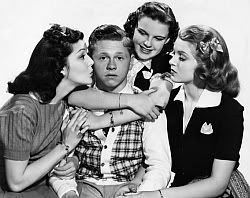
The photo up at the top of the post is, I believe, from Dancing Co-Ed, which will be on at 11:45 PM tonight. Lana Turner plays a ringer in a college dance contest that is ostensibly supposed to pick a dance partner for a movie studio star, except that the studio already knows who they want (Turner). Turner falls in love with the editor of the campus newspaper (Richard Carlson), and all sorts of complications ensue. This is typical of the sort of B movie MGM made back in the late 30s and early 40s. It's more than good enough and probably better than a lot of MGM's B movies; as I think I've said on a number of occasions I generally prefer Warner's Bs.

Wednesday, June 22, 2016

The Big Cube

Over the weekend, I had the opportunity to watch The Big Cube. It's available on DVD, so I'm comfortable doing a full-length post on the movie even though it's not on the TCM schedule any time soon.

Lana Turner plays Adriana, whom we see at the beginning performing in a play, as she's an actress. Well, soon to be a retired actress, since she's met a nice man and tells the audience that this is her final performance. That man is wealthy financier Charles Winthrop (Dan O'Herlihy), a widower with an adult daughter Lisa (Karin Mossberg). Lisa isn't particularly happy about the upcoming wedding, but she tries to be an adult about it.

Well, that is until her friend Bibi (Pamela Rodgers) introduces Lisa to some of her friends. This is the late 1960s, and it's the hippie acid scene. Lisa isn't particularly thrilled with Bibi's friends at first, but when her relationship with her stepmother continues to deteriorate, Lisa decides to spend some more time with Bibi and her friends. At least, until they all come over to the Winthrop place and have a "wild" (by the standards of late 1960s movies) party, which Dad and Stepmom walk in on. Dad is none too pleased.

But all of that is about to change. Charles and Adriana go on a vacation that involves going out on the ocean in Charles' yacht, and there's an accident that sends Adriana overboard. Charles jumps overboard to save Adriana; unfortunately, he drowns in so doing. Adriana is now a widow and executrix of a very wealthy man's estate, with the power to assent to his daughter's marriage (at least until she turns 25 and inherits the trust fund). Lisa really doesn't like that.

And she's made a boyfriend among Bibi's friends. Well, it's more that he's gone after her. That boyfriend is Johnny (George Chakiris), a med student dropout who goes after Lisa once he learns that her father was loaded. And when Daddy dies, Johnny comes up with a diabolical plan. He's good enough at chemistry that he can cook up LSD on his own apparently, so he's going to replace some of Stepmom's sedatives with LSD, in the hopes that the freak-out will drive her insane and give Lisa control of the estate!

Now, there are good movies about people who would like to marry against their parents' wishes, and might even be willing to get their parents out of the way to do it. Pretty Poison, for example, is quite entertaining. While The Big Cube has some good ideas, it ultimately begins to go south once the whole idea of driving Adriana crazy through LSD becomes the main plot point. I think there are a couple of reasons for this.

One is that the acid trip scenes are just so dopey, as though somebody in the production had just been given a new special-effects too, and was trying to figure out how best to use it. And then there's Karin Mossberg's acting. This was one of her only reasons, and there's a good reason why, which is that her acting is terrible. Lana Turner doesn't do badly, but she's not helped out by the script in the second half of the movie. In fact, the script is another problem; the attempt to drive Adriana crazy and then her playwright's (Richard Egan) attempt to restore her sanity require too much suspension of disbelief and go on too long.

If there's a bright spot, it's George Chakiris, who actually does fairly well playing such a slimy character, whose smugness makes you hate him even more. But even poor George has to suffer through a tacked-on finale that's an utter mess.

The Big Cube is one of those movies that at times hits the heights of "so bad it's good". Unfortunately, there are also a lot of times when it's just tedious.

Friday, December 26, 2014

The Great Lady Has an Interview

The Friday Night Spotlights on MGM choreographer/director Charles Walter have been continuing into Saturday mornings, albeit without the films being introduced by Robert Osborne and Brent Phillips. Not thaty were going to be introducing a short anyhow, but the lineup for this final Friday night in December includes a short that I always found bizarre: The Great Lady Gives an Interview, tomorrow morning at 8:21 AM, or just following Ziegfeld Follies (6:30 AM, 110 min).

The short has no titles and an unnamed Lana Turner doing a mock interview talking about pencils and how she's become a pencil magnate and that made her the great lady. (I think it's pencils; it's been some time since I've seen the piece.) The only thing is, she accompanied by a bunch of men in formal wear who do a dance with her with the whole thing set to music. The Nicholas Ray version of the film King of Kings was on earlier this week, which gave TCM the opportunity to run a Word of Mouth piece that they always show for that film. Screenwriter Philip Yordan talks about how he was called in by the producer, Samuel Bronston, to help with the script. When Yordan sees the "script", he says, "This is insane!" Except, Yordan in his retelling says it in a much better tone that I can reproduce on the printed page. But when I've seen this short, Yordan's "This is insane!" always springs to mind because I've always found the short so baffling.

Since it's on again, I finally decided to do a bit of research. The TCMDb page for the short has no synopsis, and there is no IMDb page for it. More research, however, reveals that Turner is actually performing a number called "Madame Crematante". That number had originally been performed by Judy Garland in the aforementioned Ziegfeld Follies, in brilliant Technicolor. Garland's version is currently on Youtube if you don't want to watch the whole movie. As for Turner's version, it's in black and white, which is because it's apparently a kinescope from an episode of The Ed Sullivan Show, from 1954 and honoring MGM's 30th anniversary. That would explain why there are no titles on this short, and why there's scant information on TCMDb and IMDb about this short. Turner's page at IMDb has her listed under "Soundtrack" for a 1954 episode of The Ed Sullivan Show, as well as under "Self".

As I said, I find the musical number bizarre, but it's one you should probably watch for yourself. If anybody has better information and wants to correct me, feel free to do so in the comments.

Wednesday, June 12, 2013

The Sea Chase

Tonight's lineup on TCM is a night of movies made by Lana Turner in the 1950s. The night kicks off at 8:00 PM with the 1958 version of Imitation of Life, which of course I've blogged about before. I don't think I've ever even seen the second movie, The Rains of Ranchipur (at 10:15 PM), in its entirety. But it's a Cinemascope and Technicolor remake of The Rains Came, which was just on TCM last week. At any rate, the movie I'd like to mention today is up third tonight: The Sea Chase, at 12:15 AM.

Lana Turner is the female lead, but the star is John Wayne. He plays Karl Ehrlich, the captain of the Ergenstrasse, a German tramp steamer docked in Syndey in late August, 1939. That date is important: Nazi Germany attacked Poland on September 1, which lead the UK to declare war against Germany, with other Commonwealth countries, including Australia, not far behind. So, at the beginning of the movie we have a war which everybody knows is coming, but hasn't quite come yet. And Ehrlich knows that if the war does come, the Australians, including his friend Commander Napier (David Farrar), are going to take Ehrlich and his crew prisoner. So when word comes that Germany has attacked Poland and the declaration of war is imminent, Ehrlich has the Ergenstrasse leave Sydney under cover of darkness.

However, there are a whole bunch of complications. First of these is that the Ergenstrasse, having been forced into a hasty escape, doesn't have all that much fuel on board. Their itinerary called for them to go to Yokohoma, but the Allies know this, and there's no way the ship, lacking fuel and being slower than Allied war ships, could ever make Yokohoma. So they're going to have to change course. Second, Ehrlich isn't a Nazi. Indeed, the reason he's captaining a broken-down cargo ship like the Ergenstrasse is because of his less than absolute loyalty toards the Nazis. Still, like every ship, there's a Nazi intelligence officer aboard, Kirchner (played by Lyle Bettger). He's certain to cause problems for Captain Ehrlich.

The third problem is Lana Turner. Well, her character, Elsa Keller. At the beginning of the movie we see Napier coming on board the Ergenstrasse with Keller, who just happens to be Napier's fiancée as well. But she's more than just a bride-to-be. Ehrlich knows she's got a past that involves a bunch of men, and when Ehrlich is making those hasty plans for the Ergenstrasse to leave Sydney at night, the German Consul in Sydney brings Elsa to the ship, with plans for her to stay on board. Elsa, in fact, is a spy, who uses her good looks to get close to men and then get military secrets from them. She's a problem for Ehrlich partly because of her past, and partly because she's good-looking enough that she's going to arouse all of the men in the crew.

So there are a lot of problems for Captain Ehrlich. And he's trying to take the Ergenstrasse all the way across the Pacific to Valparaiso in neutral Chile, where the British won't be able to molest him or his crew. But of course, getting to Valparaiso isn't going to be very easy as there's a decided lack of supplies. Ehrlich knows of an island where ships are scuttled, which should in theory enable the Ergenstrasse to get some supplies of some sort. The problem is, there are a couple of British fishermen on the island, and Kirchner murders them. Napier and the Allies are never going to believe Ehrlich's claim that Kirchner did this of his own accord in violation of Ehrlich's orders, so Ehrlich knows the crew is now a bunch of outlaws who wouldn't be prisoners of war, but murderers. Still, the Ergenstrasse tries to make it to Valparaiso....

John Wayne is decidedly un-German. Lana Turner isn't much more believably German either. In fact, the only member of the Ergenstrasse crew who could passably pull off a German accent is John Qualen playing the ship's engineer. Still, this really isn't that much more egregious than many of the movies Hollywood was making 20 years earlier -- think Spencer Tracy playing a fisherman of Portuguese descent in Captains Courageous. The plot is fairly good, if a bit formulaic. Many of the difficulties you can imagine for an underdog ship like the Ergenstrasse and its crew do indeed take place in The Sea Chase, from crew members wondering whether they should trust their captain any longer to shark attacks. Unfortunately, the ending, which I won't give away, is something I found to be even more ludicrous than all these actors playing Germans. For the most part, though, The Sea Chase is solid entertainment that would have paid the bills for the actors making it, but probably nothing any of them would have looked back on as the high point of their careers.

The Sea Chase has received a DVD release courtesy of the Warner Archive.

Thursday, March 29, 2012

They Won't Forget

I thought I had blogged about the film They Won't Forget before, but a Blogger search claims I haven't. It's airing tomorrow morning at 6:45 AM on TCM, and is an effective, underrated movie.

The scene is a small southern city in the (then) present (the movie was released in 1937) celebrating Confederate Memorial Day, with a small number of veterans of the Civil War still around to remember those days. Everybody in town celebrates, with the exception of one teacher at the local business college (Edward Norris), who can't be bothered to celebrate because he's a northern transplant. The day is a half day for everybody, and Norris lets his secretarial students out, only for one of them (a young Lana Turner in one of her earliest roles) to return looking for a compact she accidentally left in the room. Unfortunately, she winds up dead at the bottom of the building's elevator shaft, discovered by the black janitor who is understandably terrified that the cops are going to suspect him. After all, this is the South with all its racist stereotypes of black people unable to get justice, especially not when a pretty girl has been killed. It doesn't help either that you've got a people braying for justice, and a district attorney (Claude Rains) who is politically ambitious and willing to do anything ot get ahead in his career. Thankfully for the janitor, though, there's a better suspect: Norris, the outsider who is also the last person known to have seen Turner alive.

It's only in the past year that we've been through the media frenzy of the Casey Anthony trial and those in the media eager to pronounce the defendant guilty before there's even a trial, which shows that They Won't Forget is still a timely movie 75 years after its original release. And as with the trials of today, there's not only the ambitious prosecutor and a vengeful citizenry, but a media that's just as much out for blood; of course, 75 years earlier there was no live TV coverage of trials because there was pretty much no TV at all. But all the same factors were in place to ensure that it would be exceedingly difficult for the defendant to get justice. All this despite the strictures of the Production Code.

Then again, one of the things helping all this get past the folks in the Code Office is that despite the standard boilerplate about all the characters being fictitious, with any semblance to real people being purely coincidental, They Won't Forget is generally considered by those who know Southern history to be based upon actual events that happened in the Atlanta area back in the early teens, with a few changes. In real life, the murder victim was 12 or 13; here she's supposed to be about 18. Perhaps more interestingly is the hapless defendant's being a northener in the film. You'd think that would make it harder to get good bookings for this film in the south. In the original case, the defendant was Jewish, and the bias was anti-Semitism. Perhaps Hollywood's disproportionately Jewish moguls didn't want any grumblings from a largely Christian viewing public about a prejudice that didn't affect them.

As for the film itself, it's superb, thanks in no small part to Claude Rains' acting. (Well, aside from the southern accent, although Rains was just as good with a phony New York accent in They Made Me a Criminal.) Turner doesn't have much to do here since she gets killed off early; what she does have she does well. The defendant, and especially his wife (Gloria Dickson) are quite good; and then there's Elisha Cook, Jr., playing Turner's boyfriend. For some reason, he always comes across as creepy, even when he's supposed to be a reasonably good guy, as in Don't Bother To Knock. Finally, there are all the Warner Bros. values; they and director Mervyn LeRoy excelled at the sort of social commentary you'll see in this picture.

They Won't Forget has gotten a DVD release courtesy of the Warner Archive, although to be honest, it probably deserves even better. Compare and contrast it with MGM's Fury.

Thursday, December 16, 2010

Sex finds Andy Hardy

TCM is showing all of Mickey Rooney's Andy Hardy movies as part of their Star of the Month salute to him. The only thing is, they're showing them in reverse chronological order. One with a particularly interesting cast member is Love Finds Andy Hardy, which is airing overnight at 2:30 AM ET.

Love Finds Andy Hardy isn't so much a love triangle as it is a love icosahedron, or some other complex Euclidian solid. Andy's traditional love interest Polly (Ann Rutherford) is going away for Christmas, leaving Andy girlless for the big town Christmas party. Except that somebody has an escort for him. That escort is his old pal Beezy, who is going away for Christmas himself, but has a girlfriend, Cynthia (a young Lana Turner). Beezy doesn't want anybody going after Cynthia, so he offers to pay Andy to play the part of an escort for the holiday season. Andy takes him up on the offer, as it will give him the appearance of a girl, as well as some much-needed money.

Things begin to get complicated, though. Cynthia begins to fall for him, and there's always the threat that either Beazy or Polly will come back early, discovering this blossoming new love. Worse for Andy is his obnoxious new neighbor Betsy (Judy Garland), visiting her grandmother for the holidays. She's got a crush on Andy, but he thinks she's much too young for him. However, she's got a mother who's loaded and apparently doesn't care about her daughter's profligate spending. (Always like a woman to spend.) Andy could certainly use that money, and being the inveterate schemer that he is.... You know Andy's scheme will eventually backfire, until his father the judge (Lewis Stone, as always) has a heart-to-heart talk with Andy which helps Andy solve the whole problem.

Love Finds Andy Hardy is typical of the Andy Hardy movies, but with the plus of having Lana Turner. If you like the Andy Hardy movies, you've probably already seen this one; if not, it's pleasant enough to watch once. It'a also available on DVD.