Saturday, June 18, 2011

Cary Grant again?

Tonight's TCM Essential, at 8:00 PM ET, is Bringing Up Baby, a movie that I've mentioned quite a few times, but never done a full-length post on. However, since I've done two straight posts on Cary Grant movies, I'm not particularly in the mood to do another. Bringing Up Baby is an excuse if you will, to schedule a night of screwball comedies, several of which I've recommended in the past:

Twentieth Century follows Bringing Up Baby at 10:00 PM;
Nothing Sacred, a movie which really does deserve a post of its own, comes on at midnight. Fredric March plays a newsman who helps Carole Lombard, a small-town girl who thinks she's dying of radiation poisoning, only to find out the tests were wrong. And now they have to keep up the charade.
Merrily We Live is next at 1:30 AM, and is one I haven't actually seen before.
I blogged about Theodora Goes Wild back in December 2009; it's airing at 3:15 AM.
The Awful Truth is another of those movies I've mentioned a number of times without doing a full-length post about. But, like Bringing Up Baby, it stars Cary Grant (and yesterday's birthday boy Ralph Bellamy). It's on at 5:00 AM.

Friday, June 17, 2011

The most boring birthday since Ralph Bellamy


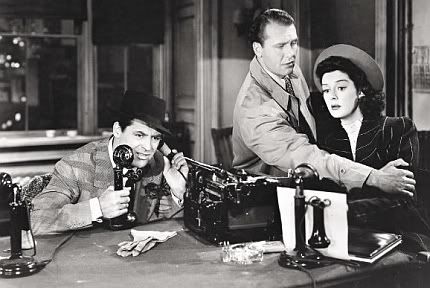
Today marks the birth anniversary of actor Ralph Bellamy, who was born on this day in 1904. TCM honored him last year in prime time on his birthday, but I'm surprised to see that I didn't mention last year that the day was Bellamy's birthday. I don't think I've ever blogged fully on the sparkling comedy His Girl Friday either, so this would be a good time to rectify that.

Bellamy, as always, plays the third wheel. The star is Cary Grant, playing newspaper editor Walter Burns. He's got a big story he wants written, that of death row inmate Earl Williams (John Qualen). There's only one person who can get that story the right way: Burns' star reporter Hildy Johnson (Rosalind Russell). There are only two problems: first, Hildy is about to retire from the journalism racket to get married to insurance salesman Bruce (Ralph Bellamy). Second, Hildy used to be the former Mrs. Walter Burns! So, it's up to Walter to come up with some ruse to get Hildy to stay just one more day to do this one last story.

If that were all there is to the movie, it would be a pretty good movie. But there's a lot more going on beneath that. It turns out that Williams' case is controversial. The governor is ordering clemency for the prisoner, but there's an election coming up soon, and the mayor doesn't want to be seen as soft on crime, so he's trying to keep anybody from finding out about the stay before Williams can be executed. Most of the press doesn't care about Williams' possible innocence, seemingly content to let him fry.

The commentary, however, is buried beneath a whole bunch of comedy, thanks to the writing of Ben Hecht and the direction of Howard Hawks. Hawks' style is well-known for being extremely rapid fire, and His Girl Friday might be Hawks at his most rapid pacing; there are constantly characters talking in orthogonal conversations, most often on telephones from the prison news room. All this is certainly helped by having leads who were both quite adept at comedy.

Thursday, June 16, 2011

The Dairy Executive's Wife

If I said I was going to recommend a movie starring Cary Grant and Loretta Young, your reaction might be, "Oh, good! They're going to show The Bishop's Wife again!" You'd be wrong. The movie I'm thinking of is Born to Be Bad, airing at 10:30 AM tomorrow on the Fox Movie Channel.

Loretta Young, who was about 21 at the time she made this, plays Letty, a single mom with a kid Mickey who seems much too old to be Young's kid, although it is mentioned at one point in the movie that Letty became a mother at 15. Letty makes her way in the world by being an escort, which is a high-class way of saying that she spends her evenings with men and walks away with their money. This means she isn't able to look after Mickey too well, who as a result becomes a truant and a mischief maker. At least, until he tries to hitch a ride on the back of a truck and gets hit by a milk truck. The milk truck is being driven by dairy company executive Malcolm Trevor (Cary Grant), who believes that he should spend at least a little time doing each of the various jobs in his business, and it was just his rotten luck to be driving the milk truck that day. He offers to help out with Mickey's medical expenses, but Letty and her crooked lawyer friend see dollar signs. They file a bogus lawsuit against Malcolm, which gets thrown out because Malcolm was smart enough to hire detectives to film Mickey perfectly healthy after the accident.

So, Mickey gets sent to reform school since Letty is clearly an unfit mother. Malcolm feels bad for the kid, and offers to become a foster parent, since he's also got a wife to look after the kid. He's even generous enough to let Letty see Mickey whenever she wants. Letty, having gotten one bad idea with the lawsuit, goes from one bad idea to another and figures she can use Mickey as a way to Malcolm's heart, which should lead directly to his wallet. But Mickey has begun to appreciate what good parenting can do for him....

Born to Be Bad is another great example of the pre-Code movie, having been released about two months before Joe Breen and company really decided to clamp down on enforcing the Production Code. Loretta Young might be at the most brazen I've ever seen her. Cary Grant had already made She Done Him Wrong, which really thrust him into the spotlight, but he hadn't quite reached the level he would by the end of the decade. As for the supporting roles, Henry Travers plays the owner of a bookshop where Letty worked when she first gave birth to Mickey (and the cradle is still in the back of the bookstore). He's the one guy who keeps a sane head about him throughout the proceedings. Born to Be Bad only runs a little more than an hour, which means the the story changes and end a bit abruptly. But it's still an interesting little movie.

Wednesday, June 15, 2011

Some like it with voiceovers

I've recommended quite a few of the docudramas made at 20th Century-Fox in the second half of the 1940s. A later docudrama, in color and wide-screen, is showing up tonight at 6:00 PM on the Fox Movie Channel: The St. Valentine's Day Massacre.

If you're conversant in history, you should know that the St. Valentine's Day Massacre refers to the February 14, 1929 gangland shooting by Al Capone's (played by Jason Robards) gang of seven members of the rival Chicago gang led by Bugs Moran (Ralph Meeker). The actual shootings don't come until the end of the movie, however. At least, not in detail; the aftermath is shown and then what we get is the run-up to the event, and how it was planned in great detail.

I shouldn't bore you with stuff on Prohibition and how this led to gangs taking over the booze racket, as that's all well-known stuff. When watching a movie based on history like The St. Valentine's Day Massacre, what's important is the presentation. Most sources who know more about Chicago gangland than I do claim that the filmmakers tried to get this as historically accurate as they could. It certainly plays as though the filmmakers are trying to do that. One of the techniques used in docudramas is the voiceover, and here it's used a bit differently than in other docudramas. Every time a new character is introduced, we hear narrator Paul Frees tell us who the character is, and a bit of biographical data about the person: date of birth, rap sheet, date and manner of death, and so on. It has the effect of making it easier to keep all the characters separate, but more importantly, it makes them seem more like the real people they were and not just movie characters. As good as James Cagney or Edward G. Robinson were at playing gangsters, you never really know just how real their characters were.

As for the performances, there's nothing much in them to distract from the story. The cast has quite a few recognizable names, such as George Segal as one of Moran's underlings, who kicks off the action by intimidating a speakeasy owner. Reed Hadley, whose name you might recall from narrating all the old Fox docudramas, shows up here in the flesh and not just the voice, as rubbed gangster Hymie Weiss.

If you're comfortable with the voiceovers, you'll probably quite enjoy The St. Valentine's Day Massacre.

Tuesday, June 14, 2011

British anthology movies

I've recommended a couple of anthology movies made at 20th Century-Fox in the past, and even at least one made by MGM. Anthologies were made all over the place, however, as you can see from the British movie Trio, which is airing tonight at 8:00 PM

The popularity of the anthology genre can be shown by the fact that Trio was a follow-up. In 1949, the movie Quartet was released, which was based on four short stories by the British writer W. Somerset Maugham, with Maugham himself narrating the pieces introducing each of the stories. The movie proved popular enough that Trio, which as you can probably guess from the title tells three more of Maugham's stories, went into production. (Another movie, Encore, was made after this.) As for the stories themselves:

First up is "The Verger", which tells the story of a church sexton (James Hayter) who has been doing his job well for close to 20 years despite being functionally illiterate. A new vicar comes along, however, and fires the sexton, which turns out to be a blessing in disguise, as our hero goes on to start his own business and wind up much more financially successful than he ever could have been as a sexton.

Next is "The Know-It-All", about a bunch of passengers on a sea voyage who have to suffer through an obnoxious self-styled know-it-all. Some of the passengers decide to extract a measure of revenge on him by embarrassing him over a piece of costume jewelry. The plot could backfire, though, as the costume necklace might be authentic, in which case the woman wearing it didn't get it from her husband.

Finally is "Sanatorium", a story about the various patients at a sanatorium for tuberculosis patients in Scotland. Star of the Month Jean Simmons shows up here, as a young female patient who falls in love with fellow patient Michael Rennie although everybody around them knows it's destined to be a doomed affair. This is the longest of the three stories, and also the best, at it has a whole bunch of vignettes in it dealing with all of the patients. It's not just the story of Simmons and Rennie.

To be honest, Trio isn't without its flaws. The first two segments ended rather quickly, which quite surprised me, as I didn't expect "Sanatorium" to run so long. Also, "The Know-It-All" is a relatively weak story, not helped by the fact that the main character is so irritating, and unctuous enough to make Jack Carson's Wally Fay look tame by comparison. It's a worthy enough movie, however, and the sort of movie that doesn't get made today.

Monday, June 13, 2011

The Enchanted Cottage

Back in September 2008, I commented about blind characters in the movies, and one of the stereotypes being that they can "see" more deeply into people than sighted people can. A good example of this might be the movie The Enchanted Cottage, which is airing tomorrow morning at 6:30 AM ET.

The blind character, Major John Hillgrove, is played by Herbert Marshall, and is really a supporting character, in that he helps bring together the two main characters, Laura (Dorothy McGuire) and Oliver (Robert Young). Laura is a homely wallflower living in an isolated cottage in a seaside town, who has pretty much given up all hope of finding love: everybody tells her she'll never find it, and when she does go out, people don't take notice of her. Into her life comes Oliver. He's a veteran of World War II who has been sent to the cottage to recover from injuries he suffered; specifically, injuries that have scarred his face.

You can probably guess what happens next. Laura and Oliver fall in love. And they learn to see the inner beauty in each other. But they think that it's the cottage causing them to see each other as beatuiful, especially since everybody else thinks of their actual physical appearance.

On the face of it, this is pretty hokey stuff, and one i should probably not like all that much. And yet, The Enchanted Cottage is really not a bad movie. It is the sort of thing that women will probably like more than men, but it isn't as obnoxiously into the "chick flick" category as, say, Dark Victory or Random Harvest (and it's definitely more to my male liking than either of those two); instead, it's somewhat more of a fantasy. The emphasis should be on somewhat as it's more rooted in reality than something like Portrait of Jenny (which I also find a better film overall).

Sunday, June 12, 2011

More Essentials, Jr. repeats

Tonight at 8:00 PM sees the second installment of this year's Essentials, Jr. series of kid-friendly movies that won't drive adults nuts. There's a feature and a short this week. First is the feature, Buster Keaton's The General. I'm not quite certain whether it's been part of Essentials, Jr. before; I'd probably be mixing it up with other Buster Keaton selections to say that it did. I know Sherlock Jr. did, and I think Steamboat Bill, Jr. did. But Keaton's silent comedies are all good enough that any of them are worth watching.

The General is followed at 9:30 PM by The Music Box, the Laurel and Hardy short about two men trying to move a piano up a flight of stairs. I know that one has been part of Essentials, Jr. before.

Saturday, June 11, 2011

I wish I had seen The Conquerors before

TCM showed The Conquerors on Thursday as part of a salute to its director William Wellman. I could have sworn I was watching a remake of Cimarron.

Richard Dix plays Roger Standish, a young bank clerk in New York City circa 1873. He's in love with the boss' daughter (Ann Harding), but Dad won't let such a man of low upbriging marry his daughter. Fortunately there's an economic crash which gives Dad a fatal heart attack. It leaves the daughter and Roger penniless, but they've got love, and decide to go west and grow up with the country. West they do, until they get ambushed in Nebraska, and Roger gets shot. His forced recovery gives them time to settle.

You can guess most of the rest, at least if you've seen Cimarron. (Roger Standish doesn't go a-wandering, but that's the one big difference.) RKO made this one in 1932, not long after the Oscar-winner, and Richard Dix plays the lead role. I couldn't help but think of Cimarron as I was watching, although one IMDb reviewer also made the astute observation that this plays out a lot like Cavalcade as well.

The cast is good enough, especially Edna Mae Oliver as the proprietress of the hotel where the Standishes wind up after Roger gets shot, and Guy Kibbee as her alcoholic husband. They're two of the great character actors, and take control of a lot of the scenes in which they appear. Oliver looks a bit too old at the start of the movie to be still alive at the end, 55 years later, but that's Hollywood. The only real problem with the movie is that the story seems stale, as though it was old even by 1932 standards. There's something about it that doesn't have the sparkle that Cimarron does. Perhaps it's the land rush scene in Cimarron. There are some interesting visual effects showing the stock market rises and ultimately crashes, but they don't hold a candle to the land rush.

I was mildly surprised to see at the end of the movie that TCM was hawking the DVD as part of the Warner Archive Collection. Not so much to see them hawking DVDs; they have to make money after all. More that this one has gotten a DVD release. If I had seen it before, I would have mentioned the TCM showing, and not make you look into getting a DVD. I had really wanted to see the following film, the fun pre-Code Love is a Racket, but it hasn't gotten a DVD release yet.

Friday, June 10, 2011

I could go on repeating posts, too

Today happens to be the birth anniversary of Judy Garland. TCM is unsurprisingly spending the entire morning and afternoon honoring her, concluding with her final film, I Could Go On Singing, at 6:15 PM. Now, I new I had blogged about that movie before, and as luck would have it, my searching the blog for posts on Dirk Bogarde (since he's starring overnight in Victim) brought it up. The post was made on Judy Garland's birthday last year. Amd, coincidentally enough, when TCM scheduled I Could Go On Singing last year, they scheduled it for 6:15 PM as well. How convenient.

So, I got to wondering how many of the movies from last year's tribute to Garland were repeated for this year's. The Clock and The Pirate were shown back-to-back both years, although this year they came a bit earlier in the day. Summer Stock showed up mid-afternoon both days, and Girl Crazy showed up in the morning. No Meet Me In St. Louis (not that I care for the movie, of course); no Babes on Broadway with Mickey Rooney; no Harvey Girls.

Now, I can understand that for people who have a relatively limited filmography, or people for whom TCM would have difficulty getting the rights to broadcast some of the movies, that the same movies would get repeated. You'd think TCM could show two completely different lineups for Judy Garland, though.

A night of movies I've blogged about

Having been at this for over three years and 1,400 posts of varying quality, I should suppose it's not surprising that quite a few of the movies on the schedule are ones I've already blogged about in the past. So it is with tonight's lineup of movies on TCM about people hiding homosexual relationships.

The night kicks off at 8:00 PM with The Best Man, a February 2009 mention starring Henry Fonda and Cliff Robertson, in which Fonda is hiding his nervous breakdown while Robertson had the gay fling in the army.
Don Murray plays the man who had his gay fling in the army in the next film, Advise and Consent, at 10:00 PM. I recommended it previously in August 2010.
The last of the three movies before TCM Underground is a British take on the subject: Victim, in which Dirk Bogarde plays a British lawyer being blackmailed for his homosexual relationship. It airs at 12:30 AM, and I recommended it back in February 2009.