Wednesday, July 9, 2008

Sleeping With the Enemy

Last night, I finally had the chance to see Rosalind Russell in the first sound version of Craig's Wife, about a wife who's so obsessed with the social standing that her marriage brings her that she'll push everything away just to keep it. I had already seen the remake, 1950's Harriet Craig, with Joan Crawford taking on the Russell role. Unfortunately, neither of these movies has been released to DVD yet.

One of the key scenes in Craig's Wife is how she wants the rooms of her house so immaculate and pristine that she notices when even a Grecian urn on the mantelpiece ever so slightly out of place. It's symptomatic of her obsessiveness, so much so that her husband deliberately smashes the urn to signify a break in his acceptance of the way his wife is treating him. When I watched that scene last night, it immediately made me think of the more recent movie Sleeping With the Enemy.

In Sleeping With the Enemy, Julia Roberts stars as a woman trapped in an abusive marriage. Her husband (played by Patrick Bergin) doesn't only beat her and use her for sex on his terms; he's obsessive to the point of wanting the hand towels in the bathroom to hang off the towel rack to exactly the same length, and have the labels on everything in the kitchen to face exactly the same way. Needless to say, Roberts grows tired of this, and makes a plan to escape by faking her own drowning. She does so, and hops a bus out to Iowa, where she hopes to make a new life for herself.

However, Sleeping With the Enemy is a Hollywood movie, so we know this isn't going to be the end of the story. Eventually, Bergin finds his wife's wedding ring, realizes she's still alive, and.... Well, you can figure out the rest of the plot from here. The only thing I'll say about the rest of the story is that the movie needed one more bullet.

Sleeping With the Enemy falls short, mostly because it makes the husband too much of a cardboard cutout. His obsession isn't chilling (like, say, Kathy Bates' in Misery, where we don't know about the penguins until it's too late); it's more buffoonish. Seeing Julia Roberts go through her house, and find mounting evidence that her husband is back (there's those pesky towels and canned goods again!) is less frightening than it is amusing. The sex scene is supposed to show us just how abusive Bergin is, but it really feels tacked-on; we also get the spectacle of Bergin working out half-naked on a treadmill, which really gives the impression that the producers felt they had somebody good-looking here, so they better figure out a way to use his body. At any rate, Sleeping With the Enemy is, like most more recent movies, available on DVD, if you wish to judge for yourself.

Tuesday, July 8, 2008

A military procedural?

Yesterday's showing of He Walked By Night got me thinking about another movie that focuses a lot on crime procedure, albeit with a decidedly military twist: The Man Who Never Was.

Clifton Webb stars in this dramatization of a true story as Ewen Montagu, a British Army Commander working with the high command in London during World War II. It's the period just before the Allies invaded Italy. Everybody knows that Sicily is the obvious place for the Allies to start their invasion of the Continent, and the Germans and Italians have consequently massed their forces in Sicily. The thinking goes that if only the Allies can somehow convince the Axis powers that the invasion might come not in Sicily, but Greece, they might move some of their troops there to defend against the possible invasion, leading to fewer deaths (and an easier time of defeating the Nazis, of course). The problem, of course, is how to convince the Nazis to move some of their troops to Greece. Eventually, the solution is reached that if the Nazis could just happen to come across some planted information discussing an invasion of Greece, they might fall for it, a state of affairs which is much easier said than done.

The first half of the movie plays out almost like the police procedurals, or peraphs like an episode of CSI in reverse. Eventually, the decision is made to have the body of a dead British officer wash ashore along the coast of Spain, with him carrying the information on the grounds that he's also got information of a personal nature that the higher ups wouldn't want sent through the normal channels. The British can't just kill somebody for their purposes, though, and anyhow have to find somebody who looks as though he's drowned. Eventually, all of the details -- or at least, every one they can think of -- are attended to, and the dead body is transported in secrecy to its eventual launching off Spain

The second half of the movie is just as good as the first half: the Fascist authorities in Spain find the body, and the intelligence information it's carrying is passed on straight away to the Germans. The Germans respond with a natural dose of skepticism, eventually deciding to send an Irish collaborator to Britain to check up on the dead "officer". (The collaborator is played by Stephen Boyd, who is probably best known for playing Massala in the Charlton Heston version of Ben-Hur. Boyd's scenes are fraught with tension, as some of the possible glitches in the British plan dawn on British intelligence, forcing them to make quick decisions about what to do to ensure the plan doesn't go wrong. There's one particularly good scene involving the roommate of the girlfriend of Webb's fellow officer. This woman, played by Gloria Grahame, nearly causes the plan to go awry through no fault of her own, as she's found that her officer-boyfriend has just been killed in action -- although that might actually be a good thing for the sake of the plan.

The Man Who Never Was is Clifton Webb's movie all the way, though. He plays what is an atypical role for him, having been almost typecast as a family man in light by the mid-1950s. (Amazing this, considering Webb had been so good in a movie like Laura at the very beginning of his career.) Webb provides enough seriousness to make the movie believable as it goes along, and enough intelligence to keep the British plan from falling apart at key points. Despite a relative paucity of action -- there's almost no violence, and Gloria Graham gets about the only emotional histrionics in the movie -- it's an outstanding movie that maintains its tension and suspsense, and should keep you waiting in anticipation to see how the British plan turns out. Happily, it's available on DVD for viewing any time you want; you don't have to wait for it show up on the Fox Movie Channel.

Monday, July 7, 2008

He walked at 9AM

While the Fox Movie Channel was airing The Rookie this morning, TCM was showing a much better movie, He Walked By Night.

He Walked By Night is what is often called a "police procedural", a docudrama dealing with the solving of a murder, much along the same lines as, say The Naked City. However, while The Naked City is a combination of drama and mystery, He Walked By Night is much more of a noir, and also focuses more on the criminal (no spoilers here, since we know he's guilty) than does The Naked City, where it takes just as long for us to figure out the identity of the killer as it does the police.

Richard Basehart plays the killer, an electronics expert (actually, he's stealing other people's technology and passing it off as his own) who shoots a policeman one night when the cop gets too close to inquiring about Basehart's less than honorable activities. Life isn't glamorous for the police, who have to do a lot of grunt work, but eventually, they're able to put all the clues together, and get their man in a tense climax. A lot of the credit for this goes to uncredited director Anthony Mann. He uses light and shadow quite effectively to heighten the tension. Watch the climax, which takes place in the sewers beneath Los Angeles; one wonders if Carroll Reed saw this before setting the climax of The Third Man in the sewers of Vienna. There's also an excellent scene in which Basehart returns to his bungalow after he's been shot by the police and removes the bullet from his own shoulder himself (since he knows the police are scoring the local emergency rooms looking for gunshot victims). It's obviously uncomfortable, and you see the sweat beading up on Basehart's face as he performs surgery on himself.

As for the rest of the cast, watch for police lab technician Lee; that's Jack Webb before he became famous. It was clearly on the set of He Walked By Night that the idea for Dragnet was born, with webb as Sgt. Friday. Indeed, it wasn't long after the release of He Walked By Night that Dragnet became first a radio show, before eventually making the transition to TV and even the big screen.

He Walked By Night was produced by the minor Eagle-Lion Films, but is one of those movie that shows just what good work can do to overcome a small budget. Perhaps it helps that it was based on a true story, that of Erwin Walker. It's an outstanding little movie from the late 1940s, and one that is just as exciting today as it must have been 60 years ago when it first premiered on screen. Happily, it's available on DVD for anybody who wants to watch it.

Sunday, July 6, 2008

I'm a game show fan

I noticed that the Fox Movie Channel are airing a movie called The Rookie at 9:00 AM ET on July 6; one of the stars is credited as "Pete Marshall". That's the same Peter Marshall who would later become the master of The Hollywood Squares. The movie was made several years before Marshall got the hosting job on Hollywood Squares. Also, Marshall isn't the only prominent host who did "real" acting, by which I mean playing a part instead of just a cameo.

There have been any number of people best known as actors, who went on to become game show hosts, both famously and hosting relatively little-known game shows. John Wayne's son Patrick appeared in quite a few movies with his father, and starred in some lesser movies, and after all this went on to host the failed 1990 version of Tic Tac Dough. Groucho Marx is well-known for hosting You Bet Your Life, although he's obviously better-known for the movies he and his brothers made. Ditto Jackie Gleason, although his one game show effort, You're in the Picture is famously remembered for having a debut episode that turned out so badly that Gleason came on the next week to apologize, cancelling the game show and replacing it with a chat show.

As for people best-known for their game show work, there might be Dick Clark, although his movies came before he got the Pyramid job -- and his most famous work might just be American Bandstand, anyway. On the other hand, the original host of Jeopardy!, Art Fleming, did some acting work after his game show was cancelled; if you look carefully you can see him as a secretary in Gregory Peck's biopic of Douglas MacArthur, titled MacArthur.

Perhaps the most interesting, though, is Bob Clayton. He eventually got the hosting job on Concentration, although most of his game show work is in announcing. He made one feature film, The Bellboy, and in it, he shows just how much acting there is in being a good announcer. Jerry Lewis is the star and title character, a bellboy at the Hotel Fontainebleau in Miami, in what is little more than sketch comedy. The sketches are somewhat predictable, but still quite funny, as Lewis plays the always silent, and well-intentioned but incompetent, Stanley. For the most part, Clayton, who plays Stanley's boss, has little blocking; he stands or sits in one spot while Jerry Lewis is being funny around him. However, Clayton has to use his voice to get his emotions across, and this is especially noticeable in one scene in which he points to a pile of bags in the background and says to Stanley, "You see that steamer trunk?" Stanley then immediately goes over to the bags, and struggles with them before finally dragging the steamer trunk over to his boss. At that point, Clayton berates Stanley: Now, Stanley, you never let me finish what I have to say. I didn't want the steamer trunk; I wanted the hat box on top of the steamer trunk. And we're left with poor Stanley having to drag the trunk back to where it was so he can get the hat box. The Bellboy is fun, escapist comedy, and it's timeless, too. It was a huge hit when it came out in 1960, and audiences of all ages can still enjoy it today. Thankfully, it's available on DVD.

Saturday, July 5, 2008

Sister Act

Venus and Serena Williams played against each other in the Wimbledon Ladies' singles final this morning, so perhaps it's a good time to discuss cinematic sisters. Probably the most famous pair is Olivia de Havilland and Joan Fontaine, both of whom are happily still alive. Joan Fontain was of course born Joan de Havilland, but took the name Fontaine from her stepfather because she didn't want to be seen as playing off her sister's success. Interestingly, in Fontaine's first movie, 1935's No More Ladies, she was credited as Joan Burfield; legend has it that she got that name from a street sign.

Dorothy and Lillian Gish are another pair of very famous sisters, and they appeared together in quite a few of D. W. Griffith's silent movies. They're not the only pair of famous sisters who starred together in the movies; the Lane sisters (Priscilla, Rosemary, and Lola) did, too, with Rosemary and Lola appearing together just this past week when TCM showed Hollywood Hotel.

On the other hand, I can't think of any sister comedy acts along the lines of the Marx Brothers or the Ritz Brothers. Musical sisters have been less uncommon in the entertainment industry. A curious example from a historical standpoint would be the Three Gumm Sisters. The showed up in a few shorts in the 1930s, most notably the early Technicolor Fiesta de Santa Barbara, which includes cameos from a bunch of more famous people: Warner Baxter, Ida Lupino, Gary Cooper, Andy Devine, and several others. The Gumm Sisters act is important, though, since Frances, the youngest of the three, was noticed by the bigwigs at MGM, who changed her name to Judy Garland, an actress who went on to somewhat bigger things. It's too bad that Fiesta de Santa Barbara isn't available on DVD.

The Gumm Sisters weren't the only time one sibling was overshadowed by another. As I pointed out when I recommended The Big Heat, the character of Glenn Ford's wife is played by Jocelyn Brando. She does a serviceable job, even if her character does get killed off early on. However, today she's probably much more remembered because her kid brother is Marlon Brando. At least Jocelyn could enunciate clearly.

There's even a classic movie about one sister being overshadowed by another, What Ever Happened to Baby Jane?, in which Bette Davis plays the child star who was eclipsed in adulthood by sister Joan Crawford, and now has to take care of Crawford after a car accident crippled her. Therein lies an entire blog post....

Friday, July 4, 2008

Brief connections on the Fourth of July

Today's post will be brief, because it's a holiday and I don't feel like spending too much time writing.

I had another geek moment the other morning when I turned on The Feminine Touch about 20 minutes in. The movie is set at a college and when the dean of the college appeared, I immediately recognized him as Grant Mitchell. I've mentioned Grant Mitchell twice before, although I've also blogged about The Great Lie without mentioning that he shows up at the beginning of it. My persoal favorite Grant Mitchell appearance is probably in Dinner at Eight, in which he plays Billie Burke's cousin, who'd rather be watching the latest Greta Garbo movie; Mitchell is the man who gets stuck holding Marie Dressler's dog.

Yesterday was the birthday of George Sanders, and TCM honored him with a bunch of movies. One they didn't show, ut I've blogged about, is Village of the Damned. Another excellent movie with George Sanders in it is Alfred Hitchcock's Foreign Correspondent. This ties in with the first half of my post: the original actor who showed up and made me realize just how many old movies I watch is Albert Bassermann, who appears in Foreign Correspondent as the diplomat whose kidnapping sparks the whole story. (And, I'm happy to say, Foreign Correspondent is available on DVD. However, I don't see myself blogging about it soon because I've blogged too much about Alfred Hitchcock.)

Thursday, July 3, 2008

Older actors are enjoyable, too

The 1954 movie Black Widow was on the Fox Movie Channel at lunchtime today, so although I'd already seen it before, I decided to watch it again. The fact that it was finally letterboxed was a big plus, but it's still a reasonably good mystery.

Set in the world of the New York theatre, Black Widow has a cast of stars who were slightly beyond their primes: Van Heflin is the lead, as a theatre producer who gets caught up in a dalliance with a young woman who has aspirations of making a name for herself in the theatre (played by Peggy Ann Garner) when his wife (Gene Tierney, unfortunately not looking nearly as hot as she was in Leave Her to Heaven -- the Cinemascope lenses must not have flattered her) is away. Eventually, she's found hanged in his apartment, and he's the natural prime suspect, being pursued by detective George Raft.

This being the New York theater, Van Heflin and his wife live in an impossibly nice apartment with huge rooms -- do they make rooms this size in New York apartments? An even more posh apartment, however, is that owned by actress Ginger Rogers and her husband, played by Reginald Gardiner, a floot above Heflin and Tierney. Rogers is a Margo Channing type in that she's dismissive of all around her, especially her husband, but also has a bit of Eve Harrington in her in that she seems to be a bit manipulative. Gardiner seems a bit mousy, although there's more to him than first meets the eye. (Of course, this being a mystery, there's more to everybody, including the victim, than first meets the eye.) I can't say that much more, however, without giving away the plot.

The actors, despite being a bit older than normal for an ensemble in a Hollywood movie (excepting those movies specifically dealing with old age), are fun to watch. Van Heflin is fine; he wasn't exactly endowed with matinee idol looks, but this role doesn't call for them. Instead, it works better as a slightly dumpy-looking man, the sort you'd expect to be going through a mid-life crisis. Gene Tierney would be fine if she had been given more to do; unfortunately, she's ignored for too much of the movie. George Raft's role is necessary but by definition not a starring role; he plays it quite appropriately, being understated and not overshadowing the various suspects, who are the real focus of the movie. Ginger Rogers is probably the best of the oldsters (although Garner as the victim is even better), although her role is a bit smaller than Heflin's. Seeing them all work together makes for eminently satisfying viewing.

Black Widow is available on DVD, which is a good thing. There was a completely different movie which also had the title Black Widow that was released in 1987; some TV listings mix up the two movies.

Wednesday, July 2, 2008

Young Lana Turner

TCM is honoring big bands every Wednesday night in July; Artie Shaw and his band appear alongside Lana Turner in one of tongights more interesting selections: Dancing Co-Ed, airing overnight at 1:30 AM ET on July 3 (that's late in the evening of July 2 in the Mountain and Pacific time zones).

In Dancing Co-Ed, Ann Rutherford stars as a secretary to an agent for a dancer. Unfortunately, the dancer's wife, who is also his normal dancing partner, has just gotten pregnant, meaning that any new projects will be put on hold. Or maybe not: Rutherford and her boss come up with an idea for a dance contest. Co-eds at colleges across America will be able to enter a contest to determine who the dancer's new partner will be. The only thing is, it's going to be a rigged contest, with a dancer they want to promote (this is where Lana Turner shows up) being entered into the contest as a ringer. Of course, the girl has to get into college.... As a result, Turner and Rutherford enroll at the same college, with Rutherford taking the entrance exam for Turner.

Things go nicely until rich big man on campus Richard Carlson falls in love with Lana Turner. (Who wouldn't?) He's the editor of the campus newspaper, and has the distinct feeling that there's something not quite right about the contest. He's determined to expose the contest as the sham he (rightly) believes it is. The film bogs down a bit here, including our two lovebirds being temporarily expelled, since it's more about the music and the dancing than it is about any semblance of a plot. Eventually, we get to the final competition, in which Turner is supposed to win, but is otherwise indisposed; this being a Hollywood musical, you know there's eventually going to be a happy ending, although I won't give away exactly how it ends. The dancing is fun -- I don't think Lana Turner got to dance like this very often in the movies -- and if you enjoy swing music, then it's a great joy to be able to watch the music of Artie Shaw. As long as you don't expect this movie to be anything more than frivolous escapism, you'll find it a lot of fun. In addition to the stars, the cast also includes some well-known character actors, including Monty Woolley as a college professor; two names more familiar to serious movie buffs, Leon Errol and Lee Bowman; and Roscoe Karns, who appeared in the recently-aired His Girl Friday but might be best known as irritating bus passenger Oscar Shavely in It Happened One Night.

As for the plot, the TCM database has a very interesting synopsis: "A college girl fights to survive in academia and show business." Technically true, but in no way representative of what the movie is really about. (Ironically, my satellite box guide gets it right.) The other interesting piece of trivia is that for once, we actually have two people who would have been the correct age to play college freshmen; Lana Turner and Ann Rutherford were both 18 when the movie was released. (Richard Carlson, on the other hand, was 27. He would also go on to play another college kid the next year in Too Many Girls.) Sadly, Dancing Co-Ed is not available on DVD, so you'll have to look for one of its infrequent showings on TCM.

Tuesday, July 1, 2008

My Sister Eileen

Just a quick heads-up about a movie that's airing overnight tonight on TCM that's not available on DVD: My Sister Eileen, airing at 12:30 AM ET on July 2 (that's late in the evening of July 1 in the rest of the US). Rosalind Russell (TCM's Star of the Month for July) stars as a writer who, along with her sister Eileen (Janet Blair) moves from small-town Ohio to a basement apartment in Greenwich Village. Russell eventually becomes a successful writer by writing about the people in her apartment building, including those who stop by to visit the previous tenant, as well as the doings of her somewhat scatter-brained sister.

It's an episodic comedy that's quite a bit of fun, and based on a true story. Watch also for a cameo at the end; I won't give away who it is.

Canada Day

July 1 marks Canada Day, marking the 1867 anniversary of the UK's granting of dominion status to Canada. Canadians celebrate by being thankful they're not Americans, while we Americans celebrate by repeating our favorite Canadian stereotypes. That, and we celebrate all the famous Canadians who escaped to America to become successful in the movies, from Mary Pickford to Mike Myers, and then some. Perhaps the best known Hollywood movie set in Canada is Johnny Belinda, although it wasn't filmed in Canada: the coast of northern California substitutes for Nova Scotia. However, it's not just Americans who have stereotypes about Canadians; Brits do, too. The British look at Canada can been seen in one of the more remarkable movies from World War II, 49th Parallel.

The genesis of this movie is that World War II started in Europe two years before the Japanese bombed Pearl Harbor, meaning that for the first two years, the Americans were officially neutral. The British government wanted to encourage Americans to get behind the British, and so commissioned director Michael Powell, and his frequent collaborator Emeric Pressburger, to make a propaganda movie aimed at Americans. The result was 49th Parallel, but it's a very atypical propaganda movie. The basic story line is that a Nazi U-boat gets stuck in Canadian waters and, while a landing party goes ashore to get provisions, is bombed out of the water, leaving six of the Nazis stranded at a Hudsons Bay trading post. These six then try to make their way south to the still-neutral United States (the 49th parallel being the line of latitude that forms the US-Canada border from Washington to Minnesota), where they can be repatriated to Germany.

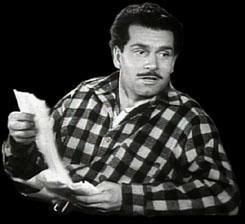
This being officially part of the war effort, quite a few stars appeared, taking on small roles for less pay than normal: Laurence Olivier (seen in the photo at left) is first among them, playing a hilariously miscast Québecois trapper (complete with horrendous accent and about a dozen siblings; thank you Catholic stereotypes); Leslie Howard plays one of his usually weak roles, as an anthropologist with a taste for modern art (what the Nazis call "degenerate") who only cares about the fight against the Nazis when they try to destroy his paintings; and Raymond Massey as a soldier who's gone AWOL but still loves his country.

The propaganda, such as it is, is sometimes blatant, notably in a sequence set at a commune of the pacifist Hutterite sect (the young Hutterite girl is played by a gorgeous Glynis Johns in one of her earliest performances). However, a lot of the time, it's much more below the surface, requiring viewers to think. The Nazis aren't portrayed as simply evil; they're also shown to be clever and manipulative, trying to play on what would have been natural divisions within Canada. Watch how the Nazis appeal to Olivier with a mention of the latent Québecois irredentism; that's something a Canadian filmmaker would probably never have done. One can only imagine what the America Firsters would have thought about this movie.

Ironically, 49th Parallel was ultimately not needed: Japan bombed Pearl Harbor before the movie was released, so by the time Americans could see it, the US was already in the war. Having said that, though, the movie was still wildly successful, in no small part due to the fact that it's much more than just propaganda. It's a darn good thriller. True, since it's supposed to be propaganda, you know the Nazis are ultimately going to fail in their attempt to make it to America. But seeing exactly how they fail is still a surprise. In addition to the excellent story, there's also a majestic score by Ralph Vaughan Williams, and wonderful location photography. 49th Parallel is available on DVD, and a movie I strongly recommend.